Efecto del manejo forestal sobre la precipitación directa en un bosque templado de Chignahuapan, Puebla
DOI:
https://doi.org/10.29298/rmcf.v17i96.1651Palabras clave:
Balance hídrico, intercepción de lluvia, partición de la precipitación, precipitación total, servicios ecosistémicos hidrológicos, tratamientos silvícolasResumen
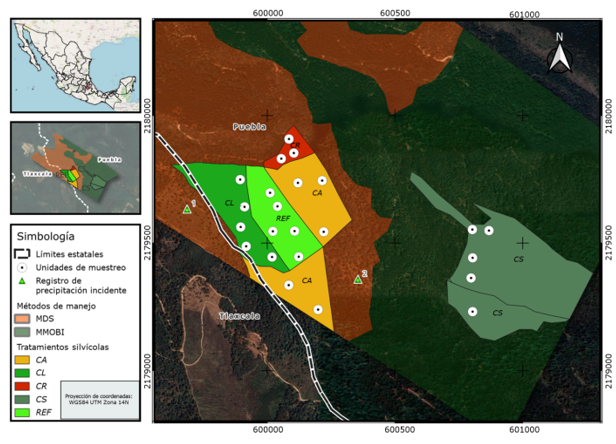
La precipitación directa (Pd) es la principal entrada de agua al suelo forestal y está determinada por las características de la lluvia y la estructura del dosel. La influencia del manejo forestal y de los atributos estructurales sobre la Pd se evaluó en un bosque templado. El establecimiento de unidades de muestreo circulares de 1 000 m2 se realizó en rodales manejados con el Método de Desarrollo Silvícola, el Método Mexicano de Ordenación de Bosques Irregulares y un rodal de Referencia (REF). Durante tres años se registró, en la época de lluvias, la precipitación total (Pt) y la Pd con pluviómetros. Los datos se analizaron mediante modelos lineales mixtos generalizados, incorporando la Pt, cobertura del dosel y tratamiento silvícola, así como la estructura jerárquica anidada de los datos y la dependencia temporal entre mediciones. La Pt tuvo mayor influencia sobre la Pd, con un aumento promedio de 1.8 % por milímetro adicional de lluvia; la cobertura del dosel presentó un efecto negativo, reduciendo la Pd en aproximadamente 1.04 % por unidad porcentual de incremento en cobertura. En comparación con REF, la Corta de aclareo registró una reducción significativa de aproximadamente 12 %. El modelo mostró buen desempeño predictivo, con una r=0.98 entre la Pd observada y predicha y un Error absoluto medio de 1.16 mm. Los resultados indican que el manejo forestal modifica la estructura del dosel, y esta influye en la partición de la lluvia. Destaca la necesidad de estudios de largo plazo para orientar un manejo adaptativo.
Descargas
Citas
Anys, M., & Weiler, M. (2024). Rainfall interception by urban trees: Event characteristics and tree morphological traits. Hydrological Processes, 38(4), Article e15146. https://doi.org/10.1002/hyp.15146 DOI: https://doi.org/10.22541/au.169999569.96302150/v1
Aussenac, G. (1981). L’interception des précipitations par les peuplements forestiers. La Houille Blanche, (7-8), 531-536. https://www.shf-lhb.org/articles/lhb/pdf/1981/05/lhb1981049.pdf DOI: https://doi.org/10.1051/lhb/1981049
Barbier, S., Balandier, P., & Gosselin, F. (2009). Influence of several tree traits on rainfall partitioning in temperate and boreal forests: a review. Annals of Forest Science, 66(6), 602. https://doi.org/10.1051/forest/2009041 DOI: https://doi.org/10.1051/forest/2009041
Bolaños-Sánchez, C., Prado-Hernández, J. V., Silván-Cárdenas, J. L., Vázquez-Peña, M. A., Madrigal-Gómez, J. M., & Martínez-Ruíz, A. (2021). Estimating rainfall interception of Pinus hartwegii and Abies religiosa using analytical models and point cloud. Forests, 12(7), Article 866. https://doi.org/10.3390/f12070866 DOI: https://doi.org/10.3390/f12070866
Brasil, J. B., de Andrade, E. M., de Queiroz-Palácio, H. A., Fernández-Raga, M., Ribeiro-Filho, J. C., Medeiros, P. H. A., & Guerreiro, M. S. (2022). Canopy effects on rainfall partition and throughfall drop size distribution in a tropical dry forest. Atmosphere, 13(7), Article 1126. https://doi.org/10.3390/atmos13071126 DOI: https://doi.org/10.3390/atmos13071126
Cavazos, T. (2024). Spring 2024: Unprecedented atmospheric heatwaves in Mexico. Frontiers in Climate, 6, Article 1449710. https://doi.org/10.3389/fclim.2024.1449710 DOI: https://doi.org/10.3389/fclim.2024.1449710
Cisneros-Vaca, C., van der Tol, C., & Ghimire, C. P. (2018). The influence of long-term changes in canopy structure on rainfall interception loss: a case study in Speulderbos, the Netherlands. Hydrology and Earth System Sciences, 22(7), 3701-3719. https://doi.org/10.5194/hess-22-3701-2018 DOI: https://doi.org/10.5194/hess-22-3701-2018
Comisión Nacional Forestal. (2017). Inventario Nacional Forestal y de Suelos. Procedimientos de muestreo. Versión 19.0. Comisión Nacional Forestal. https://www.conafor.gob.mx/apoyos/docs/externos/2022/DocumentosMetodologicos/2019/ANEXO_Procedimientos_de_muestreo_2019.pdf
Correa-Díaz, A., Villanueva-Díaz, J., Gutiérrez-García, J. V., Velasco-Bautista, E., Moreno-Sánchez, F., & Zamora-Morales, B. P. (2025). Efecto del clima y el manejo forestal en el crecimiento radial de un bosque de coníferas en Puebla, México. Madera y Bosques, 31, Article e312717. https://doi.org/10.21829/myb.2025.312717 DOI: https://doi.org/10.21829/myb.2025.312717
Crockford, R. H., & Richardson, D. P. (2000). Partitioning of rainfall into throughfall, stemflow and interception: effect of forest type, ground cover and climate. Hydrological Processes, 14(16-17), 2903-2920. https://doi.org/10.1002/1099-1085(200011/12)14:16/17%3C2903::AID-HYP126%3E3.0.CO;2-6 DOI: https://doi.org/10.1002/1099-1085(200011/12)14:16/17<2903::AID-HYP126>3.0.CO;2-6
Deguchi, A., Hattori, S., & Park, H.-T. (2006). The influence of seasonal changes in canopy structure on interception loss: Application of the revised Gash model. Journal of Hydrology, 318(1-4), 80-102. https://doi.org/10.1016/j.jhydrol.2005.06.005 DOI: https://doi.org/10.1016/j.jhydrol.2005.06.005
Flores-Ayala, E., Guerra-De la Cruz, V., Terrazas-González, G. H., Carrillo-Anzures, F., Islas-Gutiérrez, F., Acosta-Mireles, M., & Buendía-Rodríguez, E. (2016). Intercepción de lluvia en bosques de montaña en la cuenca del río Texcoco, México. Revista Mexicana de Ciencias Forestales, 7(37), 65-76. https://doi.org/10.29298/rmcf.v7i37.52 DOI: https://doi.org/10.29298/rmcf.v7i37.52
Gazol, A., Pizarro, M., Hammond, W. M., Allen, C. D., & Camarero, J. J. (2025). Droughts preceding tree mortality events have increased in duration and intensity, especially in dry biomes. Nature Communications, 16, Article 5779. https://doi.org/10.1038/s41467-025-60856-5 DOI: https://doi.org/10.1038/s41467-025-60856-5
Gbur, E. E., Stroup, W. W., McCarter, K. S., Durham, S., Young, L. J., Christman, M., West, M., & Kramer, M. (2012). Analysis of generalized linear mixed models in the agricultural and natural resources sciences. John Wiley & Sons. https://doi.org/10.2134/2012.generalized-linear-mixed-models DOI: https://doi.org/10.2134/2012.generalized-linear-mixed-models
Holwerda, F., Scatena, F. N., & Bruijnzeel, L. A. (2006). Throughfall in a Puerto Rican lower montane rain forest: A comparison of sampling strategies. Journal of Hydrology, 327(3), 592-602. https://doi.org/10.1016/j.jhydrol.2005.12.014 DOI: https://doi.org/10.1016/j.jhydrol.2005.12.014
Huber, A., & Iroumé, A. (2001). Variability of annual rainfall partitioning for different sites and forest covers in Chile. Journal of Hydrology, 248(1-4), 78-92. https://doi.org/10.1016/S0022-1694(01)00394-8 DOI: https://doi.org/10.1016/S0022-1694(01)00394-8
Jeong, S., Kume, T., Shinohara, Y., Farahnak, M., & Otsuki, K. (2022). Application of the reformulated gash analytical model for rainfall interception loss to unmanaged high-density coniferous plantations laden with dead branches. Forests, 13(5), Article 657. https://doi.org/10.3390/f13050657 DOI: https://doi.org/10.3390/f13050657
Kaushal, R., Kumar, A., Alam, N. M., Mandal, D., Jayaparkash, J., Tomar, J. M. S., Patra, S., Gupta, A. K., Mehta, H., Panwar, P., Chaturvedi, O. P., & Mishra, P. K. (2017). Effect of different canopy management practices on rainfall partitioning in Morus alba. Ecological Engineering, 102, 374-380. https://doi.org/10.1016/j.ecoleng.2017.02.029 DOI: https://doi.org/10.1016/j.ecoleng.2017.02.029
Lazcano-Hernández, I. (2006). Estimación de secuestro de carbono para cuatro coníferas en la región de Chignahuapan, Puebla [Tesis de Maestría en Ciencias Forestales, Universidad Autónoma Chapingo]. Repositorio UACH. https://repositorio.chapingo.edu.mx/items/0ee2b3b6-0e93-4c3a-9c3e-8bc386b5df83
Levene, H. (1960). Robust tests for equality of variances. In I. Olkin (Ed.), Contributions to probability and statistics (pp. 278-292). Stanford University Press. https://www.scirp.org/reference/ReferencesPapers?ReferenceID=2363177
Llorens, P. (1997). Rainfall interception by a Pinus sylvestris forest patch overgrown in a Mediterranean mountainous abandoned area II. Assessment of the applicability of Gash’s analytical model. Journal of Hydrology, 199(3), 346-359. https://doi.org/10.1016/S0022-1694(96)03335-5 DOI: https://doi.org/10.1016/S0022-1694(96)03335-5
Millennium Ecosystem Assessment (Ed.). (2005). Ecosystems and human well-being. Opportunities and challenges for business and industry. World Resources Institute. http://pdf.wri.org/ma_synthesis_business.pdf
Monárrez-González, J. C., Pérez-Verdín, G., López-González, C., Márquez-Linares, M. A., & González-Elizondo, M. del S. (2018). Efecto del manejo forestal sobre algunos servicios ecosistémicos en los bosques templados de México. Madera y Bosques, 24(2), Artículo e2421569. https://doi.org/10.21829/myb.2018.2421569 DOI: https://doi.org/10.21829/myb.2018.2421569
Muñoz-Villers, L. E., Holwerda, F., Gómez-Cárdenas, M., Equihua, M., Asbjornsen, H., Bruijnzeel, L. A., Marín-Castro, B. E., & Tobón, C. (2012). Water balances of old-growth and regenerating montane cloud forests in central Veracruz, Mexico. Journal of Hydrology, 462-463, 53-66. https://doi.org/10.1016/j.jhydrol.2011.01.062 DOI: https://doi.org/10.1016/j.jhydrol.2011.01.062
Muzylo, A., Llorens, P., Valente, F., Keizer, J. J., Domingo, F., & Gash, J. H. C. (2009). A review of rainfall interception modelling. Journal of Hydrology, 370(1-4), 191-206. https://doi.org/10.1016/j.jhydrol.2009.02.058 DOI: https://doi.org/10.1016/j.jhydrol.2009.02.058
Nayak, N., Mehrotra, R., & Mehrotra, S. (2022). Carbon biosequestration strategies: a review. Carbon Capture Science & Technology, 4, Article 100065. https://doi.org/10.1016/j.ccst.2022.100065 DOI: https://doi.org/10.1016/j.ccst.2022.100065
Pawson, S. M., Brockerhoff, E. G., Meenken, E. D., & Didham, R. K. (2008). Non-native plantation forests as alternative habitat for native forest beetles in a heavily modified landscape. Biodiversity and Conservation, 17(5), 1127-1148. https://doi.org/10.1007/s10531-008-9363-y DOI: https://doi.org/10.1007/978-90-481-2807-5_11
Pérez-Miranda, R. (Comp.). (2014). Efecto de la Deforestación sobre la variabilidad climática en cinco bosques de coníferas [Libro Técnico Núm. 6]. Instituto Nacional de Investigaciones Forestales, Agrícolas y Pecuarias. https://www.researchgate.net/publication/362965284_Efecto_de_la_Deforestacion_sobre_la_Variabilidad_Climatica_en_Cinco_Bosques_de_Coniferas
R Core Team. (2024). R: A language and environment for statistical computing (Version 4.4) [Computer software]. R Foundation for Statistical Computing. https://www.r-project.org/
Ramos-Madrigal, R., de los Santos-Posadas, H. M., Valdez-Lazalde, J. R., Velasco-Bautista, E., Ángeles-Pérez, G., & Ortiz-Reyes, A. D. (2024). Evaluation of potential productivity in coniferous forests by integrating field data and aerial laser scanning in Hidalgo, México. Forest Systems, 33(3), Article 20886. https://doi.org/10.5424/fs/2024333-20886 DOI: https://doi.org/10.5424/fs/2024333-20886
Rutter, A. J., Kershaw, K. A., Robins, P. C., & Morton, A. J. (1971). A predictive model of rainfall interception in forests, 1. Derivation of the model from observations in a plantation of Corsican pine. Agricultural Meteorology, 9, 367-384. https://doi.org/10.1016/0002-1571(71)90034-3 DOI: https://doi.org/10.1016/0002-1571(71)90034-3
Sadeghi, S. M. M., Epstein, J. M., Deljouei, A., Gorora, F. J., & Cohen, M. J. (2024). Stand age controls canopy and soil rainfall partitioning in slash pine forests. Forest Ecology and Management, 572, Article 122307. https://doi.org/10.1016/j.foreco.2024.122307 DOI: https://doi.org/10.1016/j.foreco.2024.122307
Savenije, H. H. G. (2004). The importance of interception and why we should delete the term evapotranspiration from our vocabulary. Hydrological Processes, 18(8), 1507-1511. https://doi.org/10.1002/hyp.5563 DOI: https://doi.org/10.1002/hyp.5563
Scheaffer, R. L., Mendenhall, III, W., Ott, R. L., & Gerow, K. G. (2011). Elementary survey sampling. Cengage Learning. https://books.google.com.mx/books/about/Elementary_Survey_Sampling.html?id=qKYJzgEACAAJ&redir_esc=y
Servicio Meteorológico Nacional. (2023). Monitor de Sequía en México [Base de datos]. Comisión Nacional del Agua. https://smn.conagua.gob.mx/es/climatologia/monitor-de-sequia/monitor-de-sequia-en-mexico
Shapiro, S. S., & Wilk, M. B. (1965). An analysis of variance test for normality (complete samples). Biometrika, 52(3-4), 591-611. https://doi.org/10.1093/biomet/52.3-4.591 DOI: https://doi.org/10.1093/biomet/52.3-4.591
Staelens, J., De Schrijver, A., Verheyen, K., & Verhoest, N. E. C. (2006). Spatial variability and temporal stability of throughfall water under a dominant beech (Fagus sylvatica L.) tree in relationship to canopy cover. Journal of Hydrology, 330(3), 651-662. https://doi.org/10.1016/j.jhydrol.2006.04.032 DOI: https://doi.org/10.1016/j.jhydrol.2006.04.032
Tichý, L. (2016). Field test of canopy cover estimation by hemispherical photographs taken with a smartphone. Journal of Vegetation Science, 27(2), 427-435. https://doi.org/10.1111/jvs.12350 DOI: https://doi.org/10.1111/jvs.12350
Van Stan, II, J. T., Gutmann, E., & Friesen, J. (Eds.). (2020). Precipitation partitioning by vegetation. A global synthesis. Springer Nature Switzerland AG. https://doi.org/10.1007/978-3-030-29702-2 DOI: https://doi.org/10.1007/978-3-030-29702-2
Westfall, J. A., & Edgar, C. B. (2022). Addressing non-response bias in urban forest inventories: an estimation approach. Frontiers in Forests and Global Change, 5, Article 895969. https://doi.org/10.3389/ffgc.2022.895969 DOI: https://doi.org/10.3389/ffgc.2022.895969
Yang, J., Wang, A., Shen, L., Dai, G., Liu, Y., Zhang, Y., Fei, W., & Wu, J. (2024). The impact of canopy on nutrient fluxes through rainfall partitioning in a mixed broadleaf and coniferous forest. Forests, 15(4), Article 623. https://doi.org/10.3390/f15040623 DOI: https://doi.org/10.3390/f15040623
Yim, J.-S., Shin, M.-Y., Son, Y., & Kleinn, C. (2015). Cluster plot optimization for a large area forest resource inventory in Korea. Forest Science and Technology, 11(3), 139-146. https://doi.org/10.1080/21580103.2014.968222 DOI: https://doi.org/10.1080/21580103.2014.968222
Zuur, A. F., Ieno, E. N., Walker, N., Saveliev, A. A., & Smith, G. M. (2009). Mixed effects models and extensions in ecology with R. Springer-Verlag New York. https://doi.org/10.1007/978-0-387-87458-6 DOI: https://doi.org/10.1007/978-0-387-87458-6
Descargas
Publicado
Cómo citar
Número
Sección
Licencia
Derechos de autor 2026 Revista Mexicana de Ciencias Forestales

Esta obra está bajo una licencia internacional Creative Commons Atribución-NoComercial 4.0.
Los autores que publiquen en la Revista Mexicana de Ciencias Forestales aceptan las siguientes condiciones:
De acuerdo con la legislación de derechos de autor, la Revista Mexicana de Ciencias Forestales reconoce y respeta el derecho moral de los autores, así como la titularidad del derecho patrimonial, el cual será cedido a la revista para su difusión en acceso abierto.
Todos los textos publicados por la Revista Mexicana de Ciencias Forestales –sin excepción– se distribuyen amparados bajo la licenciaCreative Commons 4.0 Atribución-No Comercial (CC BY-NC 4.0 Internacional), que permite a terceros utilizar lo publicado siempre que mencionen la autoría del trabajo y a la primera publicación en esta revista. (no permite el uso comercial)
Los autores pueden realizar otros acuerdos contractuales independientes y adicionales para la distribución no exclusiva de la versión del artículo publicado en la Revista Mexicana de Ciencias Forestales (por ejemplo, incluirlo en un repositorio institucional o darlo a conocer en otros medios en papel o electrónicos) siempre que indique clara y explícitamente que el trabajo se publicó por primera vez en la Revista Mexicana de Ciencias Forestales.
Para todo lo anterior, los autores deben remitir el formato de carta-cesión de la propiedad de los derechos de la primera publicación debidamente requisitado y firmado por los autores/as. Este formato debe ser remitido en archivo PDF al correo: editorial.forestal@inifap.gob.mx
Esta obra está bajo una licencia de Creative Commons Reconocimiento-No Comercial 4.0 Internacional.