Effect of forest management on throughfall in a temperate forest of Chignahuapan, state of Puebla
DOI:
https://doi.org/10.29298/rmcf.v17i96.1651Keywords:
Water balance, rainfall interception, rainfall allocation, total rainfall, hydrological ecosystem services, silvicultural treatmentsAbstract
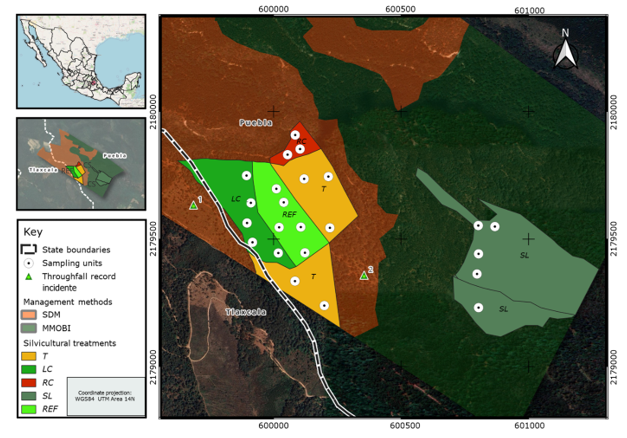
In forest ecosystems, throughfall (TF) is the primary source of water entering the soil and is determined both by the characteristics of rainfall events and by the canopy structure. The influence of forest management and structural attributes on TF was evaluated in a temperate forest. Circular sampling plots of 1 000 m2 were established in stands managed using the Silvicultural Development Method, the Mexican Method for Irregular Forest Management, and a reference stand (REF). Over a three-year period, total rainfall (TR) and daily precipitation (TF) were recorded using rain gauges during the rainy season. The data were analyzed using generalized linear mixed models, incorporating the TR, canopy cover, and silvicultural treatment, as well as the nested hierarchical structure of the data and the temporal dependence between measurements. The TR had a greater influence on the TF, with an average increase of 1.8 % for every additional millimeter of rainfall; canopy cover had a negative effect, reducing the TF by approximately 1.04 % for every percentage point increase in cover. Compared to REF, thinning (T) showed a significant reduction of approximately 12 %. The model showed good predictive performance, with a Correlation coefficient (r) of 0.98 between observed and predicted TF values and Mean absolute error of 1.16 mm. The results indicate that forest management alters the canopy structure, which in turn impacts rainfall distribution. Long-term studies are required to guide adaptive management.
Downloads
References
Anys, M., & Weiler, M. (2024). Rainfall interception by urban trees: Event characteristics and tree morphological traits. Hydrological Processes, 38(4), Article e15146. https://doi.org/10.1002/hyp.15146 DOI: https://doi.org/10.22541/au.169999569.96302150/v1
Aussenac, G. (1981). L’interception des précipitations par les peuplements forestiers. La Houille Blanche, (7-8), 531-536. https://www.shf-lhb.org/articles/lhb/pdf/1981/05/lhb1981049.pdf DOI: https://doi.org/10.1051/lhb/1981049
Barbier, S., Balandier, P., & Gosselin, F. (2009). Influence of several tree traits on rainfall partitioning in temperate and boreal forests: a review. Annals of Forest Science, 66(6), 602. https://doi.org/10.1051/forest/2009041 DOI: https://doi.org/10.1051/forest/2009041
Bolaños-Sánchez, C., Prado-Hernández, J. V., Silván-Cárdenas, J. L., Vázquez-Peña, M. A., Madrigal-Gómez, J. M., & Martínez-Ruíz, A. (2021). Estimating rainfall interception of Pinus hartwegii and Abies religiosa using analytical models and point cloud. Forests, 12(7), Article 866. https://doi.org/10.3390/f12070866 DOI: https://doi.org/10.3390/f12070866
Brasil, J. B., de Andrade, E. M., de Queiroz-Palácio, H. A., Fernández-Raga, M., Ribeiro-Filho, J. C., Medeiros, P. H. A., & Guerreiro, M. S. (2022). Canopy effects on rainfall partition and throughfall drop size distribution in a tropical dry forest. Atmosphere, 13(7), Article 1126. https://doi.org/10.3390/atmos13071126 DOI: https://doi.org/10.3390/atmos13071126
Cavazos, T. (2024). Spring 2024: Unprecedented atmospheric heatwaves in Mexico. Frontiers in Climate, 6, Article 1449710. https://doi.org/10.3389/fclim.2024.1449710 DOI: https://doi.org/10.3389/fclim.2024.1449710
Cisneros-Vaca, C., van der Tol, C., & Ghimire, C. P. (2018). The influence of long-term changes in canopy structure on rainfall interception loss: a case study in Speulderbos, the Netherlands. Hydrology and Earth System Sciences, 22(7), 3701-3719. https://doi.org/10.5194/hess-22-3701-2018 DOI: https://doi.org/10.5194/hess-22-3701-2018
Comisión Nacional Forestal. (2017). Inventario Nacional Forestal y de Suelos. Procedimientos de muestreo. Versión 19.0. Comisión Nacional Forestal. https://www.conafor.gob.mx/apoyos/docs/externos/2022/DocumentosMetodologicos/2019/ANEXO_Procedimientos_de_muestreo_2019.pdf
Correa-Díaz, A., Villanueva-Díaz, J., Gutiérrez-García, J. V., Velasco-Bautista, E., Moreno-Sánchez, F., & Zamora-Morales, B. P. (2025). Efecto del clima y el manejo forestal en el crecimiento radial de un bosque de coníferas en Puebla, México. Madera y Bosques, 31, Article e312717. https://doi.org/10.21829/myb.2025.312717 DOI: https://doi.org/10.21829/myb.2025.312717
Crockford, R. H., & Richardson, D. P. (2000). Partitioning of rainfall into throughfall, stemflow and interception: effect of forest type, ground cover and climate. Hydrological Processes, 14(16-17), 2903-2920. https://doi.org/10.1002/1099-1085(200011/12)14:16/17%3C2903::AID-HYP126%3E3.0.CO;2-6 DOI: https://doi.org/10.1002/1099-1085(200011/12)14:16/17<2903::AID-HYP126>3.0.CO;2-6
Deguchi, A., Hattori, S., & Park, H.-T. (2006). The influence of seasonal changes in canopy structure on interception loss: Application of the revised Gash model. Journal of Hydrology, 318(1-4), 80-102. https://doi.org/10.1016/j.jhydrol.2005.06.005 DOI: https://doi.org/10.1016/j.jhydrol.2005.06.005
Flores-Ayala, E., Guerra-De la Cruz, V., Terrazas-González, G. H., Carrillo-Anzures, F., Islas-Gutiérrez, F., Acosta-Mireles, M., & Buendía-Rodríguez, E. (2016). Intercepción de lluvia en bosques de montaña en la cuenca del río Texcoco, México. Revista Mexicana de Ciencias Forestales, 7(37), 65-76. https://doi.org/10.29298/rmcf.v7i37.52 DOI: https://doi.org/10.29298/rmcf.v7i37.52
Gazol, A., Pizarro, M., Hammond, W. M., Allen, C. D., & Camarero, J. J. (2025). Droughts preceding tree mortality events have increased in duration and intensity, especially in dry biomes. Nature Communications, 16, Article 5779. https://doi.org/10.1038/s41467-025-60856-5 DOI: https://doi.org/10.1038/s41467-025-60856-5
Gbur, E. E., Stroup, W. W., McCarter, K. S., Durham, S., Young, L. J., Christman, M., West, M., & Kramer, M. (2012). Analysis of generalized linear mixed models in the agricultural and natural resources sciences. John Wiley & Sons. https://doi.org/10.2134/2012.generalized-linear-mixed-models DOI: https://doi.org/10.2134/2012.generalized-linear-mixed-models
Holwerda, F., Scatena, F. N., & Bruijnzeel, L. A. (2006). Throughfall in a Puerto Rican lower montane rain forest: A comparison of sampling strategies. Journal of Hydrology, 327(3), 592-602. https://doi.org/10.1016/j.jhydrol.2005.12.014 DOI: https://doi.org/10.1016/j.jhydrol.2005.12.014
Huber, A., & Iroumé, A. (2001). Variability of annual rainfall partitioning for different sites and forest covers in Chile. Journal of Hydrology, 248(1-4), 78-92. https://doi.org/10.1016/S0022-1694(01)00394-8 DOI: https://doi.org/10.1016/S0022-1694(01)00394-8
Jeong, S., Kume, T., Shinohara, Y., Farahnak, M., & Otsuki, K. (2022). Application of the reformulated gash analytical model for rainfall interception loss to unmanaged high-density coniferous plantations laden with dead branches. Forests, 13(5), Article 657. https://doi.org/10.3390/f13050657 DOI: https://doi.org/10.3390/f13050657
Kaushal, R., Kumar, A., Alam, N. M., Mandal, D., Jayaparkash, J., Tomar, J. M. S., Patra, S., Gupta, A. K., Mehta, H., Panwar, P., Chaturvedi, O. P., & Mishra, P. K. (2017). Effect of different canopy management practices on rainfall partitioning in Morus alba. Ecological Engineering, 102, 374-380. https://doi.org/10.1016/j.ecoleng.2017.02.029 DOI: https://doi.org/10.1016/j.ecoleng.2017.02.029
Lazcano-Hernández, I. (2006). Estimación de secuestro de carbono para cuatro coníferas en la región de Chignahuapan, Puebla [Tesis de Maestría en Ciencias Forestales, Universidad Autónoma Chapingo]. Repositorio UACH. https://repositorio.chapingo.edu.mx/items/0ee2b3b6-0e93-4c3a-9c3e-8bc386b5df83
Levene, H. (1960). Robust tests for equality of variances. In I. Olkin (Ed.), Contributions to probability and statistics (pp. 278-292). Stanford University Press. https://www.scirp.org/reference/ReferencesPapers?ReferenceID=2363177
Llorens, P. (1997). Rainfall interception by a Pinus sylvestris forest patch overgrown in a Mediterranean mountainous abandoned area II. Assessment of the applicability of Gash’s analytical model. Journal of Hydrology, 199(3), 346-359. https://doi.org/10.1016/S0022-1694(96)03335-5 DOI: https://doi.org/10.1016/S0022-1694(96)03335-5
Millennium Ecosystem Assessment (Ed.). (2005). Ecosystems and human well-being. Opportunities and challenges for business and industry. World Resources Institute. http://pdf.wri.org/ma_synthesis_business.pdf
Monárrez-González, J. C., Pérez-Verdín, G., López-González, C., Márquez-Linares, M. A., & González-Elizondo, M. del S. (2018). Efecto del manejo forestal sobre algunos servicios ecosistémicos en los bosques templados de México. Madera y Bosques, 24(2), Artículo e2421569. https://doi.org/10.21829/myb.2018.2421569 DOI: https://doi.org/10.21829/myb.2018.2421569
Muñoz-Villers, L. E., Holwerda, F., Gómez-Cárdenas, M., Equihua, M., Asbjornsen, H., Bruijnzeel, L. A., Marín-Castro, B. E., & Tobón, C. (2012). Water balances of old-growth and regenerating montane cloud forests in central Veracruz, Mexico. Journal of Hydrology, 462-463, 53-66. https://doi.org/10.1016/j.jhydrol.2011.01.062 DOI: https://doi.org/10.1016/j.jhydrol.2011.01.062
Muzylo, A., Llorens, P., Valente, F., Keizer, J. J., Domingo, F., & Gash, J. H. C. (2009). A review of rainfall interception modelling. Journal of Hydrology, 370(1-4), 191-206. https://doi.org/10.1016/j.jhydrol.2009.02.058 DOI: https://doi.org/10.1016/j.jhydrol.2009.02.058
Nayak, N., Mehrotra, R., & Mehrotra, S. (2022). Carbon biosequestration strategies: a review. Carbon Capture Science & Technology, 4, Article 100065. https://doi.org/10.1016/j.ccst.2022.100065 DOI: https://doi.org/10.1016/j.ccst.2022.100065
Pawson, S. M., Brockerhoff, E. G., Meenken, E. D., & Didham, R. K. (2008). Non-native plantation forests as alternative habitat for native forest beetles in a heavily modified landscape. Biodiversity and Conservation, 17(5), 1127-1148. https://doi.org/10.1007/s10531-008-9363-y DOI: https://doi.org/10.1007/978-90-481-2807-5_11
Pérez-Miranda, R. (Comp.). (2014). Efecto de la Deforestación sobre la variabilidad climática en cinco bosques de coníferas [Libro Técnico Núm. 6]. Instituto Nacional de Investigaciones Forestales, Agrícolas y Pecuarias. https://www.researchgate.net/publication/362965284_Efecto_de_la_Deforestacion_sobre_la_Variabilidad_Climatica_en_Cinco_Bosques_de_Coniferas
R Core Team. (2024). R: A language and environment for statistical computing (Version 4.4) [Computer software]. R Foundation for Statistical Computing. https://www.r-project.org/
Ramos-Madrigal, R., de los Santos-Posadas, H. M., Valdez-Lazalde, J. R., Velasco-Bautista, E., Ángeles-Pérez, G., & Ortiz-Reyes, A. D. (2024). Evaluation of potential productivity in coniferous forests by integrating field data and aerial laser scanning in Hidalgo, México. Forest Systems, 33(3), Article 20886. https://doi.org/10.5424/fs/2024333-20886 DOI: https://doi.org/10.5424/fs/2024333-20886
Rutter, A. J., Kershaw, K. A., Robins, P. C., & Morton, A. J. (1971). A predictive model of rainfall interception in forests, 1. Derivation of the model from observations in a plantation of Corsican pine. Agricultural Meteorology, 9, 367-384. https://doi.org/10.1016/0002-1571(71)90034-3 DOI: https://doi.org/10.1016/0002-1571(71)90034-3
Sadeghi, S. M. M., Epstein, J. M., Deljouei, A., Gorora, F. J., & Cohen, M. J. (2024). Stand age controls canopy and soil rainfall partitioning in slash pine forests. Forest Ecology and Management, 572, Article 122307. https://doi.org/10.1016/j.foreco.2024.122307 DOI: https://doi.org/10.1016/j.foreco.2024.122307
Savenije, H. H. G. (2004). The importance of interception and why we should delete the term evapotranspiration from our vocabulary. Hydrological Processes, 18(8), 1507-1511. https://doi.org/10.1002/hyp.5563 DOI: https://doi.org/10.1002/hyp.5563
Scheaffer, R. L., Mendenhall, III, W., Ott, R. L., & Gerow, K. G. (2011). Elementary survey sampling. Cengage Learning. https://books.google.com.mx/books/about/Elementary_Survey_Sampling.html?id=qKYJzgEACAAJ&redir_esc=y
Servicio Meteorológico Nacional. (2023). Monitor de Sequía en México [Base de datos]. Comisión Nacional del Agua. https://smn.conagua.gob.mx/es/climatologia/monitor-de-sequia/monitor-de-sequia-en-mexico
Shapiro, S. S., & Wilk, M. B. (1965). An analysis of variance test for normality (complete samples). Biometrika, 52(3-4), 591-611. https://doi.org/10.1093/biomet/52.3-4.591 DOI: https://doi.org/10.1093/biomet/52.3-4.591
Staelens, J., De Schrijver, A., Verheyen, K., & Verhoest, N. E. C. (2006). Spatial variability and temporal stability of throughfall water under a dominant beech (Fagus sylvatica L.) tree in relationship to canopy cover. Journal of Hydrology, 330(3), 651-662. https://doi.org/10.1016/j.jhydrol.2006.04.032 DOI: https://doi.org/10.1016/j.jhydrol.2006.04.032
Tichý, L. (2016). Field test of canopy cover estimation by hemispherical photographs taken with a smartphone. Journal of Vegetation Science, 27(2), 427-435. https://doi.org/10.1111/jvs.12350 DOI: https://doi.org/10.1111/jvs.12350
Van Stan, II, J. T., Gutmann, E., & Friesen, J. (Eds.). (2020). Precipitation partitioning by vegetation. A global synthesis. Springer Nature Switzerland AG. https://doi.org/10.1007/978-3-030-29702-2 DOI: https://doi.org/10.1007/978-3-030-29702-2
Westfall, J. A., & Edgar, C. B. (2022). Addressing non-response bias in urban forest inventories: an estimation approach. Frontiers in Forests and Global Change, 5, Article 895969. https://doi.org/10.3389/ffgc.2022.895969 DOI: https://doi.org/10.3389/ffgc.2022.895969
Yang, J., Wang, A., Shen, L., Dai, G., Liu, Y., Zhang, Y., Fei, W., & Wu, J. (2024). The impact of canopy on nutrient fluxes through rainfall partitioning in a mixed broadleaf and coniferous forest. Forests, 15(4), Article 623. https://doi.org/10.3390/f15040623 DOI: https://doi.org/10.3390/f15040623
Yim, J.-S., Shin, M.-Y., Son, Y., & Kleinn, C. (2015). Cluster plot optimization for a large area forest resource inventory in Korea. Forest Science and Technology, 11(3), 139-146. https://doi.org/10.1080/21580103.2014.968222 DOI: https://doi.org/10.1080/21580103.2014.968222
Zuur, A. F., Ieno, E. N., Walker, N., Saveliev, A. A., & Smith, G. M. (2009). Mixed effects models and extensions in ecology with R. Springer-Verlag New York. https://doi.org/10.1007/978-0-387-87458-6 DOI: https://doi.org/10.1007/978-0-387-87458-6
Downloads
Published
How to Cite
Issue
Section
License
Copyright (c) 2026 Revista Mexicana de Ciencias Forestales

This work is licensed under a Creative Commons Attribution-NonCommercial 4.0 International License.
The authors who publish in Revista Mexicana de Ciencias Forestales accept the following conditions:
In accordance with copyright laws, Revista Mexicana de Ciencias Forestales recognizes and respects the authors’ moral right and ownership of property rights which will be transferred to the journal for dissemination in open access.
All the texts published by Revista Mexicana de Ciencias Forestales –with no exception– are distributed under a Creative Commons License Attribution-NonCommercial 4.0 International (CC BY-NC 4.0), which allows third parties to use the publication as long as the work’s authorship and its first publication in this journal are mentioned
The author(s) can enter into independent and additional contractual agreements for the nonexclusive distribution of the version of the article published in Revista Mexicana de Ciencias Forestales (for example, include it into an institutional repository or publish it in a book) as long as it is clearly and explicitly indicated that the work was published for the first time in Revista Mexicana de Ciencias Forestales.
For all the above, the authors shall send the form of Letter-transfer of Property Rights for the first publication duly filled in and signed by the author(s). This form must be sent as a PDF file to: ciencia.forestal2@inifap.gob.mx
This work is licensed under a Creative Commons Attribution-Noncommercial 4.0 International license.