Leaf morpho-anatomical characterization in Pinus patula Schiede ex Schltdl. & Cham. progenies
DOI:
https://doi.org/10.29298/rmcf.v17i93.1597Keywords:
Needles, leaf anatomy, resin canals, endoderm, epiderm, hypodermAbstract
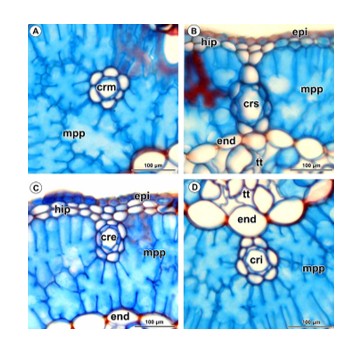
Progeny trials are experimental fields where the genetics of selected parent trees are evaluated. They bring together families from different origins that vary due to genetic and/or environmental factors. The objective of this research was to describe and analyze the foliar morpho-anatomy of Pinus patula from two progeny trials established at the Tlatoxca ranch in the state of Hidalgo and the Ojo de Agua ejido in the state of Veracruz, Mexico. Ten fascicles were collected from 64 trees. Cross-sections were made and stained with safranin and alcian blue. The structures were analyzed and described using an optical binocular microscope. The number of needles per fascicle, the number of stomatal rows (abaxial and adaxial surfaces), and the number of resin canals were subjected to an analysis of variance (P≤0.05). A single-layered epidermis composed of highly clarified rectangular cells was observed. The hypodermis is single-layered and bi-layered; 54 % of the needles at the Tlatoxca ranch exhibited a mostly bi-layered hypodermis, while at the Ojo de Agua ejido, 33 % did. Significant differences were found in the number of resin canals (P≤0.0001); at the Tlatoxca ranch, the number ranged from (2-)3(-6) with an average of 3.48, while at the Ojo de Agua ejido, the range was (0-)3(-4), with an average of 2.64. The resin canals were frequently located medially and internally, and exceptionally externally and septally. The environmental conditions of each plantation site influenced some morpho-anatomical characteristics of the P. patula needles in two two-year-old plantations.
Downloads
References
Adobe. (2012). Adobe Photoshop (CS6) (version 13.0.121) [Software]. Adobe Inc. https://www.adobe.com/mx/products/photoshop.html
Androsiuk, P., Kaczmarek, Z., & Urbaniak, L. (2011). The morphological traits of needles as markers of geographical differentiation in European Pinus sylvestris populations. Dendrobiology, (65), 3-16. https://www.idpan.poznan.pl/images/stories/dendrobiology/vol65/65_03_16.pdf
Azcárraga-Rosette, M. del R., Jácquez-Ríos, M. P., Bonfil-Campos, A., & Sandoval-Zapotitla, E. (2022). Atlas de Anatomía Vegetal. Facultad de Estudios Superiores Cuautitlán. https://books.google.com.mx/books/about/Atlas_de_anatom%C3%ADa_vegetal.html?id=hRt_EAAAQBAJ&redir_esc=y
Bozkurt, A. E., Coşkunçelebi, K., & Terzioglu, S. (2023). Variation in needle anatomy of scots pine (Pinus sylvestris L.) populations according to habitat and altitudinal zones in Türkiye. Šumarski list, 147(5-6), 215-225. https://doi.org/10.31298/sl.147.5-6.2 DOI: https://doi.org/10.31298/sl.147.5-6.2
Chávez-García, A. S., Hernández-Ramos, J., Muñoz-Flores, H. J., García-Magaña, J. J., Gómez-Cárdenas, M., & Gutiérrez-Contreras, M. (2022). Plasticidad fenotípica de progenies de árboles de Pinus pseudostrobus Lindl. superiores en producción de resina en vivero. Madera y Bosques, 28(1), Artículo e2812381. https://doi.org/10.21829/myb.2022.2812381 DOI: https://doi.org/10.21829/myb.2022.2812381
Donnelly, K., Cavers, S., Cottrell, J. E., & Ennos, R. A. (2016). Genetic variation for needle traits in Scots pine (Pinus sylvestris L.). Tree Genetics & Genomes, 12, Article 40. https://doi.org/10.1007/s11295-016-1000-4 DOI: https://doi.org/10.1007/s11295-016-1000-4
Dvorak, W. S., Hodge, G. R., Kietzka, J. E., Malan, F., Osorio, L. F., Stanger, T. K., & Brawner, J. T. (2000). Pinus patula. In Central America and Mexico Coniferous Resources Cooperative (Ed.), Conservation & testing of tropical & subtropical forest tree species (pp. 148-173). Grow Graphics. https://research.usc.edu.au/esploro/outputs/99450692102621
Espinoza-Pelcastre, C., Hernández-León, S., Gernandt, D. S., Arce-Cervantes, O., Rodríguez-Laguna, R., & González-Ávalos, J. (2018). Clave de identificación taxonómica con caracteres anatómicos foliares para especies de Pinus L. en Hidalgo. Revista Mexicana de Ciencias Forestales, 9(47), 28-49. https://doi.org/10.29298/rmcf.v9i47.167 DOI: https://doi.org/10.29298/rmcf.v9i47.167
Farjon, A., & Styles, B. T. (1997). Pinus (Pinaceae) (Vol. 75, Flora Neotropica Monographs]. Organization for Flora Neotropica, New York Botanical Garden. https://books.google.com.mx/books/about/Pinus_Pinaceae.html?id=4_csAQAAMAAJ&redir_esc=y
Fernández, A. M., & Salvo, L. (2003). Variación del área de pared celular en Pinus radiata D. Don. Maderas. Ciencia y Tecnología, 5(1), 80-87. http://dx.doi.org/10.4067/S0718-221X2003000100007 DOI: https://doi.org/10.4067/S0718-221X2003000100007
Ferreira, T., & Rasband, W. (2012). ImageJ User Guide IJ 1.46r. U. S. National Institutes of Health. https://imagej.net/ij/docs/guide/user-guide.pdf
Fick, S. E., & Hijmans, R. J. (2017). WorldClim 2: new 1-km spatial resolution climate surfaces for global land areas. International Journal of Climatology, 37(12), 4302-4315. https://doi.org/10.1002/joc.5086 DOI: https://doi.org/10.1002/joc.5086
Flores-Flores, C., López-Upton, J., & Valencia-Manzo, S. (2014). Manual técnico para el establecimiento de ensayos de procedencias y progenies. Comisión Nacional Forestal. http://www.conafor.gob.mx:8080/documentos/docs/19/0Manual%20Te%CC%81cnico%20para%20el%20Establecimiento%20de%20Ensayos.pdf
García-Esteban, L., Martín, J. A., de Palacios, P., García-Fernández, F., & López, R. (2010). Adaptive anatomy of Pinus halepensis trees from different Mediterranean environments in Spain. Trees, 24(1), 19-30. https://doi.org/10.1007/s00468-009-0375-3 DOI: https://doi.org/10.1007/s00468-009-0375-3
Geada-López, G., Sotolongo-Sospedra, R., & Pérez-Del Valle, L. (2022). Variación anatómica foliar en poblaciones naturales de Pinus tropicalis en Pinar del Río, Cuba. Revista del Jardín Botánico Nacional, 43, 155-170. https://revistas.uh.cu/rjbn/article/view/211?articlesBySimilarityPage=1
Geada-López, G., Sotolongo-Sospedra, R., Pérez-Del Valle, L., & Ramírez-Hernández, R. (2021). Diferenciación anatómica foliar en poblaciones naturales de Pinus caribaea var. caribaea (Pinaceae) en Pinar del Río y Artemisa, Cuba. Revista del Jardín Botánico Nacional, 42, 175-188. https://www.jstor.org/stable/48672484
Ghimire, B., Kim, M., Lee, J.-H., & Heo, K. (2014). Leaf anatomy of Pinus thunbergii Parl. (Pinaceae) collected from different regions of Korea. Korean Journal of Plant Taxonomy, 44(2), 91-99. https://doi.org/10.11110/kjpt.2014.44.2.91
Gianoli, E. (2004). Plasticidad fenotípica adaptativa en plantas. En H. Marino-Cabrera (Ed.), Fisiología ecológica en plantas. Mecanismos y respuestas a estrés en los ecosistemas (pp. 13-25). Ediciones Universitarias de Valparaíso. http://www2.udec.cl/~egianoli/04gianolifisioeco.pdf
Grill, D., Tausz, M., Pöllinger, U. T. E., Jiménez, M. S., & Morales, D. (2004). Effects of drought on needle anatomy of Pinus canariensis. Flora-Morphology, Distribution, Functional Ecology of Plants, 199(2), 85-89. https://doi.org/10.1078/0367-2530-00137 DOI: https://doi.org/10.1078/0367-2530-00137
Hengxiao, G., McMillin, J. D., Wagner, M. R., Zhou, J., Zhou, Z., & Xu, X. (1999). Altitudinal variation in foliar chemistry and anatomy of yunnan pine, Pinus yunnanensis, and pine sawfly (Hym., Diprionidae) performance. Journal of Applied Entomology, 123(8), 465-471. https://doi.org/10.1046/j.1439-0418.1999.00395.x DOI: https://doi.org/10.1046/j.1439-0418.1999.00395.x
Iglesias-Andreu, L. G., & Tivo-Fernández, Y. (2006). Caracterización morfométrica de la población de Pinus hartwegii Lindl. del Cofre de Perote, Veracruz, México. Ra Ximhai, 2(2), 449-468. https://www.redalyc.org/pdf/461/46120208.pdf DOI: https://doi.org/10.35197/rx.02.02.2006.08.li
Ipinza-Carmona, R. H. (1998). Mejoramiento Genético Forestal [Serie técnica/Núm. 42]. Corporación Nacional de Investigación y Fomento. https://www.researchgate.net/profile/Roberto-Ipinza/publication/256852551_Mejoramiento_Genetico_Forestal/links/57d6c3e608ae5f03b494d54a/Mejoramiento-Genetico-Forestal.pdf
Kim, M. Y., Lee, J. H., & Heo, K. (2014). Leaf anatomy of Pinus thunbergii Parl. (Pinaceae) collected from different regions of Korea. Korean Journal of Plant Taxonomy, 44(2), 91-99. https://doi.org/10.11110/kjpt.2014.44.2.91 DOI: https://doi.org/10.11110/kjpt.2014.44.2.91
Martínez, M. (1992). Los pinos mexicanos (3ra ed.). Ediciones Botas. https://books.google.com.mx/books/about/Los_pinos_mexicanos.html?id=c-osAQAAMAAJ&redir_esc=y
Nikolić, B., Bojović, S., & Marin, P. D. (2016). Morpho-anatomical traits of Pinus peuce needles from natural populations in Montenegro and Serbia. Plant Biosystems-An International Journal Dealing with all Aspects of Plant Biology, 150(5), 1038-1045. https://doi.org/10.1080/11263504.2014.1000999 DOI: https://doi.org/10.1080/11263504.2014.1000999
Pérez-Del Valle, L., Geada-López, G., & Sotolongo-Sospedra, R. (2019). Diferencias anatómicas en acículas de Pinus tropicalis Morelet en edátopos extremos de pizarras y arenas blancas en Pinar del Río. Revista Cubana de Ciencias Forestales, 7(2), 225-239. http://scielo.sld.cu/scielo.php?script=sci_arttext&pid=S2310-34692019000200225
Pérez-Luna, A., López-Upton, J., Prieto-Ruíz, J. Á., Rodríguez-Laguna, R., & Barrera-Ramírez, R. (2024). Supervivencia, fenología vegetativa y floración de rametos de un huerto semillero asexual de Pinus patula. Bosque, 45(1), 151-161. http://dx.doi.org/10.4067/s0717-92002024000100151 DOI: https://doi.org/10.4067/s0717-92002024000100151
Pérez-Olvera, C. de la P., & Ceja-Romero, J. (2019). Anatomía de la hoja de seis especies de Pinus del estado de Durango, México. Madera y Bosques, 25(1), Artículo e2511698. https://doi.org/10.21829/myb.2019.2511698 DOI: https://doi.org/10.21829/myb.2019.2511698
Perry, J. P. (1991). The pines of Mexico and Central America. Timber Press, inc. https://books.google.com.mx/books/about/The_Pines_of_Mexico_and_Central_America.html?id=u8BgAAAAMAAJ
Roden, J. S., Canny, M. J., Huang, C. X., & Ball, M. C. (2009). Frost tolerance and ice formation in Pinus radiata needles: ice management by the endodermis and transfusion tissues. Functional Plant Biology, 36(2), 180-189. https://doi.org/10.1071/FP08247 DOI: https://doi.org/10.1071/FP08247
Rodríguez-Laguna, R., & Capo-Arteaga, M. A. (2005). Morfología de acículas y conos en poblaciones naturales de Pinus arizonica Engelm. Ra Ximhai, 1(1), 131-152. https://www.redalyc.org/pdf/461/46110109.pdf DOI: https://doi.org/10.35197/rx.01.01.2005.09.RR
Rodríguez-Vásquez, M. E., Rodríguez-Ortiz, G., Enríquez-Del Valle, J. R., Campos-Ángeles, G. V., Velasco-Velasco, V. A., & Hernández-Hernández, A. (2021). Ensayos de progenies y huertos semilleros de especies forestales en México. Revista Mexicana de Agroecosistemas, 8(1), 79-88. https://revistaremaeitvo.mx/index.php/remae/article/view/273
Salaya-Domínguez, J. M., López-Upton, J., & Vargas-Hernández, J. J., (2012). Variación genética y ambiental en dos ensayos de progenies de Pinus patula. Agrociencia, 46(5), 519-534. https://www.agrociencia-colpos.org/index.php/agrociencia/article/view/973/973
SAS Institute. (2022). SAS (Version 9.00) [Software]. The SAS Institute Inc. https://www.sas.com/es_mx/learn/academic-programs/software.html
Sotolongo-Sospedra, R., Geada-López, G., Pérez-Del Valle, L., & Armas-Crespo, N. M. (2022). Effect of the position of the needles in the crown of the tree on the foliar anatomy of Pinus caribaea Morelet var. caribaea Barrett and Golfari. Revista Cubana de Ciencias Forestales, 11(1), Artículo e787. http://scielo.sld.cu/scielo.php?pid=S2310-34692023000100007&script=sci_arttext
Tiwari, S. P., Kumar, P., Yadav, D., & Chauhan, D. K. (2013). Comparative morphological, epidermal, and anatomical studies of Pinus roxburghii needles at different altitudes in the North-West Indian Himalayas. Turkish Journal of Botany, 37(1), 65-73. https://doi.org/10.3906/bot-1110-1 DOI: https://doi.org/10.3906/bot-1110-1
Toral, M., Manríquez, A., Navarro-Cerrillo, R., Tersi, D., & Naulin, P. (2010). Stomata characteristics, stomatal density and stomatic index in redwood (Sequoia sempervirens) and its variation in different plantations in Chile. Bosque, 31(2), 157-164. https://revistabosque.org/index.php/bosque/article/view/803 DOI: https://doi.org/10.4067/S0717-92002010000200009
White, T. L., Adams, W. T., & Neale, D. B. (Eds.). (2007). Forest genetics. Centre for Agriculture and Bioscience International. https://doi.org/10.1079/9781845932855.0000 DOI: https://doi.org/10.1079/9781845932855.0000
Yi, M., Jia, T., Dong, L., Zhang, L., Leng, C., Liu, S., & Lai, M. (2021). Resin yield in Pinus elliottii Engelm. is related to the resin flow rate, resin components and resin duct characteristics at three locations in southern China. Industrial Crops and Products, 160, Article 113141. https://www.sciencedirect.com/science/article/abs/pii/S092666902031058X DOI: https://doi.org/10.1016/j.indcrop.2020.113141
Zhang, M., Meng, J.-X., Zhang, Z.-J., Zhu, S.-L., & Li, Y. (2017). Genetic analysis of needle morphological and anatomical traits among nature populations of Pinus tabuliformis. Journal of Plant Studies, 6(1), 62-75. https://www.ccsenet.org/journal/index.php/jps/article/view/64939 DOI: https://doi.org/10.5539/jps.v6n1p62
Published
How to Cite
Issue
Section
License
Copyright (c) 2026 Revista Mexicana de Ciencias Forestales

This work is licensed under a Creative Commons Attribution-NonCommercial 4.0 International License.
The authors who publish in Revista Mexicana de Ciencias Forestales accept the following conditions:
In accordance with copyright laws, Revista Mexicana de Ciencias Forestales recognizes and respects the authors’ moral right and ownership of property rights which will be transferred to the journal for dissemination in open access.
All the texts published by Revista Mexicana de Ciencias Forestales –with no exception– are distributed under a Creative Commons License Attribution-NonCommercial 4.0 International (CC BY-NC 4.0), which allows third parties to use the publication as long as the work’s authorship and its first publication in this journal are mentioned
The author(s) can enter into independent and additional contractual agreements for the nonexclusive distribution of the version of the article published in Revista Mexicana de Ciencias Forestales (for example, include it into an institutional repository or publish it in a book) as long as it is clearly and explicitly indicated that the work was published for the first time in Revista Mexicana de Ciencias Forestales.
For all the above, the authors shall send the form of Letter-transfer of Property Rights for the first publication duly filled in and signed by the author(s). This form must be sent as a PDF file to: ciencia.forestal2@inifap.gob.mx
This work is licensed under a Creative Commons Attribution-Noncommercial 4.0 International license.