Sensibilidad climática y resiliencia de Pseudotsuga menziesii (Mirb.) Franco ante eventos de sequía
DOI:
https://doi.org/10.29298/rmcf.v17i93.1596Palabras clave:
Dendroecológico, Incremento en Área Basal, indices de resiliencia, variabilidad climática, sequías extremas, Sierra Madre OccidentalResumen
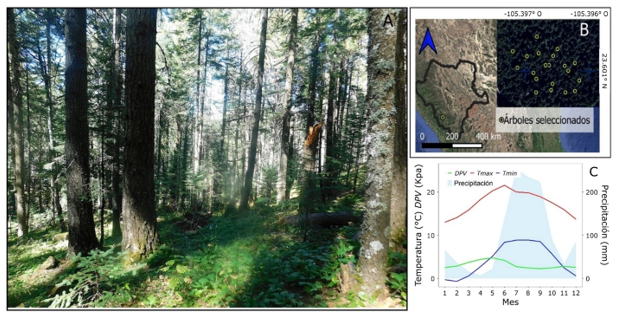
El cambio climático representa una amenaza para la dinámica y la resiliencia de los bosques templados, con profundas implicaciones para las especies con sensibilidad a la sequía y estrés hídrico. El objetivo fue evaluar la sensibilidad del crecimiento radial de Pseudotsuga menziesii a la variabilidad climática, así como la resiliencia del Incremento en Área Basal (IAB) a eventos de sequía como proxies dendroecológicos. Se desarrolló una cronología versión residual (1948-2021) con 40 series de 20 árboles en un bosque de alto valor de conservación (BAVC) en Durango, México con técnicas dendrocronológicas estándar. Los datos climáticos temperatura máxima y mínima, precipitación y déficit de presión de vapor (Tmax, Tmin, PP y DPV) se obtuvieron de TerraClimate para el periodo 1958 a 2024, y el Índice Estandarizado de Evapotranspiración Precipitación (SPEI) a seis meses de SPEI Drought Monitor. El crecimiento radial se asoció positivamente con PP y la Tmin en invierno y principios de primavera. En contraste, Tmax de diciembre y DPV en primavera disminuyeron el crecimiento, al igual que el SPEI en escalas de 3 a 11 meses. El IAB tuvo una tendencia ascendente interrumpida por sequías severas en 1974, 1999, 2006 y 2011. Los índices de resiliencia evidenciaron una reducción en la resistencia y resiliencia frente a sequías, 1965 registró el evento con un tiempo de recuperación significativamente menor. Estos resultados confirman que P. menziesii es sensible a la disponibilidad hídrica invernal y primaveral, y las sequías comprometen su capacidad de resistencia y resiliencia ante eventos climáticos extremos recientes.
Descargas
Citas
Abatzoglou, J. T., Dobrowski, S. Z., Parks, S. A., & Hegewisch, K. C. (2018). TerraClimate, a high-resolution global dataset of monthly climate and climatic water balance from 1958–2015. Scientific Data, 5, Article 170191. https://doi.org/10.1038/sdata.2017.191 DOI: https://doi.org/10.1038/sdata.2017.191
Bhandari, S., Gaire, N. P., Shah, S. K., Speer, J. H., Bhuju, D. R., & Thapa, U. K. (2019). A 307-year tree-ring SPEI reconstruction indicates modern drought in western Nepal Himalayas. Tree-Ring Research, 75(2), 73-85. https://doi.org/10.3959/1536-1098-75.2.73 DOI: https://doi.org/10.3959/1536-1098-75.2.73
Biondi, F., & Qeadan, F. (2008). A theory-driven approach to tree-ring standardization: defining the biological trend from expected basal area increment. Tree-Ring Research, 64(2), 81-96. https://doi.org/10.3959/2008-6.1 DOI: https://doi.org/10.3959/2008-6.1
Bland, J. M., & Altman, D. G. (1995). Multiple significance tests: the Bonferroni method. The British Medical Journal, 310(6973), 170. https://doi.org/10.1136/bmj.310.6973.170 DOI: https://doi.org/10.1136/bmj.310.6973.170
Cabral-Alemán, C., Villanueva-Díaz, J., Quiñonez-Barraza, G., & Gómez-Guerrero, A. (2023). Resilience of Pinus durangensis Martínez in extreme drought periods: vertical and horizontal response of tree rings. Atmosphere, 14(1), 43. https://doi.org/10.3390/ATMOS14010043 DOI: https://doi.org/10.3390/atmos14010043
Camarero, J. J., Olano, J. M., & Parras, A. (2010). Plastic bimodal xylogenesis in conifers from continental Mediterranean climates. New Phytologist, 185(2), 471-480. https://doi.org/10.1111/j.1469-8137.2009.03073.x DOI: https://doi.org/10.1111/j.1469-8137.2009.03073.x
Castruita-Esparza, L. U., Silva, L. C. R., Gómez-Guerrero, A., Villanueva-Díaz, J., Correa-Díaz, A., & Horwath, W. R. (2019). Coping with extreme events: growth and water-use efficiency of trees in Western Mexico during the driest and wettest periods of the past one hundred sixty years. Journal of Geophysical Research: Biogeosciences, 124(11), 3419-3431. https://doi.org/10.1029/2019JG005294 DOI: https://doi.org/10.1029/2019JG005294
Chávez-Gándara, M. P., Cerano-Paredes, J., Nájera-Luna, J. A., Pereda-Breceda, V., Esquivel-Arriaga, G., Cervantes-Martínez, R., Cambrón-Sandoval, V. H., Cruz-Cobos, F., & Corral-Rivas, S. (2017). Winter-spring precipitation reconstruction from tree-rings for San Dimas region, Durango, Mexico. Bosque, 38(2), 387-399. https://doi.org/10.4067/S0717-92002017000200016 DOI: https://doi.org/10.4067/S0717-92002017000200016
Cook, B. I., Cook, E. R., Smerdon, J. E., Seager, R., Williams, A. P., Coats, S., Stahle, D. W., & Villanueva-Díaz, J. (2016). North American megadroughts in the Common Era: Reconstructions and simulations. WIREs Climate Change, 7(3), 411-432. https://doi.org/10.1002/WCC.394 DOI: https://doi.org/10.1002/wcc.394
Correa-Díaz, A., Villanueva-Díaz, J., Gómez-Guerrero, A., Martínez-Bautista, H., Castruita-Esparza, L. U., Horwath, W. R., & Silva, L. C. R. (2023). A comprehensive resilience assessment of Mexican tree species and their relationship with drought events over the last century. Global Change Biology, 29(13), 3652-3666. https://doi.org/10.1111/gcb.16705 DOI: https://doi.org/10.1111/gcb.16705
Fang, O., & Zhang, Q.-B. (2019). Tree resilience to drought increases in the Tibetan Plateau. Global Change Biology, 25(1), 245-253. https://doi.org/10.1111/gcb.14470 DOI: https://doi.org/10.1111/gcb.14470
Fritts, H. C., & Swetnam, T. W. (1989). Dendroecology: a tool for evaluating variations in past and present forest environments. Advances in Ecological Research, 19, 111-188. https://doi.org/10.1016/S0065-2504(08)60158-0 DOI: https://doi.org/10.1016/S0065-2504(08)60158-0
González-Elizondo, M., Jurado, E., Návar, J., González-Elizondo, M. S., Villanueva, J., Aguirre, O., & Jiménez, J. (2005). Tree-rings and climate relationships for Douglas-fir chronologies from the Sierra Madre Occidental, Mexico: a 1681-2001 rain reconstruction. Forest Ecology and Management, 213(1-3), 39-53. https://doi.org/10.1016/J.FORECO.2005.03.012 DOI: https://doi.org/10.1016/j.foreco.2005.03.012
González-Tagle, M. A., González-Cásares, M., Himmelsbach, W., & Gárate-Escamilla, H. A. (2024). Diferencias en la respuesta de indicadores dendrocronológicos a condiciones climáticas y topográficas. Revista Mexicana de Ciencias Forestales, 15(81), 59-82. https://doi.org/10.29298/rmcf.v15i81.1435 DOI: https://doi.org/10.29298/rmcf.v15i81.1435
Greenwood, S., Ruiz-Benito, P., Martínez-Vilalta, J., Lloret, F., Kitzberger, T., Allen, C. D., Fensham, R., Laughlin, D. C., Kattge, J., Bönisch, G., Kraft, N. J. B., & Jump, A. S. (2017). Tree mortality across biomes is promoted by drought intensity, lower wood density and higher specific leaf area. Ecology letters, 20, 539-553. https://doi.org/10.1111/ele.12748 DOI: https://doi.org/10.1111/ele.12748
Holmes, R. L. (1983). Computer-assisted quality control in tree-ring dating and measurement. Tree-Ring Bulletin, 43, 51-67. http://hdl.handle.net/10150/261223
Instituto Nacional de Estadística, Geografía e Informática. (2017). Capa vectorial de uso de suelo y vegetación Serie VI [Mapa]. Instituto Nacional de Estadística, Geografía e Informática. https://www.inegi.org.mx/temas/usosuelo/#Descargas
Instituto Nacional de Estadística y Geografía. (2024). Conjunto de datos vectorial edafológico. Escala 1:250 000 Serie II Continuo nacional [Datos vectoriales]. Instituto Nacional de Estadística y Geografía. https://www.inegi.org.mx/app/biblioteca/ficha.html?upc=794551131916
Kassambara, A. (2025). rstatix: Pipe-friendly framework for basic statistical tests (version 0.7.3) [Software]. Comprehensive R Archive Network. https://doi.org/10.32614/CRAN.package.rstatix DOI: https://doi.org/10.32614/CRAN.package.rstatix
Linares, J. C., Taïqui, L., Sangüesa-Barreda, G., Seco, J. I., & Camarero, J. J. (2013). Age-related drought sensitivity of Atlas cedar (Cedrus atlantica) in the Moroccan Middle Atlas forests. Dendrochronologia, 31(2), 88-96. https://doi.org/10.1016/J.DENDRO.2012.08.003 DOI: https://doi.org/10.1016/j.dendro.2012.08.003
Lloret, F., Keeling, E. G., & Sala, A. (2011). Components of tree resilience: effects of successive low-growth episodes in old ponderosa pine forests. Oikos, 120(12), 1909-1920. https://doi.org/10.1111/J.1600-0706.2011.19372.X DOI: https://doi.org/10.1111/j.1600-0706.2011.19372.x
López-Upton, J., Valdez-Lazalde, J. R., Ventura-Ríos, A., Vargas-Hernández, J. J., & Guerra-de la Cruz, V. (2015). Extinction risk of Pseudotsuga menziesii populations in the central region of Mexico: An AHP analysis. Forests, 6(5), 1598-1612. https://doi.org/10.3390/F6051598 DOI: https://doi.org/10.3390/f6051598
Manrique-Alba, À., Beguería, S., & Camarero, J. J. (2022). Long-term effects of forest management on post-drought growth resilience: An analytical framework. Science of the Total Environment, 810, Article 152374. https://doi.org/10.1016/J.SCITOTENV.2021.152374 DOI: https://doi.org/10.1016/j.scitotenv.2021.152374
Martínez-Sifuentes, A. R., Villanueva-Díaz, J., & Estrada-Ávalos, J. (2020). Runoff reconstruction and climatic influence with tree rings, in the Mayo river basin, Sonora, Mexico. iForest-Biogeosciences and Forestry, 13(2), 98-106. https://doi.org/10.3832/ifor3190-013 DOI: https://doi.org/10.3832/ifor3190-013
Mondek, J., Matějka, K., Gallo, J., Prokůpková, A., & Hájek, V. (2021). Picea abies and Pseudotsuga menziesii radial growth in relation to climate: case study from South Bohemia. Austrian Journal of Forest Science, 138(3), 209-244. https://www.forestscience.at/content/dam/holz/forest-science/2021/03/CB2103_Art4.pdf
Neuwirth, B., Schweingruber, F. H., & Winiger, M. (2007). Spatial patterns of central European pointer years from 1901 to 1971. Dendrochronologia, 24(2-3), 79-89. https://doi.org/10.1016/J.DENDRO.2006.05.004 DOI: https://doi.org/10.1016/j.dendro.2006.05.004
Pardos, M., del Río, M., Pretzsch, H., Jactel, H., Bielak, K., Bravo, F., Brazaitis, G., Defossez, E., Engel, M., Godvod, K., Jacobs, K., Jansone, L., Jansons, A., Morin, X., Nothdurft, A., Oreti, L., Ponette, Q., Pach, M., Riofrío, J., … Calama, R. (2021). The greater resilience of mixed forests to drought mainly depends on their composition: Analysis along a climate gradient across Europe. Forest Ecology and Management, 481, Article 118687. https://doi.org/10.1016/j.foreco.2020.118687 DOI: https://doi.org/10.1016/j.foreco.2020.118687
Piraino, S., Arco-Molina, J., Hadad, M. A., & Roig-Juñent, F. A. (2022). Resilience capacity of Araucaria araucana to extreme drought events. Dendrochronologia, 75, Article 125996. https://doi.org/10.1016/J.DENDRO.2022.125996 DOI: https://doi.org/10.1016/j.dendro.2022.125996
Pollard, J. H. (1971). On distance estimators of density in randomly distributed forests. Biometrics, 27(4), 991-1002. https://doi.org/10.2307/2528833 DOI: https://doi.org/10.2307/2528833
Pompa-García, M., Dávalos-Sotelo, R., Rodríguez-Téllez, E., Aguirre-Calderón, O. A., & Treviño-Garza, E. J. (2014). Sensibilidad climática de tres versiones dendrocronológicas para una conífera mexicana. Madera y Bosques, 20(3), 139-151. https://www.scielo.org.mx/pdf/mb/v20n3/v20n3a12.pdf DOI: https://doi.org/10.21829/myb.2014.203158
R Core Team. (2025). R: A language and environment for statistical computing (Version 4.5.0) [Software]. R Foundation for Statistical Computing. https://www.R-project.org/
Rais, A., van de Kuilen, J.-W. G., & Pretzsch, H. (2014). Growth reaction patterns of tree height, diameter, and volume of Douglas-fir (Pseudotsuga menziesii [Mirb.] Franco) under acute drought stress in Southern Germany. European Journal of Forest Research, 133(6), 1043-1056. https://doi.org/10.1007/s10342-014-0821-7 DOI: https://doi.org/10.1007/s10342-014-0821-7
Rojas-García, F., Gómez-Guerrero, A., Gutiérrez-García, G., Ángeles-Pérez, G., Reyes-Hernández, V. J., & de Jong, B. H. J. (2020). Aplicaciones de la dendroecología en el manejo forestal: una revisión. Madera y Bosques, 26(3), Artículo e2632116. https://doi.org/10.21829/myb.2020.2632116 DOI: https://doi.org/10.21829/myb.2020.2632116
Secretaría de Medio Ambiente y Recursos Naturales. (2019). MODIFICACIÓN del Anexo Normativo III, Lista de especies en riesgo de la Norma Oficial Mexicana NOM-059-SEMARNAT-2010, Protección ambiental-Especies nativas de México de flora y fauna silvestres-Categorías de riesgo y especificaciones para su inclusión, exclusión o cambio-Lista de especies en riesgo, publicada el 30 de diciembre de 2010. Diario Oficial de la Federación. https://sidof.segob.gob.mx/notas/5578808
Serra-Maluquer, X., Mencuccini, M., & Martínez-Vilalta, J. (2018). Changes in tree resistance, recovery and resilience across three successive extreme droughts in the northeast Iberian Peninsula. Oecologia, 187(1), 343-354. https://doi.org/10.1007/s00442-018-4118-2 DOI: https://doi.org/10.1007/s00442-018-4118-2
Song, Y., Sterck, F., Sass-Klaassen, U., Li, C., & Poorter, L. (2022). Growth resilience of conifer species decreases with early, long-lasting and intense droughts but cannot be explained by hydraulic traits. Journal of Ecology, 110(9), 2088-2104. https://doi.org/10.1111/1365-2745.13931 DOI: https://doi.org/10.1111/1365-2745.13931
Stokes, M. A., & Smiley, T. L. (1996). An introduction to tree-ring dating (2nd edition). The University of Arizona Press. https://books.google.com.mx/books?id=THEVAQAAIAAJ&hl=es&source=gbs_book_other_versions_r&cad=3
Thurm, E. A., Uhl, E., & Pretzsch, H. (2016). Mixture reduces climate sensitivity of Douglas-fir stem growth. Forest Ecology and Management, 376, 205-220. https://doi.org/10.1016/J.FORECO.2016.06.020 DOI: https://doi.org/10.1016/j.foreco.2016.06.020
van der Maaten-Theunissen, M., Trouillier, M., Schwarz, J., Skiadaresis, G., Thurm, E. A., & van der Maaten, E. (2021). pointRes 2.0: New functions to describe tree resilience. Dendrochronologia, 70, Article 125899. https://doi.org/10.1016/J.DENDRO.2021.125899 DOI: https://doi.org/10.1016/j.dendro.2021.125899
Vejpustková, M., & Čihák, T. (2019). Climate response of Douglas fir reveals recently increased sensitivity to drought stress in Central Europe. Forests, 10(2), 97. https://doi.org/10.3390/F10020097 DOI: https://doi.org/10.3390/f10020097
Vicente-Serrano, S. M., Beguería, S., & López-Moreno, J. I. (2010). A multiscalar drought index sensitive to global warming: the standardized precipitation evapotranspiration index. Journal of Climate, 23(7), 1696-1718. https://doi.org/10.1175/2009JCLI2909.1 DOI: https://doi.org/10.1175/2009JCLI2909.1
Villanueva-Díaz, J., Fulé, P. Z., Cerano-Paredes, J., Estrada-Ávalos, J., & Sánchez-Cohen, I. (2009). Reconstrucción de la precipitación estacional para el barlovento de la Sierra Madre Occidental con anillos de crecimiento de Pseudotsuga menziesii (Mirb.) Franco. Revista Ciencia forestal en México, 34(105), 39-71. https://www.scielo.org.mx/pdf/cfm/v34n105/v34n105a3.pdf
Villanueva-Díaz, J., Castruita-Esparza, L. U., Martínez-Sifuentes, A. R., Loera-Chaparro, R., & Estrada-Ávalos, J. (2020). Chihuahua southwestern hydroclimatic variability inferred with coniferous growth rings. Revista Chapingo Serie Ciencias Forestales y del Ambiente, 26(3), 373-389. https://doi.org/10.5154/R.RCHSCFA.2019.09.071 DOI: https://doi.org/10.5154/r.rchscfa.2019.09.071
Descargas
Publicado
Cómo citar
Número
Sección
Licencia
Derechos de autor 2026 Revista Mexicana de Ciencias Forestales

Esta obra está bajo una licencia internacional Creative Commons Atribución-NoComercial 4.0.
Los autores que publiquen en la Revista Mexicana de Ciencias Forestales aceptan las siguientes condiciones:
De acuerdo con la legislación de derechos de autor, la Revista Mexicana de Ciencias Forestales reconoce y respeta el derecho moral de los autores, así como la titularidad del derecho patrimonial, el cual será cedido a la revista para su difusión en acceso abierto.
Todos los textos publicados por la Revista Mexicana de Ciencias Forestales –sin excepción– se distribuyen amparados bajo la licenciaCreative Commons 4.0 Atribución-No Comercial (CC BY-NC 4.0 Internacional), que permite a terceros utilizar lo publicado siempre que mencionen la autoría del trabajo y a la primera publicación en esta revista. (no permite el uso comercial)
Los autores pueden realizar otros acuerdos contractuales independientes y adicionales para la distribución no exclusiva de la versión del artículo publicado en la Revista Mexicana de Ciencias Forestales (por ejemplo, incluirlo en un repositorio institucional o darlo a conocer en otros medios en papel o electrónicos) siempre que indique clara y explícitamente que el trabajo se publicó por primera vez en la Revista Mexicana de Ciencias Forestales.
Para todo lo anterior, los autores deben remitir el formato de carta-cesión de la propiedad de los derechos de la primera publicación debidamente requisitado y firmado por los autores/as. Este formato debe ser remitido en archivo PDF al correo: editorial.forestal@inifap.gob.mx
Esta obra está bajo una licencia de Creative Commons Reconocimiento-No Comercial 4.0 Internacional.