Leaf metal concentrations, nutrient status and growth of Fraxinus uhdei (Wenz.) Lingelsh. in urban forests
DOI:
https://doi.org/10.29298/rmcf.v17i95.1617Keywords:
metal uptake, leaf biomass, leaf biomonitoring, urban forests, trace metals, plant nutritionAbstract
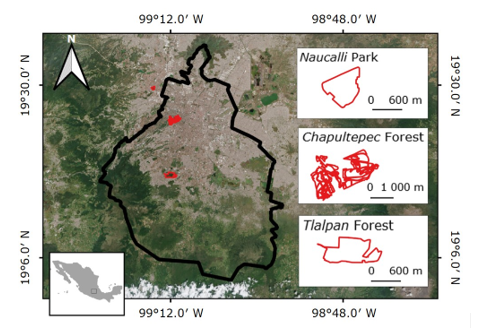
Urban air pollution places chronic stress on trees through the deposition of pollutants from human activities, including metals associated with vehicle and industrial emissions, which can disrupt physiological processes and affect plant growth. Although metal accumulation in leaves has been used as a biomonitoring tool, gaps remain in the understanding of its relationship to morphological and growth changes in dominant urban species. Within this context, the present study evaluated the concentration of metals on the leaf surface and the fraction absorbed by the tissue, as well as the nutrient content in the leaves of the ash tree (Fraxinus uhdei), a species widely distributed in urban forests in the Mexico City Metropolitan Area (ZMVM in Spanish). The analysis was conducted in three urban forests with contrasting environments. The concentrations of surface and absorbed metals and the nutrient content were determined, and their associations with morphological and growth variables were evaluated using multiple linear regression (stepwise method) and nutrient vector analysis. The results showed that copper (both surface and absorbed) was positively associated with increased leaf area, whereas metals of anthropogenic origin, such as lead, cadmium and chromium were negatively associated with increased diameter. The nutritional analysis revealed negative correlations between leaf biomass and nutrient concentrations. These findings suggest that the accumulation of metals in tree foliage may influence the physiology and nutrition of urban trees and provide a basis for their monitoring and management.
Downloads
References
Alcántar-González, G., Trejo-Téllez, L. I., & Gómez-Merino, F. C. (2016). Nutrición de cultivos. Colegio de Postgraduados. https://books.google.com.mx/books/about/Nutrici%C3%B3n_de_cultivos.html?id=TaP3vQEACAAJ&redir_esc=y
Benavides-Meza, H. M., López-Martínez, R., & Flores-Hernández, J. (2002). Daños a banquetas por arbolado de alineación establecido en cepas en la delegación Coyoacán, Distrito Federal. Revista Mexicana de Ciencias Forestales, 27(92), 53-77. https://cienciasforestales.inifap.gob.mx/index.php/forestales/article/view/902
Bierza, K., & Bierza, W. (2024). The effect of industrial and urban dust pollution on the ecophysiology and leaf element concentration of Tilia cordata Mill. Environmental Science and Pollution Research, 31, 58413–58429. https://doi.org/10.1007/s11356-024-34999-9 DOI: https://doi.org/10.1007/s11356-024-34999-9
Binkley, D., Stape, J. L., & Albaugh, T. J. (2025). Foliar nutrient concentrations and stoichiometry should not be assumed to diagnose nutrient limitation. Ecological Processes, 14, Article 27. https://doi.org/10.1186/s13717-025-00600-5 DOI: https://doi.org/10.1186/s13717-025-00600-5
Catinon, M., Ayrault, S., Daudin, L., Sevin, L., Asta, J., Tissut, M., & Ravanel, P. (2008). Atmospheric inorganic contaminants and their distribution inside stem tissues of Fraxinus excelsior L. Atmospheric Environment, 42(6), 1223-1238. https://doi.org/10.1016/j.atmosenv.2007.10.082 DOI: https://doi.org/10.1016/j.atmosenv.2007.10.082
Fonseca-Salazar, M. A., Sosa-Echeverría, R., Alarcón-Jiménez, A. L., & Sánchez-Álvarez, P. (2023). Chemical composition of wet atmospheric deposition in a natural urban reserve, conservation of green urban areas: Mexico City case study. Water, Air & Soil Pollution, 234, Article 514. https://doi.org/10.1007/s11270-023-06502-6 DOI: https://doi.org/10.1007/s11270-023-06502-6
Kabata-Pendias, A. (2010). Trace elements in soils and plants (4th ed.). CRC Press. https://doi.org/10.1201/b10158 DOI: https://doi.org/10.1201/b10158
Lindén, J., Gustafsson, M., Uddling, J., Watne, Å., & Pleijel, H. (2023). Air pollution removal through deposition on urban vegetation: The importance of vegetation characteristics. Urban Forestry & Urban Greening, 81, Article 127843. https://doi.org/10.1016/j.ufug.2023.127843 DOI: https://doi.org/10.1016/j.ufug.2023.127843
López-López, M. Á., & Alvarado-López, J. (2010). Interpretación de nomogramas de análisis de vectores para diagnóstico nutrimental de especies forestales. Madera y Bosques, 16(1), 99-108. https://doi.org/10.21829/myb.2010.1611182 DOI: https://doi.org/10.21829/myb.2010.1611182
Minitab Inc. (2004). Minitab Statistical Software (Version 14) [Computer software]. Minitab Inc. https://www.minitab.com/es-mx/support/downloads/
Molina, M. J., & Molina, L. T. (2004). Megacities and atmospheric pollution. Journal of the Air & Waste Management Association, 54(6), 644-680. https://doi.org/10.1080/10473289.2004.10470936 DOI: https://doi.org/10.1080/10473289.2004.10470936
Olguín, E. J., Sánchez-Galván, G., Pérez-Pérez, T., & Pérez-Orozco, A. (2005). Surface adsorption, intracellular accumulation and compartmentalization of Pb (II) in batch operated lagoons with Salvinia minima as affected by environmental conditions, EDTA and nutrients. Journal of Industrial Microbiology and Biotechnology, 32(11-12), 577-586. https://doi.org/10.1007/s10295-005-0250-1 DOI: https://doi.org/10.1007/s10295-005-0250-1
Omidi, S., Teiri, H., Mohammadi, F., & Hajizadeh, Y. (2025). Accumulation of heavy metals in the leaves of different tree species and its association with the levels of atmospheric PM2.5-bond heavy metals in Isfahan. International Journal of Phytoremediation, 27(2), 260-270. https://doi.org/10.1080/15226514.2024.2413414 DOI: https://doi.org/10.1080/15226514.2024.2413414
Patel, K., Chaurasia, M., & Rao, K. S. (2023). Heavy metal accumulation in leaves of selected plant species in urban areas of Delhi. Environmental Science and Pollution Research, 30, 27622-27635. https://doi.org/10.1007/s11356-022-24157-4 DOI: https://doi.org/10.1007/s11356-022-24157-4
Pérez-Harguindeguy, N., Díaz, S., Garnier, E., Lavorel, S., Poorter, H., Jaureguiberry, P., Bret-Harte, M. S., Cornwell, W. K., Craine, J. M., Gurvich, D. E., Urcelay, C., Veneklaas, E. J., Reich, P. B., Poorter, L., Wright, I. J., Ray, P., Enrico, L., Pausas, J. G., de Vos, A. C., … Cornelissen, J. H. C. (2013). New handbook for standardised measurement of plant functional traits worldwide. Australian Journal of Botany, 61(3), 167-234. https://doi.org/10.1071/BT12225 DOI: https://doi.org/10.1071/BT12225
Poorter, H., Niinemets, Ü., Poorter, L., Wright, I. J., & Villar, R. (2009). Causes and consequences of variation in leaf mass per area (LMA): A meta-analysis. New Phytologist, 182(3), 565-588. https://doi.org/10.1111/j.1469-8137.2009.02830.x DOI: https://doi.org/10.1111/j.1469-8137.2009.02830.x
Pretzsch, H., Biber, P., Uhl, E., Dahlhausen, J., Schütze, G., Perkins, D., Rötzer, T., Caldentey, J., Koike, T., van Con, T., Chavanne, A., du Toit, B., Foster, K., & Lefer, B. (2017). Climate change accelerates growth of urban trees in metropolises worldwide. Scientific Reports, 7, Article 15403. https://doi.org/10.1038/s41598-017-14831-w DOI: https://doi.org/10.1038/s41598-017-14831-w
Rai, P. K. (2016). Impacts of particulate matter pollution on plants: implications for environmental biomonitoring. Ecotoxicology and Environmental Safety, 129, 120-136. https://doi.org/10.1016/j.ecoenv.2016.03.012 DOI: https://doi.org/10.1016/j.ecoenv.2016.03.012
Ramírez-Méndez, E., Valdés-Reyna, J., Juárez-Maldonado, A., Martínez-Villegas, N. V., & López-Barbosa, L. A. (2021). Biomonitoreo de metales pesados en vegetación arbórea en la ciudad de Saltillo. Revista Mexicana de Ciencias Agrícolas, (26), 191-199. https://doi.org/10.29312/remexca.v0i26.2949 DOI: https://doi.org/10.29312/remexca.v0i26.2949
Sánchez-Landero, L. A., Benítez-Badillo, G., Sangabriel-Conde, W., Alvarado-Castillo, G., & Lagunes-Diaz, E. G. (2024). Surface deposits and intracellular concentration of atmospheric particles in foliage of urban forests in the Valley of Mexico. Trees, Forests and People, 15, Article 100492. https://doi.org/10.1016/j.tfp.2023.100492 DOI: https://doi.org/10.1016/j.tfp.2023.100492
Secretaría de Medio Ambiente de la Ciudad de México. (2023). Inventario de emisiones de la Zona Metropolitana del Valle de México 2020. Contaminantes criterio, tóxicos y gases y compuestos de efecto invernadero. Gobierno de la Ciudad de México. https://proyectos.sedema.cdmx.gob.mx/datos/storage/app/media/docpub/sedema/inventario-emisiones-cdmx-2020bis.pdf
Secretaría de Medio Ambiente y Recursos Naturales. (2002). Norma Oficial Mexicana NOM-021-RECNAT-2000, que establece las especificaciones de fertilidad, salinidad y clasificación de suelos. Estudios, muestreo y análisis. Diario Oficial de la Federación. https://www.ordenjuridico.gob.mx/Documentos/Federal/wo69255.pdf
Soba, D., Gámez, A. L., Becerril, J. M., Esteban, R., & Aranjuelo, I. (2022). Traffic restrictions during COVID-19 lockdown improve air quality and reduce metal biodeposition in tree leaves. Urban Forestry & Urban Greening, 70, Article 127542. https://doi.org/10.1016/j.ufug.2022.127542 DOI: https://doi.org/10.1016/j.ufug.2022.127542
Varela, Z., Martínez-Abaigar, J., Tomás-Las-Heras, R., Fernández, J. Á., Del-Castillo-Alonso, M.-Á., & Núñez-Olivera, E. (2023). Tree physiological variables as a proxy of heavy metal and platinum group elements pollution in urban areas. Biology, 12(9), 1180. https://doi.org/10.3390/biology12091180 DOI: https://doi.org/10.3390/biology12091180
Wendt-Thiex, N. J. (Ed.). (2023). 4.2.08 AOAC Official Method 990.03 Protein (crude) in animal feed: Combustion method. In G. W. Latimer, Jr. (Ed.), Official methods of analysis of AOAC International (22nd ed., pp. 1-6.). Association of Official Analytical Chemists International Publications. https://doi.org/10.1093/9780197610145.003.1400 DOI: https://doi.org/10.1093/9780197610145.003.1400
Youssef, N. A. (2020). Bioaccumulation of heavy metals in urban tree leaves. Egyptian Journal of Botany, 60(1), 261-273. https://doi.org/10.21608/ejbo.2019.15219.1344 DOI: https://doi.org/10.21608/ejbo.2019.15219.1344
Published
How to Cite
Issue
Section
License
Copyright (c) 2026 Revista Mexicana de Ciencias Forestales

This work is licensed under a Creative Commons Attribution-NonCommercial 4.0 International License.
The authors who publish in Revista Mexicana de Ciencias Forestales accept the following conditions:
In accordance with copyright laws, Revista Mexicana de Ciencias Forestales recognizes and respects the authors’ moral right and ownership of property rights which will be transferred to the journal for dissemination in open access.
All the texts published by Revista Mexicana de Ciencias Forestales –with no exception– are distributed under a Creative Commons License Attribution-NonCommercial 4.0 International (CC BY-NC 4.0), which allows third parties to use the publication as long as the work’s authorship and its first publication in this journal are mentioned
The author(s) can enter into independent and additional contractual agreements for the nonexclusive distribution of the version of the article published in Revista Mexicana de Ciencias Forestales (for example, include it into an institutional repository or publish it in a book) as long as it is clearly and explicitly indicated that the work was published for the first time in Revista Mexicana de Ciencias Forestales.
For all the above, the authors shall send the form of Letter-transfer of Property Rights for the first publication duly filled in and signed by the author(s). This form must be sent as a PDF file to: ciencia.forestal2@inifap.gob.mx
This work is licensed under a Creative Commons Attribution-Noncommercial 4.0 International license.