Potential distribution of Pinus cembroides Zucc. under scenarios from the Coupled Model Intercomparison Project in Mexico
DOI:
https://doi.org/10.29298/rmcf.v17i93.1594Keywords:
Climate change, CHELSEA, CMIP6, species distribution, MaxEnt, distribution modelsAbstract
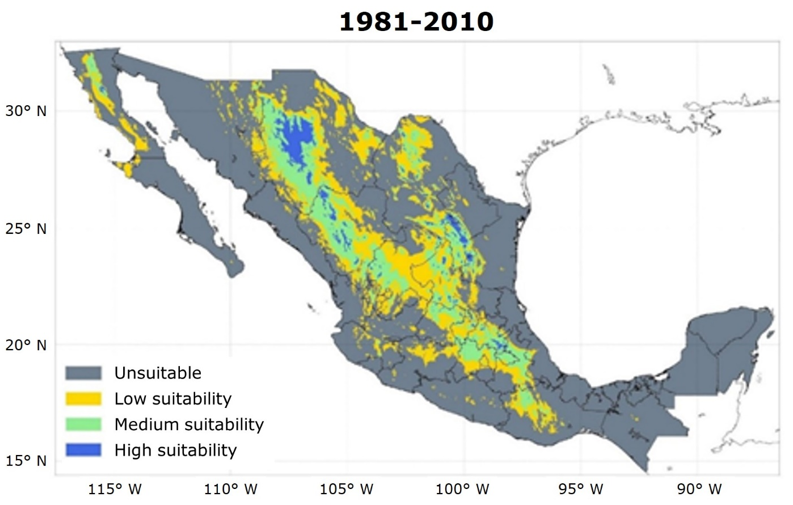
Pinus cembroides is a piñon conifer resistant to dry conditions and is widely distributed in arid and semi-arid areas of Mexico, making it ideal for assessing the impacts of climate change on conifer forests. The impacts of climate change on the potential distribution of Pinus cembroides in Mexico was assessed, considering two climatic scenarios from the Coupled Model Intercomparison Project Phase 6 (CMIP6): SSP2-4.5 (projected increase of 2.1 to 3.5 °C in mean temperature by the end of the twenty-first century) and SSP5-8.5 (projected increase of 3.3 to 5.7 °C). Modeling was based on the maximum entropy algorithm (MaxEnt), using 1 696 records of P. cembroides and 19 bioclimatic variables from CHELSA v2.1. The variables with the highest contributions were the temperature of the driest quarter (60.9 %) and the wettest quarter (28.9 %). Under the current climate conditions, only 6.3 % of mountainous regions in the Sierra Madre Oriental and Sierra Madre Occidental exhibited high suitability. Future changes in distribution were projected using a CMIP6 Multi-Model Ensemble (MME) in four periods: near-term (2021-2040), mid-term (2041-2060), far-term (2061-2080), and end of XXI century (2081-2100). In both scenarios, the potential distribution is projected to contract to ~10 % of its current extent by the end of the 21st century, limited to higher and wetter areas of low to medium suitability in Sierra de Juárez and Sierra Madre Oriental.
Downloads
References
Aguirre-Gutiérrez, J., & Duivenvoorden, J. F. (2010). Can we expect to protect threatened species in protected areas? A case study of the genus Pinus in Mexico. Revista Mexicana de Biodiversidad, 81(3), 875-882. https://doi.org/10.22201/ib.20078706e.2010.003.657 DOI: https://doi.org/10.22201/ib.20078706e.2010.003.657
Aitken, S. N., Yeaman, S., Holliday, J. A., Wang, T., & Curtis-McLane, S. (2008). Adaptation, migration or extirpation: climate change outcomes for tree populations. Evolutionary Applications, 1(1), 95–111. https://doi.org/10.1111/j.1752-4571.2007.00013.x DOI: https://doi.org/10.1111/j.1752-4571.2007.00013.x
Almazroui, M., Islam, M. N., Saeed, F., Saeed, S., Ismail, M., Ehsan, M. A., Diallo, I., O’Brien, E., Ashfaq, M., Martínez-Castro, D., Cavazos, T., Cerezo-Mota, R., Tippett, M. K., Gutowski Jr., W. J., Alfaro, E. J., Hidalgo, H. G., Vichot-Llano, A., Campbell, J. D., Kamil, S., … Barlow, M. (2021). Projected changes in temperature and precipitation over the United States, Central America, and the Caribbean in CMIP6 GCMs. Earth Systems and Environment, 5, 1-24. https://doi.org/10.1007/s41748-021-00199-5 DOI: https://doi.org/10.1007/s41748-021-00199-5
Araújo, M. B., & New, M. (2007). Ensemble forecasting of species distributions. Trends in Ecology & Evolution, 22(1), 42-47. https://doi.org/10.1016/j.tree.2006.09.010 DOI: https://doi.org/10.1016/j.tree.2006.09.010
Bobrowski, M., Weidinger, J., & Schickhoff, U. (2021). Is new always better? Frontiers in global climate datasets for modeling treeline species in the Himalayas. Atmosphere, 12(5), Article 543. https://doi.org/10.3390/atmos12050543 DOI: https://doi.org/10.3390/atmos12050543
Booth, T. H. (2022). Checking bioclimatic variables that combine temperature and precipitation data before their use in species distribution models. Austral Ecology, 47(7), 1506-1514. https://doi.org/10.1111/aec.13234 DOI: https://doi.org/10.1111/aec.13234
Bower, A. D., Frerker, K. L., Pike, C. C., Labonte, N. R., Palik, B. J., Royo, A. A., Anderson, S. M., Ferreira, A. R., & Brandt, L. A. (2024). A practical framework for applied forestry assisted migration. Frontiers in Forests and Global Change, 7, Article 1454329. https://doi.org/10.3389/ffgc.2024.1454329 DOI: https://doi.org/10.3389/ffgc.2024.1454329
Cantú-Garza, A. (2015). Identificación de refugios climáticos utilizando modelos de distribución potencial para el Noreste de México [Tesis de Maestría en Ciencias en Sistemas Ambientales, Instituto Tecnológico y de Estudios Superiores de Monterrey]. ResearchGate. https://www.researchgate.net/publication/328891064_Identificacion_de_refugios_climaticos_utilizando_modelos_de_distribucion_potencial_para_el_Noreste_de_Mexico
Carlón-Allende, T., Mendoza, M. E., Villanueva-Díaz, J., & Li, Y. (2018). Climatic response of Pinus cembroides Zucc. radial growth in Sierra del Cubo, Guanajuato, Mexico. Trees, 32, 1387-1399. https://doi.org/10.1007/s00468-018-1720-1 DOI: https://doi.org/10.1007/s00468-018-1720-1
Cavazos, T., Luna-Niño, R., Cerezo-Mota, R., Fuentes-Franco, R., Méndez, M., Pineda-Martínez, L. F., & Valenzuela, E. (2020). Climatic trends and regional climate models intercomparison over the CORDEX-CAM (Central America, Caribbean, and Mexico) domain. International Journal of Climatology, 40(3), 1396-1420. https://doi.org/10.1002/joc.6276 DOI: https://doi.org/10.1002/joc.6276
Chacón-Prieto, F., Rodríguez-Soto, C., Cuervo-Robayo, A. P., Carbajal-Monroy, J. C., & Alagador, D. (2021). Protected areas in Central Mexico—are they fit in promoting species persistence under climate and land use changes? Biological Conservation, 260, Article 109186. https://doi.org/10.1016/j.biocon.2021.109186 DOI: https://doi.org/10.1016/j.biocon.2021.109186
CHELSA. (2025). CHELSA: Climatologies at high resolution for the earth’s land surface areas [Data sets]. Swiss Federal Institute for Forest, Snow and Landscape Research. https://chelsa-climate.org/
Colorado-Ruiz, G., Cavazos, T., Salinas, J. A., De Grau, P., & Ayala, R. (2018). Climate change projections from Coupled Model Intercomparison Project phase 5 multi-model weighted ensembles for Mexico, the North American monsoon, and the mid-summer drought region. International Journal of Climatology, 38(15), 5699-5716. https://doi.org/10.1002/joc.5773 DOI: https://doi.org/10.1002/joc.5773
Comisión Nacional Forestal. (2018). Inventario Nacional Forestal y de Suelos [Base de datos]. Secretaría de Medio Ambiente y Recursos Naturales. https://snmf.cnf.gob.mx/infys/
Comisión Nacional Forestal. (2020, 16 de enero). Apoyos CONAFOR. Gobierno de México, México. https://www.gob.mx/conafor/acciones-y-programas/apoyos-conafor
Comisión Nacional para el Conocimiento y Uso de la Biodiversidad. (2020). Sistema Nacional de Información sobre Biodiversidad de México [Base de datos]. Comisión Nacional para el Conocimiento y Uso de la Biodiversidad. https://www.snib.mx/
Constante-García, V., Villanueva-Díaz, J., Cerano-Paredes, J., Cornejo-Oviedo, E. H., & Valencia-Manzo, S. (2009). Dendrocronología de Pinus cembroides Zucc. y reconstrucción de precipitación estacional para el sureste de Coahuila. Revista Ciencia Forestal en México, 34(106), 17-39. https://cienciasforestales.inifap.gob.mx/index.php/forestales/article/view/685
Dormann, C. F., Elith, J., Bacher, S., Buchmann, C., Carl, G., Carré, G., García-Marquéz, J. R., Gruber, B., Lafourcade, B., Leitão, P. J., Münkemüller, T., McClean, C., Osborne, P. E., Reineking, B., Schröder, B., Skidmore, A. K., Zurell, D., & Lautenbach, S. (2013). Collinearity: a review of methods to deal with it and a simulation study evaluating their performance. Ecography, 36(1), 27-46. https://doi.org/10.1111/j.1600-0587.2012.07348.x DOI: https://doi.org/10.1111/j.1600-0587.2012.07348.x
Earth System Grid Federation. (2025). Data search results have changed, see News for details ESGF CMIP6 search [Data MetaGrid]. Earth System Grid Federation. https://aims2.llnl.gov/search/cmip6/
Elith, J., Phillips, S. J., Hastie, T., Dudík, M., Chee, Y. E., & Yates, C. J. (2011). A statistical explanation of MaxEnt for ecologists. Diversity and Distributions, 17(1), 43-57. https://doi.org/10.1111/j.1472-4642.2010.00725.x DOI: https://doi.org/10.1111/j.1472-4642.2010.00725.x
Escobar, L. E., Lira-Noriega, A., Medina-Vogel, G., & Townsend-Peterson, A. (2014). Potential for spread of the white-nose fungus (Pseudogymnoascus destructans) in the Americas: use of Maxent and NicheA to assure strict model transference. Geospatial Health, 9(1), 221-229. https://doi.org/10.4081/gh.2014.19 DOI: https://doi.org/10.4081/gh.2014.19
Eyring, V., Bony, S., Meehl, G. A., Senior, C. A., Stevens, B., Stouffer, R. J., & Taylor, K. E. (2016). Overview of the Coupled Model Intercomparison Project Phase 6 (CMIP6) experimental design and organization. Geoscientific Model Development, 9, 1937-1958. https://doi.org/10.5194/gmd-9-1937-2016 DOI: https://doi.org/10.5194/gmd-9-1937-2016
García, E., & Comisión Nacional para el Conocimiento y Uso de la Biodiversidad. (1998). Climas. Catálogo de metadatos geográficos [Conjunto de metadatos]. Comisión Nacional para el Conocimiento y Uso de la Biodiversidad. http://geoportal.conabio.gob.mx/metadatos/doc/html/clima1mgw.html
Geng, W., Li, Y., Sun, D., Li, B., Zhang, P., Chang, H., Rong, T., Liu, Y., Shao, J., Liu, Z., Zhu, H., Lou, Y., Wang, Q., & Zhang, J. (2022). Prediction of the potential geographical distribution of Betula platyphylla Suk. in China under climate change scenarios. PLoS ONE, 17(3), Article e0262540. https://doi.org/10.1371/journal.pone.0262540 DOI: https://doi.org/10.1371/journal.pone.0262540
Gómez-Díaz, J. D., Monterroso-Rivas, A. I., Tinoco-Rueda, J. A., Toledo-Medrano, M. L., Conde-Álvarez, C., & Gay-García, C. (2011). Assessing current and potential patterns of 16 forest species driven by climate change scenarios in Mexico. Atmósfera, 24(1), 31-52. https://www.revistascca.unam.mx/atm/index.php/atm/article/view/23801
Gómez-Pineda, E., Sáenz-Romero, C., Ortega-Rodríguez, J. M., Blanco-García, A., Madrigal-Sánchez, X., Lindig-Cisneros, R., Lopez-Toledo, L., Pedraza-Santos, M. E., & Rehfeldt, G. E. (2020). Suitable climatic habitat changes for Mexican conifers along altitudinal gradients under climatic change scenarios. Ecological Applications, 30(2), Article e02041. https://doi.org/10.1002/eap.2041 DOI: https://doi.org/10.1002/eap.2041
Gutiérrez-García, J. V., Rodríguez-Trejo, D. A., Villanueva-Morales, A., García-Díaz, S., & Romo-Lozano, J. L. (2015). Calidad del agua en la producción de Pinus cembroides Zucc. en vivero. Agrociencia, 49(2), 205-219. https://www.agrociencia-colpos.org/index.php/agrociencia/article/view/1141
Haire, S. L., Villarreal, M. L., Cortés-Montaño, C., Flesch, A. D., Iniguez, J. M., Romo-Leon, J. R., & Sanderlin, J. S. (2022). Climate refugia for Pinus spp. in topographic and bioclimatic environments of the Madrean sky islands of México and the United States. Plant Ecology, 223, 577-598. https://doi.org/10.1007/s11258-022-01233-w DOI: https://doi.org/10.1007/s11258-022-01233-w
Hansen, A. J., & Phillips, L. B. (2015). Which tree species and biome types are most vulnerable to climate change in the US Northern Rocky Mountains? Forest Ecology and Management, 338, 68-83. http://dx.doi.org/10.1016/j.foreco.2014.11.008 DOI: https://doi.org/10.1016/j.foreco.2014.11.008
Harris, I., Jones, P. D., Osborn, T. J., & Lister, D. H. (2014). Updated high-resolution grids of monthly climatic observations–the CRU TS3.10 Dataset. International Journal of Climatology, 34(3), 623-642. https://doi.org/10.1002/joc.3711 DOI: https://doi.org/10.1002/joc.3711
Intergovernmental Panel on Climate Change. (2023a). SPM - Summary for policymakers. In V. Masson-Delmotte, P. Zhai, A. Pirani, S. L. Connors, C. Péan, Y. Chen, L. Goldfarb, M. I. Gomis, J. B. R. Matthews, S. Berger, M. Huang, O. Yelekçi, R. Yu, B. Zhou, E. Lonnoy, T. K. Maycock, T. Waterfield, K. Leitzell, & N. Caud, (Eds.), Climate Change 2021 - The physical science basis. Working Group I Contribution to the Sixth Assessment Report of the Intergovernmental Panel on Climate Change (pp. 3–32). Cambridge University Press. https://doi.org/10.1017/9781009157896.001 DOI: https://doi.org/10.1017/9781009157896.001
Intergovernmental Panel on Climate Change. (2023b). Climate Change 2023. Synthesis Report (H. Lee & J. Romero, Eds.). Intergovernmental Panel on Climate Change. https://www.ipcc.ch/report/ar6/syr/downloads/report/IPCC_AR6_SYR_FullVolume.pdf
Karger, D. N., Conrad, O., Böhner, J., Kawohl, T., Kreft, H., Soria-Auza, R. W., Zimmermann, N. E., Linder, H. P., & Kessler, M. (2017). Climatologies at high resolution for the earth’s land surface areas. Scientific Data, 4, Article 170122. https://doi.org/10.1038/sdata.2017.122 DOI: https://doi.org/10.1038/sdata.2017.122
Karger, D. N., Chauvier, Y., & Zimmermann, N. E. (2023). chelsa-cmip6 1.0: a python package to create high resolution bioclimatic variables based on CHELSA ver. 2.1 and CMIP6 data. Ecography, 2023(6), Article e06535. https://doi.org/10.1111/ecog.06535 DOI: https://doi.org/10.1111/ecog.06535
Klisz, M., Chakraborty, D., Cvjetković, B., Grabner, M., Lintunen, A., Mayer, K., George, J.-P., & Rossi, S. (2023). Functional traits of boreal species and adaptation to local conditions. In M. Montoro-Girona, H. Morin, S. Gauthier & Y. Bergeron (Eds.), Boreal forests in the face of climate change. Sustainable Management (pp. 323-355). Springer Cham. https://doi.org/10.1007/978-3-031-15988-6_12 DOI: https://doi.org/10.1007/978-3-031-15988-6_12
Knutti, R., Sedláček, J., Sanderson, B. M., Lorenz, R., Fischer, E. M., & Eyring, V. (2017). A climate model projection weighting scheme accounting for performance and interdependence. Geophysical Research Letters, 44(4), 1909-1918. https://doi.org/10.1002/2016GL072012 DOI: https://doi.org/10.1002/2016GL072012
Manzanilla-Quijada, G. E., & Treviño-Garza, E. J. (2024). Posibles efectos del cambio climático en la distribución potencial de especies arbóreas de bosque templado en Nuevo León, México. Ecosistemas y Recursos Agropecuarios, 11(3), Artículo e4189. https://doi.org/10.19136/era.a11n3.4189 DOI: https://doi.org/10.19136/era.a11n3.4189
Manzanilla-Quiñones, U., Aguirre-Calderón, Ó. A., Jiménez-Pérez, J., Treviño-Garza, E. J., & Yerena-Yamallel, J. I. (2019). Distribución actual y futura del bosque subalpino de Pinus hartwegii Lindl en el Eje Neovolcánico Transversal. Madera y Bosques, 25(2), Artículo e2521804. https://doi.org/10.21829/myb.2019.2521804 DOI: https://doi.org/10.21829/myb.2019.2521804
Martínez-Sánchez, J. N., Cuéllar-Rodríguez, L. G., Yerena-Yamallel, J. I., Cavazos, M. T., & Gárate-Escamilla, H. A. (2023). Comparación de bases de datos climáticos en la modelación de distribución potencial de Pinus cembroides Zucc. Revista Mexicana de Ciencias Forestales, 14(79), 135-158. https://doi.org/10.29298/rmcf.v14i79.1350 DOI: https://doi.org/10.29298/rmcf.v14i79.1350
Martínez-Sifuentes, A. R., Villanueva-Díaz, J., Manzanilla-Quiñones, U., Becerra-López, J. L., Hernández-Herrera, J. A., Estrada-Ávalos, J., & Velázquez-Pérez, A. H. (2020). Spatial modeling of the ecological niche of Pinus greggi Engelm. (Pinaceae): a species conservation proposal in Mexico under climatic change scenarios. iForest, 13(5), 426–434. https://doi.org/10.3832/ifor3491-013 DOI: https://doi.org/10.3832/ifor3491-013
Mawdsley, J. R., O’Malley, R., & Ojima, D. S. (2009). A review of climate-change adaptation strategies for wildlife management and biodiversity conservation. Conservation Biology, 23(5), 1080-1089. https://doi.org/10.1111/j.1523-1739.2009.01264.x DOI: https://doi.org/10.1111/j.1523-1739.2009.01264.x
Merow, C., Smith, M. J., & Silander Jr., J. A. (2013). A practical guide to MaxEnt for modeling species' distributions: What it does, and why inputs and settings matter. Ecography, 36(10), 1058-1069. https://doi.org/10.1111/j.1600-0587.2013.07872.x DOI: https://doi.org/10.1111/j.1600-0587.2013.07872.x
O’Neill, B. C., Tebaldi, C., van Vuuren, D. P., Eyring, V., Friedlingstein, P., Hurtt, G., Knutti, R., Kriegler, E., Lamarque, J.-F., Lowe, J., Meehl, G. A., Moss, R., Riahi, K., & Sanderson, B. M. (2016). The Scenario Model Intercomparison Project (ScenarioMIP) for CMIP6. Geoscientific Model Development, 9, 3461-3482. https://doi.org/10.5194/gmd-9-3461-2016 DOI: https://doi.org/10.5194/gmd-9-3461-2016
Palik, B. J., Clark, P. W., D’Amato, A. W., Swanston, C., & Nagel, L. (2022). Operationalizing forest-assisted migration in the context of climate change adaptation: Examples from the eastern USA. Ecosphere, 13(10), Article e4260. https://doi.org/10.1002/ecs2.4260 DOI: https://doi.org/10.1002/ecs2.4260
Pearson, R. G., Raxworthy, C. J., Nakamura, M., & Peterson, A. T. (2007). Predicting species distributions from small numbers of occurrence records: A test case using cryptic geckos in Madagascar. Journal of Biogeography, 34(1), 102-117. https://doi.org/10.1111/j.1365-2699.2006.01594.x DOI: https://doi.org/10.1111/j.1365-2699.2006.01594.x
Phillips, S. J., & Dudík, M. (2008). Modeling of species distributions with MaxEnt: new extensions and a comprehensive evaluation. Ecography, 31(2), 161-175. https://doi.org/10.1111/j.0906-7590.2008.5203.x DOI: https://doi.org/10.1111/j.0906-7590.2008.5203.x
Phillips, S. J., Anderson, R. P., & Schapire, R. E. (2006). Maximum entropy modeling of species geographic distributions. Ecological Modelling, 190(3-4), 231-259. https://doi.org/10.1016/j.ecolmodel.2005.03.026 DOI: https://doi.org/10.1016/j.ecolmodel.2005.03.026
QGIS. (2020). QGIS Geographic Information System (Version 3.16.0) [Computer software]. QGIS Association. https://qgis.org
Romero-Sánchez, M. E., González-Hernández, A., Pérez-Miranda, R., Velasco-Bautista, E., & Moreno-Sánchez, F. (2017). Efecto del cambio climático a nivel local en la distribución potencial de cuatro especies forestales de la cuenca Río Bravo-San Juan, Coahuila, México. Agroproductividad, 10(8), 42-47. https://revista-agroproductividad.org/index.php/agroproductividad/article/view/1073
Sáenz-Romero, C., Lamy, J.-B., Ducousso, A., Musch, B., Ehrenmann, F., Delzon, S., Cavers, S., Chałupka, W., Dağdaş, S., Hansen, J. K., Lee, S. J., Liesebach, M., Rau, H.-M., Psomas, A., Schneck, V., Steiner, W., Zimmermann, N. E., & Kremer, A. (2017). Adaptive and plastic responses of Quercus petraea populations to climate across Europe. Global Change Biology, 23(7), 2831-2847. https://doi.org/10.1111/gcb.13576 DOI: https://doi.org/10.1111/gcb.13576
Sáenz-Romero, C., Rehfeldt, G. E., Ortega-Rodríguez, J. M., Marín-Togo, M. C., & Madrigal-Sánchez, X. (2015). Pinus leiophylla suitable habitat for 1961–1990 and future climate. Botanical Sciences, 93(4), 709-718. http://dx.doi.org/10.17129/botsci.86 DOI: https://doi.org/10.17129/botsci.86
Soberón, J., & Peterson, A. T. (2005). Interpretation of models of fundamental ecological niches and species’ distributional areas. Biodiversity Informatics, 2, 1-10. https://doi.org/10.17161/bi.v2i0.4 DOI: https://doi.org/10.17161/bi.v2i0.4
Stewart, S. B., Fedrigo, M., Kasel, S., Roxburgh, S. H., Choden, K., Tenzin, K., Allen, K., & Nitschke, C. R. (2022). Predicting plant species distributions using climate-based model ensembles with corresponding measures of congruence and uncertainty. Diversity and Distributions, 28(5), 1105-1122. https://doi.org/10.1111/ddi.13515 DOI: https://doi.org/10.1111/ddi.13515
Téllez-Valdés, O., Miguel-Talonia, C., Suárez-Mota, M. E., Álvarez-Espino, R. X., & Hernández-Moreno, M. M. (2019). Distribución potencial de las especies Pinaceae (Pinus) y Fagaceae (Quercus) de México [Informe final SNIB-CONABIO proyecto JM010]. Facultad de Estudios Superiores Iztacala, Universidad Nacional Autónoma de México. http://www.conabio.gob.mx/institucion/proyectos/resultados/InfJM010.pdf
Thuiller, W., Guéguen, M., Renaud, J., Karger, D. N., & Zimmerman, N. E. (2019). Uncertainty in ensembles of global biodiversity scenarios. Nature Communications, 10, Article 1446. https://doi.org/10.1038/s41467-019-09519-w DOI: https://doi.org/10.1038/s41467-019-09519-w
Trenberth, K. E. (2011). Changes in precipitation with climate change. Climate Research, 47, 123-318. http://dx.doi.org/10.3354/cr00953 DOI: https://doi.org/10.3354/cr00953
Zhong, X., Zhang, L., Zhang, J., He, L., & Sun, R. (2023). Maxent modeling for predicting the potential geographical distribution of Castanopsis carlesii under various climate change scenarios in China. Forests, 14(7), Article 1397. https://doi.org/10.3390/f14071397 DOI: https://doi.org/10.3390/f14071397
Published
How to Cite
Issue
Section
License
Copyright (c) 2026 Revista Mexicana de Ciencias Forestales

This work is licensed under a Creative Commons Attribution-NonCommercial 4.0 International License.
The authors who publish in Revista Mexicana de Ciencias Forestales accept the following conditions:
In accordance with copyright laws, Revista Mexicana de Ciencias Forestales recognizes and respects the authors’ moral right and ownership of property rights which will be transferred to the journal for dissemination in open access.
All the texts published by Revista Mexicana de Ciencias Forestales –with no exception– are distributed under a Creative Commons License Attribution-NonCommercial 4.0 International (CC BY-NC 4.0), which allows third parties to use the publication as long as the work’s authorship and its first publication in this journal are mentioned
The author(s) can enter into independent and additional contractual agreements for the nonexclusive distribution of the version of the article published in Revista Mexicana de Ciencias Forestales (for example, include it into an institutional repository or publish it in a book) as long as it is clearly and explicitly indicated that the work was published for the first time in Revista Mexicana de Ciencias Forestales.
For all the above, the authors shall send the form of Letter-transfer of Property Rights for the first publication duly filled in and signed by the author(s). This form must be sent as a PDF file to: ciencia.forestal2@inifap.gob.mx
This work is licensed under a Creative Commons Attribution-Noncommercial 4.0 International license.