Stem volume models for Cordia alliodora (Ruiz & Pav.) Oken in an altitudinal gradient of Veracruz
DOI:
https://doi.org/10.29298/rmcf.v17i93.1568Keywords:
Agroforestry, self-pruning, from factor, Takata, Tezonapa, ZongolicaAbstract
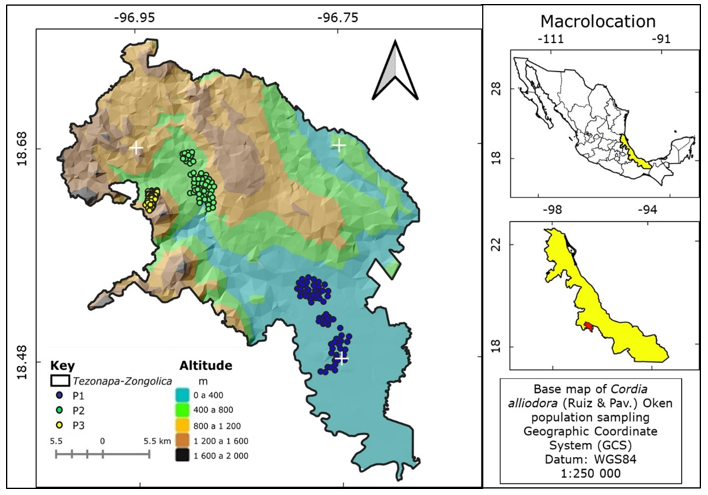
Coffee agroforestry systems (CAFS) are associated with various timber species of high economic importance requiring quantitative tools to reliably estimate their volume for commercialization. The objective was to compare the form factor (ff) and develop stem volume equations for Cordia alliodora under CAFS across an altitudinal gradient in central Veracruz. In a non-destructive sampling, diameter-height data were obtained from 220 trees located in populations at three altitude intervals: (P1) lower (60 to 150 m), (P2) intermediate (405 to 750 m), and (P3) higher (950 to 1 150 m). Eight allometric stem volume models were fitted; the best one was selected based on a rating system using six goodness-of-fit statistics. An additionality test on the intercepts and slopes of the weighted Spurr model determined that the stem volumes of the three populations can be modeled together. The ff was 0.51, 0.52, and 0.53 for populations P1, P2, and P3, respectively; therefore, it can be inferred that the evaluated stems are geometrically similar to the paraboloid. This behavior is attributed to the ability to self-prune. The model with the best fit was Takata's (Vf=Dn2Ht/20 660.335+95.767Dn) , which was corrected for heteroscedasticity with a potency structure for the variance of the residuals as a weighting factor, accounting for 95.7 % of the variability in the observed stem volume.
Downloads
References
Andrade, H. J., Segura, M. A., & Suárez, J. C. (2023). Growth and carbon sequestration in biomass of Cordia alliodora in Andean agroforestry systems with coffee. Agroforestry Systems, 97, 1435-1446. https://doi.org/10.1007/s10457-023-00868-6 DOI: https://doi.org/10.1007/s10457-023-00868-6
Aquino-Ramírez, M., Tlaxcala-Méndez, R. M., Maya-Martínez, A., Medina-Hernández, R. G., & Ríos-Saucedo, J. C. (2023). Modelos de volumen fustal para Inga punctata en un sistema agroforestal. Agrofaz–Journal of Environmental and Agroecological Sciences, 5, 51-58. https://agrofaz.net/index.php/agrofaz/issue/view/11/9.fustal%20para%20Inga%20punctata
Farfán, V. F. (2014). Agroforestería y Sistemas Agroforestales con Café. Centro Nacional de Investigaciones de Café. https://www.researchgate.net/publication/394660030_Agroforesteria_y_sistemas_agroforestales_con_cafe
Garate-Quispe, J. S., & Florez-Castillo, L. (2023). Coeficiente mórfico de Apuleia leiocarpa (Vogel) J. F. Macbr. por tipo de bosque, Amazonía peruana. Revista Mexicana de Ciencias Forestales, 14(78), 4-33. https://doi.org/10.29298/rmcf.v14i78.1336 DOI: https://doi.org/10.29298/rmcf.v14i78.1336
García-Mayoral, L. E., Valdez-Hernández, J. I., Luna-Cavazos, M., & López Morgado, R. (2015). Estructura y diversidad arbórea en sistemas agroforestales de café en la Sierra de Atoyac, Veracruz. Madera y Bosques, 21(3), 69-82. https://doi.org/10.21829/myb.2015.213457 DOI: https://doi.org/10.21829/myb.2015.213457
González-Luna, H. M., & Cruz-Castillo, J. B. (2021). Anatomía y propiedades físicas de dos especies forestales comerciales Cedro (Cedrela odorata L.) y Laurel (Cordia alliodora (Ruiz & Pav.) Oken) en Nicaragua. La Calera, 21(37), 81-86. https://doi.org/10.5377/calera.v21i37.12532 DOI: https://doi.org/10.5377/calera.v21i37.12532
Gujarati, D. N., & Porter, D. C. (2010). Econometría (5ta ed.). McGrawHill. https://gc.scalahed.com/recursos/files/r161r/w25589w/(2010)Econometria.pdf
Hernández-Ramos, J., De los Santos-Posadas, H. M., Valdéz-Lazalde, J. R., Tamarit-Urias, J. C., Ángeles-Pérez, G., Hernández-Ramos, A., Méndez-López, B., & Peduzzi, A. (2017). Estimación del volumen comercial en plantaciones de Eucalyptus urophylla con modelos de volumen total y de razón. Agrociencia, 51(5), 561-580. https://agrociencia-colpos.org/index.php/agrociencia/article/view/1311
Hernández-Ramos, J., García-Cuevas, X., Hernández-Ramos, A., Tamarit-Urias, J. C., & Buendía-Rodríguez, E. (2021). Modelos para estimar volumen fustal y ahusamiento para Manilkara zapota (L.) P. Royen en Quintana Roo, México. Acta Universitaria, 31, Artículo e3067. https://doi.org/10.15174/au.2021.3067 DOI: https://doi.org/10.15174/au.2021.3067
Hernández-Ramos, J., Hernández-Ramos, A., García-Cuevas, X., Tamarit-Urias, J. C., Martínez-Ángel, L., & García-Magaña, J. (2018). Ecuaciones de volumen total y de razón para estimar el volumen comercial de Swietenia macrophylla King. Colombia Forestal, 21(1), 34-46. https://doi.org/10.14483/2256201X.11965 DOI: https://doi.org/10.14483/2256201X.11965
Instituto Nacional de Estadística, Geografía e Informática. (2010a). Compendio de información geográfica municipal 2010. Tezonapa. Veracruz de Ignacio de la Llave. Instituto Nacional de Estadística, Geografía e Informática. https://www.inegi.org.mx/contenidos/app/mexicocifras/datos_geograficos/30/30173.pdf
Instituto Nacional de Estadística, Geografía e Informática. (2010b). Compendio de información geográfica municipal 2010. Zongolica, Veracruz de Ignacio de la Llave. Instituto Nacional de Estadística, Geografía e Informática. https://www.inegi.org.mx/contenidos/app/mexicocifras/datos_geograficos/30/30201.pdf
Mäkinen, H., Verkasalo, E., & Tuimala, A. (2014). Effects of pruning in Norway spruce on tree growth and grading of sawn boards in Finland. Forestry, 87(3), 417-424. https://doi.org/10.1093/forestry/cpt062 DOI: https://doi.org/10.1093/forestry/cpt062
Pereira-Miguel, E., Noce-Cerdeira, A. L., Brito-de Azevedo, G., de Oliveira Sousa-Azevedo, G. T., Angelo, H., Pereira, R. S., & Rezende, A. V. (2015). Compatibility between wood volume estimation methods in a eucalyptus stand. Australian Journal of Basic and Applied Sciences, 9(35), 371−376. http://www.ajbasweb.com/old/ajbas/2015/November/371-376.pdf
Picard, N., Saint-André, L., & Henry, M. (2012). Manual de construcción de ecuaciones alométricas para estimar el volumen y la biomasa de los árboles. Del trabajo de campo a la predicción. Centre de Coopération Internationale en Recherche Agronomique pour le Développement y Organización de las Naciones Unidas para la Alimentación y la Agricultura. https://www.fao.org/4/i3058s/i3058s.pdf
Quiñonez-Barraza, G., De los Santos-Posadas, H. M., Álvarez-González, J. G., & Velázquez-Martínez, A. (2014). Sistema compatible de ahusamiento y volumen comercial para las principales especies de Pinus en Durango, México. Agrociencia, 48(5), 553-567. https://agrociencia-colpos.org/index.php/agrociencia/article/view/1102
Ramírez-Martínez, A., Santiago-García, W., Quiñonez-Barraza, G., Ruiz-Aquino, F., & Martínez-Antúnez, P. (2016). Modelos de volumen fustal para Pinus ayacahuite Ehren. Revista Mexicana de Agroecosistemas, 3(2), 61-74. https://revistaremaeitvo.mx/index.php/remae/issue/view/25/23
Ramírez-Vargas, M. R., De los Santos-Posadas, H. M., Valdez-Lazalde, J. R., Reyes-Hernández, V. J., & Ayala-Sosa, J. C. (2024). Does resin tapping affect the tapering and accumulation of merchantable timber volume in pine trees? Agrociencia, 58(7), 853-868. https://doi.org/10.47163/agrociencia.v58i7.2964 DOI: https://doi.org/10.47163/agrociencia.v58i7.2964
Reyes-Cortés, L. M., Vargas-Hernández, J. J., Aldrete, A., & Honorato-Salazar, J. A. (2020). Crecimiento radial y conicidad del fuste en plantaciones con aclareo de Pinus patula Schiede ex Schlechtendal & Chamisso. Revista Fitotecnia Mexicana, 43(2), 205-214. https://doi.org/10.35196/rfm.2020.2.205 DOI: https://doi.org/10.35196/rfm.2020.2.205
SAS Institute Inc. (2025). SAS OnDemand for Academics [Software]. SAS Institute Inc. https://welcome.oda.sas.com/
Somarriba, E. J., & Beer, J. W. (1987). Dimensions, volumes and growth of Cordia alliodora in agroforestry systems. Forest Ecology and Management, 18(2), 113-126. https://doi.org/10.1016/0378-1127(87)90138-1 DOI: https://doi.org/10.1016/0378-1127(87)90138-1
Spurr, S. H. (1952). Forest Inventory. The Ronald Press Company. https://books.google.com.mx/books/about/Forest_Inventory.html?id=zNssAQAAMAAJ&redir_esc=y
Telles-Antonio, R., Gómez-Cárdenas, M., Alanís-Rodríguez, E., Aguirre-Calderón, O. A., & Jiménez-Pérez, J. (2018). Ajuste y selección de modelos matemáticos para predecir el volumen fustal de Tectona grandis L. f. en Nuevo Urecho, Michoacán, México. Madera y Bosques, 24(3), Artículo e2431544. https://doi.org/10.21829/myb.2018.2431544 DOI: https://doi.org/10.21829/myb.2018.2431544
Tlaxcala-Méndez, R. M., De los Santos-Posadas, H. M., Hernández-de la Rosa, P., & López-Ayala, J. L. (2016). Variación del factor de forma y el ahusamiento en procedencias de cedro rojo (Cedrela odorata L.). Agrociencia, 50(1), 89-105. https://www.scielo.org.mx/pdf/agro/v50n1/1405-3195-agro-50-01-89-en.pdf
Torres-Ávila, D., De los Santos-Posadas, H. M., Velázquez-Martínez, A., & Tamarit-Urias, J. C. (2020). Ahusamiento y volumen comercial de tres procedencias de pinos tropicales en plantaciones forestales de Veracruz, México. Madera y Bosques, 26(3), Artículo e263189. https://doi.org/10.21829/myb.2020.2631890 DOI: https://doi.org/10.21829/myb.2020.2631890
West, P. W. (2009). Tree and forest measurement (2nd ed). Springer Verlag. https://link.springer.com/book/10.1007/978-3-540-95966-3
Published
How to Cite
Issue
Section
License
Copyright (c) 2026 Revista Mexicana de Ciencias Forestales

This work is licensed under a Creative Commons Attribution-NonCommercial 4.0 International License.
The authors who publish in Revista Mexicana de Ciencias Forestales accept the following conditions:
In accordance with copyright laws, Revista Mexicana de Ciencias Forestales recognizes and respects the authors’ moral right and ownership of property rights which will be transferred to the journal for dissemination in open access.
All the texts published by Revista Mexicana de Ciencias Forestales –with no exception– are distributed under a Creative Commons License Attribution-NonCommercial 4.0 International (CC BY-NC 4.0), which allows third parties to use the publication as long as the work’s authorship and its first publication in this journal are mentioned
The author(s) can enter into independent and additional contractual agreements for the nonexclusive distribution of the version of the article published in Revista Mexicana de Ciencias Forestales (for example, include it into an institutional repository or publish it in a book) as long as it is clearly and explicitly indicated that the work was published for the first time in Revista Mexicana de Ciencias Forestales.
For all the above, the authors shall send the form of Letter-transfer of Property Rights for the first publication duly filled in and signed by the author(s). This form must be sent as a PDF file to: ciencia.forestal2@inifap.gob.mx
This work is licensed under a Creative Commons Attribution-Noncommercial 4.0 International license.