Ecosystem services and indicators for temperate forests in Mexico
DOI:
https://doi.org/10.29298/rmcf.v17i96.1672Keywords:
bibliometric analysis, carbon sequestration, environmental accounting, temperature ecosystem, indicators, VOSviewerAbstract
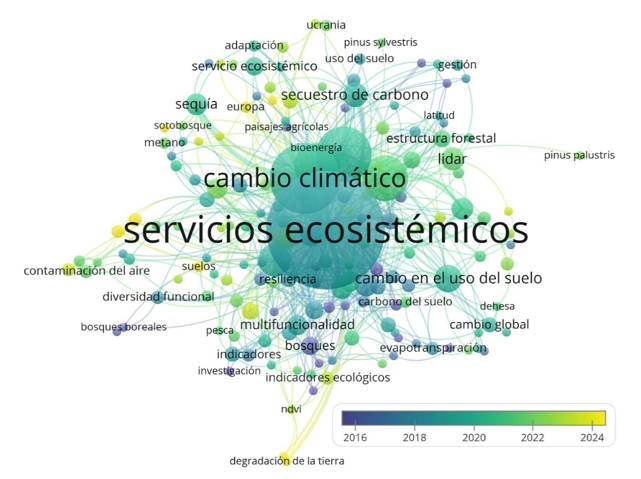
Ecosystem services (ES) are the direct and indirect contributions of nature to the well-being of society. Their measurement requires indicators for sustainable forest management. The objective was to develop a set of indicators and metrics to assess ES in the temperate forests of Mexico. A systematic review (1990-2025) was conducted, following the Prisma standard (Preferred Reporting Items for Systematic Reviews and Meta-Analyses), analyzing a final corpus of 1274 publications (669 global and 605 national). Bibliometric analysis, using the Rayyan and VOSviewer platforms, showed that research on supporting, regulating, and provisioning ES dominates at the national level (48.6 %, 37.3 %, and 12.4 %, respectively): biodiversity, carbon storage and sequestration, water flows, disturbances, timber, and biomass; while cultural ES are underrepresented (1.7 %). Through multi-criteria evaluation and a Delphi panel of 20 experts (95 % global consensus), an operational framework aligned with CICES (Common International Classification of Ecosystem Services) V5.2 was developed, comprising four categories, 19 types of ES, and 43 indicators (25 provision, 10 regulatory, 5 cultural, and 3 supporting). The results highlight the need to employ biophysical metrics validated in situ, capable of reflecting the multifunctionality of the ecosystem. The proposed set of ES, indicators, and metrics will serve as an operational tool to guide decision-making and facilitate the inclusion of ES in global environmental accounting frameworks.
Downloads
References
Baskent, E. Z., & Yılmaz, Ü. S. (2026). Quantifying and integrating ecosystem services in forest management planning. Ecosystem Services, 77, Article 101809. https://doi.org/10.1016/j.ecoser.2025.101809 DOI: https://doi.org/10.1016/j.ecoser.2025.101809
Chen, H. (2025). How to assess realized ecosystem services: Indicators, challenges in determining actual use, and suggestions. Ecosystem Services, 76, Article 101796. https://doi.org/10.1016/j.ecoser.2025.101796 DOI: https://doi.org/10.1016/j.ecoser.2025.101796
Costanza, R. (2008). Ecosystem services : Multiple classification systems are needed. Biological Conservation, 141(2), 350-352. https://doi.org/10.1016/j.biocon.2007.12.020 DOI: https://doi.org/10.1016/j.biocon.2007.12.014
Dee, L. E., Miller, S. J., Helmstedt, K. J., Boersma, K. S., Polasky, S., & Reich, P. B. (2025). Quantifying disturbance effects on ecosystem services in a changing climate. Nature Ecology & Evolution, 9(3), 436-447. https://doi.org/10.1038/s41559-024-02626-y DOI: https://doi.org/10.1038/s41559-024-02626-y
Galicia, L., & Zarco-Arista, A. E. (2014). Multiple ecosystem services, possible trade-offs and synergies in a temperate forest ecosystem in Mexico: a review. International Journal of Biodiversity Science, Ecosystem Services & Management, 10(4), 275-288. https://doi.org/10.1080/21513732.2014.973907 DOI: https://doi.org/10.1080/21513732.2014.973907
Gómez-Baggethun, E., de Groot, R., Lomas, P. L., & Montes, C. (2010). The history of ecosystem services in economic theory and practice: From early notions to markets and payment schemes. Ecological Economics, 69(6), 1209-1218. https://doi.org/10.1016/j.ecolecon.2009.11.007 DOI: https://doi.org/10.1016/j.ecolecon.2009.11.007
Gough, D., Oliver, S., & Thomas, J. (2013). Learing from research: systematic reviews for informing policy decisions. A quick guide. Alliance for Useful Evidence. https://www.betterevaluation.org/sites/default/files/2022-12/systematic%20review%20for%20informing%20policy%20decisions.pdf
Haines-Young, R. (2023). Common International Classification of Ecosystem Services (CICES) V5.2 Guidance on the Application of the Revised Structure. Fabis consulting. https://cices.eu/content/uploads/sites/8/2023/08/CICES_V5.2_Guidance_24072023.pdf
Haines-Young, R., & Potschin, M. (2016). The Cascade Model. In M. Potschin & K. Jax (Eds.), OpenNESS Ecosystem Services Reference Book [EC FP7 Grant Agreement no. 308428]. Intergovernmental Science-Policy Platform on Biodiversity and Ecosystem Services. https://www.ipbes.net/policy-support/tools-instruments/ecosystem-services-reference-book
Hinsch, M., Zulian, G., Stekker, S., Rega, C., Nabuurs, G.-J., Verweij, P., & Burkhard, B. (2024). Assessing pollinator habitat suitability considering ecosystem condition in the Hannover Region, Germany. Landscape Ecology, 39, Article 47. https://doi.org/10.1007/s10980-024-01851-x DOI: https://doi.org/10.1007/s10980-024-01851-x
Hsu, C.-C., & Sandford, B. A. (2007). The Delphi technique: making sense of consensus. Practical Assessment, Research, and Evaluation, 12(10), Article 10. https://doi.org/10.7275/pdz9-th90 DOI: https://doi.org/10.7748/paed.19.7.10.s18
Ioan, S., Roseo, F., & Brambilla, M. (2025). Mountain ecosystem services under a changing climate: A global perspective. Ecosystem Services, 73, Article 101732. https://doi.org/10.1016/j.ecoser.2025.101732 DOI: https://doi.org/10.1016/j.ecoser.2025.101732
Izquierdo-Tort, S., Alatorre, A., Shapiro-Garza, E., Corbera, E., Deschamps-Lomelí, J., Ávila-Foucat, V. S., Carabias, J., Dupras, J., Kolinjivadi, V., Nuñez, J. M., Perevochtchikova, M., Sims, K., & Van Hecken, G. (2025). Payments for ecosystem services in Mexico: Two decades of progress and challenges between research and practice. Ecosystem Services, 73, Article 101720. https://doi.org/10.1016/j.ecoser.2025.101720 DOI: https://doi.org/10.1016/j.ecoser.2025.101720
Kokkoris, I. P., Smets, B., Hein, L., Mallinis, G., Buchhorn, M., Balbi, S., Černecký, J., Paganini, M., & Dimopoulos, P. (2024). The role of Earth observation in ecosystem accounting: A review of advances, challenges and future directions. Ecosystem Services, 70, Article 101659. https://doi.org/10.1016/j.ecoser.2024.101659 DOI: https://doi.org/10.1016/j.ecoser.2024.101659
Kumar, P. (2010). The economics of ecosystems and biodiversity : ecological and economic foundations. In J. Gowdy, R. B. Howarth & C. Tisdell (Eds.), Discounting, ethics, and options for maintaining biodiversity and ecosystem integrity (Working Papers in Economics Number 1008, pp. 2-42). Rensselaer Polytechnic Institute. https://www.researchgate.net/publication/241766886_The_Economics_of_Ecosystems_and_Biodiversity_Ecological_and_Economic_Foundations
Leveau, L., Biot, N., Lobet, G., & Bertin, P. (2025). A collection of field-based indicators for assessing ecosystem services in crop fields. One Ecosystem, 10, Article e151491. https://doi.org/10.3897/oneeco.10.e151491 DOI: https://doi.org/10.3897/oneeco.10.e151491
Liu, L., Wang, W. J., Bao, S. G., Ba, S., Wang, L., Cong, Y., Wu, H., & He, H. S. (2026). Land use and landscape pattern changes dominated ecosystem service trade-offs and synergies in a temperate mountain region. Forest Ecosystems, 15, Article 100427. https://doi.org/10.1016/j.fecs.2026.100427 DOI: https://doi.org/10.1016/j.fecs.2026.100427
Mandal, A., Das, A., & Das, M. (2026). Climate change and ecosystem services: bridging science, policy, and community insights in Himalayan mountain ecosystem. Environmental Development, 58, Article 101428. https://doi.org/10.1016/j.envdev.2025.101428 DOI: https://doi.org/10.1016/j.envdev.2025.101428
Mathieu, A., Martin-Guay, M.-O., & Rivest, D. (2025). Enhancement of agroecosystem multifunctionality by agroforestry: A global quantitative summary. Global Change Biology, 31(5), Article e70234. https://doi.org/10.1111/gcb.70234 DOI: https://doi.org/10.1111/gcb.70234
Millennium Ecosystem Assessment (Ed.). (2005). Ecosystems and human well-being. Synthesis. Island Press. https://www.millenniumassessment.org/documents/document.356.aspx.pdf
Moreno-Meynard, P. (2026). Monitoring ecosystem functions in mountain catchments of chilean patagonia: A cluster-based dataset. Data in Brief, 65, Article 112481. https://doi.org/10.1016/j.dib.2026.112481 DOI: https://doi.org/10.1016/j.dib.2026.112481
Nahuelhual, L., Laterra, P., & Barrena, J. (2016). Indicadores de servicios ecosistémicos. Una revisión y análisis d su calidad. Ministerio del Medio Ambiente, Gobierno de Chile.https://doi.org/10.13140/RG.2.2.26830.46403
Okoli, C., & Pawlowski, S. D. (2004). The Delphi method as a research tool: an example, design considerations and applications. Information & Management, 42(1), 15-29. https://doi.org/10.1016/J.IM.2003.11.002 DOI: https://doi.org/10.1016/j.im.2003.11.002
Ouzzani, M., Hammady, H., Fedorowicz, Z., & Elmagarmid, A. (2016). Rayyan—a web and mobile app for systematic reviews. Systematic Reviews, 5, Article 210. https://doi.org/10.1186/s13643-016-0384-4 DOI: https://doi.org/10.1186/s13643-016-0384-4
Page, M. J., McKenzie, J. E., Bossuyt, P. M., Boutron, I., Hoffmann, T. C., Mulrow, C. D., Shamseer, L., Tetzlaff, J. M., & Moher, D. (2021). Updating guidance for reporting systematic reviews: development of the PRISMA 2020 statement. Journal of Clinical Epidemiology, 134, 103-112. https://doi.org/10.1016/j.jclinepi.2021.02.003 DOI: https://doi.org/10.1016/j.jclinepi.2021.02.003
Pereira, P., Inacio, M., Bogunovic, I., Francos, M., Barceló, D., & Zhao, W. (2022). Ecosystem services in mountain environments: benefits and threats. Pirineos. Revista de Ecología de Montaña, 177, Article e068. https://doi.org/10.3989/pirineos.2022.177001 DOI: https://doi.org/10.3989/pirineos.2022.177001
Seguin, J., Nicholson-Thomas, I., Rendón, P., Cortinovis, C., Arany, I., Czúcz, B., Duchková, H., Geneletti, D., Grondard, N., Guisado-Goñi, V., Inácio, M., Kato-Huerta, J., Kokkoris, I. P., Le Clec'h, S., Lupa, P., Mansoldo, M. D. C., Pereira, P., Ribeiro, D., Šmid-Hribar, M., ... Lange, S. (2026). Towards Integrated Ecosystem Assessments: A literature review on linking ecosystem condition indicators to ecosystem services. One Ecosystem, 11, Article e184299. https://doi.org/10.3897/oneeco.11.e184299 DOI: https://doi.org/10.3897/oneeco.11.e184299
van Eck, N. J., & Waltman, L. (2010). Software survey: VOSviewer, a computer program for bibliometric mapping. Scientometrics, 84(2), 523-538. https://doi.org/10.1007/s11192-009-0146-3 DOI: https://doi.org/10.1007/s11192-009-0146-3
von der Gracht, H. A. (2012). Consensus measurement in Delphi studies: Review and implications for future quality assurance. Technological Forecasting and Social Change, 79(8), 1525-1536. https://doi.org/10.1016/j.techfore.2012.04.013 DOI: https://doi.org/10.1016/j.techfore.2012.04.013
Yang, B.-C., Lee, C.-H., Wu, Y.-J., Phan, T. T. T., & Nguyen, V. V. (2026). Valuing forest ecosystem services for environmental damage compensation: An adaptive management approach. Environmental Development, 58, Article 101435. https://doi.org/10.1016/j.envdev.2026.101435 DOI: https://doi.org/10.1016/j.envdev.2026.101435
Downloads
Published
How to Cite
Issue
Section
License
Copyright (c) 2026 Revista Mexicana de Ciencias Forestales

This work is licensed under a Creative Commons Attribution-NonCommercial 4.0 International License.
The authors who publish in Revista Mexicana de Ciencias Forestales accept the following conditions:
In accordance with copyright laws, Revista Mexicana de Ciencias Forestales recognizes and respects the authors’ moral right and ownership of property rights which will be transferred to the journal for dissemination in open access.
All the texts published by Revista Mexicana de Ciencias Forestales –with no exception– are distributed under a Creative Commons License Attribution-NonCommercial 4.0 International (CC BY-NC 4.0), which allows third parties to use the publication as long as the work’s authorship and its first publication in this journal are mentioned
The author(s) can enter into independent and additional contractual agreements for the nonexclusive distribution of the version of the article published in Revista Mexicana de Ciencias Forestales (for example, include it into an institutional repository or publish it in a book) as long as it is clearly and explicitly indicated that the work was published for the first time in Revista Mexicana de Ciencias Forestales.
For all the above, the authors shall send the form of Letter-transfer of Property Rights for the first publication duly filled in and signed by the author(s). This form must be sent as a PDF file to: ciencia.forestal2@inifap.gob.mx
This work is licensed under a Creative Commons Attribution-Noncommercial 4.0 International license.