Plant diversity in a forest under timber production during rainy and dry seasons
DOI:
https://doi.org/10.29298/rmcf.v17i96.1656Keywords:
trees, shrubs, seasonality, herbs, Shannon-Wiener, silvicultureAbstract
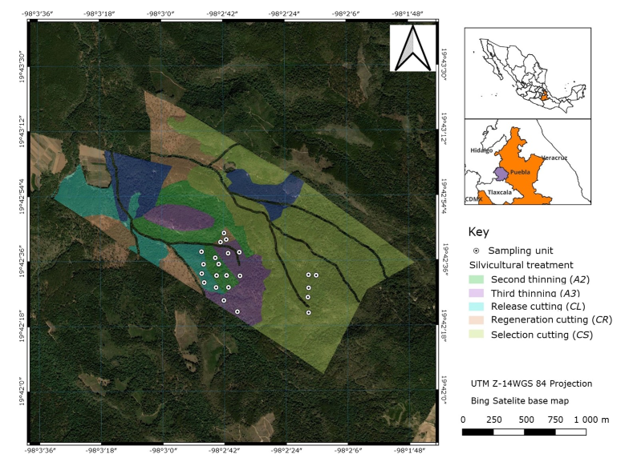
Knowledge of diversity is key for sustainable forest management. The aim of this study was to analyze plant diversity in a forest under timber production during the dry and rainy seasons in the Sierra Norte de Puebla, Mexico. Field data came from 23 0.1 ha-sampling units with nested subplots for measurement of vegetation attributes, in five silvicultural treatments, during the rainy season (2023, 2024) and the dry season of 2024. Alpha diversity was assessed using the Shannon-Wiener index, and beta diversity was analyzed using the Jaccard index. Understory vegetation included 72 species, with higher richness and diversity during both rainy seasons. Regeneration and release cuttings showed higher values of herbs and shrub diversity. Tree layer included 11 species with Pinus patula and Abies religiosa dominance showed higher diversity values in thinning and selection cuttings, and lower richness and diversity in regeneration cuttings. Floristic similarity between silvicultural treatments ranged from 0.3 to 0.7, with minimal variation among seasons. Results show that silvicultural treatments shape plant diversity, while the rainy season favors increases in plant diversity and richness relative to the dry season. The study confirms the importance of silvicultural systems in the conservation of plant diversity in managed forests.
Downloads
References
Ammer, C. (2019). Diversity and forest productivity in a changing climate. New Phytologist, 221(1), 50-66. https://doi.org/10.1111/nph.15263 DOI: https://doi.org/10.1111/nph.15263
Bauhus, J., Forrester, D. I., & Pretzsch, H. (2017). Mixed-species forests: The development of a forest management paradigm. In H. Pretzsch, D. I. Forrester & J. Bauhus (Eds.), Mixed-species forests: Ecology and management (pp. 1-25). Springer Berlin. https://doi.org/10.1007/978-3-662-54553-9_1 DOI: https://doi.org/10.1007/978-3-662-54553-9_1
Bolton, N. W., & D’Amato, A. W. (2019). Herbaceous vegetation responses to gap size within natural disturbance-based silvicultural systems in Northeastern Minnesota, USA. Forests, 10(2), Article 111. https://doi.org/10.3390/f10020111 DOI: https://doi.org/10.3390/f10020111
Caballero-Cruz, P., Treviño-Garza, E. J., Mata-Balderas, J. M., Alanís-Rodríguez, E., Yerena-Yamallel, J. I., & Cuéllar-Rodríguez, L. G. (2022). Análisis de la estructura y diversidad de bosques templados en la ladera oriental del volcán Iztaccíhuatl, México. Revista Mexicana de Ciencias Forestales, 13(71), 76-102. https://doi.org/10.29298/rmcf.v13i71.1253 DOI: https://doi.org/10.29298/rmcf.v13i71.1253
Calderón de Rzedowski, G., & Rzedowski, J. (2001). Flora fanerogámica del Valle de México. Instituto de Ecología, A. C. y Comisión Nacional para el Conocimiento y Uso de la Biodiversidad. https://www.biodiversidad.gob.mx/publicaciones/librosDig/pdf/Flora_del_Valle_de_Mx1.pdf
Comisión Nacional Forestal. (2017). Conservación de biodiversidad en el ejido Llano Grande, Puebla (Vol. 5). Programa de las Naciones Unidas para el Desarrollo-Comisión Nacional Forestal. https://www.gob.mx/cms/uploads/attachment/file/159093/05_Llano_Grande__Puebla.pdf
González-Ovando, M. L., Plascencia-Escalante, F. O., & Martínez-Trinidad, T. (2016). Áreas prioritarias para restauración ecológica y sitios de referencia en la región Chignahuapan-Zacatlán. Madera y Bosques, 22(2), 41-52. https://doi.org/10.21829/myb.2016.2221323 DOI: https://doi.org/10.21829/myb.2016.2221323
Graciano-Ávila, G., Rubio-Camacho, E. A., Alanís-Rodríguez, E., Corral-Rivas, J. J., & García-García, S. A. (2025). Estructura espacial y composición de especies arbóreas en rodales bajo dos tratamientos silvícolas en la Sierra Madre Occidental. Revista Forestal Mesoamericana Kurú, 22(51), 43-53. https://doi.org/10.18845/rfmk.v22i51.8087 DOI: https://doi.org/10.18845/rfmk.v22i51.8087
Gutiérrez-Batalla, R., Barrón-Sevilla, J. A., Luna-González, G. M., & Gutiérrez-Mauricio, M. (2025). Riqueza florística en un bosque bajo manejo forestal en la Sierra Norte de Puebla, México. Ecosistemas y Recursos Agropecuarios, 12(5), Artículo e4526. https://doi.org/10.19136/era.a12nV.4526 DOI: https://doi.org/10.19136/era.a12nV.4526
Hernández, F. J., Deras-Ávila, A. G., Deras-Ávila, N. I., & Colín, J. G. (2019). Influence of the seed tree method on the diversity of regeneration in a mixed forest in Durango, Mexico. Revista Chapingo Serie Ciencias Forestales y del Ambiente, 25(2), 219-234. https://doi.org/10.5154/r.rchscfa.2018.09.066 DOI: https://doi.org/10.5154/r.rchscfa.2018.09.066
Hong, P., Schmid, B., De Laender, F., Eisenhauer, N., Zhang, X., Chen, H., Craven, D., De Boeck, H. J., Hautier, Y., Petchey, O. L., Reich, P. B., Steudel, B., Striebel, M., Thakur, M. P., & Wang, S. (2022). Biodiversity promotes ecosystem functioning despite environmental change. Ecology Letters, 25(2), 555-569. https://doi.org/https://doi.org/10.1111/ele.13936 DOI: https://doi.org/10.1111/ele.13936
Instituto Nacional de Estadística, Geografía e Informática. (2008). Conjunto de datos vectoriales escala 1: 1 000 000. Unidades climáticas [Cartas climatológicas]. Instituto Nacional de Estadística, Geografía e Informática. https://www.inegi.org.mx/app/biblioteca/ficha.html?upc=702825267568
Kutnar, L., Pintar, A. M., Marinšek, A., & Kermavnar, J. (2026). Factors supporting a high level of understorey plant diversity in Ravine Forests (EU priority habitat type). Forests, 17(3), Article 370. https://doi.org/10.3390/f17030370 DOI: https://doi.org/10.3390/f17030370
Liu, S., Hong, G., Qin, F., Hai, L., Yang, H., Li, Z., Dong, D., Li, L., Gao, X., & Li, Z. (2026). Relationship between understory plant diversity and soil characteristics of different plantations in the Mu Us sandy land. Forests, 17(2), Article 172. https://doi.org/10.3390/f17020172 DOI: https://doi.org/10.3390/f17020172
López-Hernández, J. A., Aguirre-Calderón, Ó. A., Alanís-Rodríguez, E., Monárrez-González, J. C., González-Tagle, M. A., & Jiménez-Pérez, J. (2017). Composición y diversidad de especies forestales en bosques templados de Puebla, México. Madera y Bosques, 23(1), 39-51. https://doi.org/10.21829/myb.2017.2311518 DOI: https://doi.org/10.21829/myb.2017.2311518
Mejía-Canales, A., Franco-Maass, S., Endara-Agramont, A. R., & Ávila-Akerberg, V. (2018). Caracterización del sotobosque en bosques densos de pino y oyamel en el Nevado de Toluca, México. Madera y Bosques, 24(3), Artículo e2431656. https://doi.org/10.21829/myb.2018.2431656 DOI: https://doi.org/10.21829/myb.2018.2431656
Moreno, C. E. (2001). Métodos para medir la biodiversidad. Volumen 1. Programa Iberoamericano de Ciencia y Tecnología para el Desarrollo, Oficina Regional de Ciencia y Tecnología para América Latina y el Caribe y Sociedad Entomológica Aragonesa. http://sea-entomologia.org/PDF/MTSEA01.pdf
Pérez-López, R. I., González-Espinosa, M., Ramírez-Marcial, N., & Toledo-Aceves, T. (2020). Efectos del “Método de Desarrollo Silvícola” sobre la diversidad arbórea en bosques húmedos de montaña del norte de Chiapas, México. Revista Mexicana de Biodiversidad, 91, Artículo e913326. https://doi.org/10.22201/ib.20078706e.2020.91.3326 DOI: https://doi.org/10.22201/ib.20078706e.2020.91.3326
R Core Team. (2026). R: A language and environment for statistical computing (Version 4.5.2) [Computer software]. R Foundation for Statistical Computing. https://www.r-project.org/
Rendón-Pérez, M. A., Hernández-de la Rosa, P., Velázquez-Martínez, A., Alcántara-Carbajal, J. L., & Reyes-Hernández, V. J. (2021). Composición, diversidad y estructura de un bosque manejado del centro de México. Madera y Bosques, 27(1), Article e2712127. https://doi.org/10.21829/myb.2021.2712127 DOI: https://doi.org/10.21829/myb.2021.2712127
Rosales-Salazar, P. H., Olayo-González, M. A., Morales-Flores, J. A., Álvarez-Reyes, R., & Martínez-Huerta, I. (1982). El Método de Desarrollo Silvícola, una alternativa en la silvicultura y ordenación de bosques. Revista Chapingo, 7(35-36), 69-72. https://ru.dgb.unam.mx/items/57d0ba58-1746-4f26-8e38-d1c762faab57
Rubio-Camacho, E. A., Xelhuantzi-Carmona, J., Chávez-Durán, Á. A., & Monárrez-González, J. C. (2024). Effects of thinning on the diversity, composition, and spatial structure in a mixed temperate forest. Agro Productividad, 17(9), 125-136. https://doi.org/10.32854/agrop.v17i9.3033 DOI: https://doi.org/10.32854/agrop.v17i9.3033
Salinas-Cruz, E., González-Guillén, M. de J., León-Merino, A., & Rodríguez-Hernández, F. R. (2017). La actividad forestal en el desarrollo económico de Chignahuapan, Puebla. Región y Sociedad, 29(69), 185-218. https://doi.org/10.22198/rys.2017.69.a270 DOI: https://doi.org/10.22198/rys.2017.69.a270
Servicio Meteorológico Nacional. (2020). Normal climatológica 1991-2020 [Base de datos climáticos]. Comisión Nacional del Agua. https://smn.conagua.gob.mx/tools/RESOURCES/Normales_Climatologicas/Normales9120/tlax/nor9120_29032.txt
Silva-González, E., Aguirre-Calderón, O. A., Alanís-Rodríguez, E., González-Tagle, M. A., Treviño-Garza, E. J., & Corral-Rivas, J. J. (2022). Evaluación del aprovechamiento forestal en la diversidad y estructura de un bosque templado en Durango. Revista Mexicana de Ciencias Forestales, 13(71), 103-132. https://doi.org/10.29298/rmcf.v13i71.1017 DOI: https://doi.org/10.29298/rmcf.v13i71.1017
Su, X., Wang, M., Huang, Z., Fu, S., & Chen, H. Y. H. (2019). Forest understorey vegetation: colonization and the availability and heterogeneity of resources. Forests, 10(11), Article 944. https://doi.org/10.3390/f10110944 DOI: https://doi.org/10.3390/f10110944
Downloads
Additional Files
Published
How to Cite
Issue
Section
License
Copyright (c) 2026 Revista Mexicana de Ciencias Forestales

This work is licensed under a Creative Commons Attribution-NonCommercial 4.0 International License.
The authors who publish in Revista Mexicana de Ciencias Forestales accept the following conditions:
In accordance with copyright laws, Revista Mexicana de Ciencias Forestales recognizes and respects the authors’ moral right and ownership of property rights which will be transferred to the journal for dissemination in open access.
All the texts published by Revista Mexicana de Ciencias Forestales –with no exception– are distributed under a Creative Commons License Attribution-NonCommercial 4.0 International (CC BY-NC 4.0), which allows third parties to use the publication as long as the work’s authorship and its first publication in this journal are mentioned
The author(s) can enter into independent and additional contractual agreements for the nonexclusive distribution of the version of the article published in Revista Mexicana de Ciencias Forestales (for example, include it into an institutional repository or publish it in a book) as long as it is clearly and explicitly indicated that the work was published for the first time in Revista Mexicana de Ciencias Forestales.
For all the above, the authors shall send the form of Letter-transfer of Property Rights for the first publication duly filled in and signed by the author(s). This form must be sent as a PDF file to: ciencia.forestal2@inifap.gob.mx
This work is licensed under a Creative Commons Attribution-Noncommercial 4.0 International license.