Sequence in the distribution of mistletoe under climate change: Laxaxalpan River sub-basin, state of Puebla
DOI:
https://doi.org/10.29298/rmcf.v17i96.1655Keywords:
arceuthobium globosum Hawksw. & Wiens, Suitable area, temperate forest, climate change, pines, parasitic plantsAbstract
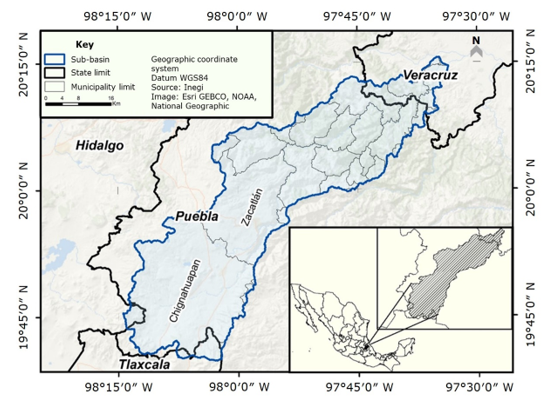
Parasitic plants are a contributing factor to the decline in forest health, and their distribution has expanded in recent years due to climate change. The objective of this study was to determine the distribution of current and future suitability, under climate change scenarios, of Arceuthobium globosum in temperate forests of the Laxaxalpan River sub-basin, state of Puebla, Mexico. The MaxEnt algorithm was used, and model performance was evaluated using the AUC and partial ROC indices for the current period. The General Circulation Models (GCMs) CanESM5-CanOE and GFDL-ESM4 were also considered under the SSP126 and SSP370 scenarios for the period 2041-2060. Chi-square tests with Monte Carlo simulation were applied to evaluate changes in suitability categories. The current distribution showed a predominance of areas with low and no suitability for mistletoe. Overall, climate change scenarios indicated an increase in areas with no suitability and the disappearance of those with high suitability, while the areas with medium and low suitability decreased significantly. The chi-square analysis showed a significant reduction in medium and high suitability areas, with a transition to low and no suitability categories. The results suggest that future climatic conditions in the study area will no longer be suitable for the distribution of dwarf mistletoe, highlighting the high sensitivity of this parasitic species to climate change.
Downloads
References
Álvarez, O. (1992). Sectores climáticos de Cuba. Aplicación del Método de Lang. Revista Cubana de Meteorología, 5(2), 10-19.
Cambrón-Sandoval, V. H., Méndez-González, J., Ledesma-Colunga, M. C., Luna-Soria, H., García-Aranda, M. A., Cerano-Paredes, J., Obregón-Zuñiga, J. A., & Vergara-Pineda, S. (2018). Variabilidad climática e interacción con otros factores que afectan la dinámica poblacional de descortezadores en bosques amenazados de México (Fondo Sectorial CONAFOR-CONACyT-2014, C01-234547 Sectorial CONAFOR-CONACyT-2014, C01-234547). Consejo Nacional de Ciencia y Tecnología, Comisión Nacional Forestal. https://sivicoff.cnf.gob.mx/ContenidoPublico/09%20Manuales%20t%C3%A9cnicos/Libro_Variabilidad_Clim%C3%A1tica_Din%C3%A1mica_Poblacional_Descortezadores.pdf
Chakraborty, A., Joshi, P. K., & Sachdeva, K. (2016). Predicting distribution of major forest tree species to potential impacts of climate change in the central Himalayan región. Ecological Engineering, 97, 593-609. http://dx.doi.org/10.1016/j.ecoleng.2016.10.006 DOI: https://doi.org/10.1016/j.ecoleng.2016.10.006
Cibrián-Tovar, D. (2011). Insectos y patógenos que afectan a las áreas arboladas de Puebla. En Comisión Nacional para el Conocimiento y Uso de la Biodiversidad (Coord.), La Biodiversidad en Puebla. Estudio de Estado (pp. 287-291). Comisión Nacional para el Conocimiento y Uso de la Biodiversidad, Gobierno del Estado de Puebla, Benemérita Universidad Autónoma de Puebla. https://smadsot.puebla.gob.mx/images/Biodiversidad_en_Puebla2.pdf
Cibrián-Tovar, D., Vázquez-Collazo, I., & Cibrián-Tovar, J. (2007). Muérdagos enanos del género Arceuthobium. En D. Cibrián-Tovar, D. Alvarado-Rosales & S. E. García-Díaz (Edits.), Enfermedades forestales en México (pp. 357-395). Universidad Autónoma Chapingo.
Comisión Nacional Forestal. (2025). Reporte nacional de plagas forestales. 01 de enero al 31 de diciembre de 2024. Secretaría de Medio Ambiente y Recursos Naturales. https://sivicoff.cnf.gob.mx/ContenidoPublico/Estadisticas%20nacionales%20de%20afectacion/2024/Reporte%20Nacional%20de%20Plagas%20Forestales%2001%20de%20Enero%20al%2031%20Diciembre%20del%202024.pdf
Comisión Nacional para el Conocimiento y Uso de la Biodiversidad. (2011). División política estatal 1:250 000. 2010 (Catálogo de metadatos geográficos). Comisión Nacional para el Conocimiento y Uso de la Biodiversidad. http://geoportal.conabio.gob.mx/metadatos/doc/html/dest_2010gw.html
Comisión Nacional para el Conocimiento y Uso de la Biodiversidad. (2023). La Dualidad de Hutchinson. Comisión Nacional para el Conocimiento y Uso de la Biodiversidad. https://sites.google.com/site/nichesandareasofdistribution/conceptos-y-teoria/concepts-and-theory
Endara-Agramont, Á. R., Varo-Rodríguez, R. D., Aguirre-Zúñiga, J. J., & García-Jacinto, F. (2023). Guía ilustrativa para la identificación de muérdagos en bosques templados de México (1ra ed.). Aldus. https://www.researchgate.net/publication/378103167_Guia_ilustrativa_para_la_identificacion_de_muerdagos_en_bosques_templados_de_Mexico
Eyring, V., Righi, M., Lauer, A., Evaldsson, M., Wenzel, S., Jones, C., Anav, A., Andrews, O., Cionni, I., Davin, E. L., Deser, C., Ehbrecht, C., Friedlingstein, P., Gleckler, P., Gottschaldt, K.-D., Hagemann, S., Juckes, M., Kindermann, S., Krasting, J., … Williams, K. D. (2016). ESMValTool (v1. 0)–a community diagnostic and performance metrics tool for routine evaluation of Earth system models in CMIP. Geoscientific Model Development, 9, 1747-1802. https://doi.org/10.5194/gmd-9-1747-2016 DOI: https://doi.org/10.5194/gmd-9-1747-2016
Fick, S. E., & Hijmans, R. J. (2017). WorldClim 2: new 1-km spatial resolution climate surfaces for global land areas. International Journal of Climatology, 37(12), 4302-4315. https://doi.org/10.1002/joc.5086 DOI: https://doi.org/10.1002/joc.5086
García, E., & Comisión Nacional para el Conocimiento y Uso de la Biodiversidad. (1998). Climas. Catálogo de metadatos geográficos [Conjunto de metadatos]. Comisión Nacional para el Conocimiento y Uso de la Biodiversidad. http://geoportal.conabio.gob.mx/metadatos/doc/html/clima1mgw.html
Global Biodiversity Information Facility. (2025). GBIF Global Biodiversity Information Facility [Database]. Global Core Biodata Resource. https://www.gbif.org
iNaturalist. (2024). iNaturalist biodiversity observations database [Database]. iNaturalist. https://www.inaturalist.org/
Instituto Nacional de Estadística y Geografía. (2018). División política municipal, 1:250 000, 2018 [Catálogo de metadatos geográficos]. Instituto Nacional de Estadística y Geografía. http://geoportal.conabio.gob.mx/metadatos/doc/html/muni_2018gw.html
Instituto Nacional de Estadística y Geografía. (2021). Uso de Suelo y Vegetación, escala 1:250 000, serie VII (continuo nacional) [Catálogo de metadatos geográficos]. Instituto Nacional de Estadística y Geografía. http://geoportal.conabio.gob.mx/metadatos/doc/html/usv250s7gw.html
Instituto Nacional de Estadística y Geografía. (2023). Continuo de elevaciones mexicano y modelos digitales de elevación [Mapa interactivo]. Instituto Nacional de Estadística y Geografía. https://www.inegi.org.mx/app/geo2/elevacionesmex/
Instituto Nacional de Estadística, Geografía e Informática. (2001). Conjunto de datos vectoriales Fisiográficos. Continuo Nacional serie I. Provincias fisiográficas, escala: 1:1 000 000 [Carta fisiográfica]. Instituto Nacional de Estadística, Geografía e Informática. https://www.inegi.org.mx/app/biblioteca/ficha.html?upc=702825267575
Intergovernmental Panel on Climate Change. (2021). Summary for policymakers. In V. Masson-Delmotte, P. Zhai, A. Pirani, S. L. Connors, C. Péan, S. Berger, N. Caud, Y. Chen, L. Goldfarb, M. I. Gomis, M. Huang, K. Leitzell, E. Lonnoy, J. B. R. Matthews, T. K. Maycock, T. Waterfield, O. Yelekçi, R. Yu & B. Zhou (Eds.), Climate change 2021: The physical science basis. Contribution of Working Group I to the Sixth Assessment Report of the Intergovernmental Panel on Climate Change (pp. 3-31). Cambridge University Press. https://doi.org/10.1017/9781009157896.001 DOI: https://doi.org/10.1017/9781009157896.001
Kearney, M., & Porter, W. (2009). Mechanistic niche modelling: combining physiological and spatial data to predict species’ ranges. Ecology Letters, 12, 334-350. https://doi.org/10.1111/j.1461-0248.2008.01277.x DOI: https://doi.org/10.1111/j.1461-0248.2008.01277.x
Körner, C. (2007). The use of ‘altitude’ in ecological research. Trends in Ecology & Evolution, 22(11), 569-574. https://www.sciencedirect.com/science/article/abs/pii/S0169534707002819 DOI: https://doi.org/10.1016/j.tree.2007.09.006
Manzanilla-Quiñones, U., Delgado-Valerio, P., Hernández-Ramos, J., Molina-Sánchez, A., García-Magaña, J. J., & Rocha-Granados, M. del C. (2019). Similaridad del nicho ecológico de Pinus montezumae y P. pseudostrobus (Pinaceae) en México: implicaciones para la selección de áreas productoras de semillas y de conservación. Acta Botánica Mexicana, (126), Artículo e1398. https://doi.org/10.21829/abm126.2019.1398 DOI: https://doi.org/10.21829/abm126.2019.1398
Nair, K. S. S. (2007). Tropical forest insect pests. Ecology, impact, and management. Cambridge University Press. https://doi.org/10.1017/CBO9780511542695 DOI: https://doi.org/10.1017/CBO9780511542695
Nickrent, D. L. (2002). Parasitic plants of the world. In J. A. López-Sáez, P. Catalán & L. Sáez (Eds.), Parasitic Plants of the Iberian Peninsula and Balearic Islands (pp. 7-27). Mundi-Prensa Libros, S. A., Madrid. https://www.researchgate.net/publication/265579731_Plantas_parasitas_en_el_mundo
Osorio-Olvera, L., Lira-Noriega, A., Soberón, J., Peterson, A. T., Falconi, M., Contreras-Díaz, R. G., Martínez-Meyer, E., Barve, V., & Barve, N. (2020). NTBOX: An R package with graphical user interface for modelling and evaluating multidimensional ecological niches. Methods in Ecology and Evolution, 11(10), 1199-1206. https://doi.org/10.1111/2041-210X.13452 DOI: https://doi.org/10.1111/2041-210X.13452
Peterson, A. T., Papeş, M., & Soberón, J. (2008). Rethinking receiver operating characteristic analysis applications in ecological niche modeling. Ecological Modelling, 213(1), 63-72. https://doi.org/10.1016/j.ecolmodel.2007.11.008 DOI: https://doi.org/10.1016/j.ecolmodel.2007.11.008
Peterson, A. T., Soberón, J., Pearson, R. G., Anderson, R. P., Martínez-Meyer, E., Nakamura, M., & Bastos-Araújo, M. (2011). Ecological niches and geographic distributions. Princeton University Press. https://www.researchgate.net/publication/230709994_Ecological_Niches_and_Geographic_Distributions DOI: https://doi.org/10.23943/princeton/9780691136868.003.0003
Phillips, S. (2010). A Brief Tutorial on Maxent. Lessons in Conservation, 3, 108-135. https://doi.org/10.5531/cbc.linc.3.1.6 DOI: https://doi.org/10.5531/cbc.linc.3.1.6
R Core Team. (2025). The R Project for Statistical Computing (Version 4.4.1) [Computer software]. The R Foundation. https://www.r-project.org/
Ramírez-Dávila, J. F., & Porcayo-Camargo, E. (2009). Estudio de la distribución espacial del muérdago enano (Arceuthobium sp.) en el Nevado de Toluca, México, utilizando el Método del SADIE. Madera y Bosques, 15(2), 93-111. https://doi.org/10.21829/myb.2009.1521193 DOI: https://doi.org/10.21829/myb.2009.1521193
Secretaría de la Convención Internacional de Protección Fitosanitaria. (2018). Normas internacionales para medidas fitosanitarias. NIMF 5. Glosario de términos fitosanitarios. Food and Agriculture Organization of United Nations. https://www.ippc.int/static/media/files/publication/es/2018/07/ISPM_05_2018_Es_2018-07-10_PostCPM13.pdf
Sosa-Díaz, L., Méndez-González, J., García-Aranda, M. A., Cambrón-Sandoval, V. H., Villarreal-Quintanilla, J. Á., Ruiz-González, C. G., & Montoya-Jiménez, J. C. (2018). Distribución potencial de barrenadores, defoliadores, descortezadores y muérdagos en bosques de coníferas de México. Revista Mexicana de Ciencias Forestales, 9(47), 187-208. https://doi.org/10.29298/rmcf.v9i47.159 DOI: https://doi.org/10.29298/rmcf.v9i47.159
Van Geert, P. L. C., Steenbeek, H. W., & Kunnen, E. S. (2012). Monte Carlo techniques: Statistical simulation for developmental data. In S. Kunnen (Ed.), A dynamic systems approach to adolescent development (pp. 43-52). Routledge. https://research.rug.nl/en/publications/monte-carlo-techniques-statistical-simulation-for-developmental-d/
WorldClim. (2023). Future climate data [Database]. WorldClim. https://worldclim.org/data/cmip6/cmip6climate.html
Published
How to Cite
Issue
Section
License
Copyright (c) 2026 Revista Mexicana de Ciencias Forestales

This work is licensed under a Creative Commons Attribution-NonCommercial 4.0 International License.
The authors who publish in Revista Mexicana de Ciencias Forestales accept the following conditions:
In accordance with copyright laws, Revista Mexicana de Ciencias Forestales recognizes and respects the authors’ moral right and ownership of property rights which will be transferred to the journal for dissemination in open access.
All the texts published by Revista Mexicana de Ciencias Forestales –with no exception– are distributed under a Creative Commons License Attribution-NonCommercial 4.0 International (CC BY-NC 4.0), which allows third parties to use the publication as long as the work’s authorship and its first publication in this journal are mentioned
The author(s) can enter into independent and additional contractual agreements for the nonexclusive distribution of the version of the article published in Revista Mexicana de Ciencias Forestales (for example, include it into an institutional repository or publish it in a book) as long as it is clearly and explicitly indicated that the work was published for the first time in Revista Mexicana de Ciencias Forestales.
For all the above, the authors shall send the form of Letter-transfer of Property Rights for the first publication duly filled in and signed by the author(s). This form must be sent as a PDF file to: ciencia.forestal2@inifap.gob.mx
This work is licensed under a Creative Commons Attribution-Noncommercial 4.0 International license.