Relationship between the size of pruning wounds and the location of the cut in urban trees
DOI:
https://doi.org/10.29298/rmcf.v17i95.1618Keywords:
urban trees, urban forest, compartmentalization, pruning wounds, Hamburg method, urban pruningAbstract
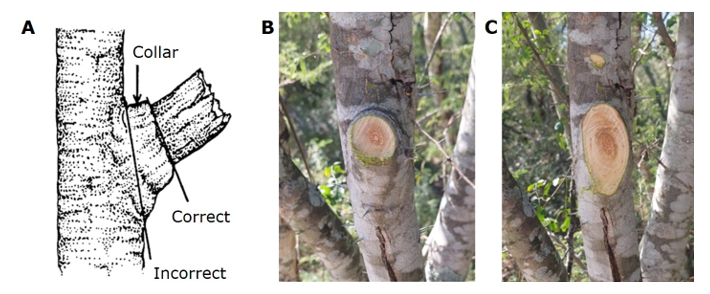
Pruning urban trees is a key practice for maintaining their structural stability, functionality and longevity; however, improper cut location can generate extensive wounds that compromise the tree's structural integrity and increase its vulnerability to pathogenic fungi and other microorganisms. The Hamburg method stipulates that cuts should be made after the branch collar and the bark wrinkle, preserving the tissues responsible for compartmentalization, a physiological mechanism that limits the spread of internal decay. However, in the management of urban trees in various cities, cutting trees flush with the steem is still a common practice. This study evaluated the effect of pruning cut location (correct and flush pruning) on wound size in ten tree species used in Northeastern Mexico. To this end, two diameters per wound were measured to calculate its area, and statistical tests were applied to determine differences between species and cut type. Results indicated that flush pruning produces significantly larger wounds, with an average increase of 73 % compared to pruning done after the branch collar and bark wrinkling, with values ranging from 54 to 99 % depending on the species. These differences confirm that the location of the pruning cut directly influences the size of the wound and the tree's ability to compartmentalize.
Downloads
References
Alanís, E., Jiménez, J., Mora-Olivo, A., Canizales, P., & Rocha, L. (2014). Estructura y composición del arbolado urbano de un campus universitario del noreste de México. Revista Iberoamericana de Ciencias, 1(7), 93-101. https://www.researchgate.net/publication/271271778_Estructura_y_composicion_del_arbolado_urbano_de_un_campus_universitario_del_noreste_de_Mexico
Alanís-Rodríguez, E., Mora-Olivo, A., & Marroquín-de la Fuente, J. S. (2020). Muestreo ecológico de la vegetación. Universidad Autónoma de Nuevo León. https://libros.uat.edu.mx/index.php/librosuat/catalog/view/221/182/537
Branthomme, A. (Comp.). (2004). National forest inventory. Field manual template (Working Paper 94/E). Food and Agriculture Organization. https://openknowledge.fao.org/server/api/core/bitstreams/614a9eed-25cf-4c10-a6b7-7f85611565ef/content
Canizales-Velázquez, P. A., Alanís-Rodríguez, E., Holguín-Estrada, V. A., García-García, S., & Collantes-Chávez-Costa, A. (2020). Caracterización del arbolado urbano de la ciudad de Montemorelos, Nuevo León. Revista Mexicana de Ciencias Forestales, 11(62), 111-135. https://doi.org/10.29298/rmcf.v11i62.768 DOI: https://doi.org/10.29298/rmcf.v11i62.768
Drénou, C. (2000). La poda de los árboles ornamentales: del por qué al cómo. Mundi-Prensa Libros. https://dialnet.unirioja.es/servlet/libro?codigo=143550
Dujesiefken, D., & Stobbe, H. (2002). The Hamburg tree pruning system–a framework for pruning of individual trees. Urban Forestry & Urban Greening, 1, 75-82. https://trees.umn.edu/sites/trees.umn.edu/files/files/media/hamburg_tree_pruning_system.pdf DOI: https://doi.org/10.1078/1618-8667-00008
Leal-Elizondo, C. E, Leal-Elizondo, N., Alanís-Rodríguez, E., Pequeño-Ledesma, M. Á., Mora-Olivo, A., & Buendía-Rodríguez, E. (2018). Estructura, composición y diversidad del arbolado urbano de Linares, Nuevo León. Revista Mexicana de Ciencias Forestales, 9(48), 252-270. https://doi.org/10.29298/rmcf.v8i48.129 DOI: https://doi.org/10.29298/rmcf.v8i48.129
Martínez-Trinidad, T., & Islas-Rodríguez, L. (2010). Biología y compartimentación del árbol. ArbolAMA, (3), 21-29. https://www.researchgate.net/publication/344156016_BIOLOGIA_Y_COMPARTIMENTACION_DEL_ARBOL
Morris, H., Hietala, A. M., Jansen, S., Ribera, J., Rosner, S., Salmeia, K. A., & Schwarze, F. W. M. R. (2020). Using the CODIT model to explain secondary metabolites of xylem in defence systems of temperate trees against decay fungi. Annals of Botany, 125(5), 701-720. https://doi.org/10.1093/aob/mcz138 DOI: https://doi.org/10.1093/aob/mcz138
Neely, D. (1988). Closure of branch pruning wounds with conventional and “Shigo” cuts. Journal of Arboriculture, 14(11), 261-264. https://doi.org/10.48044/jauf.1988.062 DOI: https://doi.org/10.48044/jauf.1988.062
Pietzarka, U. (2016). Tree pruning: methods and parameters. In A. Roloff (Edit.), Urban Tree Management for the sustainable development of green cities (pp. 154-168). John Wiley & Sons, Ltd. https://content.e-bookshelf.de/media/reading/L-4159854-2e383bc4f1.pdf
Purcell, L. (2015). Lo esencial para la poda de árboles. Forestry and Natural Resources, 506, 1-18. https://www.extension.purdue.edu/extmedia/FNR/FNR-506-S-W.pdf
R Core Team. (2021). R: A Language and Environment for Statistical Computing (Version 4.1) [Software]. R Foundation for Statistical Computing. https://www.r-project.org/
Shigo, A. L. (1984). Compartmentalization: a conceptual framework for understanding how trees grow and defend themselves. Annual Review of Phytopathology, 22, 189-214. https://doi.org/10.1146/annurev.py.22.090184.001201 DOI: https://doi.org/10.1146/annurev.py.22.090184.001201
Shigo, A. L., & Marx, H. G. (1977). Compartmentalization of decay in trees (Agriculture Information Bulletin No. 405). United States Department of Agriculture. https://research.fs.usda.gov/download/treesearch/5292.pdf
Shigo, A. L., McGinnes, Jr., E. A., Funk, D. T., & Rogers, N. (1979). Internal defects associated with pruned and nonpruned branch stubs in Black Walnut (Forest Service Research Paper NE-440). United States Department of Agriculture. https://research.fs.usda.gov/treesearch/14974
Smiley, E. T., Matheny, N., & Lilly, S. (2017). Best management practices: Tree risk assessment (2nd ed.). International Society of Arboriculture. https://www.cabidigitallibrary.org/doi/full/10.5555/20183082467
Van der Zanden, A. M., Cogger, C., Sullivan, D. M., Kropf, J. A., Bobbitt, V., Fox, R., Kennell, H., Moulton, H., Pinyuh, G., Robson, M., Patterson, P., Maleike, R., Olsen, J., Azarenko, A., Strik, B., Antonelli, A. L., Stanke, G., Adams, E. B., Collman, S. J., … Wingate, M. (2008). Sustainable Gardening: The Oregon-Washington Master Gardener Handbook. Oregon State University. https://extension.oregonstate.edu/catalog/pub/em-8742-sustainable-gardening-oregon-washington-master-gardener-handbook
Welch, B. L. (1947). The generalization of Student’s problem when several different population variances are involved. Biometrika, 34(1-2), 28-35. https://doi.org/10.1093/biomet/34.1-2.28 DOI: https://doi.org/10.1093/biomet/34.1-2.28
Wickham, H. (2010). A layered grammar of graphics. Journal of Computational and Graphical Statistics, 19(1), 3-28. https://doi.org/10.1198/jcgs.2009.07098 DOI: https://doi.org/10.1198/jcgs.2009.07098
Published
How to Cite
Issue
Section
License
Copyright (c) 2026 Revista Mexicana de Ciencias Forestales

This work is licensed under a Creative Commons Attribution-NonCommercial 4.0 International License.
The authors who publish in Revista Mexicana de Ciencias Forestales accept the following conditions:
In accordance with copyright laws, Revista Mexicana de Ciencias Forestales recognizes and respects the authors’ moral right and ownership of property rights which will be transferred to the journal for dissemination in open access.
All the texts published by Revista Mexicana de Ciencias Forestales –with no exception– are distributed under a Creative Commons License Attribution-NonCommercial 4.0 International (CC BY-NC 4.0), which allows third parties to use the publication as long as the work’s authorship and its first publication in this journal are mentioned
The author(s) can enter into independent and additional contractual agreements for the nonexclusive distribution of the version of the article published in Revista Mexicana de Ciencias Forestales (for example, include it into an institutional repository or publish it in a book) as long as it is clearly and explicitly indicated that the work was published for the first time in Revista Mexicana de Ciencias Forestales.
For all the above, the authors shall send the form of Letter-transfer of Property Rights for the first publication duly filled in and signed by the author(s). This form must be sent as a PDF file to: ciencia.forestal2@inifap.gob.mx
This work is licensed under a Creative Commons Attribution-Noncommercial 4.0 International license.