Flujo y conectividad genética de Bursera linanoe (La Llave) Rzed., Calderón & Medina en un paisaje fragmentado
DOI:
https://doi.org/10.29298/rmcf.v17i97.1662Palabras clave:
biología de la conservación, dispersión biótica, dispersión de semillas, estructura genética, genética del paisaje, selva caducifoliaResumen
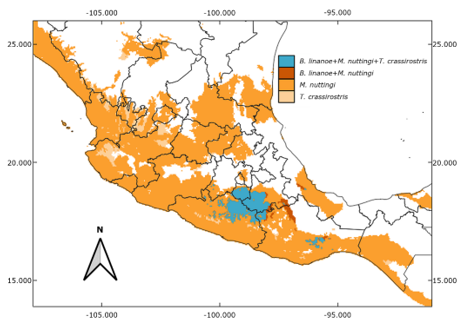
La fragmentación del hábitat amenaza la persistencia de las especies, al reducir el flujo génico. Bursera linanoe, un árbol endémico y de importancia cultural en el centro-sur de México, presenta declive poblacional debido a la presión extractiva y pérdida de hábitat. Se analizó la estructura genética y la conectividad poblacional de esta especie mediante herramientas de genética molecular, modelación espacial y análisis ecológicos. Se evaluaron cuatro poblaciones con marcadores ISSR (Inter-Simple Sequence Repeats) y se determinó una diferenciación genética de moderada a alta (FST=0.31), lo que indica una limitada conectividad genética entre localidades. Los análisis multivariados y bayesianos identificaron tres grupos genéticos principales asociados a regiones geográficas (Morelos, Guerrero y Oaxaca); ello sugiere que tanto barreras físicas, como la fragmentación del hábitat han influido en la estructuración genética. La prueba de Mantel evidenció aislamiento por distancia, mientras que el análisis de redes de migración mostró un flujo asimétrico, con conectividad entre poblaciones centrales, que indicaron posibles dinámicas fuente-sumidero. Los modelos de genética del paisaje revelaron que la distancia geográfica y la resistencia del paisaje tienen efectos similares, lo que sugiere que la conectividad no depende de un solo factor, sino de su interacción. Adicionalmente, la modelación de nicho evidenció traslape espacial entre B. linanoe y aves frugívoras (principalmente Myiarchus y Tyrannus), lo que respalda su papel como dispersores clave. El estudio destaca la importancia de conservar corredores biológicos y las interacciones planta-dispersor para mantener la viabilidad genética de la especie.
Descargas
Citas
Almazán-Núñez, R. C., Eguiarte, L. E., Arizmendi, M. del C., & Corcuera, P. (2016). Myiarchus flycatchers are the primary seed dispersers of Bursera longipes in a Mexican dry forest. PeerJ, 4, Article e2126. https://doi.org/10.7717/peerj.2126
Arias, D. M., Albarrán-Lara, A. L., González-Rodríguez, A., Peñaloza-Ramírez, J., Dorado, O., & Leyva, E. (2012). Genetic diversity and structure of wild populations of the tropical dry forest tree Jacaratia mexicana (Brassicales: Caricaceae) at a local scale in Mexico. Revista de Biología Tropical, 60(1), 1-10. http://www.scielo.sa.cr/scielo.php?script=sci_arttext&pid=S0034-77442012000100001&lng=en&tlng=en
Barton, K. (2026). MuMIn: Multi-model inference (R package version 1.47.5) [Software]. Comprehensive R Archive Network. https://CRAN.R-project.org/package=MuMIn
Bates, D., Mächler, M., Bolker, B., & Walker, S. (2015). Fitting linear mixed-effects models using lme4. Journal of Statistical Software, 67(1), 1-48. https://doi.org/10.18637/jss.v067.i01
Boshier, D., Broadhurst, L., Cornelius, J., Gallo, L., Koskela, J., Loo, J., Petrokofsky, G., & St. Clair, B. (2015). Is local best? Examining the evidence for local adaptation in trees and its scale. Environmental Evidence, 4, Article 20. https://link.springer.com/article/10.1186/s13750-015-0046-3#citeas
Bucharova, A., Durka, W., Hölzel, N., Kollmann, J., Michalski, S., & Bossdorf, O. (2017). Are local plants the best for ecosystem restoration? It depends on how you analyze the data. Ecology and Evolution, 7(24), 10683-10689. https://doi.org/10.1002/ece3.3585
Caye, K., Deist, T. M., Martins, H., Michel, O., & François, O. (2016). TESS3: Fast inference of spatial population structure and genome scans for selection. Molecular Ecology Resources, 16(2), 540-548. https://doi.org/10.1111/1755-0998.12471
Coppi, A., Cecchi, L., Selvi, F., & Raffaelli, M. (2010). The frankincense tree (Boswellia sacra, Burseraceae) from Oman: ITS and ISSR analyses of genetic diversity and implications for conservation. Genetic Resources and Crop Evolution, 57, 1041-1052. https://doi.org/10.1007/s10722-010-9546-8
Cordeiro, N. J., & Howe, H. F. (2003). Forest fragmentation severs mutualism between seed dispersers and an endemic African tree. Proceedings of the National Academy of Sciences of the United States of America, 100(24), 14052-14056. https://doi.org/10.1073/pnas.2331023100
Cruz-Cruz, E., Mariles-Flores, V., Solares-Arenas, F., Gómez-Cárdenas, M., Serrano-Altamirano, V., Ayerde-Lozada, D., Fuentes-López, M. E., Castellanos-Bolaños, J. F., Orozco-Cirilo, S., Vargas-Álvarez, D., & Borja-de la Rosa, A. (2009). Adaptación ecológica y climática de linaloe (Bursera linanoe) (La Llave) Rzedowski, Calderón & Medina). En E. Cruz-Cruz, V. Mariles-Flores, M. Gómez-Cárdenas & D. Vargas-Álvarez (Comps.), Fundamentos técnicos para el manejo de poblaciones naturales de linaloe (Bursera linanoe (La llave) Rzedowski, Calderon & Medina) en México (Libro Técnico Núm. 14, pp. 1-31). Instituto Nacional de Investigaciones Forestales, Agrícolas y Pecuarias. https://www.researchgate.net/profile/Martin-Cardenas-5/publication/369657169_Fundamentos_Tecnicos_para_el_Manejo_de_Poblaciones_Naturales_de_Linaloe_Bursera_linanoe_La_Llave_Rzedowski_Calderon_Medina_en_Mexico/links/64265f5f66f8522c38e7b607/Fundamentos-Tecnicos-para-el-Manejo-de-Poblaciones-Naturales-de-Linaloe-Bursera-linanoe-La-Llave-Rzedowski-Calderon-Medina-en-Mexico.pdf
Cruz-Larios, I. J. (2022). Diversidad genética de lináloe (Bursera linanoe) y diversidad arbórea de ecosistemas donde se distribuye esta especie [Tesis doctoral, Colegio de Postgraduados Campus Montecillo]. Repositorio Institucional del Colegio de Postgraduados. http://colposdigital.colpos.mx:8080/xmlui/bitstream/handle/10521/5056/Cruz_Larios_IJ_DC_Ciencias_Forestales_2022.pdf?sequence=1&isAllowed=y
Cruz-Larios, I. J., Ramírez-Herrera, C., Hernández-Rodríguez, M., Velasco-García, M. V., Cetina-Alcalá, V. M., & Valdez-Hernández, J. I. (2024). Diversidad genética de lináloe en poblaciones del bosque tropical caducifolio en México. Revista Fitotecnia Mexicana, 47(2), 191-198. https://doi.org/10.35196/rfm.2024.2.191
Cushman, S. A., Shirk, A., & Landguth, E. L. (2012). Separating the effects of habitat area, fragmentation and matrix resistance on genetic differentiation in complex landscapes. Landscape Ecology, 27, 369-380. https://doi.org/10.1007/s10980-011-9693-0
Dos Santos-Araújo, F., Vasconcelos-Pacheco, M., de Almeida-Vieira, F., dos Santos-Ferrari, C., Cardoso-Félix, F., & Teixeira-das Chagas, K. P. (2016). ISSR molecular markers for the study of the genetic diversity of Mimosa caesalpiniaefolia Benth. Idesia, 34(3), 47-52. http://dx.doi.org/10.4067/S0718-34292016000300007
Doyle, J. J., & Doyle, J. L. (1987). A rapid DNA isolation procedure for small quantities of fresh leaf tissue. Phytochemical Bulletin, 19(1), 11-15. https://worldveg.tind.io/record/33886
Epps, C. W., & Keyghobadi, N. (2015). Landscape genetics in a changing world: disentangling historical and contemporary influences and inferring change. Molecular Ecology, 24(24), 6021-6040. https://doi.org/10.1111/mec.13454
Escalona-Prado, C. E. (2025). Evaluación de la vulnerabilidad ecológica de Bursera linanoe (La Llave), mediante el modelado de nicho ecológico y análisis espacial [Tesis de Maestría, Universidad Nacional Autónoma de México]. Repositorio Institucional de la Universidad Nacional Autónoma de México. https://ru.dgb.unam.mx/items/2cf16e1b-7db6-4d8c-ac0b-e9457a0e28de
Evanno, G., Regnaut, S., & Goudet, J. (2005). Detecting the number of clusters of individuals using the software STRUCTURE: a simulation study. Molecular Ecology, 14(8), 2611-2620. https://doi.org/10.1111/j.1365-294X.2005.02553.x
Fick, S. E., & Hijmans, R. J. (2017). WorldClim 2: New 1-km spatial resolution climate surfaces for global land areas. International Journal of Climatology, 37(12), 4302-4315. https://doi.org/10.1002/joc.5086
Fischer, J., & Lindenmayer, D. B. (2007). Landscape modification and habitat fragmentation: a synthesis. Global Ecology and Biogeography, 16(3), 265-280. https://doi.org/10.1111/j.1466-8238.2007.00287.x
Fuentes, A. C. D., Samain, M. S., & Martínez-Salas, E. (2019). Bursera linanoe (The IUCN Red List of Threatened Species 2019: e.T137373440A137376654). International Union for Conservation of Nature and Natural Resources. https://dx.doi.org/10.2305/IUCN.UK.2019-3.RLTS.T137373440A137376654.en
Gámez, N., Escalante, T., Espinosa, D., Eguiarte, L. E., & Morrone, J. J. (2014). Temporal dynamics of areas of endemism under climate change: a case study of Mexican Bursera (Burseraceae). Journal of Biogeography, 41(5), 871-881. https://doi.org/10.1111/jbi.12249
Gilroy, J. J., & Edwards, D. P. (2017). Source-sink dynamics: a neglected problem for landscape-scale biodiversity conservation in the tropics. Current Landscape Ecology Reports, 2, 51-60. https://doi.org/10.1007/s40823-017-0023-3
Global Biodiversity Information Facility. (2021, November 10). Bursera linanoe 524 occurrences downloaded. Global Core Biodata Resource. https://doi.org/10.15468/dl.svy89w
Global Biodiversity Information Facility. (2024a, August 7). Tyrannus melancholicus satrapa 60 occurrences downloaded. Global Core Biodata Resource. https://doi.org/10.15468/dl.fv7dpp
Global Biodiversity Information Facility. (2024b, August 7). Myiarchus nuttingi 264 occurrences downloaded. Global Core Biodata Resource. https://doi.org/10.15468/dl.36ndfs
Global Biodiversity Information Facility. (2024c, August 7). Tyrannus crassirostris 73 occurrences downloaded. Global Core Biodata Resource. https://doi.org/10.15468/dl.b8nfwy
Guzmán-Pozos, A. M., Ramírez-Herrera, C., Aldrete, A., & Cruz-Cruz, E. (2018). Germinación y emergencia de Bursera linanoe (La Llave) Rzedowski, Calderón & Medina. Revista Fitotecnia Mexicana, 41(2), 107-115. https://doi.org/10.35196/rfm.2018.2.107-115
Hamrick, J. L., Murawski, D. A., & Nason, J. D. (1993). The influence of seed dispersal mechanisms on the genetic structure of tropical tree populations. Vegetatio, 107, 281-297. https://doi.org/10.1007/BF00052230
Hersch-Martínez, P., Glass, R., & Fierro-Álvarez, A. (2004). Linaloe [Bursera aloexylon (Schiede) Engl.]: An aromatic wood caught between tradition and economic pressure. In M. N. Alexiades & P. Shanley (Eds.), Forest products, livelihoods and conservation: case studies of non-timber forest product systems (pp. 413-436). Center for International Forestry Research. https://www.jstor.org/stable/resrep02086.27
Hijmans, R. J., Barbosa, M., Ghosh, A., & Mandel, A. (2026, April 11). Geodata: Access Geographic Data (Version 0.6-9) [Software]. Comprehensive R Archive Network. https://doi.org/10.32614/CRAN.package.geodata
Howe, H. F. (2016). Making dispersal syndromes and networks useful in tropical conservation and restoration. Global Ecology and Conservation, 6, 152-178. https://doi.org/10.1016/j.gecco.2016.03.002
Instituto Nacional de Estadística, Geografía e Informática. (2015). Información de la Carta de Uso del Suelo y Vegetación a escala 1:250 000 (USYV). Instituto Nacional de Estadística, Geografía e Informática. https://www.inegi.org.mx/programas/usyv/#descargas
Kass, J. M., Pinilla-Buitrago, G. E., Paz, A., Johnson, B. A., Grisales-Betancur, V., Meenan, S. I., Attali, D., Broennimann, O., Galante, P. J., Maitner, B. S., Owens, H. L., Varela, S., Aiello-Lammens, M. E., Merow, C., Blair, M. E., & Anderson, R. P. (2023). Wallace 2: A Shiny app for modeling species niches and distributions redesigned to facilitate expansion via module contributions. Ecography, 2023(3), Article e06547. https://doi.org/10.1111/ecog.06547
Kass, J. M., Vilela, B., Aiello-Lammens, M. E., Muscarella, R., Merow, C., & Anderson, R. P. (2018). WALLACE: A flexible platform for reproducible modeling of species niches and distributions built for community expansion. Methods in Ecology and Evolution, 9(4), 1151-1156. https://doi.org/10.1111/2041-210X.12945
Keenan, K., McGinnity, P., Cross, T. F., Crozier, W. W., & Prodöhl, P. A. (2013). diveRsity: An R package for the estimation and exploration of population genetics parameters and their associated errors. Methods in Ecology and Evolution, 4(8), 782-788. https://doi.org/10.1111/2041-210X.12067
Manel, S., Schwartz, M. K., Luikart, G., & Taberlet, P. (2003). Landscape genetics: Combining landscape ecology and population genetics. Trends in Ecology & Evolution, 18(4), 189-197. https://research.fs.usda.gov/download/treesearch/30816.pdf
Mantel, N. (1967). The detection of disease clustering and a generalized regression approach. Cancer Research, 27(2), 209-220. https://aacrjournals.org/cancerres/article/27/2_Part_1/209/476508/The-Detection-of-Disease-Clustering-and-a
McRae, B. H., & Beier, P. (2007). Circuit theory predicts gene flow in plant and animal populations. Proceedings of the National Academy of Sciences of the United States of America, 104(50), 19885-19890. https://doi.org/10.1073/pnas.0706568104
Medina-Tello, C., Gómez-Cárdenas, M., Castellanos-Bolaños, J. F., Cruz-Cruz, E., Aparicio-López, M., & Bautista-Bautista, G. (2023). Registro histórico de la problemática de la repoblación natural del linaloe Bursera linanoe (La Llave) Rzedowski, Calderón & Medina. e-CUCBA, 10(19), 243-251. https://doi.org/10.32870/ecucba.vi19.283
Mesa-Sierra, N., de la Peña-Domene, M., Campo, J., & Giardina, C. P. (2022). Restoring mexican tropical dry forests: A national review. Sustainability, 14(7), Article 3937. https://doi.org/10.3390/su14073937
Miles, L., Newton, A. C., DeFries, R. S., Ravilious, C., May, I., Blyth, S., Kapos, V., & Gordon, J. E. (2006). A global overview of the conservation status of tropical dry forests. Journal of Biogeography, 33(3), 491-505. https://doi.org/10.1111/j.1365-2699.2005.01424.x
Nakagawa, S., & Schielzeth, H. (2013). A general and simple method for obtaining R2 from generalized linear mixed-effects models. Methods in Ecology and Evolution, 4(2), 133-142. https://doi.org/10.1111/j.2041-210x.2012.00261.x
Ortiz-Pulido, R., & Rico-Gray, V. (2006). Seed dispersal of Bursera fagaroides (Burseraceae): The effect of linking environmental factors. The Southwestern Naturalist, 51(1), 11-21. https://doi.org/10.1894/0038-4909(2006)51[11:SDOBFB]2.0.CO;2
Oyler-McCance, S. J., Fedy, B. C., & Landguth, E. L. (2013). Sample design effects in landscape genetics. Conservation Genetics, 14, 275-285. https://doi.org/10.1007/s10592-012-0415-1
Portillo-Quintero, C. A., & Sánchez-Azofeifa, G. A. (2010). Extent and conservation of tropical dry forests in the Americas. Biological Conservation, 143(1), 144-155. https://doi.org/10.1016/j.biocon.2009.09.020
QGIS Development Team. (2024). QGIS Geographic Information System (version v3.36.1) [Software]. Open-Source Geospatial Foundation. https://qgis.org/
R Core Team. (2024). R: A language and environment for statistical computing (Version 4.6.0) [Software]. R Foundation for Statistical Computing. https://www.r-project.org/
Reyes-Ortiz, J. L., Octavio-Aguilar, P., López-Mata, L., & Sánchez-González, A. (2022). Diversity and genetic structure of Dicksonia navarrensis (Dicksoniaceae) populations in the Mexican Sierra Madre Oriental. Tropical Conservation Science, 15, 1-11. https://doi.org/10.1177/19400829221128539
Rodríguez-Godínez, R., Sánchez-González, L. A., Arizmendi, M. del C., & Almazán-Núñez, R. C. (2022). Bursera fruit traits as drivers of fruit removal by flycatchers. Acta Oecologica, 114, Article 103811. https://doi.org/10.1016/j.actao.2022.103811
Rosas, F., Quesada, M., Lobo, J. A., & Sork, V. L. (2011). Effects of habitat fragmentation on pollen flow and genetic diversity of the endangered tropical tree Swietenia humilis (Meliaceae). Biological Conservation, 144(12), 3082-3088. https://doi.org/10.1016/j.biocon.2011.10.003
Sage, K. M., Johnson, T. L., Teglas, M. B., Nieto, N. C., & Schwan, T. G. (2017). Ecological niche modeling and distribution of Ornithodoros hermsi associated with tick-borne relapsing fever in western North America. PLoS Neglected Tropical Diseases, 11(10), Article e0006047. https://doi.org/10.1371/journal.pntd.0006047
Saghai-Maroof, M. A., Soliman, K. M., Jorgensen, R. A., & Allard, R. W. (1984). Ribosomal DNA spacer-length polymorphisms in barley: mendelian inheritance, chromosomal location, and population dynamics. Proceedings of the National Academy of Sciences of the United States of America, 81(24), 8014-8018. https://doi.org/10.1073/pnas.81.24.8014
Schroeder, J. W., Tran, H. T., & Dick, C. W. (2014). Fine scale spatial genetic structure in Pouteria reticulata (Engl.) Eyma (Sapotaceae), a dioecious, vertebrate dispersed tropical rain forest tree species. Global Ecology and Conservation, 1, 43-49. https://doi.org/10.1016/j.gecco.2014.07.002
Secretaría de Medio Ambiente y Recursos Naturales. (2010). NORMA Oficial Mexicana NOM-059-SEMARNAT-2010. Protección ambiental-Especies nativas de México de flora y fauna silvestres-Categorías de riesgo y especificaciones para su inclusión, exclusión o cambio-Lista de especies en riesgo. Diario Oficial de la Federación. https://www.profepa.gob.mx/innovaportal/file/435/1/nom_059_semarnat_2010.pdf
Sotelo-Caro, O., Valencia-Díaz, S., Infante-Mata, D. M., Castillo-Campos, G., & Flores-Palacios, A. (2023). The effect of chronic disturbance on the woody plant diversity in a tropical dry forest of Central Mexico. Flora, 306, Article 152352. https://doi.org/10.1016/j.flora.2023.152352
Stephens, C. R., Sierra-Alcocer, R., González-Salazar, C., Barrios, J. M., Salazar-Carrillo, J. C., Robredo-Ezquivelzeta, E., & del Callejo-Canal, E. (2019). SPECIES: A platform for the exploration of ecological data. Ecology and Evolution, 9(4), 1638-1653. https://doi.org/10.1002/ece3.4800
Storfer, A., Murphy, M. A., Evans, J. S., Goldberg, C. S., Robinson, S., Spear, S. F., Dezzani, R., Delmelle, E., Vierling, L., & Waits, L. P. (2007). Putting the “landscape” in landscape genetics. Heredity, 98, 128-142. https://doi.org/10.1038/sj.hdy.6800917
Thomas, E., Gil-Tobón, C., Gutiérrez, J. P., Alcázar-Caicedo, C., Moscoso-Higuita, L. G., Becerra, L. A., Loo, J., & González, M. A. (2017). Genetic diversity of Enterolobium cyclocarpum in Colombian seasonally dry tropical forest: implications for conservation and restoration. Biodiversity and Conservation, 26, 825-842. https://doi.org/10.1007/s10531-016-1274-8
Trejo, I., & Dirzo, R. (2000). Deforestation of seasonally dry tropical forest: a national and local analysis in Mexico. Biological Conservation, 94(2), 133-142. https://doi.org/10.1016/S0006-3207(99)00188-3
Valiente-Banuet, A., Aizen, M. A., Alcántara, J. M., Arroyo, J., Cocucci, A., Galetti, M., García, M. B., García, D., Gómez, J. M., Jordano, P., Medel, R., Navarro, L., Obeso, J. R., Oviedo, R., Ramírez, N., Rey, P. J., Traveset, A., Verdú, M., & Zamora, R. (2015). Beyond species loss: the extinction of ecological interactions in a changing world. Functional Ecology, 29, 299-307. https://doi.org/10.1111/1365-2435.12356
Van Strien, M. J., Keller, D., & Holderegger, R. (2012). A new analytical approach to landscape genetic modelling: Least-cost transect analysis and linear mixed models. Molecular Ecology, 21(16), 4010-4023. https://doi.org/10.1111/j.1365-294X.2012.05687.x
Wright, S. (1978). Evolution and the genetics of populations. Volume 4: Variability within and among natural populations. University of Chicago Press. https://www.scirp.org/reference/referencespapers?referenceid=1966008
Descargas
Archivos adicionales
Publicado
Cómo citar
Número
Sección
Licencia
Derechos de autor 2026 Revista Mexicana de Ciencias Forestales

Esta obra está bajo una licencia internacional Creative Commons Atribución-NoComercial 4.0.
Los autores que publiquen en la Revista Mexicana de Ciencias Forestales aceptan las siguientes condiciones:
De acuerdo con la legislación de derechos de autor, la Revista Mexicana de Ciencias Forestales reconoce y respeta el derecho moral de los autores, así como la titularidad del derecho patrimonial, el cual será cedido a la revista para su difusión en acceso abierto.
Todos los textos publicados por la Revista Mexicana de Ciencias Forestales –sin excepción– se distribuyen amparados bajo la licenciaCreative Commons 4.0 Atribución-No Comercial (CC BY-NC 4.0 Internacional), que permite a terceros utilizar lo publicado siempre que mencionen la autoría del trabajo y a la primera publicación en esta revista. (no permite el uso comercial)
Los autores pueden realizar otros acuerdos contractuales independientes y adicionales para la distribución no exclusiva de la versión del artículo publicado en la Revista Mexicana de Ciencias Forestales (por ejemplo, incluirlo en un repositorio institucional o darlo a conocer en otros medios en papel o electrónicos) siempre que indique clara y explícitamente que el trabajo se publicó por primera vez en la Revista Mexicana de Ciencias Forestales.
Para todo lo anterior, los autores deben remitir el formato de carta-cesión de la propiedad de los derechos de la primera publicación debidamente requisitado y firmado por los autores/as. Este formato debe ser remitido en archivo PDF al correo: editorial.forestal@inifap.gob.mx
Esta obra está bajo una licencia de Creative Commons Reconocimiento-No Comercial 4.0 Internacional.