Physical, morphometric, and physiological quality of Dasylirion cedrosanum Trel. seeds in Viesca, state of Coahuila de Zaragoza
DOI:
https://doi.org/10.29298/rmcf.v17i97.1663Keywords:
Embryo, germination, provenance, sotol, intraspecific variation, viabilityAbstract
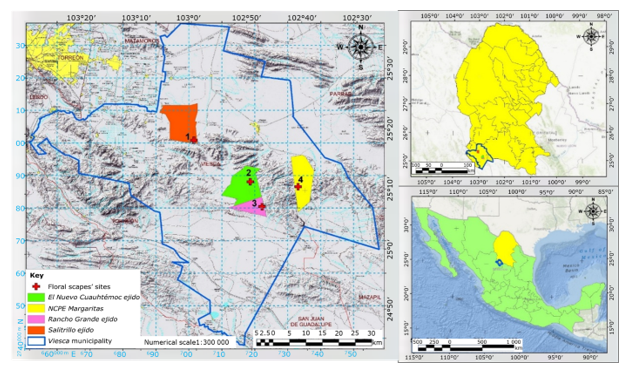
The quality of propagative material is a key factor in the regeneration and management of plant species. There is limited information on variations in quality between Dasylirion cedrosanum seeds from different natural localities or provenances. Within this context, the objective of this study was to evaluate the morphometric, physical, and physiological quality of D. cedrosanum seeds collected in four locations within Viesca municipality, state of Coahuila de Zaragoza, Mexico. Morphometric variables (length and width) and physical (pure seeds, empty seeds, inert matter, bulk density, and moisture content) and physiological quality parameters (viability, germination, abnormal seedlings, and ungerminated seeds) were analyzed. The results showed significant differences in seed size and physiological quality (p≤0.05) between localities, while some physical variables showed no variation. Viability ranged between 60 and 96 %, and germination, from 55 to 94 percent, with the highest values recorded at Rancho Grande. The linear regression between viability and germination was significant (p<0.001) and explained 56.8 % of the variation; therefore, the viability may indicate germination behavior. However, the presence of abnormal seedlings suggests that viability does not fully explain the physiological quality of the evaluated lots. Overall, the results show that the quality of propagation material varies across localities, highlighting the importance of selecting D. cedrosanum seed sources with high physiological performance for use in propagation and management programs in arid ecosystems.
Downloads
References
Becerra-López, J. L., Rosales-Serna, R., Ehsan, M., Becerra-López, J. S., Czaja, A., Estrada-Rodríguez, J. L., Romero-Méndez, U., Santana-Espinosa, S., Reyes-Rodríguez, C. M., Ríos-Saucedo, J. C., & Domínguez-Martínez, P. A. (2020). Climatic change and habitat availability for three sotol species in México: a vision towards their sustainable use. Sustainability, 12(8), Article 3455. https://doi.org/10.3390/su12083455
Benavides-Mendoza, A., Hernández-Juárez, A., & Francisco-Francisco, N. (2023). Germinación, crecimiento vegetativo y morfología floral de Dasylirion cedrosanum del matorral rosetófilo de Coahuila. CienciaUAT, 18(1), 191-201. https://doi.org/10.29059/cienciauat.v18i1.1772
Finch-Savage, W. E., & Leubner-Metzger, G. (2006). Seed dormancy and the control of germination. New Phytologist, 171(3), 501-523. https://doi.org/10.1111/j.1469-8137.2006.01787.x
Finkelstein, R., Reeves, W., Ariizumi, T., & Steber, C. (2008). Molecular aspects of seed dormancy. Annual Review of Plant Biology, 59, 387-415. https://doi.org/10.1146/annurev.arplant.59.032607.092740
Granados-Sánchez, D., Sánchez-González, A., Granados-Victorino, R. L., & Borja-de la Rosa, A. (2011). Ecología de la vegetación del Desierto Chihuahuense. Revista Chapingo Serie Ciencias Forestales y del Ambiente, 17(Esp.), 111-130. https://doi.org/10.5154/r.rchscfa.2010.10.102
Huss, J. C., & Gierlinger, N. (2021). Functional packaging of seeds. New Phytologist, 230(6), 2154-2163. https://doi.org/10.1111/nph.17299
Instituto Nacional de Estadística, Geografía e Informática. (2006). Conjunto de datos vectoriales escala 1:1 000 000. Precipitación media anual [Carta climatológica]. Instituto Nacional de Estadística, Geografía e Informática. https://www.inegi.org.mx/app/biblioteca/ficha.html?upc=702825267544
Instituto Nacional de Estadística, Geografía e Informática. (2008). Conjunto de datos vectoriales escala 1:1 000 000. Unidades climáticas [Carta climática]. Instituto Nacional de Estadística, Geografía e Informática. https://www.inegi.org.mx/app/biblioteca/ficha.html?upc=702825267568
Instituto Nacional de Estadística y Geografía. (2018). Conjunto de datos vectoriales de uso del suelo y vegetación. Escala 1:250 000. Serie VII. Conjunto Nacional [Cartas de uso del suelo y vegetación]. Instituto Nacional de Estadística y Geografía. https://www.inegi.org.mx/app/biblioteca/ficha.html?upc=889463842781
International Seed Testing Association. (2024). Rules Proposals for the International Rules for Seed Testing 2025 Edition (Document OGM24-05). International Seed Testing Association. https://www.seedtest.org/api/rm/2P6ZX54AR2A37H5/rules-proposals-final.pdf
Madrid-Solórzano, J. M., García-Alcaraz, J. L., Jiménez-Macías, E., Martínez-Cámara, E., & Blanco-Fernández, J. (2021). Life cycle analysis of sotol production in Mexico. Frontiers in Sustainable Food Systems, 5, Article 769478. https://doi.org/10.3389/fsufs.2021.769478
Moles, A. T., & Westoby, M. (2006). Seed size and plant strategy across the whole life cycle. Oikos, 113(1), 91-105. https://doi.org/10.1111/j.0030-1299.2006.14194.x
Morales-Santos, M. E., Peña-Valdivia, C. B., García-Esteva, A., Aguilar-Benítez, G., & Kohashi-Shibata, J. (2017). Características físicas y de germinación en semillas y plántulas de frijol (Phaseolus vulgaris L.) silvestre, domesticado y su progenie. Agrociencia, 51, 43-62. https://www.agrociencia-colpos.org/index.php/agrociencia/article/view/1277
Orozco-Sifuentes, M. M., García-Martínez, J. E., Arévalo-Sanmiguel, C. A., Ramírez-Godina, F., & Reyes-Valdés, M. H. (2019). Potencial nutritivo de las semillas de sotol (Dasylirion cedrosanum). Revista Fitotecnia Mexicana, 42(4), 385-392. https://doi.org/10.35196/rfm.2019.4.385-392
Ortiz-López, A., Velasco-Velasco, V. A., Martínez-Gutiérrez, G. A., Campos-Angeles, G. V., & Rodríguez-Ortiz, G. (2023). Morfología de los frutos de Dasylirion spp. procedentes de la mixteca oaxaqueña. Revista Mexicana de Agroecosistemas, 10(2), 78-89. https://revistaremaeitvo.mx/index.php/remae/article/view/369/342
Ortiz-López, A., Velasco-Velasco, V. A., Martínez-Gutiérrez, G. A., Campos-Angeles, G. V., & Rodríguez-Ortiz, G. (2024). Potencial germinativo de Dasylirion spp. como respuesta a regímenes térmicos pregerminativos. Ecosistemas y Recursos Agropecuarios, 11(3), Artículo e4005. https://era.ujat.mx/rera/es/article/view/4005
Penfield, S. (2017). Seed dormancy and germination. Current Biology, 27, R874-R878. https://doi.org/10.1016/j.cub.2017.05.050
Pérez-Sánchez, R. M., Jurado, E., Chapa-Vargas, L., & Flores, J. (2011). Seed germination of Southern Chihuahuan Desert plants in response to elevated temperatures. Journal of Arid Environments, 75(10), 978-980. https://doi.org/10.1016/j.jaridenv.2011.04.020
Probert, R. J., Daws, M. I., & Hay, F. R. (2009). Ecological correlates of ex situ seed longevity: a comparative study on 195 species. Annals of Botany, 104(1), 57-69. https://doi.org/10.1093/aob/mcp082
R Core Team. (2025). Index of/bin/windows/base/old/4.5.2 [Software]. R Foundation for Statistical Computing. https://cran.r-project.org/bin/windows/base/old/4.5.2/
Rajjou, L., Duval, M., Gallardo, K., Catusse, J., Bally, J., Job, C., & Job, D. (2012). Seed germination and vigor. Annual Review of Plant Biology, 63, 507-533. https://doi.org/10.1146/annurev-arplant-042811-105550
Rubio-de Casas, R., Willis, C. G., Pearse, W. D., Baskin, C. C., Baskin, J. M., & Cavender-Bares, J. (2017). Global biogeography of seed dormancy is determined by seasonality and seed size: a case study in the legumes. New Phytologist, 214(4), 1527-1536. https://doi.org/10.1111/nph.14498
Ruiz-Flores, S. I., & Castro-Castro, A. (2024). Distribución, riqueza, endemismo y conservación del género Dasylirion (Asparagaceae, Convallarioideae). Acta Botánica Mexicana, 131, Artículo e2367. https://doi.org/10.21829/abm131.2024.2367
Toribio-Ferrer, L. M., Aguirre-Calderón, O. A., Alanís-Rodríguez, E., Morán-Martínez, A. L., Toribio-Ferrer, E., & Rascón-Solano, J. (2025). Redistribución del valor bruto de producción como estrategia para estabilizar los ingresos comunitarios en zonas áridas: estudio de caso en el NCPE Nuevo San Pedro, Coahuila. e-CUCBA, 12(26), 61-68. https://doi.org/10.32870/e-cucba.vi26.404
Villarreal-Quintanilla, J. A., Bartolomé-Hernández, J. A., Estrada-Castillón, E., Ramírez-Rodríguez, H., & Martínez-Amador, S. J. (2017). El elemento endémico de la flora vascular del Desierto Chihuahuense. Acta Botánica Mexicana, 118, 65-96. https://doi.org/10.21829/abm118.2017.1201
Downloads
Published
How to Cite
Issue
Section
License
Copyright (c) 2026 Revista Mexicana de Ciencias Forestales

This work is licensed under a Creative Commons Attribution-NonCommercial 4.0 International License.
The authors who publish in Revista Mexicana de Ciencias Forestales accept the following conditions:
In accordance with copyright laws, Revista Mexicana de Ciencias Forestales recognizes and respects the authors’ moral right and ownership of property rights which will be transferred to the journal for dissemination in open access.
All the texts published by Revista Mexicana de Ciencias Forestales –with no exception– are distributed under a Creative Commons License Attribution-NonCommercial 4.0 International (CC BY-NC 4.0), which allows third parties to use the publication as long as the work’s authorship and its first publication in this journal are mentioned
The author(s) can enter into independent and additional contractual agreements for the nonexclusive distribution of the version of the article published in Revista Mexicana de Ciencias Forestales (for example, include it into an institutional repository or publish it in a book) as long as it is clearly and explicitly indicated that the work was published for the first time in Revista Mexicana de Ciencias Forestales.
For all the above, the authors shall send the form of Letter-transfer of Property Rights for the first publication duly filled in and signed by the author(s). This form must be sent as a PDF file to: ciencia.forestal2@inifap.gob.mx
This work is licensed under a Creative Commons Attribution-Noncommercial 4.0 International license.