Effects of forest management on the carbon-nitrogen ratio of litter in temperate forests
DOI:
https://doi.org/10.29298/rmcf.v17i96.1654Keywords:
Temperate forests, organic carbon, litter, total nitrogen, C:N ratio, silvicultural treatmentsAbstract
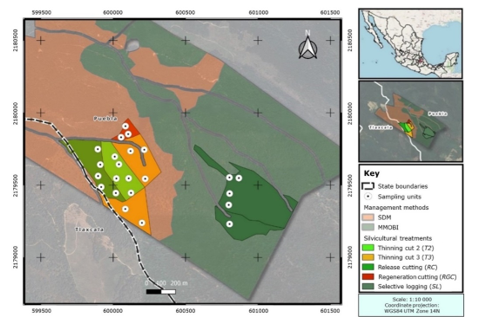
In temperate forests, carbon storage is distributed among biomass, mineral soil, and litter. The latter acts as both a carbon source and a carbon sink, as it accumulates plant debris that, through microbial decomposition, promotes the formation of stable organic matter in the soil and controls the gradual release of labile organic compounds. This study assessed the impact of various silvicultural treatments on the carbon-nitrogen ratio in the litter of managed Pinus patula forests in the Emiliano Zapata ejido, Chignahuapan, state of Puebla, Mexico. Circular sampling plots of 1 000 m2 were established, 18 of them distributed across stands treated with Regeneration cutting (RGC), Release cutting (RC), Thinning 2 (T2), and Thinning 3 (T3), and five in stands with Selective logging (SL). The basal area of the tree stand was estimated, and the litter was sampled in two layers (LL: leaf litter and FE: fermentation); the soil variables of temperature, moisture, and pH were measured. In the laboratory, organic carbon (OC) and total nitrogen (TN) were determined, and the C:N ratio was calculated for both layers using general linear models with a gamma distribution and effects modeled using a Structural partial equation model. The C:N ratio was found to differ between LL and FE; the treatment with the most open canopy (RGC) had the greatest influence on the forest floor microclimate. Therefore, silvicultural treatments modulate soil and climate conditions, affecting the decomposition of organic matter and carbon sequestration in the litter layer.
Downloads
References
Alhamd, L., Arakaki, S., & Hagihara, A. (2004). Decomposition of leaf litter of four tree species in a subtropical evergreen broad-leaved forest, Okinawa Island, Japan. Forest Ecology and Management, 202(1-3), 1-11. https://doi.org/10.1016/j.foreco.2004.02.062 DOI: https://doi.org/10.1016/j.foreco.2004.02.062
Althuizen, I. H., Lee, H., Sarneel, J. M., & Vandvik, V. (2018). Long-term climate regime modulates the impact of short-term climate variability on decomposition in alpine grassland soils. Ecosystems, 21, 1580-1592. https://doi.org/10.1007/s10021-018-0241-5 DOI: https://doi.org/10.1007/s10021-018-0241-5
Bao, H. W. S. (2023, August 23). bruceR: Broadly useful convenient and efficient R functions (Version 2026) [Computer software]. Comprehensive R Archive Network. https://CRAN.R-project.org/package=bruceR
Cano-Flores, O., Vela-Correa, G., Acevedo-Sandoval, O. A., & Valera-Pérez, M. Á. (2020). Concentraciones de carbono orgánico en el arbolado y suelos del área natural protegida El Faro en Tlalmanalco, Estado de México. Terra Latinoamericana, 38(4), 895-905. https://doi.org/10.28940/terra.v38i4.757 DOI: https://doi.org/10.28940/terra.v38i4.757
Comisión Nacional Forestal. (2017). Inventario Nacional Forestal y de Suelos. Procedimientos de muestreo. Versión 17.3. Comisión Nacional Forestal. https://www.snieg.mx/DocAcervoINN/documentacion/inf_nvo_acervo/SNIGMA/Inv_Nac_For_Suelos/INFyS_2017_Procedimientos_de_muestreo_V_17_3.pdf
Dai, K., Johnson, C. E., & Driscoll, C. T. (2001). Organic matter chemistry and dynamics in clear-cut and unmanaged hardwood forest ecosystems. Biogeochemistry, 54, 51-83. https://doi.org/10.1023/A:1010697518227 DOI: https://doi.org/10.1023/A:1010697518227
Davidson, E. A., & Janssens, I. A. (2006). Temperature sensitivity of soil carbon decomposition and feedbacks to climate change. Nature, 440, 165-173. https://doi.org/10.1038/nature04514 DOI: https://doi.org/10.1038/nature04514
De Frenne, P., Lenoir, J., Luoto, M., Scheffers, B. R., Zellweger, F., Aalto, J., Ashcroft, M. B., Christiansen, D. M., Decocq, G., De Pauw, K., Govaert, S., Greiser, C., Gril, E., Hampe, A., Jucker, T., Klinges, D. H., Koelemeijer, I. A., Lmbrechts, J. J., Marrec, R., … Hylander, K. (2021). Forest microclimates and climate change: Importance, drivers and future research agenda. Global Change Biology, 27(11), 2279-2297. https://doi.org/10.1111/gcb.15569 DOI: https://doi.org/10.1111/gcb.15569
Fernández-Getino-García, A. P. (2024). Characterization of soil organic carbon at profile scale in two forest soils under pine and holm oak. Soil Research, 62(7), Article SR24051. https://doi.org/10.1071/SR24051 DOI: https://doi.org/10.1071/SR24051
Galicia, L., Gamboa-Cáceres, A. M., Cram, S., Chávez-Vergara, B., Peña-Ramírez, V., Saynes, V., & Siebe, C. (2016). Almacén y dinámica del carbono orgánico del suelo en bosques templados de México. Terra Latinoamericana, 34(1), 1-29. http://www.scielo.org.mx/scielo.php?script=sci_arttext&pid=S0187-57792016000100001&lng=es&tlng=es
García, E. (2004). Modificaciones al sistema de clasificación climática de Köppen (Serie Libros, Núm. 6). Instituto de Geografía de la Universidad Nacional Autónoma de México. https://publicaciones.geografia.unam.mx/index.php/ig/catalog/book/83
Getino-Álvarez, M., San-Martin, R., Pretzsch, H., Pach, M., Bravo, F., & Turrión, M.-B. (2023). Assessing soil C stock and C to N ratio of soil organic matter under mixed pine-beech forests at different scales. European Journal of Forest Research, 142, 1081-1098. https://doi.org/10.1007/s10342-023-01578-5 DOI: https://doi.org/10.1007/s10342-023-01578-5
Gilliam, F. S., Dick, D. A., Kerr, M. L., & Adams, M. B. (2004). Effects of silvicultural practices on soil carbon and nitrogen in a nitrogen saturated central Appalachian (USA) hardwood forest ecosystem. Environmental Management, 33(Suppl 1), S108-S119. https://doi.org/10.1007/s00267-003-9121-6 DOI: https://doi.org/10.1007/s00267-003-9121-6
Gregorich, E. G., Janzen, H., Ellert, B. H., Helgason, B. L., Qian, B., Zebarth, B. J., Angers, D. A., Beyaert, R. P., Drury, C. F., Duguid, S. D., May, W. E., McConkey, B. G., & Dyck, M. F. (2017). Litter decay controlled by temperature, not soil properties, affecting future soil carbon. Global Change Biology, 23(4), 1725-1734. https://doi.org/10.1111/gcb.13502 DOI: https://doi.org/10.1111/gcb.13502
Holm, S. (1979). A simple sequentially rejective multiple test procedure. Scandinavian Journal of Statistics, 6(2), 65-70. https://www.jstor.org/stable/4615733
Kirkby, C. A., Kirkegaard, J. A., Richardson, A. E., Wade, L. J., Blanchard, C., & Batten, G. (2011). Stable soil organic matter: A comparison of C:N:P:S ratios in Australian and other world soils. Geoderma, 163(3-4), 197-208. https://doi.org/10.1016/j.geoderma.2011.04.010 DOI: https://doi.org/10.1016/j.geoderma.2011.04.010
Kuśmierz, S., Skowrońska, M., Tkaczyk, P., Lipiński, W., & Mielniczuk, J. (2023). Soil organic carbon and mineral nitrogen contents in soils as affected by their pH, texture and fertilization. Agronomy, 13(1), Article 267. https://doi.org/10.3390/agronomy13010267 DOI: https://doi.org/10.3390/agronomy13010267
Latterini, F., Dyderski, M. K., Horodecki, P., Picchio, R., Venanzi, R., Lapin, K., & Jagodziński, A. M. (2023). The effects of forest operations and silvicultural treatments on litter decomposition rate: a meta-analysis. Current Forestry Reports, 9, 276-290. https://doi.org/10.1007/s40725-023-00190-5 DOI: https://doi.org/10.1007/s40725-023-00190-5
Lefcheck, J. S. (2016). PIECEWISESEM: Piecewise structural equation modelling in R for ecology, evolution, and systematics. Methods in Ecology and Evolution, 7(5), 573-579. https://doi.org/10.1111/2041-210X.12512 DOI: https://doi.org/10.1111/2041-210X.12512
Leyva-Pablo, T., de León-González, F., Etchevers-Barra, J. D., Cortés-Pérez, M., Santiago-García, W., Ponce-Mendoza, A., & Fuentes-Ponce, M. H. (2021). Almacenamiento de carbono en bosques con manejo forestal comunitario. Madera y Bosques, 27(4), Artículo e2742421. https://doi.org/10.21829/myb.2021.2742421 DOI: https://doi.org/10.21829/myb.2021.2742421
López-Merlín, D., Maldonado, V., Wayson, C., Carrillo, O., Dupuy-Rada, J. M., Ángeles-Pérez, G., Caamal-Sosa, J. P., Méndez-López, B., Sánchez-Santos, G., Chávez-Aguilar, G., Johnson, K., Tamayo, M., & Puc, S. (2015). Capitulo III. Reservorios del carbono en parcelas permanentes. En Fortalecimiento REDD+ (Ed.), Protocolo para la estimación de la dinámica del carbono forestal en sitios de medición intensiva: un enfoque multi-escala (pp. 16-47). Fortalecimiento REDD+ y Cooperación Sur-Sur. https://pmcarbono.org/pmc/descargas/proyectos/Documentos_Red_Mex-SMIC/Protocolo_Red_Mex_SMIC-MultiEscala.pdf
Mamani, M., Miranda, R., López, M. A., Yujra, E., López, M., & Chuquimia, A. (2020). Validación del método Kjeldahl en la determinación del Nitrógeno Mineral, mediante el uso de Cloruro Potasio. Apthapi, 6(2), 1917-1925. https://apthapi.umsa.bo/index.php/ATP/article/view/60
Manzoni, S., Taylor, P., Richter, A., Porporato, A., & Ågren, G. I. (2012). Environmental and stoichiometric controls on microbial carbon-use efficiency in soils. New Phytologist, 196(1), 79-91. https://doi.org/10.1111/j.1469-8137.2012.04225.x DOI: https://doi.org/10.1111/j.1469-8137.2012.04225.x
Paz-Pellat, F., Wong-González, J., & Torres-Alamilla, R. (Eds.). (2015). Estado actual del conocimiento del ciclo del carbono y sus interacciones en México: Síntesis a 2015 (Serie: Síntesis Nacionales). Programa Mexicano del Carbono, Centro del Cambio Global y la Sustentabilidad en el Sureste, A. C., Centro Internacional de Vinculación y Enseñanza de la Universidad Juárez Autónoma de Tabasco. https://www.researchgate.net/publication/301650937_Serie_Sintesis_Nacionales_ESTADO_ACTUAL_DEL_CONOCIMIENTO_DEL_CICLO_DEL_CARBONO_Y_SUS_INTERACCIONES_EN_MEXICO_SINTESIS_A_2015
Paul, K. I., England, J. R., & Roxburgh, S. H. (2022). Carbon dynamics in tree plantings: How changes in woody biomass impact litter and soil carbon. Forest Ecology and Management, 521, Article 120406. https://doi.org/10.1016/j.foreco.2022.120406 DOI: https://doi.org/10.1016/j.foreco.2022.120406
Pérez-Vázquez, Z. R., Ángeles-Pérez, G., Chávez-Vergara, B., Valdez-Lazalde, J. R., & Ramírez-Guzmán, M. E. (2021). Enfoque espacial para modelación de carbono en el mantillo de bosques bajo manejo forestal maderable. Madera y Bosques, 27(1), Artículo e2712122. https://doi.org/10.21829/myb.2021.2712122 DOI: https://doi.org/10.21829/myb.2021.2712122
Prévost-Bouré, N. C., Soudani, K., Damesin, C., Berveiller, D., Lata, J.-C., & Dufrêne, E. (2010). Increase in aboveground fresh litter quantity over-stimulates soil respiration in a temperate deciduous forest. Applied Soil Ecology, 46(1), 26-34. https://doi.org/10.1016/j.apsoil.2010.06.004 DOI: https://doi.org/10.1016/j.apsoil.2010.06.004
R Core Team. (2024). R: A language and environment for statistical computing (Version 4.5.2) [Computer software]. R Foundation for Statistical Computing. https://www.R-project.org/
Ramírez-Maldonado, H. (2017). Manual para la elaboración de programas de manejo forestal maderable en clima templado frío [Libro blanco]. Comisión Nacional Forestal. https://www.gob.mx/cms/uploads/attachment/file/314226/Manual_para_la_Elaboracion_de_PMFM.pdf
Rocha-Loredo, A. G., & Ramírez-Marcial, N. (2009). Producción y descomposición de hojarasca en diferentes condiciones sucesionales del bosque de pino-encino en Chiapas, México. Boletín de la Sociedad Botánica de México, 84, 1-12. https://www.scielo.org.mx/scielo.php?script=sci_arttext&pid=S0366-21282009000100001 DOI: https://doi.org/10.17129/botsci.2287
Spohn, M., & Stendahl, J. (2024). Soil carbon and nitrogen contents in forest soils are related to soil texture in interaction with pH and metal cations. Geoderma, 441, Article 116746. https://doi.org/10.1016/j.geoderma.2023.116746 DOI: https://doi.org/10.1016/j.geoderma.2023.116746
Tong, R., Ji, B., Wang, G. G., Lou, C., Ma, C., Zhu, N., Yuan, W., & Wu, T. (2024). Canopy gap impacts on soil organic carbon and nutrient dynamic: a meta-analysis. Annals of Forest Science, 81, Article 12. https://doi.org/10.1186/s13595-024-01224-z DOI: https://doi.org/10.1186/s13595-024-01224-z
Valladares-Samperio, K., & Galicia-Sarmiento, L. (2021). Impacts of forest management on soil properties: a fundamental research topic for Mexico. Revista Chapingo Serie Ciencias Forestales y del Ambiente, 27(1), 33-52. http://dx.doi.org/10.5154/r.rchscfa.2019.11.088 DOI: https://doi.org/10.5154/r.rchscfa.2019.11.088
Velasco-Bautista, E., Gutiérrez-García, J. V., Correa-Díaz, A., Ortiz-Reyes, A. D., & Moreno-Sánchez, F. (2025). Diseño de muestreo temporal y métodos alternativos de estimación en un sistema de monitoreo forestal [Folleto Técnico Núm. 38]. Instituto Nacional de Investigaciones Forestales, Agrícolas y Pecuarias.
Zar, J. H. (2010). Biostatistical analysis (5th ed.). Pearson Prentice Hall. https://books.google.com.mx/books/about/Biostatistical_Analysis.html?id=LCRFAQAAIAAJ&redir_esc=y
Zhang, Y. J., Guo, S. L., Zhao, M., Du, L. L., Li, R. J., Jiang, J. S., Wang, R., & Li, N. N. (2015). Soil moisture influence on the interannual variation in temperature sensitivity of soil organic carbon mineralization in the Loess Plateau. Biogeosciences, 12(11), 3655-3664. https://doi.org/10.5194/bg-12-3655-2015 DOI: https://doi.org/10.5194/bg-12-3655-2015
Zhang, S., Sjögren, J., & Jönsson, M. (2024). Retention forestry amplifies microclimate buffering in boreal forests. Agricultural and Forest Meteorology, 350, Article 109973. https://doi.org/10.1016/j.agrformet.2024.109973 DOI: https://doi.org/10.1016/j.agrformet.2024.109973
Downloads
Published
How to Cite
Issue
Section
License
Copyright (c) 2026 Revista Mexicana de Ciencias Forestales

This work is licensed under a Creative Commons Attribution-NonCommercial 4.0 International License.
The authors who publish in Revista Mexicana de Ciencias Forestales accept the following conditions:
In accordance with copyright laws, Revista Mexicana de Ciencias Forestales recognizes and respects the authors’ moral right and ownership of property rights which will be transferred to the journal for dissemination in open access.
All the texts published by Revista Mexicana de Ciencias Forestales –with no exception– are distributed under a Creative Commons License Attribution-NonCommercial 4.0 International (CC BY-NC 4.0), which allows third parties to use the publication as long as the work’s authorship and its first publication in this journal are mentioned
The author(s) can enter into independent and additional contractual agreements for the nonexclusive distribution of the version of the article published in Revista Mexicana de Ciencias Forestales (for example, include it into an institutional repository or publish it in a book) as long as it is clearly and explicitly indicated that the work was published for the first time in Revista Mexicana de Ciencias Forestales.
For all the above, the authors shall send the form of Letter-transfer of Property Rights for the first publication duly filled in and signed by the author(s). This form must be sent as a PDF file to: ciencia.forestal2@inifap.gob.mx
This work is licensed under a Creative Commons Attribution-Noncommercial 4.0 International license.