Variación adaptativa en caracteres morfológicos de plántulas de Pinus patula Schiede ex Schltdl. & Cham.
DOI:
https://doi.org/10.29298/rmcf.v17i96.1647Palabras clave:
capacidad germinativa, correlaciones canónicas, diferenciación genética, evaluación temprana, rasgos morfológicos, selección naturalResumen
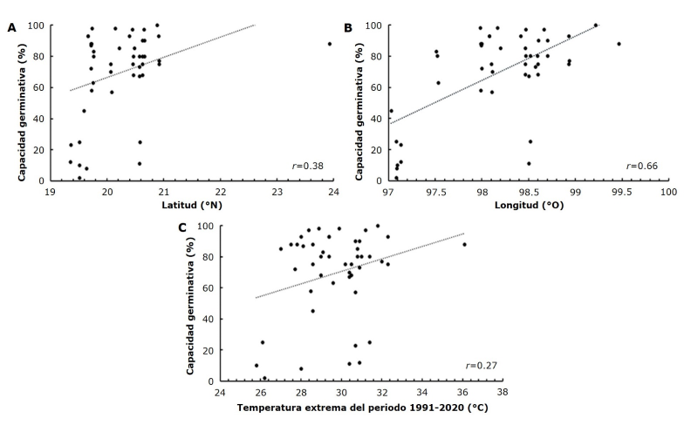
La fase de establecimiento de las plantas leñosas está sujeta a fuertes presiones de selección, por ello las características morfológicas de las plántulas tienen un alto valor adaptativo y son importantes en los procesos de mejora genética. Los objetivos del presente estudio fueron determinar el valor adaptativo en características morfológicas de plántulas de Pinus patula y su relación con las condiciones geoclimáticas del sitio de origen de la semilla. La capacidad germinativa (CG), el número de cotiledones (NC), la longitud de cotiledones (LC) y la longitud de hipocótilo (LH) fueron evaluadas y correlacionadas con variables geoclimáticas del periodo 1991-2020 de los sitios de origen de las progenies. La variación genética entre familias resultó amplia; la mayor variación en CG registró valores promedio de 11 a 100 %. Con excepción del NC, la correlación entre las variables morfológicas con la latitud, longitud, temperatura media anual, temperatura del mes más cálido, fechas de inicio y término del periodo sin heladas, precipitación en forma de nieve y temperatura extrema varió de -0.29 a 0.66. Las semillas de sitios más al norte y al oeste, más cálidos y con mayor periodo libre de heladas, presentaron valores superiores de CG, LC y LH. La primera función canónica explicó 77 % de la variación entre variables morfológicas y geoclimáticas. Los resultados contribuyen a identificar los factores geoclimáticos que influyen en la adaptación de Pinus patula en etapas tempranas de desarrollo, para favorecer el vigor inicial de las plántulas y su adaptación durante la fase de establecimiento.
Descargas
Citas
Adams, W. T., Aitken, S. N., Joyce, D. G., Howe, G. T., & Vargas-Hernández, J. (2001). Evaluating efficacy of early testing for stem growth in coastal Douglas-fir. Silvae Genetica, 50(3-4), 167-175. https://pnwtirc.forestry.oregonstate.edu/evaluating-efficacy-early-testing-stem-growth-coastal-douglas-fir
Badilla, Y., & Murillo, O. (2026). Optimal age for selection in breeding clonal Tectona grandis. Silvae Genetica, 75(1), 1-8. https://doi.org/10.2478/sg-2026-0001 DOI: https://doi.org/10.2478/sg-2026-0001
Bareke, T (2018). Biology of seed development and germination physiology. Advances in Plants & Agriculture Research, 8(4), 336-346. https://www.doi.org/10.15406/apar.2018.08.00335 DOI: https://doi.org/10.15406/apar.2018.08.00335
Barton, K. E., Jones, C., Edwards, K. F., Shiels, A. B., & Knight, T. (2020). Local adaptation constrains drought tolerance in a tropical foundation tree. Journal of Ecology, 108(4), 1540-1552. https://doi.org/10.1111/1365-2745.13354 DOI: https://doi.org/10.1111/1365-2745.13354
Blanco-Pastor, J. L., Barre, P., Keep, T., Ledauphin, T., Escobar-Gutiérrez, A., Roschanski, A. M., Willner, E., Dehmer, K. J., Hegarty, M., Muylle, H., Veeckman, E., Vandepoele, K., Ruttink, T., Roldán-Ruiz, I., Manel, S., & Sampoux, J.-P. (2021). Canonical correlations reveal adaptive loci and phenotypic responses to climate in perennial ryegrass. Molecular Ecology Resources, 21(3), 849-870. https://doi.org/10.1111/1755-0998.13289 DOI: https://doi.org/10.1111/1755-0998.13289
Cai, H., Shao, J., & Shen, Y. (2025). Seed storability in forest trees: research progress and future perspectives. Forests, 16(3), Article 467. https://doi.org/10.3390/f16030467 DOI: https://doi.org/10.3390/f16030467
Cai, N., Xu, Y., Chen, S., He, B., Li, G., Li, Y., & Duan, A. (2016). Variation in seed and seedling traits and their relations to geo-climatic factors among populations in Yunnan Pine (Pinus yunnanensis). Journal of Forest Research, 27, 1009-1017. https://doi.org/10.1007/s11676-016-0228-z DOI: https://doi.org/10.1007/s11676-016-0228-z
Callejas-Díaz, M., Chambel, M. R., San-Martín-Lorén, J., Gea-Izquierdo, G., Santos-del-Blanco, L., Postma, E., & Climent, J. M. (2022). The role of maternal age, growth, and environment in shaping offspring performance in an aerial conifer seed bank. American Journal of Botany, 109(3), 366-376. https://doi.org/10.1002/ajb2.1811 DOI: https://doi.org/10.1002/ajb2.1811
Capilla-Dinorin, E., López-Upton, J., Jiménez-Casas, M., & Pérez-Luna, A. (2025). Supervivencia y crecimiento inicial de Pinus chiapensis en gradientes ambientales de Puebla y Veracruz. Ecosistemas y Recursos Agropecuarios, 12(3), Artículo e4739. https://doi.org/10.19136/era.a12n3.4739 DOI: https://doi.org/10.19136/era.a12n3.4739
Capilla-Dinorin, E., López-Upton, J., Jiménez-Casas, M., & Rebolledo-Camacho, V. (2021). Características reproductivas y calidad de semilla en poblaciones fragmentadas de Pinus chiapensis (Martínez) Andresen. Revista Fitotecnia Mexicana, 44(2), 211-219. https://doi.org/10.35196/rfm.2021.2.211 DOI: https://doi.org/10.35196/rfm.2021.2.211
Caruso, C. M., Maherali, H., & Martin, R. A. (2019). A meta-analysis of natural selection on plant functional traits. International Journal of Plant Sciences, 181(1), 44-55. https://doi.org/10.1086/706199 DOI: https://doi.org/10.1086/706199
Castoldi, E., & Molina, J. A. (2014). Effect of seed mass and number of cotyledons on seed germination after heat treatment in Pinus sylvestris L. var. iberica Svob. Forest Systems, 23(3), 483-489. https://doi.org/10.5424/fs/2014233-05480 DOI: https://doi.org/10.5424/fs/2014233-05480
Center for Forest Conservation Genetics. (2023). ClimateNA_MAP (version 7.42) [Climate database]. University of British Columbia. https://climatena.ca/mapversion
Christie, K., Pierson, N. R., Lowry, D. B., & Holeski, L. M. (2022). Local adaptation of seed and seedling traits along a natural aridity gradient may both predict and constrain adaptive responses to climate change. American Journal of Botany, 109(10), 1529-1544. https://doi.org/10.1002/ajb2.16070 DOI: https://doi.org/10.1002/ajb2.16070
Corbineau, F. (2024). The effects of storage conditions on seed deterioration and ageing: how to improve seed longevity. Seeds, 3(1), 56-75. https://doi.org/10.3390/seeds3010005 DOI: https://doi.org/10.3390/seeds3010005
Duncan, C., Schultz, N., Lewandrowski, W., Good, M. K., & Cook. S. (2019). Lower dormancy with rapid germination is an important strategy for seeds in an arid zone with unpredictable rainfall. PLoS One, 14(9), Article e0218421. https://doi.org/10.1371/journal.pone.0218421 DOI: https://doi.org/10.1371/journal.pone.0218421
Dvorak, W. S., Hodge, G. R., Kietzka, J. E., Malan, F., Osorio, L. F., & Stanger, T. K. (2000). Pinus patula. In Central America and Mexico Coniferous Resources Cooperative (Ed.), Conservation & testing of tropical & subtropical forest tree species (pp. 148-173). College of Natural Resources. https://www.cabidigitallibrary.org/doi/full/10.5555/20003029405
Escobar-Sandoval, M. C., Vargas-Hernández, J. J., López-Upton, J., Espinosa-Zaragoza, S., & Borja-de la Rosa, A. (2018). Parámetros genéticos de calidad de madera, crecimiento y ramificación en Pinus patula. Madera y Bosques, 24(2), Artículo e2421595. https://doi.org/10.21829/myb.2018.2421595 DOI: https://doi.org/10.21829/myb.2018.2421595
Farahani, H. A., Moaveni, P., & Maroufi, K. (2011). Effect of seed size on germination percentage in green gram (Vigna radiata L.). Advances in Environmental Biology, 5(7), 1674-1679. https://www.aensiweb.com/old/aeb/2011/1674-1679.pdf
Farfán-Vázquez, E. de G., Jasso-Mata, J., López-Upton, J., Vargas-Hernández, J. J., & Ramírez-Herrera, C. (2002). Parámetros genéticos y eficiencia de la selección temprana en Pinus ayacahuite Ehren. var. ayacahuite. Revista Fitotecnia Mexicana, 25(3), 239-246. https://doi.org/10.35196/rfm.2002.3.239 DOI: https://doi.org/10.35196/rfm.2002.3.239
George-Miranda, S., Guillén, S., Viveros-Viveros, H., Montero-Nava, R., & Martínez y Pérez, J. L. (2022). Low germination rate of Pinus hartwegii seeds from trees growing at high elevations: Vulnerability to climate change? Forest Ecology and Management, 507, Article 120001. https://doi.org/10.1016/j.foreco.2021.120001 DOI: https://doi.org/10.1016/j.foreco.2021.120001
Ghildiyal, S. K., Sharma, C. M., & Gairola, S. (2009). Environmental variation in seed and seedling characteristics of Pinus roxburghii Sarg. from Uttarakhand, India. Applied Ecology and Environmental Research, 7(2), 121-129. https://doi.org/10.15666/aeer/0702_121129 DOI: https://doi.org/10.15666/aeer/0702_121129
Hamann, A., Koshy, M. P., Namkoong, G., & Ying, C. C. (2000). Genotype×environment interactions in Alnus rubra: developing seed zones and seed-transfer guidelines with spatial statistics and GIS. Forest Ecology and Management, 136(1-3), 107-119. https://doi.org/10.1016/S0378-1127(99)00284-4 DOI: https://doi.org/10.1016/S0378-1127(99)00284-4
Hermesh, R., & Acharya, S. N. (1992). Influence of maternal plant environment and provenance on alpine bluegrass seed germination. Canadian Journal of Plant Science, 72(3), 801-808. https://doi.org/10.4141/cjps92-096 DOI: https://doi.org/10.4141/cjps92-096
Hojjat, S. (2011). Effects of seed size on germination and seedling growth of some Lentil genotypes (Lens culinaris Medik.). International Journal of Agriculture and Crop Sciences, 3(1), 1-5. https://www.researchgate.net/publication/330159194_Effects_of_seed_size_on_germination_and_seedling_growth_of_some_Lentil_genotypes_Lens_culinaris_Medik
International Seed Testing Association. (2024). International Rules for Seed Testing. In International Seed Testing Association (Ed.), International Rules for Seed Testing (Chapter 2, i–2-44 (52)). International Seed Testing Association. https://www.seedtest.org/api/rm/9356SQF24TUK454/ista-rules-2024-02-sampling-final.pdf
Juárez-Agis, A., López-Upton, J., Vargas-Hernández, J. J., & Sáenz-Romero, C. (2006). Variación geográfica en la germinación y crecimiento inicial de plántulas de Pseudotsuga menziesii de México. Agrociencia, 40(6), 783-792. https://www.agrociencia-colpos.org/index.php/agrociencia/article/view/509
Larson, J. E., Anacker, B. L., Wanous, S., & Funk, J. L. (2020). Ecological strategies begin at germination: Traits, plasticity and survival in the first 4 days of plant life. Functional Ecology, 34(5), 968-979. https://doi.org/10.1111/1365-2435.13543 DOI: https://doi.org/10.1111/1365-2435.13543
Leger, E. A., Atwater, D. Z., & James, J. J. (2019). Seed and seedling traits have strong impacts on establishment of a perennial bunchgrass in invaded semi-arid systems. Journal of Applied Ecology, 56(6), 1343-1354. https://doi.org/10.1111/1365-2664.13367 DOI: https://doi.org/10.1111/1365-2664.13367
Liu, L., Hu, J., Chen, X., Xu, X., Yang, Y., & Ni, J. (2022). Adaptation strategy of karst forests: Evidence from the community-weighted mean of plant functional traits. Ecology and Evolution, 12(3), Article e8680. https://doi.org/10.1002/ece3.8680 DOI: https://doi.org/10.1002/ece3.8680
Loha, A., Tigabu, M., Teketay, D., Lundkvist, K., & Fries, A. (2006). Provenance variation in seed morphometric traits, germination, and seedling growth of Cordia africana Lam. New Forest, 32, 71-86. https://doi.org/10.1007/s11056-005-3872-2 DOI: https://doi.org/10.1007/s11056-005-3872-2
Metz, J., Freundt, H., & Jeltsch, F. (2018). Stable germination behavior but partly changing seed-seed interactions along a steep rainfall gradient. Basic and Applied Ecology, 28, 5-16. https://doi.org/10.1016/j.baae.2018.01.004 DOI: https://doi.org/10.1016/j.baae.2018.01.004
Morales-González, E., López-Upton, J., Vargas-Hernández, J. J., Ramírez-Herrera, C., & Gil-Muñoz, A. (2013). Parámetros genéticos de Pinus patula en un ensayo de progenies establecido en dos altitudes. Revista Fitotecnia Mexicana, 36(2), 155-162. https://doi.org/10.35196/rfm.2013.2.155 DOI: https://doi.org/10.35196/rfm.2013.2.155
Pérez-Luna, A., Prieto-Ruíz, J. Á., López-Upton, J., Madrid-Aispuro, R. E., & Salcido-Ruíz, S. (2024). Ensayos de germinación y producción de planta de procedencias-progenies de Pinus patula. Bosque, 45(2), 257-269. http://dx.doi.org/10.4067/s0717-92002024000200257 DOI: https://doi.org/10.4067/s0717-92002024000100151
Ranade, S. S., & García-Gil, M. R. (2021). Molecular signatures of local adaptation to light in Norway spruce. Planta, 253, Article 53. https://doi.org/10.1007/s00425-020-03517-9 DOI: https://doi.org/10.1007/s00425-020-03517-9
Rawat, K., & Bakshi, M. (2011). Provenance variation in cone, seed and seedling characteristics in natural populations of Pinus wallichiana A. B. Jacks (Blue Pine) in India. Annals of Forest Research, 54(1), 39-55. https://doi.org/10.15287/afr.2011.96 DOI: https://doi.org/10.15287/afr.2011.95
Rehfeldt, G. E. (1993). Genetic variation in the Ponderosae of the Southwest. American Journal of Botany, 80(3), 330-343. https://doi.org/10.1002/j.1537-2197.1993.tb13807.x DOI: https://doi.org/10.1002/j.1537-2197.1993.tb13807.x
Rzedowski, J. (1978). Vegetación de México. Editorial Limusa, S. A.
Sáenz-Romero, C. (2004). Zonificación estatal y altitudinal para la colecta y movimiento de semillas de coníferas en México. En J. J. Vargas-Hernández, B. Bermejo-Velázquez & F. T. Ledig (Eds.), Manejo de recursos genéticos forestales (2da edición, pp. 65-77). Colegio de Postgraduados y Comisión Nacional Forestal. https://d1wqtxts1xzle7.cloudfront.net/40552297/Manejo_de_Recursos_geneticos_Forestales-libre.pdf?1449003820=&response-content-disposition=inline%3B+filename%3DManejo_de_Recursos_geneticos_Forestales.pdf&Expires=1782167979&Signature=Nc740dY4zH8uudv6iql1JnYMA3GPGtYMD4so0CwEqPXReU4tYg0wwbMiQHikEvg-1EH~XqO1ceWVVHdStRPl9IhcM6q2TNSioH3n2pr-uHc5Qm35v6xlVeUiWNS0VNNHSWBphj41j6vrRKRrkPJIg9c~64kaTXOcnOUuTovh7GpyN13nObX4rdOF51QaH6WcdeRtAodsjJd-8MPelhjlxJ6veO3gGbYkeodz-y7UFS554dNd8iC~w~V2Dhdk1FWOKNK1G6fA21DxSXTMxlwCh3xhunQefQWmB2z0p29fPktd1ftZQv2pq-dbJQtZYovPaMmOy2~EaLhZ9K84~GEt8A__&Key-Pair-Id=APKAJLOHF5GGSLRBV4ZA#page=66
Salaya-Domínguez, J. M., López-Upton, J., & Vargas-Hernández, J. J. (2012). Variación genética y ambiental en dos ensayos de progenies de Pinus patula. Agrociencia, 46(5), 519-534. https://www.agrociencia-colpos.org/index.php/agrociencia/article/view/973
SAS Institute Inc. (2012). Installation and Maintenance instructions for SAS® 9.2 installation kit for z/OS® Cartridges. SAS Institute Inc. https://support.sas.com/documentation/installcenter/en/ikinstallcartii/63179/PDF/default/install_cart.pdf
Sasaki, S., & Kozlowski, T. T. (1970). Effects of cotyledon and hypocotyls photosynthesis on growth of young pine seedlings. New Phytologist, 69(2), 493-500. https://doi.org/10.1111/j.1469-8137.1970.tb02445.x DOI: https://doi.org/10.1111/j.1469-8137.1970.tb02445.x
Seiffert, S., Weber, S., Sack, U., & Keller, T. (2024). Use of logit transformation within statistical analyses of experimental results obtained as proportions: example of method validation experiments and EQA in flow cytometry. Frontiers in Molecular Biosciences, 11, Article 1335174. https://doi.org/10.3389/fmolb.2024.1335174 DOI: https://doi.org/10.3389/fmolb.2024.1335174
Singh, O., & Thapliyal, M. (2012). Variation in cone and seed characters in blue pine (Pinus wallichiana) across natural distribution in western Himalayas. Journal of Forestry Research, 23, 235-239. https://doi.org/10.1007/s11676-012-0246-4 DOI: https://doi.org/10.1007/s11676-012-0246-4
Singh, O., Bordoloi, S., & Mahanta, N. (2015). Variability in cone, seed and seedling characteristics of Pinus kesiya Royle ex. Gordon. Journal of Forestry Research, 26, 331-337. https://doi.org/10.1007/s11676-015-0036-x DOI: https://doi.org/10.1007/s11676-015-0036-x
Ulusan, M. D., & Bilir, N. (2008). Broad-sense heritability for seedling characters and its importance for breeding in Scots pine. Süleyman Demirel University Faculty of Arts and Science Journal of Science, 3(2), 133-138. https://dergipark.org.tr/en/pub/sdufeffd/article/134649
Vargas-Hernández, J. J., & Adams, W. T. (1992). Age-age correlation and early selection for wood density in young coastal Douglas-fir. Forest Science, 38(2), 467-478. https://doi.org/10.1093/forestscience/38.2.467 DOI: https://doi.org/10.1093/forestscience/38.2.467
Vela, G. L. (1980). Contribución a la ecología de Pinus patula Schl. et Cham. [Publicación especial Núm. 19]. Instituto Nacional de Investigaciones Forestales.
Velasco-García, M. V., & Hernández-Hernández, A. (2024). Altitudinal genetic variation of Pinus oocarpa seedling emergence in the Southern Mountains, Oaxaca, México. Seeds, 3(1), 1-15. https://doi.org/10.3390/seeds3010001 DOI: https://doi.org/10.3390/seeds3010001
Wahid, N., & Bounoua, L. (2013). The relationship between seed weight, germination and biochemical reserves of maritime pine (Pinus pinaster Ait.) in Morocco. New Forests, 44, 385-397. https://doi.org/10.1007/s11056-012-9348-2 DOI: https://doi.org/10.1007/s11056-012-9348-2
Welles, S. R., & Funk, J. L. (2021). Patterns of intraspecific trait variation along an aridity gradient suggest both drought escape and drought tolerance strategies in an invasive herb. Annals of Botany, 127(4), 461-471. https://doi.org/10.1093/aob/mcaa173 DOI: https://doi.org/10.1093/aob/mcaa173
Zhang, H., Zhou, D., Matthew, C., Wang, P., & Zheng, W. (2008). Photosynthetic contribution of cotyledons to early seedling development in Cynoglossum divaricatum and Amaranthus retroflexus. New Zealand Journal of Botany, 46(1), 39-48. https://doi.org/10.1080/00288250809509752 DOI: https://doi.org/10.1080/00288250809509752
Descargas
Publicado
Cómo citar
Número
Sección
Licencia
Derechos de autor 2026 Revista Mexicana de Ciencias Forestales

Esta obra está bajo una licencia internacional Creative Commons Atribución-NoComercial 4.0.
Los autores que publiquen en la Revista Mexicana de Ciencias Forestales aceptan las siguientes condiciones:
De acuerdo con la legislación de derechos de autor, la Revista Mexicana de Ciencias Forestales reconoce y respeta el derecho moral de los autores, así como la titularidad del derecho patrimonial, el cual será cedido a la revista para su difusión en acceso abierto.
Todos los textos publicados por la Revista Mexicana de Ciencias Forestales –sin excepción– se distribuyen amparados bajo la licenciaCreative Commons 4.0 Atribución-No Comercial (CC BY-NC 4.0 Internacional), que permite a terceros utilizar lo publicado siempre que mencionen la autoría del trabajo y a la primera publicación en esta revista. (no permite el uso comercial)
Los autores pueden realizar otros acuerdos contractuales independientes y adicionales para la distribución no exclusiva de la versión del artículo publicado en la Revista Mexicana de Ciencias Forestales (por ejemplo, incluirlo en un repositorio institucional o darlo a conocer en otros medios en papel o electrónicos) siempre que indique clara y explícitamente que el trabajo se publicó por primera vez en la Revista Mexicana de Ciencias Forestales.
Para todo lo anterior, los autores deben remitir el formato de carta-cesión de la propiedad de los derechos de la primera publicación debidamente requisitado y firmado por los autores/as. Este formato debe ser remitido en archivo PDF al correo: editorial.forestal@inifap.gob.mx
Esta obra está bajo una licencia de Creative Commons Reconocimiento-No Comercial 4.0 Internacional.