Presence of Euplatypus segnis (Chapuis, 1865) on Fraxinus uhdei (Wenz.) Lingelsh. at central Mexico
DOI:
https://doi.org/10.29298/rmcf.v17i97.1642Keywords:
ambrosia, borers, coleoptera, beetles, urban pests, platypodinaeAbstract
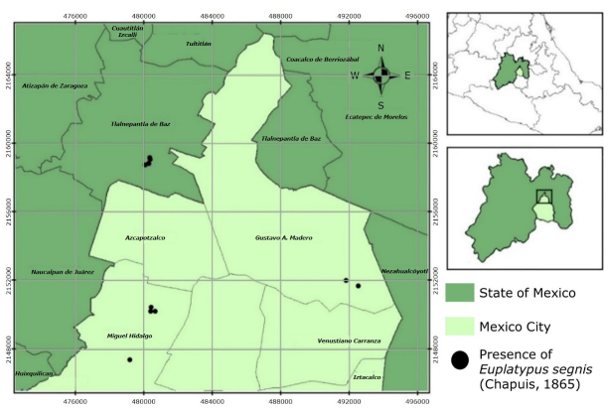
For this research study, specimens from the collection stored in the Integrated Pest Management Laboratory of the Iztacala Graduate School of Higher Studies, Universidad Nacional Autónoma de México (FESI) were reviewed. These organisms correspond to urban pest monitoring projects in the Valley of Mexico. They came from three different collection sources: (1) Lindgreen traps, during 2018-2019, in green areas of the FESI in Tlalnepantla de Baz, State of Mexico; (2) Specimens captured with homemade traps baited with ethanol during 2023 for the monitoring of the ash bark beetle Hylesinus aztecus in the Bosque de Aragón, Gustavo A. Madero Borough, Mexico City; (3) Manual collection of specimens of Fraxinus uhdei that presented secretions on the trunks in the Miguel Hidalgo Borough, Mexico City. For identification, photographic records were made using electron microscopy. Based on this, the presence of Euplatypus segnis on F. uhdei ash trees in Mexico City and the State of Mexico is recorded. Both entities are new records for this insect in the country. This species of ambrosial beetle causes fungal infections in host trees, with an unusual density of these coleopterans and the generation of secretions in the bark. Therefore, monitoring of these organisms in the Valley of Mexico is recommended to document their distribution and impact on urban trees.
Downloads
References
Alvidrez-Villarreal, R., Hernández-Castillo, F. D., García-Martínez, O., Mendoza-Villarreal, R., Rodríguez-Herrera, R., & Aguilar, C. N. (2012). Isolation and pathogenicity of fungi associated to ambrosia borer (Euplatypus segnis) found injuring pecan (Carya illinoensis) wood. Agricultural Sciences, 3(3), 405-416. http://dx.doi.org/10.4236/as.2012.33048
Atkinson, T. H. (2017). Familia Curculionidae: Platypodinae. En D. Cibrián-Tovar (Ed.), Fundamentos de Entomología Forestal (pp. 277-278). Universidad Autónoma Chapingo. https://www.researchgate.net/publication/337447577_Fundamentos_de_Entomologia_Forestal_Conacyt
Atkinson, T. H., Johnson, A., Hulcr, J., & Kuo, E. (2025, December 17). Euplatypus segnis (Chapuis, 1865) (Database). Bark and Ambrosia Beetles of the World. https://barkandambrosiabeetles.org/beetle/euplatypus-segnis/
Atkinson, T. H., Martínez-Fernández, E., Saucedo-Céspedes, E., & Burgos-Solorio, A. (1986). Scolytidae y Platypodidae (Coleoptera) asociados a selva baja y comunidades derivadas en el estado de Morelos, México. Folia Entomológica Mexicana, (69), 41-82. https://www.monarthrum.info/pdf_assets/atkinson%20et%20al%201986_FEM_69_41.pdf
Báez-Pérez, A. L., Gómez-Romero, M., Villegas, J., de la Barrera, E., Carreto-Montoya, L., & Lindig-Cisneros, R. (2015). Inoculación con hongos micorrízicos y fertilización con urea de plantas de Fraxinus uhdei en acrisoles provenientes de sitios degradados. Botanical Sciences, 93(3), 501-508. https://doi.org/10.17129/botsci.207
Beramendi-Orosco, L. E., Hernández-Morales, S., Gonzalez-Hernandez, G., Constante-García, V., & Villanueva-Diaz, J. (2016). Dendrochronological potential of Fraxinus Uhdei and its use as bioindicator of fossil CO2 emissions deduced from radiocarbon concentrations in tree rings. Radiocarbon, 55(2), 833-840. https://doi.org/10.1017/S0033822200057994
Calderón de Rzedowski, G., & Rzedowski, J. (2005). Flora fanerogámica del Valle de México. Instituto de Ecología, A. C. y Comisión Nacional para el Conocimiento y Uso de la Biodiversidad. https://www.biodiversidad.gob.mx/publicaciones/librosDig/pdf/Flora_del_Valle_de_Mx1.pdf
Cibrián-Tovar, D., Méndez-Montiel, J. T., Campos-Bolaños, R., Yates, III, H. O., & Flores-Lara, J. E. (1995). Insectos forestales de México. Universidad Autónoma Chapingo. https://archive.org/details/insectosforestal0000unse/page/n3/mode/2up
Francis, J. K. (1990). Fraxinus uhdei (Wenzig) Lingelsh. Fresno, tropical ash. Oleaceae. Olive family [White paper, SO-ITF-SM-28]. United States Department Agriculture, Forest Service. https://research.fs.usda.gov/treesearch/30403
Global Biodiversity Information Facility. (2025, October 20). Euplatypus segnis (Database). Global Core Biodata Resource. https://doi.org/10.15468/dl.qkv42z
Gobierno del Distrito Federal. (2008). Decreto por el que se declara Área de Valor Ambiental del Distrito Federal con la categoría de bosque urbano, al Bosque de San Juan de Aragón. Gaceta Oficial del Distrito Federal. https://www.sedema.cdmx.gob.mx/storage/app/uploads/public/5a7/36e/068/5a736e0685a51764657472.pdf
Johnson-Montes, S. A., Martínez-Morales, O., Muñoz-Viveros, A. L., Páez-Gerardo, L. E., Ibarra-González, M. P., Reséndiz-Martínez, F., Benítez-Rangel, E., Chávez-Carpio, C. Y., Cruz-Rodríguez, C. I., & Vanegas-Rico, J. P. (2025). Phytosanitary analysis of Fraxinus uhdei and economic impact of its bark beetle in the second largest park of Mexico city. REDIA, 108, 213-221. http://dx.doi.org/10.19263/REDIA-108.25.26
Red de Viveros de Biodiversidad. (2021). Catálogo 2021 Árboles de la Red de Viveros de Biodiversidad para reforestación/proyectos de osc/investigación/usos agropecuarios/comunidades rurales y urbanas. Red de Viveros de Biodiversidad. https://revivemx.org/Recursos/Catalogos/Catalogo_arboles_redviverosbio.pdf
Rendón-Correa, A., Dorantes-Hernández, F., Mejía-Valencia, S., & Alamilla-Fonseca, L. N. (2021). Características macroscópicas, propiedades y usos de la madera de especies nativas y exóticas en México (1ra ed.). Comisión Nacional para el Conocimiento y Uso de la Biodiversidad. https://cites.org/sites/default/files/timber_id_materials/files/Mexico_timber_macro_characteristics_2021.pdf?__cf_chl_f_tk=i5yPBmDsPol2TJLDayOIwf.YDorXk_Tp2aEFFmLhVSU-1783377626-1.0.1.1-vVNQ4NW2rQhYdVlzjdhEzVuNuycubpAeYy9mSIasUiU
Rzedowski, J. (2006). Vegetación de México (1a edición digital). Comisión Nacional para el Conocimiento y Uso de la Biodiversidad. https://drive.google.com/file/d/0B4QXYW6LByLUeDNSaE5jUFBWbmM/view?resourcekey=0-47doiOVtp0RQ13PyUp1PLw
Saavedra-Romero, L. de L., Alvarado-Rosales, D., Martínez-Trinidad, T., & Hernández-de la Rosa, P. (2019). Identification of defects and risks in trees of San Juan de Aragon Forest, Mexico City. Revista Chapingo Serie Ciencias Forestales y del Ambiente, 25(1), 31-47. http://dx.doi.org/10.5154/r.rchscfa.2018.06.049
Smith-Cognato, S., Johnson, A., & Atkinson, T. (2026, July 9). Free Identification of Bark and Ambrosia Beetles (Database). United States Department of Agriculture. https://ambrosiasymbiosis.org/mysterybeetles/
Soto-Hernández, M., & Barros-Barrios, M. M. (2018). Diversidad de picudos (Coleoptera: Curculionidae) en huertas de nogal pecanero en el norte de Coahuila, México. Revista Mexicana de Ciencias Agrícolas, 9(2), 473-480. https://doi.org/10.29312/remexca.v9i2.1087
Tello, M.-L., Tomalak, M., Siwecki, R., Gáper, J., Motta, E., & Mateo-Sagasta, E. (2005). Biotic urban growing conditions—Threats, pests and diseases. In C. Konijnendijk, K. Nilsson, T. Randrup & J. Schipperijn (Edits.), Urban forests and trees: A reference book (pp. 325-365). Springer-Verlag Berlin. https://doi.org/10.1007/3-540-27684-X_13
Villanueva-Díaz, J., Pérez-Evangelista, E. R., Beramendi-Orozco, L., & Cerano-Paredes, J. (2015). Crecimiento radial anual del fresno (Fraxinus udhei (Wenz.) Lingelsh.) en dos parques de la Comarca Lagunera. Revista Mexicana de Ciencias Forestales, 6(31), 40-57. https://doi.org/10.29298/rmcf.v6i31.194
Villaseñor, J. L. (2016). Checklist of the native vascular plants of México. Revista Mexicana de Biodiversidad, 87(3), 559-902. https://doi.org/10.1016/j.rmb.2016.06.017
Wood, S. L. (1982). The bark and ambrosia beetles of North and Central America (Coleoptera: Scolytidae), a taxonomic monograph. Great Basin Naturalist Memoirs, 6, 1-1356. https://biostor.org/reference/239409
Zaragoza-Hernández, A. Y., Cetina-Alcalá, V. M., López-López, M. Á., Chacalo-Hilú, A., de la Isla-de Bauer, M. de L., Alvarado-Rosales, D., & González-Rosas, H. (2015). Identificación de daños en el arbolado de tres parques del Distrito Federal. Revista Mexicana de Ciencias Forestales, 6(32), 63-82. https://doi.org/10.29298/rmcf.v6i32.99
Downloads
Published
How to Cite
Issue
Section
License
Copyright (c) 2026 Revista Mexicana de Ciencias Forestales

This work is licensed under a Creative Commons Attribution-NonCommercial 4.0 International License.
The authors who publish in Revista Mexicana de Ciencias Forestales accept the following conditions:
In accordance with copyright laws, Revista Mexicana de Ciencias Forestales recognizes and respects the authors’ moral right and ownership of property rights which will be transferred to the journal for dissemination in open access.
All the texts published by Revista Mexicana de Ciencias Forestales –with no exception– are distributed under a Creative Commons License Attribution-NonCommercial 4.0 International (CC BY-NC 4.0), which allows third parties to use the publication as long as the work’s authorship and its first publication in this journal are mentioned
The author(s) can enter into independent and additional contractual agreements for the nonexclusive distribution of the version of the article published in Revista Mexicana de Ciencias Forestales (for example, include it into an institutional repository or publish it in a book) as long as it is clearly and explicitly indicated that the work was published for the first time in Revista Mexicana de Ciencias Forestales.
For all the above, the authors shall send the form of Letter-transfer of Property Rights for the first publication duly filled in and signed by the author(s). This form must be sent as a PDF file to: ciencia.forestal2@inifap.gob.mx
This work is licensed under a Creative Commons Attribution-Noncommercial 4.0 International license.