Equations for biomass estimation of Tiquilia canescens (DC.) A. T. Richardson in desert shrublands
DOI:
https://doi.org/10.29298/rmcf.v17i97.1637Keywords:
Chihuahuan desert, allometric equations, woody crinklemat, microphyllus scrub, rosette-forming scrub, linear modelsAbstract
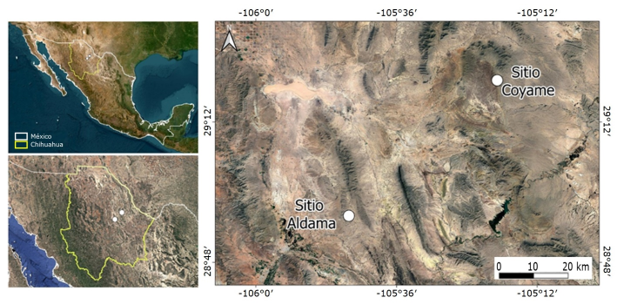
Tiquilia canescens is a shrub found in the desert scrublands of northern Mexico; because it is so abundant, it may play an important role in carbon sequestration and storage. However, there are no allometric functions for estimating its biomass. The objective of this study was to design equations to estimate the aboveground, root and total biomass of T. canescens. Allometric measurements were taken on 49 plants found in desert scrublands in the Aldama and Coyame del Sotol municipalities, state of Chihuahua. The fit of the linear, linearized potential allometric, and linearized exponential models for predicting biomass was evaluated. Based on fit statistics such as higher adjusted R2 values and lower Akaike Information Criteria (AIC) values, the variables with the greatest predictive power for total biomass were the long crown diameter (LCD, 47.9±18.0 cm), the short basal stem diameter (SBSD, 20.3±11.7 mm), and the canopy cover (CC, 1 754.4±1,342.8 cm2). The linearized potential model provided the best fit (lower RMSE and higher Pseudo-R2). Cross-validation was performed to test the predictive power of the equations. The final equations for estimating the aboveground, root, and total biomass of T. canescens included only the LCD, and these equations were robust and reliable for use in the Chihuahuan Desert scrubs and ecologically similar sites in North-central Mexico.
Downloads
References
Barbour, M. G., Burk, J. H., & Pitts, W. D. (1987). Terrestrial plant ecology (2nd ed.). The Benjamin/Cummings Publishing Company, Inc. https://books.google.com.mx/books/about/Terrestrial_Plant_Ecology.html?id=Ip3wAAAAMAAJ&redir_esc=y
Baskerville, G. L. (1972). Use of logarithmic regression in the estimation of plant biomass. Canadian Journal of Forestry, 2, 49-53. https://www.esf.edu/quest/documents/Baskerville-1972-CJFR.pdf
Baty, F., Ritz, C., Charles, S., Brutsche, M., Flandrois, J.-P., & Delignette-Muller, M.-L. (2015). A toolbox for nonlinear regression in R: The package nlstools. Journal of Statistical Software, 66(5), 1-21. https://www.researchgate.net/publication/282743750_A_Toolbox_for_Nonlinear_Regression_inR_The_Packagenlstools
Blanco-Oyonarte, P., & Navarro-Cerrillo, R. M. (2003). Aboveground phytomass models for major species in shrub ecosystems of western Andalusia. Investigación Agraria-Sistemas y Recursos Forestales, 12(3), 47-55. https://doi.org/10.5424/1078
Briones, O., Búrquez, A., Martínez-Yrizar, A., Pavón, N., & Perroni, Y. (2018). Biomasa y productividad en las zonas áridas mexicanas. Madera y Bosques, 24(Especial), Artículo e2401898. https://doi.org/10.21829/myb.2018.2401898
Briones, O., Flores-Martínez, A., Castellanos, A. E., Perroni, Y., & Hernández-Guerrero, A. (2020). Población, servicios ecosistémicos, ciclo del carbono y políticas públicas en las zonas secas de México. Elementos para Políticas Públicas, 4(2), 79-97. https://www.elementospolipub.org/ojs/index.php/e pp/article/view/36
Cayuela, L., & de la Cruz, M. (2022). Análisis de datos ecológicos en R. Mundi-Prensa. https://books.google.com.mx/books?id=RAB7EAAAQBAJ&printsec=frontcover&hl=es&source=gbs_ge_summary_r&cad=0#v=onepage&q&f=false
Conti, G., Enrico, L., Casanoves, F., & Díaz, S. (2013). Shrub biomass estimation in the semiarid Chaco forest: a contribution to the quantification of an underrated carbon stock. Annals of Forest Science, 70, 515-524. https://doi.org/10.1007/s13595-013-0285-9
Conti, G., Gorné, L. D., Zeballos, S. R., Lipoma, M. L., Gatica, G., Kowaljow, E., Whitworth-Hulse, J. I., Cuchietti, A., Poca, M., Pestoni, S., & Fernandes, P. M. (2019). Developing allometric models to predict the individual aboveground biomass of shrubs worldwide. Global Ecology and Biogeography, 28(7), 961-975. https://doi:10.1111/geb.12907
Flores-Hernández, C. de J., Méndez-González, J., Sánchez-Pérez, F. de J., Méndez-Encina, F. M., López-Díaz, Ó. M., & López-Serrano, P. M. (2020). Allometric equations for predicting Agave lechuguilla Torr. aboveground biomass in Mexico. Forests, 11(7), Article 784. https://doi:10.3390/f11070784
Granados-Sánchez, D., Sánchez-González, A., Granados-Victorino, R. L., & Borja-de la Rosa, A. (2011). Ecología de la vegetación del Desierto Chihuahuense. Revista Chapingo Serie Ciencias Forestales y del Ambiente, 17(Edición Especial), 111-130. https://doi.org/10.5154/r.rchscfa.2010.10.102
Hernández-Gómez, M. Á., Pando-Moreno, M., Mata-González, R., González-Rodríguez, H., Chacón-Hernández, J., & Gutiérrez, M. (2018). Predicción de biomasa radicular en especies de pastizales semiáridos en el sur del Desierto Chihuahuense. Revista Mexicana de Ciencias Forestales, 9(50), 274-293. https://doi.org/10.29298/rmcf.v9i50.226
Hernández-Ramos, A., Cano-Pineda, A., Flores-López, C., Hernández-Ramos, J., García-Cuevas, X., Martínez-Salvador, M., & Martínez-Ángel, L. (2019). Modelos para estimar biomasa de Euphorbia antisyphilitica Zucc. en seis municipios de Coahuila. Madera y Bosques, 25(2), Artículo e2521806. https://doi.org/10.21829/myb.2019.2521806
Instituto Nacional de Estadística, Geografía e Informática. (2010a). Compendio de Información Geográfica Municipal de los Estados Unidos Mexicanos. Aldama, Chihuahua, clave geoestadística 08002. Instituto Nacional de Estadística, Geografía e Informática. https://www.inegi.org.mx/contenidos/app/mexicocifras/datos_geograficos/08/08002.pdf
Instituto Nacional de Estadística, Geografía e Informática. (2010b). Compendio de Información Geográfica Municipal de los Estados Unidos Mexicanos. Coyame del Sotol, Chihuahua, clave geoestadística 08015. Instituto Nacional de Estadística, Geografía e Informática. https://www.inegi.org.mx/contenidos/app/mexicocifras/datos_geograficos/08/08015.pdf
James, G., Witten, D., Hastie, T., & Tibshirani, R. (2021). An introduction to statistical learning: with applications in R (2nd ed.). Springer. https://www.casact.org/sites/default/files/2022-12/James-G.-et-al.-2nd-edition-Springer-2021.pdf
Kramer, P. J. (1983). Water relations of plants. Elsevier Inc. https://doi.org/10.1016/C2012-0-01578-5
Ludwig, J. A., Reynolds, J. F., & Whitson, P. D. (1975). Size-biomass relationships of several Chihuahuan Desert shrubs. The American Midland Naturalist, 94(2), 451-461. https://doi.org/10.2307/2424437
Maldonado-Ortiz, M., López-Serrano, P. M., Valdez-Cepeda, R. D., Mata-González, R., García-González, F., & Martínez-Salvador, M. (2022). Ecuaciones para estimar biomasa total de candelilla (Euphorbia antisyphilitica Zucc.) en Chihuahua. Revista Mexicana de Ciencias Forestales, 13(72), 173-200. https://doi:10.29298/rmcf.v13i72.1231
Melgoza-Castillo, A., Morales-Nieto, C. R., Royo-Márquez, M. H., Quintana-Martínez, G., Lebgue-Keleng, T., & Sierra-Tristan, S. (2016). Manual práctico para la identificación de las principales plantas en los agostaderos de Chihuahua. Universidad Autónoma de Chihuahua. https://isbnmexico.indautor.cerlalc.org/catalogo.php?mode=detalle&nt=191993
Mellado, M., Rodríguez, A., Villareal, J. A., & Olvera, A. (2005). The effect of pregnancy and lactation on diet composition and dietary preference of goats in a desert rangeland. Small Ruminant Research, 58(1), 79-85. https://doi.org/10.1016/j.smallrumres.2004.07.014
Moore, M. J., & Jansen, R. K. (2007). Origins and biogeography of gypsophily in the Chihuahuan Desert plant group Tiquilia Subg. Eddya (Boraginaceae). Systematic Botany, 32(2), 392-414. http://dx.doi.org/10.1600/036364407781179680
Neter, J., Wasserman, W., & Kutner, M. H. (1983). Applied Linear Regression Models (2nd ed.). Richard D. Irwin, Inc. https://www.ime.unicamp.br/~dias/John%20Neter%20Applied%20linear%20regression%20models.pdf
Parresol, B. R. (1999). Assessing tree and stand biomass: A review with examples and critical comparisons. Forest Science, 45(4), 573-593. https://research.fs.usda.gov/download/treesearch/1180.pdf
Paz-Pellat, F., Velázquez-Rodríguez, A., Sánchez-Sánchez, C., Salas-Aguilar, V., Méndez-González, J., Acosta-Mireles, M., & Nájera-Luna, J. A. (2021). Alometría generalizada para la estimación de la biomasa aérea total de plantas leñosas: marco teórico general y aplicaciones. Madera y Bosques, 27(4), Artículo e2742442. https://doi:10.21829/myb.2021.2742442
R Core Team. (2024). R: A Language and Environment for Statistical Computing (Version 4.2.1) [Software]. R Foundation for Statistical Computing. https://www.R-project.org/
Rojas-García, F., De Jong, B. H. J., Martínez-Zurimendí, P., & Paz-Pellat, F. (2015). Database of 478 allometric equations to estimate biomass for Mexican trees and forests. Annals of Forest Science, 72, 835-864. https://doi.org/10.1007/s13595-015-0456-y
Rzedowski, J. (2006). Vegetación de México (1ra. Edición digital). Comisión Nacional para el Conocimiento y Uso de la Biodiversidad. https://drive.google.com/file/d/0B4QXYW6LByLUeDNSaE5jUFBWbmM/view?resourcekey=0-47doiOVtp0RQ13PyUp1PLw
Secretaría de Medio Ambiente y Recursos Naturales. (2016). Informe de la situación del medio ambiente en México 2015. Compendio de Estadísticas Ambientales, Indicadores Clave, de Desempeño Ambiental y de Crecimiento Verde. Secretaría de Medio Ambiente y Recursos Naturales. https://www.gob.mx/cms/uploads/attachment/file/161446/Cap_CC_completo.pdf
Villalobos, C. (2007). Estimating aboveground biomass of mariola (Parthenium incanum) from plant dimensions. In R. E. Sosebee, D. B. Wester, C. M. Britton, E. D. McArthur & S. G. Kitchen (Comps.), Proceedings: Shrubland dynamics—fire and water (pp. 132-135). United States Department of Agriculture, Forest Service. https://research.fs.usda.gov/treesearch/28371
Downloads
Published
How to Cite
Issue
Section
License
Copyright (c) 2026 Revista Mexicana de Ciencias Forestales

This work is licensed under a Creative Commons Attribution-NonCommercial 4.0 International License.
The authors who publish in Revista Mexicana de Ciencias Forestales accept the following conditions:
In accordance with copyright laws, Revista Mexicana de Ciencias Forestales recognizes and respects the authors’ moral right and ownership of property rights which will be transferred to the journal for dissemination in open access.
All the texts published by Revista Mexicana de Ciencias Forestales –with no exception– are distributed under a Creative Commons License Attribution-NonCommercial 4.0 International (CC BY-NC 4.0), which allows third parties to use the publication as long as the work’s authorship and its first publication in this journal are mentioned
The author(s) can enter into independent and additional contractual agreements for the nonexclusive distribution of the version of the article published in Revista Mexicana de Ciencias Forestales (for example, include it into an institutional repository or publish it in a book) as long as it is clearly and explicitly indicated that the work was published for the first time in Revista Mexicana de Ciencias Forestales.
For all the above, the authors shall send the form of Letter-transfer of Property Rights for the first publication duly filled in and signed by the author(s). This form must be sent as a PDF file to: ciencia.forestal2@inifap.gob.mx
This work is licensed under a Creative Commons Attribution-Noncommercial 4.0 International license.