Growth and stem quality of Southern black pine provenances in Metepec, State of Mexico
DOI:
https://doi.org/10.29298/rmcf.v16i92.1582Keywords:
correlation, Annual periodic increment, latitude, pinus greggii Engelm. ex Parl. var. australis Donahue & Lopez Upton, stem straightness, survivalAbstract
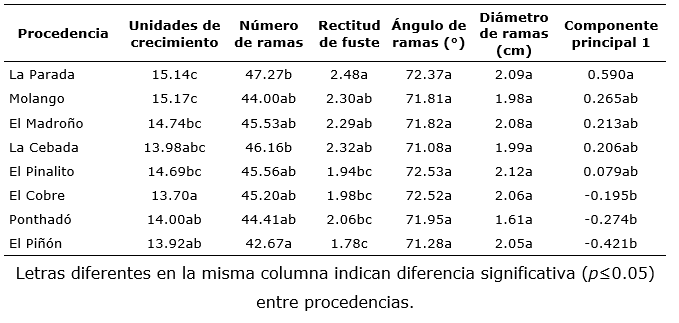
In Mexico, the Southern black pine (Pinus greggii var. australis) is widely used for timber plantations and reforestation, but it is necessary to assess its performance at specific sites in order to select superior genotypes. The objective of this research study was to determine differences among provenances in terms of growth and stem quality, as well as to evaluate their relationship with environmental variables. The assessment was conducted in a provenance trial of eight sources of Southern black pine, established in Metepec, State of Mexico. All variables showed significant differences among provenances (p≤0.0002), except for branch angle and diameter (p≥0.3558). The provenances El Madroño, El Cobre and El Pinalito exhibited the highest survival rates (69.57 to 79.54 %). La Parada, El Madroño, El Pinalito, El Cobre and La Cebada showed higher stem volume (115.1 to 134.6 dm3), periodic annual increment in diameter at breast height (1.83 to 2.14 cm), and in height (0.80 to 0.84 m). La Parada, Molango, El Madroño and La Cebada produced the straightest stems, whereas El Cobre, El Piñón and Ponthadó showed fewer growth units and branches. Growth variables were positively correlated with latitude (r≥0.711, p≤0.048), while the number of growth units and stem straightness were correlated with precipitation (r≥0.761, p≤0.028) and branch diameter was correlated with latitude and altitude (r≥0.714, p≤0.047). El Madroño is recommended for both reforestation and timber plantations due to its high survival, growth performance, and stem quality.
Downloads
References
Azamar-Oviedo, M., López-Upton, J., Vargas-Hernández, J. J., y Plancarte-Barrera, A. (2000). Evaluación de un ensayo de procedencias-progenies de Pinus greggii y su conversión a huerto semillero. En Secretaría de Medio Ambiente y Recursos Naturales y Programa Nacional de Reforestación en México (Comps.), Memorias del 1er Congreso Nacional de Reforestación (pp. 1-9). Colegio de Postgraduados Campus Montecillo. https://www.researchgate.net/publication/288834300_Evaluacion_de_un_ensayo_de_procedencias-progenies_de_Pinus_greggii_y_su_conversion_a_huerto_semillero
Burney, O., Aldrete, A., Alvarez-Reyes, R., Prieto-Ruíz, J. A., Sánchez-Velazquez, J. R., & Mexal, J. G. (2015). México—Addressing challenges to reforestation. Journal of Forestry, 113(4), 404-413. https://doi.org/10.5849/jof.14-007 DOI: https://doi.org/10.5849/jof.14-007
Carle, J. B., & Holmgren, L. P. B. (2009). Wood from planted forests: global outlook to 2030. In J. Evans (Ed.), Planted forests: uses, impacts and sustainability (pp. 47-59). Food and Agriculture Organization of the United Nations. https://doi.org/10.1079/9781845935641.0047 DOI: https://doi.org/10.1079/9781845935641.0047
Carle, J. B., Duval, A., & Ashfordc, S. (2020). The future of planted forests. International Forestry Review, 22(1), 65-80. https://doi.org/10.1505/146554820829523970 DOI: https://doi.org/10.1505/146554820829523970
Cavassin-Diniz, C. C., Timofeiczyk Jr., R., Gonçalves-Robert, R., da Silva-Lopes, E., Garzel-Leodoro da Silva, J. C., Martins-de Oliveira, F., & Silva-Oliveira, G. (2020). Influence of bifurcation on thinning, productivity and harvester production costs of Pinus taeda L. Australian Journal of Crop Science, 14(8), 1259-1263. https://doi.org/10.21475/ajcs.20.14.08.p2377 DOI: https://doi.org/10.21475/ajcs.20.14.08.p2377
Conover, W. J. (2012). The rank transformation-an easy and intuitive way to connect many nonparametric methods to their parametric counterparts for seamless teaching introductory statistics courses. WIRES Computional Statistics, 4(5), 332-338. https://doi.org/10.1002/wics.1216 DOI: https://doi.org/10.1002/wics.1216
Food and Agriculture Organization of the United Nations. (2020). Forests for human health and well-being. Strengthening the forest–health–nutrition nexus (Forestry Working Paper No. 18). Food and Agriculture Organization of the United Nations. https://doi.org/10.4060/cb1468en DOI: https://doi.org/10.4060/cb1468en
Gómez-Romero, M., Soto-Correa, J. C., Blanco-García, J. A., Sáenz-Romero, C., Villegas, J., y Lindig-Cisneros, R. (2012). Estudios de especies de pino para restauración de sitios degradados. Agrociencia, 46(8), 795-807. https://www.agrociencia-colpos.org/index.php/agrociencia/article/view/994
Hernández-Hernández, M. L., Velasco-García, M. V., López-Upton, J., Galán-Larrea, R., Ramírez-Herrera, C., y Viveros-Viveros, H. (2019). Crecimiento y supervivencia de procedencias de Enterolobium cyclocarpum en la costa de Oaxaca, México. Bosque, 40(2), 173-183. http://dx.doi.org/10.4067/S0717-92002019000200173 DOI: https://doi.org/10.4067/S0717-92002019000200173
Imaña E., J., y Encinas B., O. (2008). Epidometría forestal. Universidad de Brasilia. https://www.monografias.com/trabajos-pdf2/epidometria-forestal/epidometria-forestal.pdf
López-Upton, J., Ramírez-Herrera, C., Plascencia-Escalante, O., y Jasso-Mata, J. (2004). Variación en crecimiento de diferentes poblaciones de las dos variedades de Pinus greggii. Agrociencia, 38(4), 457-464. https://agrociencia-colpos.org/index.php/agrociencia/article/view/338
Muñoz-Flores, H. J., Velarde-Ramírez, J. C., García-Magaña, J. J., Sáenz-Reyes, J. T., Olvera-Delgadillo, E. H., y Hernández-Ramos, J. (2012). Predicción de volúmenes de fuste total para plantaciones de Pinus greggii Engelm. Revista Mexicana de Ciencias Forestales, 3(14), 11-22. https://doi.org/10.29298/rmcf.v3i14.471 DOI: https://doi.org/10.29298/rmcf.v3i14.471
Nocetti, M., & Brunetti, M. (2024). Advancements in wood quality assessment: standing tree visual evaluation—a review. Forests, 15(6), 943. https://doi.org/10.3390/f15060943 DOI: https://doi.org/10.3390/f15060943
Ortiz-Mendoza, R., Aguirre-Calderón, O. A., Gómez-Cárdenas, M., Treviño-Garza, E. J., y González-Tagle, M. A. (2021). Crecimiento de procedencias de Pinus greggii Engelm. ex Parl. en suelos degradados de la Mixteca Alta, Oaxaca. Revista Mexicana de Ciencias Forestales, 12(64), 4-22. https://doi.org/10.29298/rmcf.v12i64.710 DOI: https://doi.org/10.29298/rmcf.v12i64.710
Pérez, C. J., Locatelli, B., Vignola, R., e Imbach, P. (2008). Importancia de los bosques tropicales en las políticas de adaptación al cambio climático. Recursos Naturales y Ambiente, 51-52, 4–11. https://www.cifor-icraf.org/es/conocimiento/publicacion/4820/
Protectora de Bosques del Estado de México. (2024). Plantaciones forestales comerciales. Gobierno del Estado de México. https://probosque.edomex.gob.mx/plantaciones_forestales
Reyes-Esteves, G. I., López-Upton, J., Velasco-García, M. V., & Jiménez-Casas, M. (2022). Genetic parameters of a progeny trial of Pinus greggii Engelmann ex Parlatore var. australis Donahue & López in the Mixteca Alta of Oaxaca, Mexico. Revista Chapingo Serie Ciencias Forestales y del Ambiente, 28(1), 75-88. http://dx.doi.org/10.5154/r.rchscfa.2020.10.067 DOI: https://doi.org/10.5154/r.rchscfa.2020.10.067
Rodríguez-Laguna, R., Valencia-Manzo, S., Meza-Rangel, J., Capó-Arteaga, M. Á., y Reynoso-Pérez, A. (2008). Crecimiento y características de la copa de procedencias de Pinus greggii Engelm. en Galeana, Nuevo León. Revista Fitotecnia Mexicana, 31(1), 19-26. https://revistafitotecniamexicana.org/documentos/31-1/3a.pdf DOI: https://doi.org/10.35196/rfm.2008.1.19
Rojas-Vergara, P. (2023). Informe de gira técnica: utilización de técnicas nucleares para mejorar la adaptación y la productividad de especies forestales frente al cambio climático. Ciencia & Investigación Forestal, 29(2), 99-111. https://doi.org/10.52904/0718-4646.2023.587 DOI: https://doi.org/10.52904/0718-4646.2023.587
Salazar-García, J. G., Vargas-Hernández, J. J., Jasso-Mata, J., Molina-Galán, J. D., Ramírez-Herrera, C., y López-Upton, J. (1999). Variación en el patrón de crecimiento en altura de cuatro especies de Pinus en edades tempranas. Madera y Bosques, 5(2), 19-34. https://doi.org/10.21829/myb.1999.521345 DOI: https://doi.org/10.21829/myb.1999.521345
Sánchez-Rosales, B., Velasco-García, M. V., Hernández-Hernández, A., Gómez-Cárdenas, M., & López-Teloxa, L. C. (2025). Genetic parameters and family selection of Pinus pseudostrobus var. apulcensis through growth and stem quality in Mixteca Oaxaqueña Region, Mexico. Forests, 16(6), 959. https://doi.org/10.3390/f16060959 DOI: https://doi.org/10.3390/f16060959
Valencia-Manzo, S., Velasco-García, M. V., Gómez-Cárdenas, M., Ruiz-Muñoz, M., y Capó-Arteaga, M. Á. (2006). Ensayo de procedencias de Pinus greggii Engelm. en dos localidades de la Mixteca Alta de Oaxaca, México. Revista Fitotecnia Mexicana, 29(1), 27-32. https://www.redalyc.org/pdf/610/61029104.pdf DOI: https://doi.org/10.35196/rfm.2006.1.27
Valencia-Manzo, S., Playas-Ramos, I., Cornejo-Oviedo, E. H., y Flores-López, C. (2017). Patrón de alargamiento del brote terminal en un ensayo de procedencias de Pinus greggii Engelm. en la Sierra de Arteaga, Coahuila. Madera y Bosques, 23(1), 133-141. https://doi.org/10.21829/myb.2017.2311555 DOI: https://doi.org/10.21829/myb.2017.2311555
Vásquez-García, I., Cetina Alcalá, V. M., Campos-Bolaños, R., y Casal-Ángeles, L. F. (2016). Evaluación de plantaciones forestales en tres comunidades de la Mixteca Alta Oaxaqueña. Agroproductividad, 9(2), 12-19. https://revista-agroproductividad.org/index.php/agroproductividad/article/view/716/585
Velasco-Velasco, V. A., Enríquez-del Valle, J. R., Rodríguez-Ortiz, G., Campos-Ángeles, G. V., Gómez-Cárdenas, M., y García-García, M. L. (2012). Evaluación de procedencias de Pinus greggii Engelm. ex Parl. en plantaciones de la Mixteca Oaxaqueña. Revista Mexicana de Ciencias Forestales, 3(9), 41-50. https://doi.org/10.29298/rmcf.v3i9.534 DOI: https://doi.org/10.29298/rmcf.v3i9.534
Velázquez-Martínez, A., Fierros-González, A. M., Aldrete, A., Gómez-Guerrero, A., Fernández-Cázares, S., de los Santos-Posadas, H., Llanderal-Ocampo, T., González, M. de J., López-Upton, J., y Ramírez-Herrera, C. (2013). Situación actual y perspectivas de las plantaciones forestales comerciales en México. Comisión Nacional Forestal. http://www.conafor.gob.mx:8080/biblioteca/ver.aspx?articulo=434
White, T. L., Adams, W. T., & Neale, D. B. (2007). Forest genetics. CAB International. https://doi.org/10.1079/9781845932855.0000 DOI: https://doi.org/10.1079/9781845932855.0000
Zobel, B., y Talbert, J. (1988). Técnicas de mejoramiento genético de árboles forestales. Limusa. https://books.google.com.mx/books/about/T%C3%A9cnicas_de_mejoramiento_gen%C3%A9tico_de.html?id=FusgOgAACAAJ&redir_esc=y
Published
How to Cite
Issue
Section
License
Copyright (c) 2025 Revista Mexicana de Ciencias Forestales

This work is licensed under a Creative Commons Attribution-NonCommercial 4.0 International License.
The authors who publish in Revista Mexicana de Ciencias Forestales accept the following conditions:
In accordance with copyright laws, Revista Mexicana de Ciencias Forestales recognizes and respects the authors’ moral right and ownership of property rights which will be transferred to the journal for dissemination in open access.
All the texts published by Revista Mexicana de Ciencias Forestales –with no exception– are distributed under a Creative Commons License Attribution-NonCommercial 4.0 International (CC BY-NC 4.0), which allows third parties to use the publication as long as the work’s authorship and its first publication in this journal are mentioned
The author(s) can enter into independent and additional contractual agreements for the nonexclusive distribution of the version of the article published in Revista Mexicana de Ciencias Forestales (for example, include it into an institutional repository or publish it in a book) as long as it is clearly and explicitly indicated that the work was published for the first time in Revista Mexicana de Ciencias Forestales.
For all the above, the authors shall send the form of Letter-transfer of Property Rights for the first publication duly filled in and signed by the author(s). This form must be sent as a PDF file to: ciencia.forestal2@inifap.gob.mx
This work is licensed under a Creative Commons Attribution-Noncommercial 4.0 International license.