Sitios de referencia para la restauración de bosques periurbanos afectados por la minería en la Región de Inambari, Amazonía peruana
DOI:
https://doi.org/10.29298/rmcf.v17i98.1674Palabras clave:
diversidad efectiva, estructura forestal, Índice de Valor de Importancia, minería aurífera, números de Hill, similitud florísticaResumen
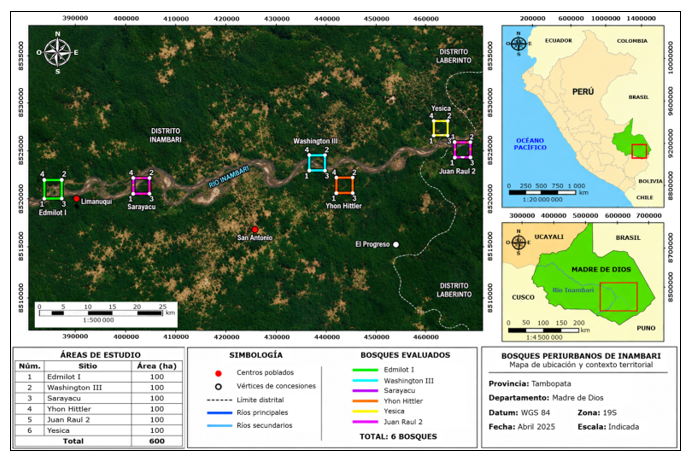
Los bosques periurbanos afectados por actividades mineras pueden aportar referencias ecológicas para orientar la recuperación de áreas degradadas cuando conservan atributos representativos de composición, diversidad y estructura. En este estudio se evaluó el potencial de seis concesiones mineras de la cuenca del Río Inambari, Amazonía peruana, para funcionar como sitios de referencia en futuras acciones de restauración. Se establecieron parcelas rectangulares de 0.1 ha y se registraron todos los individuos arbóreos con diámetro a la altura del pecho ≥10 cm. Se determinaron la riqueza taxonómica, números de Hill de órdenes q=0, q=1 y q=2, el diámetro, la altura, área basal, Índice de Valor de Importancia y la similitud florística mediante los índices de Jaccard y Bray-Curtis, además de una ordenación de escalamiento multidimensional no métrico (NMDS). Se registraron 2 063 individuos, agrupados en 57 familias, 172 géneros y 404 especies. Edmilot I presentó la mayor riqueza observada y área basal; respecto al número efectivo de especies comunes en Washington III se registró el valor más alto, mientras que en Yesica ocurrió lo mismo, pero para el número efectivo de especies dominantes. Yhon Hittler y Juan Raul 2 mostraron menor diversidad efectiva y una marcada dominancia de Iriartea deltoidea. Washington III y Sarayacu tuvieron una NMDS muy semejante, y entre Yhon Hittler y Juan Raul 2. El uso complementario de varios sitios permite establecer referencias más representativas de la variabilidad ecológica del paisaje para orientar la restauración de bosques periurbanos afectados por la minería.
Descargas
Referencias
Alvarez-Montalván, C. E., Manrique-León, S., Vela-Da Fonseca, M., Cardozo-Soarez, J., Callo-Ccorcca, J., Bravo-Camara, P., Castañeda-Tinco, I., & Alvarez-Orellana, J. (2021). Composición florística, estructura y diversidad arbórea de un bosque amazónico en Perú. Scientia Agropecuaria, 12(1), 73-82. https://doi.org/10.17268/sci.agropecu.2021.009
Asigbaase, M., Sjogersten, S., Lomax, B. H., & Dawoe, E. (2019). Tree diversity and its ecological importance value in organic and conventional cocoa agroforests in Ghana. PLoS ONE, 14(1), Article e0210557. https://doi.org/10.1371/journal.pone.0210557
Beauchamp, V. B., & Shafroth, P. B. (2011). Floristic composition, beta diversity, and nestedness of reference sites for restoration of xeroriparian areas. Ecological Applications, 21(2), 465-476. https://doi.org/10.1890/09-1638.1
Bray, J. R., & Curtis, J. T. (1957). An ordination of the upland forest communities of southern Wisconsin. Ecological Monographs, 27(4), 325-349. https://doi.org/10.2307/1942268
Caballero-Espejo, J., Messinger, M., Román-Dañobeytia, F., Ascorra, C., Fernandez, L. E., & Silman, M. (2018). Deforestation and forest degradation due to gold mining in the Peruvian Amazon: A 34-year perspective. Remote Sensing, 10(12), Article 1903. https://doi.org/10.3390/rs10121903
Chazdon, R. L., Norden, N., Colwell, R. K., & Chao, A. (2022). Monitoring recovery of tree diversity during tropical forest restoration: lessons from long-term trajectories of natural regeneration. Philosophical Transactions of the Royal Society B, 378(1867), Article 20210069. https://doi.org/10.1098/rstb.2021.0069
Chazdon, R. L., Peres, C. A., Dent, D., Sheil, D., Lugo, A. E., Lamb, D., Stork, N. E., & Miller, S. E. (2009). The potential for species conservation in tropical secondary forests. Conservation Biology, 23(6), 1406-1417. https://doi.org/10.1111/j.1523-1739.2009.01338.x
Clarke, K. R. (1993). Non-parametric multivariate analyses of changes in community structure. Australian Journal of Ecology, 18(1), 117-143. https://doi.org/10.1111/j.1442-9993.1993.tb00438.x
Curtis, J. T., & McIntosh, R. P. (1951). An upland forest continuum in the Prairie-Forest Border Region of Wisconsin. Ecology, 32(3), 476-496. https://doi.org/10.2307/1931725
Garate-Quispe, J., Herrera-Machaca, M., Pareja-Auquipata, V., Alarcón-Aguirre, G., Baez-Quispe, S., & Carpio-Vargas, E. E. (2024). Resilience of aboveground biomass of secondary forests following the abandonment of gold mining activity in the southeastern Peruvian Amazon. Diversity, 16(4), Article 233. https://doi.org/10.3390/d16040233
Gastauer, M., de Medeiros-Sarmento, P. S., Araujo-Santos, V. C., Frois-Caldeira, C., Ramos, S. J., Teodoro, G. S., & Siqueira, J. O. (2020). Vegetative functional traits guide plant species selection for initial mineland rehabilitation. Ecological Engineering, 148, Article 105763. https://doi.org/10.1016/j.ecoleng.2020.105763
Govaerts, R., Lughadha, E. N., Black, N., Turner, R., & Paton, A. (2021). The World Checklist of Vascular Plants, a continuously updated resource for exploring global plant diversity. Scientific Data, 8(1), Article 215. https://doi.org/10.1038/s41597-021-00997-6
Hammer, Ø., Harper, D. A. T., & Ryan, P. D. (2001). PAST: Paleontological Statistics Software Package for Education and Data Analysis. Palaeontologia Electronica, 4(1), Article 4. https://palaeo-electronica.org/2001_1/past/issue1_01.htm
Higgs, E., Falk, D. A., Guerrini, A., Hall, M., Harris, J., Hobbs, R. J., Jackson, S. T., Rhemtulla, J. M., & Throop, W. (2014). The changing role of history in restoration ecology. Frontiers in Ecology and the Environment, 12(9), 499-506. https://doi.org/10.1890/110267
Jaccard, P. (1912). The distribution of the flora in the alpine zone. New Phytologist, 11(2), 37-50. https://doi.org/10.1111/j.1469-8137.1912.tb05611.x
Jost, L., & González-Oreja, J. (2012). Midiendo la diversidad biológica: Más allá del índice de Shannon. Acta Zoológica Lilloana, 56(1-2), 3-14. https://www.lillo.org.ar/journals/index.php/acta-zoologica-lilloana/article/view/240
Juárez-Fragoso, M. A., Perroni, Y., Dáttilo, W., Gómez-Díaz, J. A., & Guevara, R. (2024). The landscape scale of effect on the alpha and beta diversities of woody species in a semideciduous tropical forest. Landscape Ecology, 39, Article 33. https://doi.org/10.1007/s10980-024-01809-z
Nytch, C. J., Rojas-Sandoval, J., Erazo-Oliveras, A., Santiago-García, R. J., & Meléndez-Ackerman, E. J. (2023). Effects of historical land use and recovery pathways on composition, structure, ecological function, and ecosystem services in a Caribbean secondary forest. Forest Ecology and Management, 546, Article 121311. https://doi.org/10.1016/j.foreco.2023.121311
Pitman, N. C. A., Silman, M. R., & Terborgh, J. W. (2013). Oligarchies in Amazonian tree communities: a ten-year review. Ecography, 36(2), 114-123. https://doi.org/10.1111/j.1600-0587.2012.00083.x
Pretzsch, H., Biber, P., Uhl, E., Dahlhausen, J., Rötzer, T., Caldentey, J., Koike, T., van Con, T., Chavanne, A., Seifert, T., du Toit, B., Farnden, C., & Pauleit, S. (2015). Crown size and growing space requirement of common tree species in urban centres, parks, and forests. Urban Forestry & Urban Greening, 14(3), 466-479. https://doi.org/10.1016/j.ufug.2015.04.006
Python Software Foundation. (2026). Python 3.13.5 [Software]. Python Software Foundation. https://www.python.org/downloads/release/python-3135/
Román-Dañobeytia, F., Cabanillas, F., Lefebvre, D., Farfan, J., Alferez, J., Polo-Villanueva, F., Llacsahuanga, J., Vega, C. M., Velasquez, M., Corvera, R., Condori, E., Ascorra, C., Fernandez, L. E., & Silman, M. R. (2021). Survival and early growth of 51 tropical tree species in areas degraded by artisanal gold mining in the Peruvian Amazon. Ecological Engineering, 159, Article 106097. https://doi.org/10.1016/j.ecoleng.2020.106097
Rosenfield, M. F., Jakovac, C. C., Vieira, D. L. M., Poorter, L., Brancalion, P. H. S., Vieira, I. C. G., de Almeida, D. R. A., Massoca, P., Schietti, J., Albernaz, A. L. M., Ferreira, M. J., & Mesquita, R. C. G. (2023). Ecological integrity of tropical secondary forests: concepts and indicators. Biological Reviews, 98(2), 662-676. https://doi.org/10.1111/brv.12924
Rother, D. C., Liboni, A. P., Silva-Magnago, L. F., Chao, A., Chazdon, R. L., & Ribeiro-Rodrigues, R. (2019). Ecological restoration increases conservation of taxonomic and functional beta diversity of woody plants in a tropical fragmented landscape. Forest Ecology and Management, 451, Article 117538. https://doi.org/10.1016/j.foreco.2019.117538
Ruiz-Jaén, M. C., & Aide, T. M. (2005). Vegetation structure, species diversity, and ecosystem processes as measures of restoration success. Forest Ecology and Management, 218(1), 159-173. https://doi.org/10.1016/j.foreco.2005.07.008
San-José, M., Werden, L. K., Joyce, F. H., Reid, J. L., Holl, K. D., & Zahawi, R. A. (2022). Effects of landscape structure on restoration success in tropical premontane forest. Scientific Reports, 12, Article 13452. https://doi.org/10.1038/s41598-022-16542-3
SAS Institute Inc. (2016). SAS/STAT User’s Guide, Version 9.4 [Software]. SAS Institute Inc. https://www.scirp.org/reference/referencespapers?referenceid=2877863
Ssekuubwa, E., van Goor, W., Snoep, M., Riemer, K., Wanyama, F., Waiswa, D., Yikii, F., & Tweheyo, M. (2022). Does restoration success vary with tree size under restoration plantings and regrowth forests? Conservation Science and Practice, 4(9), Article e12781. https://doi.org/10.1111/csp2.12781
Velásquez-Ramírez, M. G., Guerrero-Barrantes, J. A., Thomas, E., Gamarra-Miranda, L. A., Pillaca, M., Tello-Peramas, L. D., & Bazán-Tapia, L. R. (2020). Heavy metals in alluvial gold mine spoils in the peruvian amazon. CATENA, 189, Article 104454. https://doi.org/10.1016/j.catena.2020.104454
Villa, P. M., Martins, S. V., Rodrigues, A. C., Safar, N. V. H., Castro-Bonilla, M. A., & Ali, A. (2019). Testing species abundance distribution models in tropical forest successions: Implications for fine-scale passive restoration. Ecological Engineering, 135, 28-35. https://doi.org/10.1016/j.ecoleng.2019.05.015
Zhen, W., Kwan, K. Y., Wang, C.-C., Wu, X., Guo, G., Deng, Q., Huang, X., Wang, X., Zhu, J., & Xu, P. (2022). Community structure of benthic macroinvertebrates in native and introduced mangroves of northern Beibu Gulf, China: Implication for restoring mangrove ecosystems. Marine Pollution Bulletin, 180, Article 113796. https://doi.org/10.1016/j.marpolbul.2022.113796
Descargas
Publicado
Número
Sección
Licencia
Derechos de autor 2026 Revista Mexicana de Ciencias Forestales

Esta obra está bajo una licencia internacional Creative Commons Atribución-NoComercial 4.0.
Los autores que publiquen en la Revista Mexicana de Ciencias Forestales aceptan las siguientes condiciones:
De acuerdo con la legislación de derechos de autor, la Revista Mexicana de Ciencias Forestales reconoce y respeta el derecho moral de los autores, así como la titularidad del derecho patrimonial, el cual será cedido a la revista para su difusión en acceso abierto.
Todos los textos publicados por la Revista Mexicana de Ciencias Forestales –sin excepción– se distribuyen amparados bajo la licenciaCreative Commons 4.0 Atribución-No Comercial (CC BY-NC 4.0 Internacional), que permite a terceros utilizar lo publicado siempre que mencionen la autoría del trabajo y a la primera publicación en esta revista. (no permite el uso comercial)
Los autores pueden realizar otros acuerdos contractuales independientes y adicionales para la distribución no exclusiva de la versión del artículo publicado en la Revista Mexicana de Ciencias Forestales (por ejemplo, incluirlo en un repositorio institucional o darlo a conocer en otros medios en papel o electrónicos) siempre que indique clara y explícitamente que el trabajo se publicó por primera vez en la Revista Mexicana de Ciencias Forestales.
Para todo lo anterior, los autores deben remitir el formato de carta-cesión de la propiedad de los derechos de la primera publicación debidamente requisitado y firmado por los autores/as. Este formato debe ser remitido en archivo PDF al correo: editorial.forestal@inifap.gob.mx
Esta obra está bajo una licencia de Creative Commons Reconocimiento-No Comercial 4.0 Internacional.