Servicios ecosistémicos del arbolado urbano en dos parques de Guadalajara, Jalisco
DOI:
https://doi.org/10.29298/rmcf.v17i98.1671Palabras clave:
biomasa aérea, carbono aéreo, diversidad florística, especies nativas, estructura arbórea, paisaje urbanoResumen
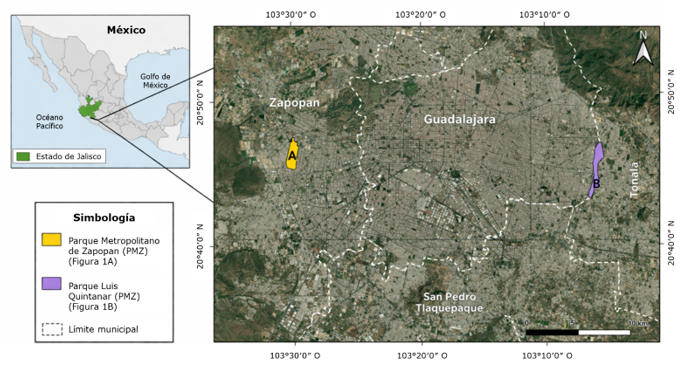
El arbolado urbano es parte de la infraestructura verde y genera servicios ecosistémicos que dependen de su estructura, composición, manejo y desarrollo. Al respecto, en el presente estudio se compara la composición florística, estructura arbórea y el carbono aéreo almacenado en los parques Metropolitano de Zapopan y Luis Quintanar, Guadalajara, Jalisco, México. Se analizó una submuestra aleatoria equivalente a 50 % de los individuos registrados en cada sitio, integrada por 329 árboles en el primer parque y 509 en el segundo. Se determinaron la riqueza taxonómica, abundancia relativa, origen de las especies y los índices de Shannon, Simpson y Pielou. La estructura se caracterizó con el diámetro a la altura del pecho, altura total, diámetro de copa, área basal y área de copa. La biomasa aérea se estimó con una ecuación alométrica basada en el diámetro y el carbono aéreo mediante una fracción de 0.47. El Parque Metropolitano de Zapopan presentó 35 especies, 23 géneros, 14 familias, mayor proporción de especies nativas y diversidad de Shannon alta. El Parque Luis Quintanar registró 18 taxa, 18 géneros y 13 familias, además predominaron individuos con más desarrollo estructural. En este sitio, el diámetro, la altura, área basal, biomasa aérea y el carbono aéreo fueron significativamente superiores. El carbono almacenado alcanzó 2.88 Mg C ha-1 en el parque Luis Quintanar y 0.80 Mg C ha-¹ en el Metropolitano de Zapopan. Los resultados evidencian que la diversidad florística y el desarrollo estructural representan componentes complementarios para evaluar los servicios ecosistémicos del arbolado urbano.
Descargas
Referencias
Amer, A., Franceschi, E., Hjazin, A., Shoqeir, J. H., Moser-Reischl, A., Rahman, M. A., Tadros, M., Pauleit, S., Pretzsch, H., & Rötzer, T. (2023). Structure and ecosystem services of three common urban tree species in an arid climate city. Forests, 14(4), Article 671. https://doi.org/10.3390/f14040671
Avery, T. E., & Burkhart, H. E. (2015). Forest measurements (5th ed.). Waveland Press, Inc. https://books.google.com.pe/books?id=IWx1CQAAQBAJ&printsec=copyright#v=onepage&q&f=false
Bidolakh, D., Lakyda, P., Myroniuk, V., Hayda, Y., & Pidkhovna, S. (2023). Assessment and representation of Urban Trees Ecosystem Services: A case study in Pryzamkovyi park. Folia Forestalia Polonica, 65(2), 104-116. https://doi.org/10.2478/ffp-2023-0011
Burkhart, H. E., & Tomé, M. (2012). Modeling forest trees and stands. Springer Science. https://doi.org/10.1007/978-90-481-3170-9
Castro-Díez, P., Vaz, A. S., Silva, J. S., van Loo, M., Alonso, Á., Aponte, C., Bayón, Á., Bellingham, P. J., Chiuffo, M. C., DiManno, N., Julian, K., Kandert, S., La Porta, N., Marchante, H., Maule, H. G., Mayfield, M. M., Metcalfe, D., Monteverdi, M. C., Núñez, M. A., … Godoy, O. (2019). Global effects of non-native tree species on multiple ecosystem services. Biological Reviews, 94(4), 1477-1501. https://doi.org/10.1111/brv.12511
Chao, A., Gotelli, N. J., Hsieh, T. C., Sander, E. L., Ma, K. H., Colwell, R. K., & Ellison, A. M. (2014). Rarefaction and extrapolation with Hill numbers: a framework for sampling and estimation in species diversity studies. Ecological Monographs, 84(1), 45-67. https://doi.org/10.1890/13-0133.1
Chave, J., Réjou-Méchain, M., Búrquez, A., Chidumayo, E., Colgan, M. S., Delitti, W. B. C., Duque, A., Eid, T., Fearnside, P. M., Goodman, R. C., Henry, M., Martínez-Yrízar, A., Mugasha, W. A., Muller-Landau, H. C., Mencuccini, M., Nelson, B. W., Ngomanda, A., Nogueira, E. M., Ortiz-Malavassi, E., … Vieilledent, G. (2014). Improved allometric models to estimate the aboveground biomass of tropical trees. Global Change Biology, 20(10), 3177-3190. https://doi.org/10.1111/gcb.12629
Cruz-de León, G., & Cruz-de León, J. (2006). The segmental conic model for forest measurements. Madera y Bosques, 12(2), 3-13. https://doi.org/10.21829/myb.2006.1221245
García-Valencia, A., Sánchez-Sánchez, O., Ramírez-Soto, A., & Ramos-Palacios, C. R. (2025). Diagnóstico y servicios ecosistémicos del arbolado de alineación en Xalapa, Veracruz, México. Polibotánica, (59), 159-180. https://doi.org/10.18387/polibotanica.59.10
Instituto Nacional de Estadística, Geografía e Informática. (2010a). Compendio de información geográfica municipal 2010. Guadalajara, Jalisco. Instituto Nacional de Estadística, Geografía e Informática. https://www.inegi.org.mx/contenidos/app/mexicocifras/datos_geograficos/14/14039.pdf
Instituto Nacional de Estadística, Geografía e Informática. (2010b). Compendio de información geográfica municipal 2010. Zapopan, Jalisco. Instituto Nacional de Estadística, Geografía e Informática. https://www.inegi.org.mx/contenidos/app/mexicocifras/datos_geograficos/14/14120.pdf
Kim, J., Kang, Y., Kim, D., Son, S., & Kim, E. J. (2024). Carbon storage and sequestration analysis by urban park grid using i-Tree Eco and drone-based modeling. Forests, 15(4), Article 683. https://doi.org/10.3390/f15040683
Leal-Elizondo, C. E., Leal-Elizondo, N., Alanís-Rodríguez, E., Pequeño-Ledezma, M. Á., Mora-Olivo, A., & Buendía-Rodríguez, E. (2018). Estructura, composición y diversidad del arbolado urbano de Linares, Nuevo León. Revista Mexicana de Ciencias Forestales, 9(48), 252-270. https://doi.org/10.29298/rmcf.v8i48.129
Magurran, A. E. (2004). Measuring biological diversity. Blackwell Science Ltd. http://www.bio-nica.info/Biblioteca/Magurran2004MeasuringBiological.pdf
Mann, H. B., & Whitney, D. R. (1947). On a test of whether one of two random variables is stochastically larger than the other. The Annals of Mathematical Statistics, 18(1), 50-60. https://doi.org/10.1214/aoms/1177730491
Martínez-Trinidad, T., Hernández-López, P., López-López, S. F., & Mohedano-Caballero, L. (2021). Diversidad, estructura y servicios ecosistémicos del arbolado en cuatro parques de Texcoco mediante i-Tree Eco. Revista Mexicana de Ciencias Forestales, 12(67), 202-223. https://doi.org/10.29298/rmcf.v12i67.880
McPherson, E. G., Xiao, Q., & Aguaron, E. (2013). A new approach to quantify and map carbon stored, sequestered and emissions avoided by urban forests. Landscape and Urban Planning, 120, 70-84. https://doi.org/10.1016/j.landurbplan.2013.08.005
Moreno, R., Nery, A., Zamora, R., Lora, Á., & Galán, C. (2024). Contribution of urban trees to carbon sequestration and reduction of air pollutants in Lima, Peru. Ecosystem Services, 67, Article 101618. https://doi.org/10.1016/j.ecoser.2024.101618
Morgenroth, J., Nowak, D. J., & Koeser, A. K. (2020). DBH distributions in America’s urban forests—An overview of structural diversity. Forests, 11(2), Article 135. https://doi.org/10.3390/f11020135
Nero, B. F., Kuusaana, E. D., Ahmed, A., & Campion, B. B. (2024). Carbon storage and tree species diversity of urban parks in Kumasi, Ghana. City and Environment Interactions, 24, Article 100156. https://doi.org/10.1016/j.cacint.2024.100156
Nowak, D. J., & Crane, D. E. (2002). Carbon storage and sequestration by urban trees in the USA. Environmental Pollution, 116(3), 381-389. https://doi.org/10.1016/S0269-7491(01)00214-7
Ortega-Álvarez, R., Rodríguez-Correa, H. A., & MacGregor-Fors, I. (2011). Trees and the city: Diversity and composition along a Neotropical Gradient of Urbanization. International Journal of Ecology, 2011, Article 704084. https://doi.org/10.1155/2011/704084
Pretzsch, H., Biber, P., Uhl, E., Dahlhausen, J., Rötzer, T., Caldentey, J., Koike, T., van Con, T., Chavanne, A., Seifert, T., du Toit, B., Farnden, C., & Pauleit, S. (2015). Crown size and growing space requirement of common tree species in urban centres, parks, and forests. Urban Forestry & Urban Greening, 14(3), 466-479. https://doi.org/10.1016/j.ufug.2015.04.006
Saavedra-Romero, L. de L., Hernández-de la Rosa, P., Alvarado-Rosales, D., Martínez-Trinidad, T., & Villa-Castillo, J. (2019). Diversidad y estructura arbórea, indicadores de salud aplicados a un bosque urbano de la Ciudad de México. Polibotánica, (47), 25-37. https://doi.org/10.18387/polibotanica.47.3
SAS Institute Inc. (2017). SAS/Stat User’s Guide, Version 9.4 [Computer software]. SAS Institute Inc. https://www.scienceopen.com/book?vid=5f350505-ff8c-4c2b-92e0-8ab04ebc2024
Sharma, G., Morgenroth, J., Richards, D. R., & Ye, N. (2025). Advancing urban forest and ecosystem service assessment through the integration of remote sensing and i-Tree Eco: A systematic review. Urban Forestry & Urban Greening, 104, Article 128659. https://doi.org/10.1016/j.ufug.2024.128659
Sjöman, H., Hirons, A. D., & Bassuk, N. L. (2015). Urban forest resilience through tree selection—Variation in drought tolerance in Acer. Urban Forestry & Urban Greening, 14(4), 858-865. https://doi.org/10.1016/j.ufug.2015.08.004
Velasco, E., & Chen, K. W. (2019). Carbon storage estimation of tropical urban trees by an improved allometric model for aboveground biomass based on terrestrial laser scanning. Urban Forestry & Urban Greening, 44, Article 126387. https://doi.org/10.1016/j.ufug.2019.126387
World Flora Online. (2026). World Flora Online [Data set]. Global Strategy for Plant Conservation and Convention on Biological Diversity. https://www.worldfloraonline.org/
Descargas
Publicado
Número
Sección
Licencia
Derechos de autor 2026 Revista Mexicana de Ciencias Forestales

Esta obra está bajo una licencia internacional Creative Commons Atribución-NoComercial 4.0.
Los autores que publiquen en la Revista Mexicana de Ciencias Forestales aceptan las siguientes condiciones:
De acuerdo con la legislación de derechos de autor, la Revista Mexicana de Ciencias Forestales reconoce y respeta el derecho moral de los autores, así como la titularidad del derecho patrimonial, el cual será cedido a la revista para su difusión en acceso abierto.
Todos los textos publicados por la Revista Mexicana de Ciencias Forestales –sin excepción– se distribuyen amparados bajo la licenciaCreative Commons 4.0 Atribución-No Comercial (CC BY-NC 4.0 Internacional), que permite a terceros utilizar lo publicado siempre que mencionen la autoría del trabajo y a la primera publicación en esta revista. (no permite el uso comercial)
Los autores pueden realizar otros acuerdos contractuales independientes y adicionales para la distribución no exclusiva de la versión del artículo publicado en la Revista Mexicana de Ciencias Forestales (por ejemplo, incluirlo en un repositorio institucional o darlo a conocer en otros medios en papel o electrónicos) siempre que indique clara y explícitamente que el trabajo se publicó por primera vez en la Revista Mexicana de Ciencias Forestales.
Para todo lo anterior, los autores deben remitir el formato de carta-cesión de la propiedad de los derechos de la primera publicación debidamente requisitado y firmado por los autores/as. Este formato debe ser remitido en archivo PDF al correo: editorial.forestal@inifap.gob.mx
Esta obra está bajo una licencia de Creative Commons Reconocimiento-No Comercial 4.0 Internacional.