Revista Mexicana de Ciencias Forestales Vol. 17 (98)
Dasonomía Urbana (2026)
DOI: https://doi.org/10.29298/rmcf.v17i98.1682 Research article
The urban vegetation in the conservation of the abundance and diversity of day-flying butterflies in Ciudad Victoria, state of Tamaulipas La vegetación urbana en la conservación de la riqueza y diversidad de mariposas diurnas en Ciudad Victoria, Tamaulipas
Santiago Niño-Maldonado1, Vannia del Carmen Gómez-Moreno1*, Jesús Lumar Reyes-Muñoz2, José Norberto Lucio-García3, Sandra Aurora Esquivel-Niño4 |
Fecha de recepción/Reception date: 21 de abril de 2026.
Fecha de aceptación/Acceptance date: 29 de agosto de 2026.
_______________________________
1Universidad Autónoma de Tamaulipas, Facultad de Ingeniería y Ciencias, Centro Universitario Victoria. México.
2Universidad Juárez del Estado de Durango, Facultad de Ciencias Biológicas. México.
3Tecnológico Nacional de México-Instituto Tecnológico de Cd. Victoria. México.
4Laboratory of Synergistic Approaches for Neurodegeneration. Departamento de Genética y Biología Molecular, Centro de Investigación y de Estudios Avanzados (Cinvestav)-Unidad Zacatenco. México.
*Autor para correspondencia; correo-e: mantiz@hotmail.com
*Corresponding author; e-mail: mantiz@hotmail.com
Abstract
Urbanization transforms vegetation cover and fragments habitats, affecting resource availability for invertebrates, including butterflies, which perform essential ecological functions. The presence, density, and structure of vegetation in urban areas influence the richness, diversity, and composition of butterfly communities because these organisms depend on plant resources for feeding, reproduction, and persistence. This study analyzed the diversity, composition, and distribution of diurnal butterflies in relation to vegetation heterogeneity in Ciudad Victoria, Tamaulipas, Mexico. Twelve study sites were selected, and supervised classification was conducted to characterize and quantify land-cover types. A total of 144 surveys were conducted using entomological nets along designated sampling routes. 297 species wre identified which belong to 186 genera and six families. Kricogonia lyside and Phoebis agarithe had the highest abundances. The Río San Marcos site had the highest species richness (197 spp.), followed by Benito Juárez ejido. Comparative analysis of community composition detected no significant differences among sites with different vegetation types. These results indicate that, despite urbanization, Ciudad Victoria keeps green areas with vegetation cover that can support the persistence of diverse diurnal butterfly communities. These green spaces play an important role in maintaining local diversity and resource availability within the urban mosaic.
Keywords: Green area, city, species composition, urban ecology, invertebrates, urbanization.
Resumen
La urbanización transforma la cobertura vegetal y fragmenta los hábitats, e incide sobre la disponibilidad de recursos para los invertebrados, entre ellos las mariposas, que cumplen funciones ecológicas esenciales. La presencia, densidad y estructura de la vegetación en las áreas urbanas influyen en la riqueza, diversidad y composición de las comunidades de mariposas, debido a su dependencia de los recursos vegetales para la alimentación, reproducción y permanencia. Este estudio analizó la diversidad, composición y distribución de mariposas diurnas en relación con la heterogeneidad de la vegetación en Ciudad Victoria, Tamaulipas. Se seleccionaron 12 sitios de estudio y se realizó una clasificación supervisada para caracterizar y cuantificar las coberturas del suelo. Se efectuaron 144 muestreos mediante recorridos con red entomológica. Se identificaron 297 especies pertenecientes a 186 géneros y seis familias. Kricogonia lyside y Phoebis agarithe registraron las mayores abundancias. El sitio Río San Marcos presentó la mayor riqueza específica (197 spp.), seguido por Ejido Benito Juárez. El análisis comparativo de la composición comunitaria no detectó diferencias significativas entre los sitios con diferentes tipos de vegetación. Los resultados indican que, pese al proceso de urbanización, Ciudad Victoria conserva áreas verdes con una cobertura vegetal capaz de favorecer la persistencia de comunidades diversas de mariposas diurnas. Estos espacios desempeñan un papel relevante en el mantenimiento de la diversidad local y en la disponibilidad de recursos dentro del mosaico urbano.
Palabras clave: Área verde, ciudad, composición de especies, ecología urbana, invertebrados, urbanización.
Introduction
Urbanization significantly alters natural ecosystems through land transformation, habitat fragmentation, and the construction of infrastructure to meet human needs (McDonnell & Hahs, 2010). This process represents a major global threat to biodiversity, as it reduces original vegetation cover, alters environmental conditions, and limits resource availability for numerous species (Czech et al., 2000). In response to this scenario, various studies over recent decades have analyzed the impact of urban development on biodiversity, highlighting issues such as habitat loss, vegetation fragmentation, invasive species, pollution, and increasing pressure on priority conservation areas (McDonnell & Hahs, 2010; Potgieter et al., 2024).
Within cities, urban green spaces are critically important as vegetation remnants and connectivity elements that can partially mitigate the negative effects of urbanization (Hong et al., 2012). Vegetation cover—comprising trees, shrubs, and native plants—can enhance the structural heterogeneity of the urban landscape and support species persistence by providing a greater diversity of resources and microhabitats (Gómez-Moreno et al., 2023). Research in urban ecology has shown that wildlife persistence in cities depends on both the characteristics of green spaces (such as size, vegetation composition, and resource availability) and the specific attributes of each species, including their ecological requirements and adaptive ability (Koptur et al., 2024; McKinney, 2008). However, most of these studies have focused on vertebrates, while invertebrates have received less attention, despite their taxonomic dominance and fundamental role in ecosystem functioning (McKinney, 2008).
Among invertebrates, diurnal butterflies stand out as one of the most studied groups due to their sensitivity to environmental changes and their ecological importance as pollinators and key components of food webs (Greeney et al., 2012). The presence and diversity of these organisms in urban environments are closely linked to vegetation availability, as host plants and floral resources determine essential processes such as feeding and reproduction. However, many species face threats associated with land-use change, pollution, and urban expansion, which can lead to declines in abundance, local extinctions, and shifts in community composition (Anoop et al., 2023; Lizee et al., 2016). The quality and quantity of resources available to larvae and adults, as well as the degree of connectivity between green spaces, directly influence species occupancy and persistence (Muñoz-Galicia et al., 2023). In this regard, plant composition and the structure of urban green cover are determining factors for understanding butterfly diversity patterns within urban landscapes.
Against this backdrop, it is necessary to evaluate how forest vegetation cover and vegetation heterogeneity influence butterfly diversity and composition in mid-sized cities in Northeastern Mexico, where information remains limited. This study analyzes the diversity, composition, and distribution of diurnal butterflies in relation to the heterogeneity and characteristics of urban vegetation across 12 green spaces in Ciudad Victoria, state of Tamaulipas, Mexico.
Materials and Methods
Study Area
Ciudad Victoria municipality, state of Tamaulipas, Mexico, is located in the central region of the state (23°43'15.4" N and 99°09'04.9" W; 365 masl) and covers an area of 1 538.25 km2 (Instituto Nacional de Estadística y Geografía [Inegi], 2025). It has a population around 380 000 inhabitants and an urban area of 70.22 km2 (Instituto Nacional de Estadística, Geografía e informática [INEGI], 2016).
The climate is humid semi-warm, with mean annual temperatures ranging from 18 to 22 °C and average annual precipitation of 360 to 800 mm (Comisión Nacional para el Conocimiento y Uso de la Biodiversidad [Conabio], 2026). Natural forest vegetation within the municipality includes submontane scrub as well as oak and pine forests (Zurita-Zaragoza & Elizondo-Elizondo, 2009). Submontane scrub and secondary vegetation dominate the urban periphery, which also includes cultivated areas; meanwhile, urban green spaces feature tree species such as Fraxinus americana L., Azadirachta indica A. Juss., Casuarina cunninghamiana Miq., Ficus benjamina L., Tecoma stans (L.) Juss., Ehretia anacua (Terán & Berland.) I. M. Johnst., and Pithecellobium dulce (Roxb.) Benth. (Gómez-Moreno et al., 2023).
Selection and description of study sites
Field surveys were conducted to select study sites in Ciudad Victoria, Tamaulipas, based on three criteria: (1) Presence of vegetation patches, (2) Location within the Ciudad Victoria municipality, and (3) Similar surface areas.
Twelve sites were selected, each ranging from 19.50 to 22.10 ha in size. Subsequently, land cover for each site was analyzed using Level-1 Landsat 8 OLI/TIRS C1 satellite imagery via the USGS Global Visualization Viewer (United States Geological Survey [USGS], 2025) and through supervised classification in ArcGIS 10.2 (Environmental Systems Research Institute [ESRI], 2025). Training samples obtained in the field and verified against high-spectral-resolution orthophotography (30 m) were used for this purpose. Land cover was categorized into four classes: vegetation, bare soil, urbanized areas, and water bodies. The Maximum Likelihood algorithm was applied to classify each pixel (Vargas-Sanabria & Campos-Vargas, 2018). Afterward, thematic maps were generated for each site, and the area of each category was measured in hectares using zonal statistics. This facilitated the determination of the dominant land cover across the 12 study sites (Table 1, Figure 1). Additionally, the 1:250 000 scale land-use and vegetation layer series VII (Inegi, 2018) was used to define vegetation types across the sites.
Table 1. Location, total area, and land cover of the 12 study sites in Ciudad Victoria, Tamaulipas, Mexico.
Site |
Key |
Coordinates |
Total area (ha) |
Vegetation (ha) |
Urban (ha) |
Bare ground (ha) |
Water body |
Type of vegetation |
1 Boca de Juan Capitán |
BJC |
23°38′53″ N-99°06′31″ W |
19.41 |
10.11 |
9.30 |
0.003 |
Yes |
MAT-VS-CUL |
2 Col. Esfuerzo Popular |
CEP |
23°41′56″ N-99°08′40″ W |
20.27 |
15.75 |
4.52 |
2.42 |
No |
MAT-VS |
3 Col. Área Pajaritos |
CAP |
23°45′07″ N-99°06′23″ W |
21.90 |
13.14 |
4.81 |
3.95 |
No |
MAT-AVA |
4 Ejido Benito Juárez |
EBJ |
23°47′00″ N-99°08′00″ W |
22.30 |
14.20 |
5.42 |
2.68 |
No |
AN-AI-MSM |
5 El Cuartel |
EC |
23°43′50″ N-99°11′00″ W |
19.10 |
14.33 |
1.91 |
2.87 |
No |
MAT-VS |
6 La Misión |
LM |
23°48′09″ N-99°06′66″ W |
19.00 |
15.75 |
2.25 |
3.00 |
|
MSM-VS-CUL |
7 Paseo Méndez |
PM |
23°43′30″ N-99°09′00″ W |
20.30 |
17.60 |
1.20 |
1.50 |
Yes |
MAT-VR |
8 Planetario |
P |
23°43′00″ N-99°07′30″ W |
21.50 |
16.70 |
0.00 |
4.80 |
No |
ORN-AI-MAT |
9 Río San Marcos |
RSM |
23°43′00″ N-99°13′00″ W |
21.80 |
18.90 |
0.65 |
2.29 |
Yes |
AN-AI-MAT-VR |
10 Santa Ana |
SA |
23°43′00″ N-99°13′30″ W |
22.00 |
10.56 |
0.66 |
10.78 |
Yes |
AF-AN-MAT-VR |
11 Universidad Autónoma de Tamaulipas |
UAT |
23°43′02″ N-99°09′01″ W |
22.10 |
2.65 |
13.90 |
5.52 |
No |
MSM-AN-AI-ORN-JAR |
12 Unidad Deportiva |
UD |
23°42′12″ N-99°06′58″ W |
21.80 |
12.90 |
3.79 |
5.01 |
Yes |
AN-AI-MAT |
MAT = Scrubland; MSM = Submontane scrub; VS = Secondary vegetation; VR = Riparian vegetation; CUL = Cultivated areas; AN = Native trees; AI = Introduced trees; AF = Fruit trees; ORN = Ornamental plants; JAR = Gardens.
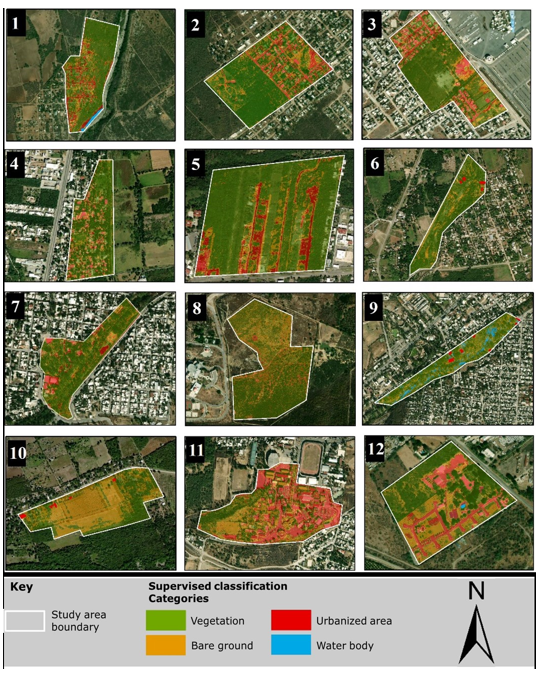
Study areas: 1 = Boca de Juan Capitán (BJC); 2 = Col. Esfuerzo Popular (CEP); 3 = Col. Área Pajaritos (CAP); 4 = Ejido Benito Juárez (EBJ); 5 = El Cuartel (EC); 6 = La Misión (LM); 7 = Paseo Méndez (PM); 8 = Planetario (P); 9 = Río San Marcos (RSM); 10 = Santa Ana (SA); 11 = Universidad Autónoma de Tamaulipas (UAT); 12 = Unidad Deportiva (UD).
Figure 1. Supervised classification analysis for the 12 study areas in Ciudad Victoria, Tamaulipas, Mexico.
The resulting classification was validated through field surveys, during which the dominant plant species and vegetation structure of each site were recorded. The identification of the observed species was verified using online taxonomic databases such as worldfloraonline.org (World Flora Online [WFO], 2026), as well as specialized catalogs (Conabio, 2024; Villaseñor, 2016). This information made it possible to confirm the vegetation types present in the study areas.
Sampling
Sampling was conducted over a one-year period, from June 2024 to July 2025. Each of the 12 sites was visited once a month, with one sampling day allocated per site. Two teams participated in each session; each team consisted of two observers trained in butterfly capture, handling, and identification to standardize detection and recording criteria. To optimize travel time, both teams simultaneously sampled two sites grouped by geographic proximity, working between 08:00 and 16:00 hours.
Continuous surveys were conducted along four pre-established linear transects within each site. The transects ranged from 300 to 400 m in length and were spaced 50 to 60 m apart. All surveys were performed at a constant speed, moving in a single direction from start to finish to minimize the double-counting of individuals. Both teams applied the same sampling effort at all sites to ensure comparability across areas, and all visible butterflies along the path were captured. Entomological aerial nets—featuring a 42 cm diameter hoop, fine mesh, and a 1.5 m handle—were used for this purpose.
Specialized field guides were consulted to identify the specimens (Glassberg, 2017; Llorente-Bousquets et al., 1997; Luis-Martínez et al., 2003). Data recorded included the species, time of capture, sampling area, and date. Afterward, the specimens were released at the capture site. Using the compiled list of species, the conservation status of each taxon was assessed in accordance with the International Union for Conservation of Nature (IUCN, 2025) Red List and NOM-059-SEMARNAT-2025 (Secretaría de Medio Ambiente y Recursos Naturales [Semarnat], 2025).
Statistical analyses
PERMANOVA (Permutational Multivariate Analysis of Variance) was used to determine whether significant differences existed in butterfly community composition among study sites, employing the Bray-Curtis distance measure (abundance matrix), 999 permutations, and a significance level of P<0.05 (Anderson, 2001). Sampling effort was evaluated using species accumulation curves based on the Chao1 and Jackknife 2 non-parametric estimators. Additionally, 95 % confidence intervals were calculated via bootstrapping to assess the precision of richness estimates (Colwell & Coddington, 1994). Diversity was compared using the Shannon-Wiener (H’; richness and evenness), Simpson (1-D; probability of co-occurrence), and dominance (D; high values indicate species dominance) indexes (Gotelli & Colwell, 2001). These indices were converted into Effective Numbers of Species (ENS), following the approach proposed by Jost (2007). Species richness corresponds to order q=0; the Shannon index was transformed via eH’ (q=1) and the Simpson index via 1/D (q=2), allowing diversity to be expressed as the equivalent number of equally abundant species and facilitating comparisons between communities (Jost, 2007). All statistical analyses were performed using PAST 4.03 (Hammer & Harper, 2025), RStudio 2025-09 (Posit Software PBC., 2025), and EstimateS version 8.2 (Colwell, 2025).
Results
A total of 19 765 specimens representing 297 butterfly species—distributed across 186 genera and six families—were identified (Appendix 1). The most abundant species were: Kricogonia lyside (Godart, 1819) with 1 308 individuals, Phoebis agarithe (Boisduval, 1836) with 1 138, Lerodea arabus (Edwards, 1882) with 704, Pyrisitia lisa (Boisduval & LeConte, 1829) with 644, Libytheana carinenta (Cramer, 1777) with 634, Mestra dorcas (Fabricius, 1775) with 601, Pyrgus oileus (Linnaeus, 1767) with 507, and Hemiargus hanno (Stoll, 1790)with 381 individuals. Regarding expected richness, the sampling was estimated to represent 93.3 % of the species according to the Chao1 estimator, 87.4 % according to Jacknife 2, and 92.8 % according to Bootstrap.
Diversity analysis among study sites
Abundance ranged from 1 003 individuals at UAT to 2 430 at RSM. Species richness (q=0) ranged from 122 (CAP and UAT) to 197 species (RSM). Effective diversity of order 1 (q=1)—which accounts for both richness and evenness of abundance—showed values of 87.36 effective species at EBJ, followed by RSM (83.93), EC (70.81), and UD (69.41) (Table 2); the lowest values were found at CAP (33.45 effective species), SA (39.65), and BJC (45.15). Effective diversity of order 2 (q=2)—which gives greater weight to dominant species—was 58.82 effective species at EBJ, followed by RSM (47.62) and PM (43.48), while UD and UAT both recorded 41.67. In contrast, CAP (11.11) and SA (12.99) recorded the lowest values, suggesting greater dominance by a few species.
Table 2. Effective numbers of species (ENS) for the 12 sampling areas in Ciudad Victoria, Tamaulipas, Mexico.
|
BJC |
CEP |
CAP |
EBJ |
EC |
LM |
PM |
P |
RSM |
SA |
UAT |
UD |
Abu |
1 602 |
1 870 |
1 215 |
1 333 |
1 964 |
1 985 |
1 437 |
1 284 |
2 430 |
2 231 |
1 003 |
1 411 |
q=0 |
133 |
152 |
122 |
157 |
165 |
144 |
143 |
131 |
197 |
169 |
122 |
137 |
q=1 |
45.15 |
59.74 |
33.45 |
87.36 |
70.81 |
50.91 |
68.03 |
50.91 |
83.93 |
39.65 |
64.72 |
69.41 |
q=2 |
22.73 |
29.41 |
11.11 |
58.82 |
35.71 |
22.22 |
43.48 |
24.39 |
47.62 |
12.99 |
41.67 |
43.48 |
BJC = Boca de Juan Capitán; CEP = Col. Esfuerzo Popular; CAP = Col. Área Pajaritos; EBJ = Ejido Benito Juárez; EC = El Cuartel; LM = La Misión; PM = Paseo Méndez; P = Planetario; RSM = Río San Marcos; SA = Santa Ana; UAT = Universidad Autónoma de Tamaulipas; UD = Unidad Deportiva. Abu = Abundance; q=0 refers to observed species richness; q=1 represents effective diversity derived from the Shannon index (eH′); q=2 corresponds to effective diversity derived from the Simpson index (1/D).
In the PERMANOVA analysis (Table 3), the total sum of squares was 15.47, while the within-group sum of squares was 11.83. The F-value was 1.007, indicating a small difference between the groups, with a P-value of 0.441, showing that there were no significant differences in butterfly species composition among the study sites.
Table 3. PERMANOVA analysis of butterfly communities at the 12 study sites in Ciudad Victoria, Tamaulipas, Mexico.
BJC |
CEP |
CAP |
EBJ |
EC |
LM |
PM |
P |
RSM |
SAN |
UAT |
UD |
||||||||||||||
BJC |
- |
0.7941 |
1.243 |
1.115 |
0.9826 |
1.018 |
1.422 |
1.178 |
0.9795 |
0.8286 |
0.9468 |
0.705 |
|||||||||||||
CEP |
0.6697 |
- |
0.9969 |
0.986 |
0.8672 |
0.7559 |
1.153 |
0.92 |
1.16 |
1.1 |
0.8521 |
0.721 |
|||||||||||||
CAP |
0.1663 |
0.5078 |
- |
0.9342 |
1.15 |
0.97 |
0.959 |
1.083 |
1.294 |
1.022 |
0.9059 |
0.888 |
|||||||||||||
EBJ |
0.1991 |
0.3151 |
0.6611 |
- |
0.9645 |
1.014 |
1.204 |
1.195 |
1.258 |
1.141 |
1.062 |
0.796 |
|||||||||||||
EC |
0.4 |
0.7121 |
0.2016 |
0.5139 |
- |
0.9402 |
1.528 |
1.18 |
0.9313 |
1.033 |
1.082 |
0.757 |
|||||||||||||
LM |
0.3986 |
0.9416 |
0.5324 |
0.2809 |
0.639 |
- |
1.039 |
0.7768 |
1.153 |
0.8563 |
1.025 |
0.723 |
|||||||||||||
PM |
0.1765 |
0.2845 |
0.5641 |
0.1945 |
0.1135 |
0.3997 |
- |
1.215 |
1.467 |
1.365 |
1.041 |
0.955 |
|||||||||||||
P |
0.462 |
0.5422 |
0.3106 |
0.1958 |
0.2335 |
0.7198 |
0.344 |
- |
1.353 |
1.013 |
1.021 |
0.748 |
|||||||||||||
RSM |
0.3477 |
0.2277 |
0.2637 |
0.1434 |
0.6007 |
0.2224 |
0.14 |
0.1734 |
- |
0.7659 |
1.063 |
0.687 |
|||||||||||||
SAN |
0.5134 |
0.2827 |
0.4777 |
0.2001 |
0.5119 |
0.776 |
0.116 |
0.4535 |
0.6889 |
- |
1.229 |
0.897 |
|||||||||||||
UAT |
0.372 |
0.658 |
0.5727 |
0.3496 |
0.2878 |
0.3692 |
0.396 |
0.3991 |
0.4243 |
0.1642 |
- |
0.473 |
|||||||||||||
UD |
0.890 |
0.971 |
0.791 |
0.828 |
0.942 |
0.969 |
0.461 |
0.828 |
0.860 |
0.740 |
0.968 |
- |
|||||||||||||
UD |
0.890 |
0.971 |
0.791 |
0.828 |
0.942 |
0.969 |
0.461 |
0.828 |
0.860 |
0.740 |
0.968 |
- |
|
||||||||||||
BJC = Boca de Juan Capitán; CEP = Col. Esfuerzo Popular; CAP = Col. Área Pajaritos; EBJ = Ejido Benito Juárez; EC = El Cuartel; LM = La Misión; PM = Paseo Méndez; P = Planetario; RSM = Río San Marcos; SA = Santa Ana; UAT = Universidad Autónoma de Tamaulipas; UD = Unidad Deportiva. P-values are shown below the diagonal, and F-values above the diagonal.
Of the 297 recorded species (Appendix 1), the majority are classified as Least Concern (LC) according to the International Union for Conservation of Nature (IUCN, 2025) and do not fall into any risk category under NOM-059-SEMARNAT-2025 (Semarnat, 2025). The exception was Danaus plexippus (Linnaeus, 1758), listed as subject to special protection (Pr) under NOM-059-SEMARNAT-2025 (Semarnat, 2025) and noted as having a declining population trend by the IUCN (2025). This species exhibited varying levels of abundance across the 12 sites, with PM, BJC, UAT, and SA standing out as the most significant.
Discussion
In this study, 297 species of diurnal butterflies were recorded in the green areas of Ciudad Victoria—a remarkable richness supported by the vegetation (primarily forest-like) within an urban environment (Ramírez-Restrepo & Halffter, 2013). This result suggests that, despite the degree of urbanization, these spaces sustain a Papilionoidea community. The presence of six butterfly families recorded in Mexico underscores the importance of urban green areas (Llorente-Bousquets et al., 2014). Although studies on diurnal butterflies have been conducted in other Mexican cities—such as Xalapa, state of Veracruz (172 species identified), San Cristóbal de las Casas, state of Chiapas (90 species), and La Cantera Park in Mexico City (50 species) (Ayala-Azcárraga et al., 2025; León-Cortés et al., 2019; Ramírez-Restrepo & Halffter, 2013; Ramírez-Restrepo et al., 2015)—a comparison of species richness was ruled out due to differences in sampling effort, study duration, the extent of the areas evaluated, and taxonomic criteria. For instance, the study by Ramírez-Restrepo et al. (2015) in Xalapa did not include the family Hesperiidae—a group representing a significant proportion of Papilionoidea diversity in Mexico—which likely reduced the observed richness and limits comparability with the present study.
This species richness positions Ciudad Victoria as an urban system with high conservation potential in Northeastern Mexico. The results suggest that the conservation of mosaics featuring varied forest vegetation—such as scrubland, secondary vegetation, and a mix of native and introduced trees—alongside cultivated areas, ornamental vegetation, and water bodies (Table 1), constitutes a key factor in sustaining diverse butterfly communities in urban environments (Muñoz-Galicia et al., 2023). Structural quality and resource availability appear to play a more decisive role than the absolute amount of green space (Ramírez-Restrepo & Halffter, 2013).
Regarding the most abundant butterfly species in the city's green areas, Kricogonia lyside, Phoebis agarithe, and Lerodea arabus stood out; this highlights their adaptability to modified environments and potential opportunistic behavior (Koptur et al., 2024), enabling them to exploit resources available in urban green spaces. Koptur et al. (2024) note that some species, such as Kricogonia lyside, can adapt to urbanized environments and successfully complete their life cycles—with larvae feeding on ornamental and exotic plants common in city gardens—whereas others, like Phoebis agarithe and Lerodea arabus, are adapted to submontane scrublands and are frequently found near human-altered areas such as gardens, lawns, roadsides, trails, and parks. In contrast, 37 species were recorded based on a single specimen, which may indicate a degree of sensitivity to urban environmental conditions (Appendix 1).
This low abundance may also be linked to specific ecological requirements—such as the availability of host plants for feeding or shelter sites—resources that urban areas fail to provide for these species (Muñoz-Galicia et al., 2023).
Variations in species richness and abundance were identified across sites; Río San Marcos exhibited the highest values (197 species; 2 430 individuals), followed by Santa Ana (169 species; 2 231 individuals) and El Cuartel (165 species; 1 964 individuals). These results suggest that these sites offer favorable environmental conditions, such as greater availability of floral resources (Natuhara et al., 1999). Although located in different contexts, Río San Marcos and Santa Ana share the presence of water bodies and riparian areas—key elements for many species. In these environments, adults engage in mud-puddling (sucking moisture from mud puddles) to obtain essential minerals that boost reproductive success (Anoop et al., 2023), a behavior frequently observed during sampling.
The high effective species richness at the Benito Juárez ejido and Río San Marcos sites—as reflected by the Shannon and Simpson indexes—suggests communities that are relatively even and characterized by low dominance. This similarity may be linked to the presence of scrubland vegetation, a common feature of both sites that likely provides a wider variety of resources and environmental conditions for butterflies; they include Acacia farnesiana (L.) Wight & Arn., Neltuma juliflora (Sw.) Raf., Senegalia berlandieri (Benth.) Britton & Rose, Erythrostemon mexicanus (Rose) Gagnon & G. P. Lewis) and Mimosa texana (A. Gray) Small, which serve as sources of nectar, shelter and breeding grounds. From the perspective of landscape mosaic theory, conserving this type of native vegetation within the urban matrix can foster the establishment of diversity hotspots by maintaining the resources and environmental conditions that support the persistence of butterfly communities (Muñoz-Galicia et al., 2023; Natuhara et al., 1999). In contrast, the lowest effective species richness was identified at the Col. Área Pajaritos and Santa Ana sites. This could be related to a higher proportion of bare ground and urban surface area (Figure 1), as well as lower heterogeneity and availability of plant resources (Muñoz-Galicia et al., 2023; Ramírez-Restrepo & Halffter, 2013); these factors could limit the presence of species with specific ecological requirements and favor only those capable of utilizing the resources available at these sites (Koptur et al., 2024).
The PERMANOVA analysis did not detect significant differences in composition among the sites. This result may indicate a relatively similar community composition—a common phenomenon in urbanized landscapes where generalist and highly mobile species tend to dominate while specialists decline (Lizee et al., 2016; Sidat & Bhatt, 2020). The absence of marked compositional differences could be attributed to an urban matrix that allows species movement between vegetation patches, or to environmental conditions that are not contrasting enough to generate different assemblages (Kumar et al., 2023). In this regard, Ciudad Victoria still retains small patches of vegetation, including wooded areas, public and residential gardens, planters, vacant lots with secondary growth, and remnants of native vegetation. These elements can help maintain urban landscape connectivity and serve as transit sites for butterflies, reducing isolation between green spaces and facilitating the movement of individuals between them (Gómez-Moreno et al., 2023; Greeney et al., 2012). Collectively, this connectivity could foster the exchange of individuals among sites and, consequently, contribute to maintaining a relatively similar community composition.
Furthermore, urban green spaces can serve as important elements for migratory species such as Danaus plexippus by maintaining resources and conditions that facilitate their temporary stay during their movements. The presence of D. plexippus—a species under special protection in Mexico (Semarnat, 2025) with declining global populations (IUCN, 2025)—highlights the importance of these spaces as potential feeding and resting sites during migration (Koptur et al., 2024; Myers et al., 2019). The availability of vegetation across various urban patches can facilitate the species' movement and provide necessary resources along its journey. In this context, sites such as Paseo Méndez, Boca de Juan Capitán and the Universidad Autónoma de Tamaulipas could function as micro-corridors and stopover points within the urban landscape, helping to maintain functional connectivity for the species along its migratory route (Myers et al., 2019).
Conclusions
The green spaces of Ciudad Victoria harbor high diurnal butterfly richness, underscoring their importance as refuges and conservation areas within the urban landscape. Species richness tended to increase in sites with greater native vegetation cover and the presence of scrubland remnants, while tending to decrease in areas with a higher proportion of bare ground and urbanized surfaces. The Río San Marcos and Benito Juárez ejido sites stood out for exhibiting the highest values of effective species and for harboring species of conservation interest, such as Danaus plexippus. Overall, these results demonstrate the role of urban green spaces in maintaining butterfly diversity and support the implementation of conservation and restoration strategies based on the use of native forest vegetation and the establishment of pollinator gardens, with the aim of improving connectivity, resource availability, and habitat quality within the urban environment.
Acknowledgments
The authors wish to express their gratitude to the Universidad Autónoma de Tamaulipas, particularly the School of Graduate Studies in Engineering and Sciences, for the facilities provided. Likewise, they thank the consultancy Servicios Profesionales en Biodiversidad for their financial support, and the reviewers for their comments, which helped improve this manuscript.
Conflict of interest
The authors declare that there is no conflict of interest with any company or institution related to this work.
Contribution by author
Santiago Niño-Maldonado: species identification, manuscript preparation, and fieldwork; Vannia del Carmen Gómez-Moreno: manuscript review, statistical analysis, map preparation and fieldwork; Jesús Lumar Reyes-Muñoz: manuscript review and assistance with specimen identification; José Norberto Lucio-García: manuscript review; and Sandra Aurora Esquivel-Niño: manuscript review.
References
Anderson, M. J. (2001). A new method for non-parametric multivariate analysis of variance. Austral Ecology, 26(1), 32-46. https://doi.org/10.1111/j.1442-9993.2001.01070.pp.x
Anoop, N. R., Femi, E. B., Yathumon, M. A., & Punnath, A. (2023). Butterflies with a taste for elephant dung: Puddling of adult butterflies on elephant dung in India's Western Ghats. Food Webs, 37, Article e00323. https://doi.org/10.1016/j.fooweb.2023.e00323
Ayala-Azcárraga, C., Hinojosa-Díaz, I. A., Segura, O., Pacheco-Muñoz, R., Larrucea-Garritz, A., & Díaz, D. (2025). Evaluation of sustainable landscape design: presence of native pollinators in an urban park in Mexico City, Mexico. Sustainability, 17(2), Article 799. https://doi.org/10.3390/su17020799
Colwell, R. K. (2025). EstimateS (Version 8.2) [Computer software]. Academic Website-EstimateS. https://www.robertkcolwell.org/pages/1407
Colwell, R. K., & Coddington, J. A. (1994). Estimating terrestrial biodiversity through extrapolation. Philosophical Transactions of the Royal Society B Biological Sciences, 345(1311), 101-118. https://doi.org/10.1098/rstb.1994.0091
Comisión Nacional para el Conocimiento y Uso de la Biodiversidad. (2024). EncicloVida [Base de datos]. Comisión Nacional para el Conocimiento y Uso de la Biodiversidad. https://enciclovida.mx/
Comisión Nacional para el Conocimiento y Uso de la Biodiversidad. (2026). Geoportal Conabio 2026. Climas [Mapa interactivo escala 1:1 000 000]. Comisión Nacional para el Conocimiento y Uso de la Biodiversidad. http://www.conabio.gob.mx/informacion/gis/?vns=gis_root/clima/climas/clima1mgw
Czech, B., Krausman, P. R., & Devers, P. K. (2000). Economic associations among causes of species endangerment in the United States: Associations among causes of species endangerment in the United States reflect the integration of economic sectors, supporting the theory and evidence that economic growth proceeds at the competitive exclusion of nonhuman species in the aggregate. BioScience, 50(7), 593-601. https://doi.org/10.1641/0006-3568(2000)050[0593:EAACOS]2.0.CO;2
Environmental Systems Research Institute. (2025). ArcGIS Esri comprehensive geospatial platform (Version 10.2) [Computer software]. Environmental Systems Research Institute. https://www.esri.com/en-us/home
Glassberg, J. (2017). A Swift Guide to Butterflies of Mexico and Central America. Princeton University Press. https://www.jstor.org/stable/j.ctt1wf4d1m
Gómez-Moreno, V. del C., González-Gaona, O. J., Niño-Maldonado, S., Azuara-Domínguez, A., & Barrientos-Lozano, L. (2023). Las áreas verdes urbanas con vegetación mixta favorecen la riqueza y abundancia de aves en Ciudad Victoria, Tamaulipas, México. Revista de Biología Tropical, 71(1), Article e50729. https://doi.org/10.15517/rev.biol.trop..v71i1.50729
Gotelli, N. J., & Colwell, R. K. (2001). Quantifying biodiversity: procedures and pitfalls in the measurement and comparison of species richness. Ecology Letters, 4(4), 379-391. https://doi.org/10.1046/j.1461-0248.2001.00230.x
Greeney, H. F., Dyer, L. A., & Smilanich, A. M. (2012). Feeding by lepidopteran larvae is dangerous: A review of caterpillars’ chemical, physiological, morphological, and behavioral defenses against natural enemies. Invertebrate Survival Journal, 9, 7-34. https://www.isj.unimore.it/index.php/ISJ/article/view/256
Hammer, Ø., & Harper, D. A. T. (2025). PAST data analysis package (version 4.03) [Computer software]. University of Oslo. https://palaeo-electronica.org/2001_1/past/pastprog/index.html
Hong, S.-H., Han, B.-H., Choi, S.-H., Sung, C. Y., & Lee, K.-J. (2012). Planning an ecological network using the predicted movement paths of urban birds. Landscape and Ecological Engineering, 9, 165-174. https://doi.org/10.1007/s11355-012-0194-3
Instituto Nacional de Estadística y Geografía. (2018). Conjunto de datos Vectoriales de Uso de Suelo y Vegetación. Escala 1:250 000. Serie VII. Conjunto Nacional [Cartas de Uso del Suelo y Vegetación]. Instituto Nacional de Estadística y Geografía. https://www.inegi.org.mx/app/biblioteca/ficha.html?upc=889463842781
Instituto Nacional de Estadística y Geografía. (2025). Consulta de indicadores sociodemográficos y económicos por área geográfica [Base de datos]. Instituto Nacional de Estadística y Geografía. https://www.inegi.org.mx/
Instituto Nacional de Estadística, Geografía e informática. (2016). Conjunto de Datos Vectoriales de Uso de Suelo y Vegetación. Escala 1:250 000. Serie VI. Capa Unión [Cartas de Uso del Suelo y Vegetación]. Instituto Nacional de Estadística, Geografía e informática. https://www.inegi.org.mx/app/biblioteca/ficha.html?upc=889463173359
International Union for Conservation of Nature. (2025). The IUCN Red List of Threatened Species. Version 2026-1 [Database]. International Union for Conservation of Nature. https://www.iucnredlist.org/en
Jost, L. (2007). Partitioning diversity into independent alpha and beta components. Ecology, 88(10), 2427-2439. https://doi.org/10.1890/06-1736.1
Koptur, S., Salas-Primoli, A., Ferrerira-Paulino-Neto, H., & Whitfield, J. (2024). Pierid butterflies, legume hostplants, and parasitoids in urban areas of Southern Florida. Insects, 15(2), Article 123. https://doi.org/10.3390/insects15020123
Kumar, P., Parmar, B., & Kumar, P. (2023). Preliminary checklist of butterfly diversity from the Himachal Pradesh Agricultural University, Palampur, India. Environment Conservation Journal, 24(3), 215-221. https://doi.org/10.36953/ecj.16492525
León-Cortés, J. L., Caballero, U., Miss-Barrera, I. D., & Girón-Intzin, M. (2019). Preserving butterfly diversity in an ever-expanding urban landscape? A case study in the highlands of Chiapas, México. Journal of Insect Conservation, 23, 405-418. https://doi.org/10.1007/s10841-019-00149-7
Lizee, M.-H., Tatoni, T., & Deschamps-Cottin, M. (2016). Nested patterns in urban butterfly species assemblages: respective roles of plot management, park layout and landscape features. Urban Ecosystems, 19, 205-224. https://doi.org/10.1007/s11252-015-0501-5
Llorente-Bousquets, J. E., Oñate-Ocaña, L., Luis-Martínez, A., Vargas-Fernández, I. (1997). Papilionidae y Pieridae de México: distribución geográfica e ilustración. Universidad Nacional Autónoma de México. https://books.google.com.ec/books?id=X_5HfolC85EC&printsec=frontcover&hl=es&source=gbs_ge_summary_r&cad=0#v=onepage&q&f=false
Llorente-Bousquets, J., Vargas-Fernández, I., Luis-Martínez, A., Trujano-Ortega, M., Hernández-Mejía, B. C., & Warren, A. D. (2014). Biodiversidad de Lepidoptera en México. Revista Mexicana de Biodiversidad, 85(Supl. 85), S353-S371. https://doi.org/10.7550/rmb.31830
Luis-Martínez, A., Llorente-Bousquets, J. E., & Vargas-Fernández, I. (2003). Nymphalidae de México I (Danainae, Apaturinae, Biblidinae y Heliconiinae): Distribución geográfica e ilustración. Universidad Nacional Autónoma de México. https://books.google.com.mx/books?id=41LBD5QLPK4C&printsec=frontcover&hl=es&source=gbs_ge_summary_r&cad=0#v=onepage&q&f=false
McDonnell, M. J., & Hahs, A. K. (2010). Comparative ecology of cities and towns: past, present and future. In M. J. McDonnell, A. K. Hahs & J. H. Breuste (Eds.), Ecology of cities and towns: A comparative approach. Cambridge University Press. https://doi.org/10.1017/cbo9780511609763.006
McKinney, M. L. (2008). Effects of urbanization on species richness: A review of plants and animals. Urban Ecosystems, 11, 161-176. https://doi.org/10.1007/s11252-007-0045-4
Muñoz-Galicia, D., Lara, C., Castillo-Guevara, C., Cuautle, M., & Rodríguez-Flores, C. (2023). Impacts of land use change on native plant–butterfly interaction networks from central Mexico. PeerJ, 11, Article e16205. https://doi.org/10.7717/peerj.16205
Myers, A., Bahlai, C. A., & Landis, D. A. (2019). Habitat type influences Danaus plexippus (Lepidoptera: Nymphalidae) oviposition and egg survival on Asclepias syriaca (Gentianales: Apocynaceae). Environmental Entomology, 48(3), 675-684. https://doi.org/10.1093/ee/nvz046
Natuhara, Y., Imai, C., & Takahashi, M. (1999). Pattern of land mosaics affecting butterfly assemblage at Mt Ikoma, Osaka, Japan. Ecological Research, 14(2), 105-118. https://doi.org/10.1046/j.1440-1703.1999.00287.x
Posit Software PBC. (2025). Downloads: RStudio 2025-09 Desktop [Software computer]. RStudio Builds. https://dailies.rstudio.com/version/2025.09.0+387/
Potgieter, L. J., Li, D., Baiser, B., Kühn, I., Aronson, M. F. J., Carboni, M., Celesti-Grapow, L., De Matos, A. C. L., Lososová, Z., Montaño-Centellas, F. A., Pyšek, P., Richardson, D. M., Tsang, T. P. N., Zenni, R. D., & Cadotte, M. W. (2024). Cities shape the diversity and spread of nonnative species. Annual Review of Ecology, Evolution and Systematics, 55, 157-180. https://doi.org/10.1146/annurev-ecolsys-102722-012749
Ramírez-Restrepo, L., & Halffter, G. (2013). Butterfly diversity in a regional urbanization mosaic in two Mexican cities. Landscape and Urban Planning, 115, 39-48. https://doi.org/10.1016/j.landurbplan.2013.03.005
Ramírez-Restrepo, L., Cultid-Medina, C. A., & MacGregor-Fors, I. (2015). How many butterflies are there in a city of Circa half a million people? Sustainability, 7(7), 8587-8597. https://doi.org/10.3390/su7078587
Secretaría de Medio Ambiente y Recursos Naturales. (2025). PROYECTO de Norma Oficial Mexicana PROY-NOM-059-SEMARNAT-2025, Protección ambiental-Especies nativas de México de flora y fauna silvestres-Categorías de riesgo y especificaciones para su inclusión, exclusión o cambio. Diario Oficial de la Federación. https://diariooficial.gob.mx/nota_detalle_popup.php?codigo=5754858
Sidat, A., & Bhatt, U. (2020). Annotated checklist of butterflies of Ankleshwar—an industrial town in Gujarat, India. Check List, 16(4), 997-1015. https://doi.org/10.15560/16.4.997
United States Geological Survey. (2025). SGS Global Visualization Viewer (GloVis). United States Government. http://glovis.usgs.gov/
Vargas-Sanabria, D., & Campos-Vargas, C. (2018). Sistema multi-algoritmo para la clasificación de coberturas de la tierra en el bosque seco tropical del Área de Conservación Guanacaste, Costa Rica. Tecnología en Marcha, 31(1), 58-69. https://doi.org/10.18845/tm.v31i1.3497
Villaseñor, J. L. (2016). Checklist of the native vascular plants of México. Revista Mexicana de Biodiversidad, 87(3), 559-902. https://doi.org/10.1016/j.rmb.2016.06.017
World Flora Online. (2026, 6 May). World Flora Online [Data set]. Global Strategy for Plant Conservation and Convention on Biological Diversity. https://www.worldfloraonline.org/
Zurita-Zaragoza, O., & Elizondo-Elizondo, R. (2009). Guía de árboles y otras plantas nativas de la zona metropolitana de Monterrey. Fondo Editorial de Nuevo León. https://fondoeditorialnl.gob.mx/producto/guia-de-arboles-nativos-en-la-zona-metropolitana-de-monterrey-digital/
Todos los textos publicados por la Revista Mexicana de Ciencias Forestales –sin excepción– se distribuyen amparados bajo la licencia Creative Commons 4.0 Atribución-No Comercial (CC BY-NC 4.0 Internacional), que permite a terceros utilizar lo publicado siempre que mencionen la autoría del trabajo y a la primera publicación en esta revista.