Revista Mexicana de Ciencias Forestales Vol. 17 (98)
Dasonomía Urbana (2026)
DOI: https://doi.org/10.29298/rmcf.v17i98.1674 Research article
Reference sites for the restoration of mining-affected peri-urban forests in the Inambari district, Peruvian Amazon Sitios de referencia para la restauración de bosques periurbanos afectados por la minería en el distrito de Inambari, Amazonía peruana
Carlos Emerico Nieto Ramos1, Luis Armando Nieto Ramos2, Bayron Alexander Ruiz-Blandon3, Efrén Hernández-Alvarez4, Rosario Marilu Bernaola-Paucar5* |
Fecha de recepción/Reception-date: 8 de abril de 2026.
Fecha de aceptación/Acceptance date: 16 de agosto de 2026.
_______________________________
1Facultad de Ingeniería, Escuela Profesional de Ingeniería Forestal y Medio Ambiente, Universidad Nacional Amazónica de Madre de Dios. Perú.
2Universidad Andina del Cusco, Filial Puerto Maldonado. Perú.
3Instituto Nacional de Investigaciones Forestales, Agrícolas y Pecuarias. México.
4Universidad de Guadalajara, Centro Universitario de Ciencias Biológicas y Agropecuarias, Departamento de Producción Forestal. México.
5Escuela Profesional de Ingeniería Agroindustrial, Facultad de Ingeniería, Universidad Nacional Autónoma Altoandina de Tarma. Perú.
*Autor para correspondencia; correo-e: rbernaola@unaat.edu.pe
*Corresponding author; e-mail: rbernaola@unaat.edu.pe
Abstract
Peri-urban forests affected by mining activities can provide ecological benchmarks to guide the restoration of degraded areas when they retain representative attributes of composition, diversity, and structure. This study evaluated the potential of six mining concessions in the Inambari River basin, in the Peruvian Amazon, to serve as reference sites for future restoration efforts. Rectangular plots of 0.1 ha were established, and all tree individuals with a diameter at breast height ≥10 cm were recorded. Taxonomic richness, Hill’s q-numbers for orders q=0, q=1, and q=2, diameter, height, basal area, Importance Value Index, and floristic similarity were determined using the Jaccard and Bray-Curtis indexes, along with a non-metric multidimensional scaling (NMDS) analysis. A total of 2 063 individuals were recorded, grouped into 57 families, 172 genera, and 404 species. Edmilot I had the greatest observed richness and basal area; Washington III had the highest effective number of common species, while Yesica had the highest effective number of dominant species. Yhon Hittler and Juan Raul 2 showed lower effective diversity and a marked dominance of Iriartea deltoidea. Washington III and Sarayacu had very similar NMDS results, and so did Yhon Hittler and Juan Raul 2. The complementary use of multiple sites allows for the establishment of more representative benchmarks of the landscape’s ecological variability to guide the restoration of peri-urban forests affected by mining.
Keywords: Effective diversity, forest structure, Importance Value Index, gold mining, Hill’s numbers, floristic similarity.
Resumen
Los bosques periurbanos afectados por actividades mineras pueden aportar referencias ecológicas para orientar la recuperación de áreas degradadas cuando conservan atributos representativos de composición, diversidad y estructura. En este estudio se evaluó el potencial de seis concesiones mineras de la cuenca del Río Inambari, Amazonía peruana, para funcionar como sitios de referencia en futuras acciones de restauración. Se establecieron parcelas rectangulares de 0.1 ha y se registraron todos los individuos arbóreos con diámetro a la altura del pecho ≥10 cm. Se determinaron la riqueza taxonómica, números de Hill de órdenes q=0, q=1 y q=2, el diámetro, la altura, área basal, Índice de Valor de Importancia y la similitud florística mediante los índices de Jaccard y Bray-Curtis, además de una ordenación de escalamiento multidimensional no métrico (NMDS). Se registraron 2 063 individuos, agrupados en 57 familias, 172 géneros y 404 especies. Edmilot I presentó la mayor riqueza observada y área basal; respecto al número efectivo de especies comunes en Washington III se registró el valor más alto, mientras que en Yesica ocurrió lo mismo, pero para el número efectivo de especies dominantes. Yhon Hittler y Juan Raul 2 mostraron menor diversidad efectiva y una marcada dominancia de Iriartea deltoidea. Washington III y Sarayacu tuvieron una NMDS muy semejante, y entre Yhon Hittler y Juan Raul 2. El uso complementario de varios sitios permite establecer referencias más representativas de la variabilidad ecológica del paisaje para orientar la restauración de bosques periurbanos afectados por la minería.
Palabras clave: Diversidad efectiva, estructura forestal, Índice de Valor de Importancia, minería aurífera, números de Hill, similitud florística.
Introduction
Ecosystem restoration encompasses a range of actions aimed at halting and reversing degradation, from impact reduction and remediation to rehabilitation and ecological restoration. The latter aims to support the recovery of a native ecosystem based on its composition, structure, functioning, and ability to sustain itself over time. In this context, reference sites, reference models, and reference ecosystems serve different functions.
A reference site is a real-world area that provides data on an ecosystem's composition, structure, and functioning. The reference model integrates information from one or more sites, historical records, and other sources to represent the expected condition and variability during recovery. The reference ecosystem corresponds to the ecological condition that guides the long-term restoration goal. Because ecosystems exhibit spatial and temporal variation, reference points should not be understood as rigid representations of the past, but rather as a basis for defining recovery pathways consistent with the ecological history and current conditions of the landscape (Higgs et al., 2014).
In the Peruvian Amazon, alluvial gold mining causes loss of forest cover, soil removal and redistribution, changes in drainage, and a reduction in sources of regeneration—changes that result in mosaics composed of forest remnants, severely degraded areas, and secondary communities at various stages of development (Caballero-Espejo et al., 2018). Research in Madre de Dios shows that recovery of biomass, diversity, and structure depends on the type of mining, disturbance intensity, and the time since the site was abandoned. Native species also show contrasting survival and growth responses when planted in areas degraded by gold mining (Garate-Quispe et al., 2024; Román-Dañobeytia et al., 2021).
Identifying key sites in these landscapes requires information on species richness and diversity, tree structure, dominance, and floristic similarity between areas. The floristic composition and structure are therefore not the ultimate goal of the analysis, but rather the basis for selecting local reference points, defining initial attributes, and guiding future restoration efforts. Floristic studies conducted in Peruvian Amazonian forests and in previously reforested areas confirm the value of these indicators for interpreting vegetation reorganization and establishing recovery criteria (Alvarez-Montalván et al., 2021).
In this context, this study aimed to identify, among six peri-urban forests affected by mining in the Inambari District, those with the greatest potential to serve as reference sites for future restoration efforts by characterizing their floristic composition, diversity, tree structure, and the ecological importance of the species.
Materials and Methods
Study area
The study was conducted at six mining concessions located in the Inambari River basin, in the district of Inambari, Tambopata province, Madre de Dios Department, in the southeastern part of the Peruvian Amazon. The evaluated area is located in the UTM coordinate system, datum WGS 84, zone 19S, between 387743-465417 m E and 8504406-8535240 m N (Figure 1). The concessions are distributed along the Inambari River corridor, near the following population centers: Limamoj, Asnai, Inambari Centro, El Progreso, Ancamayo Bajo, and Puerto Maltas. Alluvial gold mining has shaped the landscape, causing vegetation loss, soil removal, river-channel changes, and hydrological alterations that have created a mosaic of remaining forests, degraded areas, and sections with secondary vegetation (Velásquez-Ramírez et al., 2020).
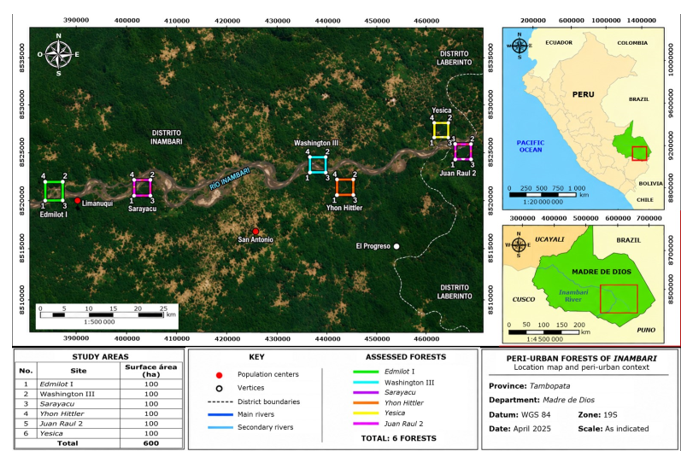
Distrito Inambari = District of Inambari; Distrito Laberinto = District of Laberinto. Limanuqui = Limanuqui town; San Antonio = San Antonio town; El Progreso = El Progreso town. Río Imambari = Inambari River. O = West.
Figure 1. Location of the six mining concessions evaluated in the Inambari River basin, Madre de Dios, Peru.
Sampling design and database
Rectangular plots measuring 100×10 m, equivalent to 0.1 ha, were established and distributed across the six mining concessions. In each plot, all trees with a diameter at breast height of or above 10 cm (DBH≥10 cm) were recorded. For each individual, the family, genus, species, DBH (model 283D Forestry Suppliers® diameter tape), and total height (model PM-5/360 PC Suunto® clinometer) were recorded. Taxonomic identification was conducted in the field with the assistance of specialists. Subsequently, the scientific names were reviewed in the World Checklist of Vascular Plants to verify accepted names, update synonyms, correct spelling inconsistencies, and standardize the taxonomic classification in the records (Govaerts et al., 2021).
Floristic composition and taxonomic richness
The floristic composition was described based on the number of families, genera, and species recorded in each concession and across the entire study area.
Structural analysis of the forest
The structure of the tree vegetation was assessed using mensuration variables, primarily diameter at breast height (DBH) and total height (H). Based on the DBH, the individual basal area (BA) of each tree was calculated using the following expression (Equation 1) (Pretzsch et al., 2015):
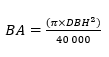 (1)
Where:
BA = Individual basal area (m2)
DBH = Diameter at breast height (cm)
ϖ = 3.1416
The total basal area per concession was calculated as the sum of individual basal areas and standardized to m2 ha-1 based on the area actually sampled. In restoration studies, comparing the structure, diversity, and composition across different areas makes it possible to establish baseline values and identify the ecological variation that must be taken into account when defining recovery goals (Beauchamp & Shafroth, 2011; Ruiz-Jaén & Aide, 2005).
Importance Value Index (IVI)
The ecological importance of the species was assessed using the Importance Value Index (IVI), calculated as the sum of relative abundance, relative frequency, and relative dominance (Equation 2) (Curtis & McIntosh, 1951):
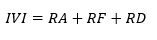 (2)
Where:
IVI = Importance Value Index
RA = Relative abundance
RF = Relative frequency
RD = Relative dominance
Relative frequency (Equation 3):
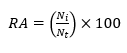 (3)
Where:
Ni= Number of individuals of the i species
Nt= Total number of the registered individuals
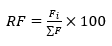
Relative frequency (Equation 4):
 (4)
Where:
Fi= Frequency of the i species
∑F = Sum of the frequencies of all species
The frequency of each species was determined based on the number of plots in which it was present.
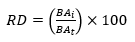
Relative frequency (Equation 5):
 (5)
Where:
BAi= Total basal area of the i species
BAt= Total basal area of all the species
Alpha and beta diversity analysis
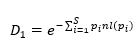
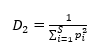
Alpha diversity was assessed using Hill indexes of orders q=0, q=1, and q=2 (Equations 6 to 8). The value q=0 corresponds to the observed species richness; q=1 represents the effective number of common species and was obtained using the exponential of the Shannon index; and q=2 expresses the effective number of dominant species and was calculated as the inverse of Simpson's concentration. This approach allows diversity to be expressed in comparable units of effective species and avoids the interpretive limitations of traditional indexes (Jost & González-Oreja, 2012).
 (6)
 (7)
 (8)
Where:
D0= Effective number of species of order 0 or observed species richness
D1 = Effective number of common species
D2 = Effective number of dominant species
S = Total number of recorded species
pi = Proportion of individuals belonging to the i species
nl = Natural logarithm
Hill's figures were calculated directly from the abundances recorded in each concession. Due to differences in sampling effort, the observed richness (q=0) was interpreted with caution and in conjunction with q=1 and q=2, which incorporate the distribution of abundances. Beta diversity was assessed using the Jaccard and Bray-Curtis similarity indexes (Bray & Curtis, 1957; Jaccard, 1912).
Criteria for identifying reference sites
The potential of each concession as a reference site was assessed by integrating four attribute groups: effective richness and diversity, tree structure, ecological importance of species, and floristic similarity. Sites with high diversity values or notable structural attributes were considered relevant, as were those with specific compositions that increased the range of variability represented. The selection was not based on a single score, but rather on the ecological complementarity among concessions, so as to establish a more representative benchmark of the landscape.
Statistical and multivariate analysis
Statistical analyses were performed using SAS version 9.4 (SAS Institute Inc., 2016). Descriptive statistics were calculated, and the normality of the variables was tested using the Shapiro-Wilk test. Because this assumption was not met, the Kruskal-Wallis test was used to analyze the differences between concessions in the DBH and total height. When significant differences were detected, the Dwass-Steel-Critchlow-Fligner multiple comparison test was applied (Zhen et al., 2022). The results are expressed as mean±standard error, and statistical groups are denoted by different letters. A significance level of α=0.05 was used in all analyses.
Jaccard and Bray-Curtis similarity matrices were calculated in PAST (Hammer et al., 2001), based on the species composition and abundance of each concession. For the NMDS analysis, Bray-Curtis similarity was transformed into dissimilarity. The NMDS was performed in Python version 3.13.5 (Python Software Foundation, 2026) using the Bray-Curtis dissimilarity matrix, and the quality of the ordination was evaluated using the stress value. The NMDS was used because of its suitability for representing differences in composition based on abundance data and ecological dissimilarity (Clarke, 1993).
Results and Discussion
Floristic composition and taxonomic richness
In the six concessions evaluated, 2 063 tree individuals were recorded, representing 57 families, 172 genera, and 404 species (Table 1).
Table 1. Taxonomic diversity of the tree community in six mining concessions in the Inambari River basin in Madre de Dios, Peru.
Study area |
Plots |
Individuals |
Families |
Genera |
Species |
Edmilot I |
10 |
553 |
44 |
114 |
158 |
Washington III |
10 |
562 |
38 |
103 |
154 |
Sarayacu |
10 |
582 |
39 |
105 |
156 |
Yhon Hittler |
3 |
112 |
23 |
39 |
41 |
Juan Raul 2 |
3 |
120 |
23 |
41 |
42 |
Yesica |
3 |
134 |
32 |
56 |
83 |
Total |
39 |
2 063 |
57 |
172 |
404 |
From a conservation perspective, the main contribution lies not only in the high richness of species, but also in the documentation of the identity, abundance, and distribution of the recorded species. This information, combined with data on forest diversity and structure, makes it possible to identify representative plant communities and establish local benchmarks for selecting species, defining restoration goals, and subsequently evaluating the progress of restored areas. The ecological integrity of secondary forests should be assessed using several complementary attributes, as no single indicator can on its own represent the composition, structure, and functioning of the ecosystem (Rosenfield et al., 2023).
Diversity indexes and structural attributes
Hill's data revealed marked differences in tree diversity across the concessions (Table 2). Species richness (q=0) was highest at Edmilot I, Sarayacu, and Washington III, with 158, 156, and 154 species, respectively; Yesica registered 83, while Juan Raul 2 registered 42 species, and Yhon Hittler, 41. Due to differences in sampling intensity, these values should be interpreted with caution. The orders q=1 and q=2 provided complementary information by incorporating the distribution of abundances and reducing the relative weight of rare species (Jost & González-Oreja, 2012).
Table 2. Hill's indexes of tree diversity in six mining concessions in the Inambari River basin, in Madre de Dios, Peru.
Study area |
q=0 |
q=1 |
q=2 |
Edmilot I |
158 |
69.38 |
30.06 |
Washington III |
154 |
81.26 |
43.05 |
Sarayacu |
156 |
79.03 |
40.32 |
Yhon Hittler |
41 |
14.27 |
5.33 |
Juan Raul 2 |
42 |
16.01 |
6.39 |
Yesica |
83 |
67.82 |
53.44 |
q=0 represents the observed richness; q=1, the effective number of common species, and q=2, the effective number of dominant species.
From a restoration perspective, Washington III and Sarayacu provide relevant examples because they combine high biodiversity with a broad representation of common species. Yesica provides a complementary measure, as it reported the highest effective number of dominant species (q=2), which reflects a more balanced distribution of abundances. Edmilot I stood out for its greater taxonomic breadth. These differences show that no single concession encompasses the full range of floristic variation in the landscape; therefore, the combined use of several sites allows for the creation of a more representative benchmark for potential recovery trajectories. In disturbed tropical landscapes, comparing communities with different compositions and levels of diversity makes it possible to set restoration goals that are consistent with local variability (Chazdon et al., 2009; Rother et al., 2019).
Structural attributes varied among the concessions. The standardized basal area per hectare was highest in Edmilot I (34.64 m2 ha-1), followed by Sarayacu (29.59 m2 ha-1), Washington III (29.19 m2 ha-1), and Yhon Hittler (27.03 m2 ha-1). Juan Raul 2 and Yesica registered 22.00 and 16.37 m2 ha-1, respectively (Figure 2).
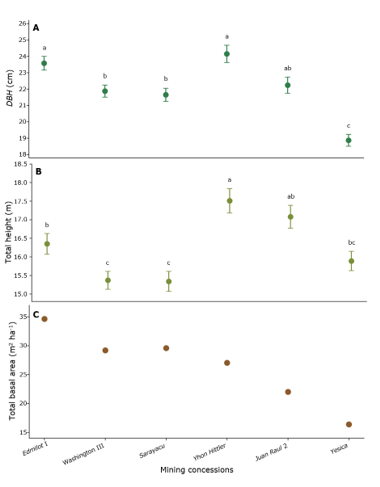
A = Diameter at breast height; B = Total height; C = Total standardized basal area. In figures A and B, the dots represent the mean±standard error. Different letters indicate significant differences (p<0.05).
Figure 2. Diameter at breast height, total height, and total standardized basal area per hectare in six mining concessions in the Inambari River basin, Madre de Dios, Peru.
The observed pattern indicates that the average tree size and basal area per hectare did not necessarily follow the same trend. Yhon Hittler had higher DBH and height values, but a smaller basal area than that recorded for Edmilot I, Washington III, and Sarayacu. In restoration, these attributes are interpreted in a complementary manner to assess how closely the recovering vegetation resembles the reference forests in terms of structure (Ssekuubwa et al., 2022). Differences in DBH, height, and basal area have also been documented among secondary forests undergoing different recovery trajectories within the same district (Nytch et al., 2023).
Importance Value Index and dominant species
Analysis of the Importance Value Index (IVI) showed that, within each concession, a small set of species accounted for the highest relative importance values; however, their composition and ranking varied between sites (Table 3). This pattern is consistent with the oligarchic structure described in forests of the Upper Amazon, where a small number of common species can account for a significant proportion of the individuals and the forest structure (Pitman et al., 2013).
Table 3. Species with the highest Importance Value Index (IVI) by study area in the Inambari River basin, Madre de Dios, Peru.
Study area |
Species |
IVI (%) |
Edmilot I |
Iriartea deltoidea Ruiz & Pav. |
7.25 |
Otoba parvifolia (Markgr.) A. H. Gentry |
5.12 |
|
Hevea guianensis Aubl. |
3.30 |
|
Washington III |
Euterpe precatoria Mart. |
5.41 |
Iriartea deltoidea Ruiz & Pav. |
4.68 |
|
Tetragastris altissima (Aubl.) Swart (sinonimia de Protium altissimum (Aubl.) Marchand) |
3.76 |
|
Sarayacu |
Euterpe precatoria Mart. |
5.66 |
Iriartea deltoidea Ruiz & Pav. |
4.89 |
|
Tetragastris altissima(Aubl.) Swart (sinonimia de Protium altissimum (Aubl.) Marchand) |
3.83 |
|
Yhon Hittler |
Iriartea deltoidea Ruiz & Pav. |
22.64 |
Brosimum alicastrum Sw. |
13.60 |
|
Otoba parvifolia (Markgr.) A. H. Gentry |
7.18 |
|
Juan Raul 2 |
Iriartea deltoidea Ruiz & Pav. |
21.64 |
Otoba parvifolia (Markgr.) A. H. Gentry |
6.46 |
|
Quararibea wittii K. Schum. & Ulbr. |
5.89 |
|
Yesica |
Tachigali amarumayu Huamantupa, H. C. Lima & D. B. O. S. Cardoso |
7.96 |
Cecropia sciadophylla Mart. |
4.74 |
|
Helicostylis tomentosa (Poepp. & Endl.) J. F. Macbr. |
4.40 |
Yhon Hittler and Juan Raul 2 reported a much higher IVI for Iriartea deltoidea Ruiz & Pav., with values of 22.64 and 21.64 %, respectively. A few species often dominate recovering tropical communities, where a small group of taxa can account for a large portion of the forest’s abundance and basal area (Asigbaase et al., 2019; Villa et al., 2019).
In Yesica, the greatest ecological importance was attributed Tachigali amarumayu Huamantupa, H. C. Lima & D. B. O. S. Cardoso (7.96 %), followed by Cecropia sciadophylla Mart. (7.74 %) and Helicostylis tomentosa (Poepp. & Endl.) J. F. Macbr. (4.40 %). From a restoration perspective, the IVI makes it possible to identify species representative of the local structure, because it takes into account their abundance, spatial distribution, and contribution to the basal area. However, a high value alone is not proof of persistence, resilience, or the ability to accelerate succession. The selection of species for use in mining areas should complement the IVI with information on natural regeneration, tolerance to site conditions, and functional attributes related to establishment and growth (Gastauer et al., 2020). Consequently, I. deltoidea and Euterpe precatoria Mart. can be considered species that are structurally representative of several concessions, while T. amarumayu and C. sciadophylla provide evidence of a different local composition.
Floristic similarity
The floristic similarity revealed a marked differentiation among the six concessions. Washington III and Sarayacu showed the greatest similarity, with Jaccard values of 0.9620 and Bray-Curtis values of 0.9476 (Figure 3).

The closer the points are to each other, the greater the floristic similarity. Stress=0.0001.
Figure 3. NMDS clustering of six mining concessions based on Bray-Curtis dissimilarity.
In contrast, Washington III and Sarayacu showed virtually no similarities to Juan Raul 2, both in terms of both species presence and species abundance. These results indicate a considerable overlap in taxa among concession groups and show that similar species richness does not necessarily imply an equivalent floristic composition. A joint assessment of taxon identity and abundance is essential for identifying different trajectories of community reorganization, because changes in dominance may remain hidden when only richness or diversity values are compared (Chazdon et al., 2022).
Yhon Hittler and Juan Raul 2 reported a Jaccard similarity index of 0.2576, but a considerably higher Bray-Curtis similarity index of 0.6638. This difference indicates that they shared a limited proportion of taxa, although the common species had relatively similar abundances. This pattern is consistent with the high ecological importance of Iriartea deltoidea in both concessions, where it accounted for more than 21 % of the IVI. The variation between the indexes shows that beta diversity reflects both species replacement and the distribution of species abundances—components that may respond differently to landscape configuration and heterogeneity (Juárez-Fragoso et al., 2024).
From a restoration perspective, these results indicate that a single concession does not represent the full range of plant diversity in the Inambari River basin. Washington III and Sarayacu can serve as examples of the same community structure, while Edmilot I, Yesica, and the group consisting of Yhon Hittler and Juan Raul 2 provide complementary floristic conditions. Selecting multiple reference sites incorporates spatial variability in the landscape and avoids setting restoration goals based on a single community, especially when connectivity, surrounding forest cover, and local conditions can influence vegetation establishment and composition during restoration (San-José et al., 2022).
The use of reference sites in restoration
The identified sites can be used complementarily to define reference attributes based on the conditions to be restored. Washington III and Sarayacu are examples of communities with high effective diversity and similar composition; Edmilot I provides values associated with greater species richness and basal area, and Yesica exhibits a distinct floristic composition with a more balanced distribution of dominant species. These attributes can be used to select native species, set composition and structure goals, and evaluate the progress of managed areas. Using multiple reference points accounts for the landscape's ecological variability and prevents setting restoration goals based on a single forest condition (Beauchamp & Shafroth, 2011; Ruiz-Jaén & Aide, 2005).
Conclusions
The six concessions differ in terms of effective diversity, structure, dominance, and floristic composition. Washington III and Sarayacu stand out for their high diversity of common species and high floristic similarity, while Edmilot I has the greatest observed species richness and basal area. Yesica complements these findings by reporting the highest effective number of dominant species and a distinct floristic composition. Yhon Hittler and Juan Raul 2 represent a condition of lower effective diversity and greater dominance of Iriartea deltoidea. The integration of these attributes allows identifying complementary reference sites that represent different ecological configurations of the landscape and provide comparative values to guide future restoration efforts in peri-urban forests affected by mining activities in the Peruvian Amazon.
Acknowledgments
The authors would like to thank the National Amazonian University of Madre de Dios (Universidad Nacional Amazónica de Madre de Dios) for the financial support provided through competitive grants for research projects, as well as Marilyn Zuleth Ruiz Guzmán for her involvement in the project.
Conflict of interest
The authors declare that they have no conflicts of interest.
Contributions by author
Carlos Emerico Nieto Ramos and Luis Armando Nieto Ramos: conceptualization, fieldwork, and revision of the manuscript; Bayron Alexander Ruiz-Blandon: technical revision and editing of the manuscript; Efrén Hernández-Alvarez: analysis of information and fieldwork; Rosario Marilu Bernaola-Paucar: conceptualization, supervision, data analysis, and drafting of the manuscript. All authors reviewed and approved the final version of the manuscript.
References
Alvarez-Montalván, C. E., Manrique-León, S., Vela-Da Fonseca, M., Cardozo-Soarez, J., Callo-Ccorcca, J., Bravo-Camara, P., Castañeda-Tinco, I., & Alvarez-Orellana, J. (2021). Composición florística, estructura y diversidad arbórea de un bosque amazónico en Perú. Scientia Agropecuaria, 12(1), 73-82. https://doi.org/10.17268/sci.agropecu.2021.009
Asigbaase, M., Sjogersten, S., Lomax, B. H., & Dawoe, E. (2019). Tree diversity and its ecological importance value in organic and conventional cocoa agroforests in Ghana. PLoS ONE, 14(1), Article e0210557. https://doi.org/10.1371/journal.pone.0210557
Beauchamp, V. B., & Shafroth, P. B. (2011). Floristic composition, beta diversity, and nestedness of reference sites for restoration of xeroriparian areas. Ecological Applications, 21(2), 465-476. https://doi.org/10.1890/09-1638.1
Bray, J. R., & Curtis, J. T. (1957). An ordination of the upland forest communities of southern Wisconsin. Ecological Monographs, 27(4), 325-349. https://doi.org/10.2307/1942268
Caballero-Espejo, J., Messinger, M., Román-Dañobeytia, F., Ascorra, C., Fernandez, L. E., & Silman, M. (2018). Deforestation and forest degradation due to gold mining in the Peruvian Amazon: A 34-year perspective. Remote Sensing, 10(12), Article 1903. https://doi.org/10.3390/rs10121903
Chazdon, R. L., Norden, N., Colwell, R. K., & Chao, A. (2022). Monitoring recovery of tree diversity during tropical forest restoration: lessons from long-term trajectories of natural regeneration. Philosophical Transactions of the Royal Society B, 378(1867), Article 20210069. https://doi.org/10.1098/rstb.2021.0069
Chazdon, R. L., Peres, C. A., Dent, D., Sheil, D., Lugo, A. E., Lamb, D., Stork, N. E., & Miller, S. E. (2009). The potential for species conservation in tropical secondary forests. Conservation Biology, 23(6), 1406-1417. https://doi.org/10.1111/j.1523-1739.2009.01338.x
Clarke, K. R. (1993). Non-parametric multivariate analyses of changes in community structure. Australian Journal of Ecology, 18(1), 117-143. https://doi.org/10.1111/j.1442-9993.1993.tb00438.x
Curtis, J. T., & McIntosh, R. P. (1951). An upland forest continuum in the Prairie-Forest Border Region of Wisconsin. Ecology, 32(3), 476-496. https://doi.org/10.2307/1931725
Garate-Quispe, J., Herrera-Machaca, M., Pareja-Auquipata, V., Alarcón-Aguirre, G., Baez-Quispe, S., & Carpio-Vargas, E. E. (2024). Resilience of aboveground biomass of secondary forests following the abandonment of gold mining activity in the southeastern Peruvian Amazon. Diversity, 16(4), Article 233. https://doi.org/10.3390/d16040233
Gastauer, M., de Medeiros-Sarmento, P. S., Araujo-Santos, V. C., Frois-Caldeira, C., Ramos, S. J., Teodoro, G. S., & Siqueira, J. O. (2020). Vegetative functional traits guide plant species selection for initial mineland rehabilitation. Ecological Engineering, 148, Article 105763. https://doi.org/10.1016/j.ecoleng.2020.105763
Govaerts, R., Lughadha, E. N., Black, N., Turner, R., & Paton, A. (2021). The World Checklist of Vascular Plants, a continuously updated resource for exploring global plant diversity. Scientific Data, 8(1), Article 215. https://doi.org/10.1038/s41597-021-00997-6
Hammer, Ø., Harper, D. A. T., & Ryan, P. D. (2001). PAST: Paleontological Statistics Software Package for Education and Data Analysis. Palaeontologia Electronica, 4(1), Article 4. https://palaeo-electronica.org/2001_1/past/issue1_01.htm
Higgs, E., Falk, D. A., Guerrini, A., Hall, M., Harris, J., Hobbs, R. J., Jackson, S. T., Rhemtulla, J. M., & Throop, W. (2014). The changing role of history in restoration ecology. Frontiers in Ecology and the Environment, 12(9), 499-506. https://doi.org/10.1890/110267
Jaccard, P. (1912). The distribution of the flora in the alpine zone. New Phytologist, 11(2), 37-50. https://doi.org/10.1111/j.1469-8137.1912.tb05611.x
Jost, L., & González-Oreja, J. (2012). Midiendo la diversidad biológica: Más allá del índice de Shannon. Acta Zoológica Lilloana, 56(1-2), 3-14. https://www.lillo.org.ar/journals/index.php/acta-zoologica-lilloana/article/view/240
Juárez-Fragoso, M. A., Perroni, Y., Dáttilo, W., Gómez-Díaz, J. A., & Guevara, R. (2024). The landscape scale of effect on the alpha and beta diversities of woody species in a semideciduous tropical forest. Landscape Ecology, 39, Article 33. https://doi.org/10.1007/s10980-024-01809-z
Nytch, C. J., Rojas-Sandoval, J., Erazo-Oliveras, A., Santiago-García, R. J., & Meléndez-Ackerman, E. J. (2023). Effects of historical land use and recovery pathways on composition, structure, ecological function, and ecosystem services in a Caribbean secondary forest. Forest Ecology and Management, 546, Article 121311. https://doi.org/10.1016/j.foreco.2023.121311
Pitman, N. C. A., Silman, M. R., & Terborgh, J. W. (2013). Oligarchies in Amazonian tree communities: a ten-year review. Ecography, 36(2), 114-123. https://doi.org/10.1111/j.1600-0587.2012.00083.x
Pretzsch, H., Biber, P., Uhl, E., Dahlhausen, J., Rötzer, T., Caldentey, J., Koike, T., van Con, T., Chavanne, A., Seifert, T., du Toit, B., Farnden, C., & Pauleit, S. (2015). Crown size and growing space requirement of common tree species in urban centres, parks, and forests. Urban Forestry & Urban Greening, 14(3), 466-479. https://doi.org/10.1016/j.ufug.2015.04.006
Python Software Foundation. (2026). Python 3.13.5 [Software]. Python Software Foundation. https://www.python.org/downloads/release/python-3135/
Román-Dañobeytia, F., Cabanillas, F., Lefebvre, D., Farfan, J., Alferez, J., Polo-Villanueva, F., Llacsahuanga, J., Vega, C. M., Velasquez, M., Corvera, R., Condori, E., Ascorra, C., Fernandez, L. E., & Silman, M. R. (2021). Survival and early growth of 51 tropical tree species in areas degraded by artisanal gold mining in the Peruvian Amazon. Ecological Engineering, 159, Article 106097. https://doi.org/10.1016/j.ecoleng.2020.106097
Rosenfield, M. F., Jakovac, C. C., Vieira, D. L. M., Poorter, L., Brancalion, P. H. S., Vieira, I. C. G., de Almeida, D. R. A., Massoca, P., Schietti, J., Albernaz, A. L. M., Ferreira, M. J., & Mesquita, R. C. G. (2023). Ecological integrity of tropical secondary forests: concepts and indicators. Biological Reviews, 98(2), 662-676. https://doi.org/10.1111/brv.12924
Rother, D. C., Liboni, A. P., Silva-Magnago, L. F., Chao, A., Chazdon, R. L., & Ribeiro-Rodrigues, R. (2019). Ecological restoration increases conservation of taxonomic and functional beta diversity of woody plants in a tropical fragmented landscape. Forest Ecology and Management, 451, Article 117538. https://doi.org/10.1016/j.foreco.2019.117538
Ruiz-Jaén, M. C., & Aide, T. M. (2005). Vegetation structure, species diversity, and ecosystem processes as measures of restoration success. Forest Ecology and Management, 218(1), 159-173. https://doi.org/10.1016/j.foreco.2005.07.008
San-José, M., Werden, L. K., Joyce, F. H., Reid, J. L., Holl, K. D., & Zahawi, R. A. (2022). Effects of landscape structure on restoration success in tropical premontane forest. Scientific Reports, 12, Article 13452. https://doi.org/10.1038/s41598-022-16542-3
SAS Institute Inc. (2016). SAS/STAT User’s Guide, Version 9.4 [Software]. SAS Institute Inc. https://www.scirp.org/reference/referencespapers?referenceid=2877863
Ssekuubwa, E., van Goor, W., Snoep, M., Riemer, K., Wanyama, F., Waiswa, D., Yikii, F., & Tweheyo, M. (2022). Does restoration success vary with tree size under restoration plantings and regrowth forests? Conservation Science and Practice, 4(9), Article e12781. https://doi.org/10.1111/csp2.12781
Velásquez-Ramírez, M. G., Guerrero-Barrantes, J. A., Thomas, E., Gamarra-Miranda, L. A., Pillaca, M., Tello-Peramas, L. D., & Bazán-Tapia, L. R. (2020). Heavy metals in alluvial gold mine spoils in the peruvian amazon. CATENA, 189, Article 104454. https://doi.org/10.1016/j.catena.2020.104454
Villa, P. M., Martins, S. V., Rodrigues, A. C., Safar, N. V. H., Castro-Bonilla, M. A., & Ali, A. (2019). Testing species abundance distribution models in tropical forest successions: Implications for fine-scale passive restoration. Ecological Engineering, 135, 28-35. https://doi.org/10.1016/j.ecoleng.2019.05.015
Zhen, W., Kwan, K. Y., Wang, C.-C., Wu, X., Guo, G., Deng, Q., Huang, X., Wang, X., Zhu, J., & Xu, P. (2022). Community structure of benthic macroinvertebrates in native and introduced mangroves of northern Beibu Gulf, China: Implication for restoring mangrove ecosystems. Marine Pollution Bulletin, 180, Article 113796. https://doi.org/10.1016/j.marpolbul.2022.113796
Todos los textos publicados por la Revista Mexicana de Ciencias Forestales –sin excepción– se distribuyen amparados bajo la licencia Creative Commons 4.0 Atribución-No Comercial (CC BY-NC 4.0 Internacional), que permite a terceros utilizar lo publicado siempre que mencionen la autoría del trabajo y a la primera publicación en esta revista.