Revista Mexicana de Ciencias Forestales Vol. 17 (98)
Dasonomía Urbana (2026)
DOI: https://doi.org/10.29298/rmcf.v17i98.1671 Research article
Ecosystem services of urban trees in two parks in Guadalajara, Jalisco state Servicios ecosistémicos del arbolado urbano en dos parques de Guadalajara, Jalisco
Efrén Hernández-Alvarez1, Bayron Alexander Ruiz-Blandon2*, Mario Alberto Hernández-Tovar3, Rosario Marilu Bernaola-Paucar4 |
Fecha de recepción/Reception date: 5 de abril de 2026.
Fecha de aceptación/Acceptance date: 12 de agosto de 2026.
_______________________________
1Universidad de Guadalajara, Centro Universitario de Ciencias Biológicas y Agropecuarias, Departamento de Producción Forestal. México.
2Instituto Nacional de Investigaciones Forestales, Agrícolas y Pecuarias. México.
3Universidad de Guadalajara, Centro Universitario de Ciencias Exactas e Ingenierías, Departamento de Madera, Celulosa y Papel. México.
4Escuela Profesional de Ingeniería Agroindustrial, Facultad de Ingeniería, Universidad Nacional Autónoma Altoandina de Tarma. Perú.
*Autor para correspondencia; correo-e: ruiz.bayron@inifap.gob.mx
*Corresponding author; e-mail: ruiz.bayron@inifap.gob.mx
Abstract
Urban trees are part of the green infrastructure and provide ecosystem services that depend on their structure, composition, management, and development. In this regard, this study compares the floristic composition, tree structure and stored aboveground carbon in the Zapopan Metropolitan Park and the Luis Quintanar Park in Guadalajara, Jalisco, Mexico. A random subsample equivalent to 50 % of the individuals at each site was analyzed, consisting of 329 trees in the former park and 509 in the latter. The taxonomic richness, relative abundance, species origin, and Shannon, Simpson and Pielou indexes were determined. The structure was characterized by diameter at breast height, total height, crown diameter, basal area and crown area. The aboveground biomass was estimated using an allometric equation based on the diameter, and the aboveground carbon was estimated using a fraction of 0.47. The Zapopan Metropolitan Park featured 35 species, 23 genera and 14 families, with a higher proportion of native species and a high Shannon diversity index. The Luis Quintanar Park recorded 18 taxa, 18 genera, and 13 families; in addition, individuals with greater structural development predominated. At this site, the diameter, height, basal area, aboveground biomass and aboveground carbon were significantly higher. The stored carbon reached 2.88 Mg C ha-1 in the Luis Quintanar Park and 0.80 Mg C ha-1 in the Zapopan Metropolitan Park. Results show that the floristic diversity and the structural development are complementary components for assessing the ecosystem services provided by urban trees.
Keywords: Aboveground biomass, aboveground carbon, plant diversity, native species, tree structure, urban landscape.
Resumen
El arbolado urbano es parte de la infraestructura verde y genera servicios ecosistémicos que dependen de su estructura, composición, manejo y desarrollo. Al respecto, en el presente estudio se compara la composición florística, estructura arbórea y el carbono aéreo almacenado en los parques Metropolitano de Zapopan y Luis Quintanar, Guadalajara, Jalisco, México. Se analizó una submuestra aleatoria equivalente a 50 % de los individuos registrados en cada sitio, integrada por 329 árboles en el primer parque y 509 en el segundo. Se determinaron la riqueza taxonómica, abundancia relativa, origen de las especies y los índices de Shannon, Simpson y Pielou. La estructura se caracterizó con el diámetro a la altura del pecho, altura total, diámetro de copa, área basal y área de copa. La biomasa aérea se estimó con una ecuación alométrica basada en el diámetro y el carbono aéreo mediante una fracción de 0.47. El Parque Metropolitano de Zapopan presentó 35 especies, 23 géneros, 14 familias, mayor proporción de especies nativas y diversidad de Shannon alta. El Parque Luis Quintanar registró 18 taxa, 18 géneros y 13 familias, además predominaron individuos con más desarrollo estructural. En este sitio, el diámetro, la altura, área basal, biomasa aérea y el carbono aéreo fueron significativamente superiores. El carbono almacenado alcanzó 2.88 Mg C ha-1 en el parque Luis Quintanar y 0.80 Mg C ha-¹ en el Metropolitano de Zapopan. Los resultados evidencian que la diversidad florística y el desarrollo estructural representan componentes complementarios para evaluar los servicios ecosistémicos del arbolado urbano.
Palabras clave: Biomasa aérea, carbono aéreo, diversidad florística, especies nativas, estructura arbórea, paisaje urbano.
Introduction
Urban trees are part of green infrastructure and provide environmentally and socially significant ecosystem services, including microclimate regulation, pollutant capture, carbon sequestration, shade provision, and improved population well-being and recreational opportunities (Moreno et al., 2024; Ortega-Álvarez et al., 2011). The assessment incorporates dendrometric variables and functional attributes that allow characterization of tree-stand structure and estimation of biomass and stored carbon (Sharma et al., 2025). In this context, carbon sequestration plays a central role because it connects to climate change mitigation and planning for more resilient cities (McPherson et al., 2013). Its size depends on the diameter at breast height (DBH), total height, crown size, and species composition (Kim et al., 2024; Pretzsch et al., 2015).
Urban and metropolitan parks are well-suited for this type of analysis because they contain a significant portion of the tree vegetation and reflect differences in management, composition, and structural development within the same urban matrix (Nero et al., 2024). In Mexico, Martínez-Trinidad et al. (2021) demonstrated in Texcoco city, State of Mexico, that studying the tree cover makes it possible to describe the structure, diversity and the ecosystem services, which is useful for its management; while García-Valencia et al. (2025) noted in Xalapa city that the tree composition and condition influence the provision of ecosystem services. Despite this, comparative studies of metropolitan parks within a single urban region using the same analytical criteria remain less common (Leal-Elizondo et al., 2018). In this context, this study compared the floristic composition, tree structure, and aboveground carbon storage in the Zapopan Metropolitan Park and the Luis Quintanar Park in Guadalajara city, state of Jalisco, Mexico.
Materials and Methods
Study area
The study was conducted in two parks in the Guadalajara Metropolitan Area, Jalisco: the Zapopan Metropolitan Park (ZMP) and the Luis Quintanar Park (LQP). For the analysis, 50 % of the total area of each green space was considered, equivalent to 50 ha in the ZMP and 46 ha in the LQP. The approximate central coordinates were 20.67° N and 103.44° W for the ZMP, and 20.67° N and 103.27° W for the LQP. The ZMP is located in the Zapopan municipality, and the LQP is located in Guadalajara (Figure 1). Both municipalities are characterized by a warm, subhumid climate with summer rains and moderate humidity; in Zapopan, there are also localized areas with warm subhumid conditions characterized by lower humidity and temperate subhumid conditions characterized by higher humidity, associated with the municipality’s topographic variation (Instituto Nacional de Estadística, Geografía e Informática [INEGI], 2010a, 2010b).
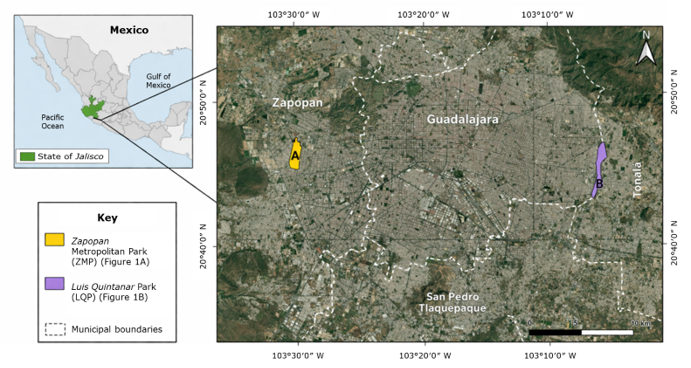
Zapopan = Zapopan municipality; Guadalajara = City of Guadalajara.
Figure 1. Location of the parks analyzed in the Guadalajara Metropolitan Area, Jalisco, Mexico.
Sampling design and selection of individuals
An inventory was conducted of the tree vegetation present on 50 % of the total area of each park, equivalent to 50 ha in the ZMP and 46 ha in the LQP. The corresponding mensuration variables were recorded for each individual tree. Because the parks differed in the number of trees recorded, a uniform sampling fraction was utilized to maintain a comparable selection intensity across sites and to prevent the park with the highest abundance from being disproportionately represented in the analyses. Therefore, 50 % of the individuals surveyed in each park were selected at random and in a reproducible manner. The analytical sample consisted of 329 individuals in the ZMP and 509 in the LQP (Chao et al., 2014).
Measurement of mensuration variables
The diameter at breast height (DBH), total height (H) and crown diameter of each tree were recorded, as these variables allow describing the size, vertical growth, and canopy spread in studies of urban tree vegetation (Avery & Burkhart, 2015; Burkhart & Tomé, 2012). DBH was measured at 1.30 m above ground level using a model 283D Forestry Suppliers® diameter tape. When forking occurred below that height, each stem was considered a separate individual; when it occurred above that height, it was recorded as a single tree. When bulges or deformations were present at 1.30 m, the measurement was taken immediately above the irregularity (Cruz-de León & Cruz-de León, 2006). H was determined using a model HS080 Haga® hypsometer, from an appropriate horizontal distance from the tree. The canopy diameter was recorded in meters using a model TFC-50ME Truper® measuring tape by taking a horizontal measurement of the canopy's projection.
Taxonomic refinement and analyzed variables
The database was reviewed to identify incomplete records, spelling errors in the scientific names, inconsistent abbreviations, and ambiguous taxonomic categories. Family, genus, and species names were standardized and verified using World Flora Online (WFO, 2026) in order to avoid overestimates of species richness and improve the consistency of the floristic results (Saavedra-Romero et al., 2019). Following the taxonomic review, the numerical consistency of the mensuration variables was verified, and only the records useful for subsequent analyses were retained. The original variables considered were family, genus, species, origin, DBH, H, and crown diameter.
Structural characteristics of trees
The structural characterization was based on DBH, H and crown diameter, as these variables allow for a description of tree size, space occupancy and canopy display in urban parks (Amer et al., 2023; Morgenroth et al., 2020). The individual basal area was calculated from the DBH (Equation 1), while the crown area was estimated from the crown diameter (Equation 2) (Avery & Burkhart, 2015; Pretzsch et al., 2015).
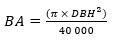 (1)
Where:
BA = Individual basal area (m2)
DBH = Diameter at breast height (cm)
ϖ = 3.1416
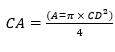 (2)
Where:
CA = Crown area (m2)
CD = Crown diameter (m)
ϖ = 3.1416
The structural variables were summarized using means and standard errors for each park. In addition, the distribution of individuals was represented using diameter and height classes in order to identify differences in structural organization among sites (Bidolakh et al., 2023; Morgenroth et al., 2020).
Floristic composition and tree diversity
The floristic composition was described by the number of families, genera, and species recorded in the ZMP and the LQP, as well as the absolute and relative abundance of the taxa present. This procedure allowed identification of the dominant groups and provided insights into their relationship with the structural development and carbon storage (Leal Elizondo et al., 2018; Ortega-Álvarez et al., 2011). Alpha diversity was assessed based on species richness (S), the Shannon index (H’) (Equation 3), the Simpson index (1−D) (Equation 4), and Pielou’s evenness index (J’) (Equation 5), as these indicators make it possible to analyze richness, dominance, and uniformity in a complementary manner (Chao et al., 2014; Magurran, 2004).
 (3)
Where:
H’ = Shannon index
nl = Natural logarithm
pi = Proportion of individuals of the i species
 (4)
Where:
1−D = Simpson index
pi = Proportion of individuals of the i species
 (5)
Where:
J’ = Pielou’s evenness index
H’ = Shannon index
S = Number of species
In addition, species were classified as native or introduced, an attribute that provides useful information for ecological interpretation of the tree community and for discussions on management in urban areas (Castro-Díez et al., 2019; Sjöman et al., 2015).
Estimation of biomass and stored carbon
Aboveground biomass was estimated using a general allometric equation for tropical trees based on DBH, since the available data do not uniformly include information on basic wood density or adjusted height for all individuals. Under these conditions, the use of a general model (Equation 6) made it possible to maintain a consistent approach across parks (Chave et al., 2014).
 (6)
Where:
AGB = Aboveground biomass (kg tree-1)
exp = Base of the natural logarithm
nl = Natural logarithm
DBH = Diameter at breast height (cm)
Aboveground carbon was calculated from the estimated aboveground biomass (Equation 7), using a carbon fraction of 0.47 (Nowak & Crane, 2002).
 (7)
Where:
SAC = Stored atmospheric carbon (kg C tree-1)
AGB = Aboveground biomass (kg tree-1)
0.47 = Carbon fraction of dry biomass
The individual values for biomass and aboveground carbon were averaged for each park and area to compare their ecosystem contributions (McPherson et al., 2013).
Statistical analysis
The floristic composition of the ZMP and LQP was described in terms of family, genus, and species richness, as well as the absolute and relative abundance of the recorded taxa (Saavedra-Romero et al., 2019). Alpha diversity was assessed using the Shannon, Simpson and Pielou indexes (Chao et al., 2014; Magurran, 2004). The difference between the Shannon indexes of the two parks was assessed using Hutcheson's t-test. For the structural and functional variables (DBH, total height, crown diameter, basal area, crown area, aboveground biomass, and aboveground carbon), means and standard errors were calculated for each park. Normality was assessed using the Shapiro-Wilk test, and homogeneity of variances was assessed using Levene’s test. The DBH, total height, crown diameter, basal area, crown area, aboveground biomass, and aboveground carbon did not meet these assumptions (p<0.05); therefore, the differences between the two parks were assessed using the Mann-Whitney test (Mann & Whitney, 1947). Statistical analyses were performed using SAS version 9.4 (SAS Institute Inc., 2017).
Results and Discussion
Floristic composition, plant richness and plant diversity
A total of 48 species which belong to 15 families were identified. In the ZMP, taxa belonging to the Pinaceae, Fabaceae, and Fagaceae families predominated, while in the LQP, the Fabaceae, Bignoniaceae, Casuarinaceae, Oleaceae, and Salicaceae families were most heavily represented. This pattern reflects two clearly distinct floristic assemblages within the same metropolitan context (Table 1).
Table 1. Flora recorded in the ZMP and LQP parks.
Family |
Scientific name |
LQP (n) |
ZMP (n) |
Total (n) |
Altingiaceae |
Liquidambar styraciflua L. |
- |
3 |
3 |
Anacardiaceae |
Schinus molle L. |
6 |
- |
6 |
Bignoniaceae |
Jacaranda mimosifolia D. Don |
95 |
4 |
99 |
Tabebuia rosea (Bertol.) DC. |
- |
3 |
3 |
|
Tecoma stans (L.) Juss. |
- |
4 |
4 |
|
Burseraceae |
Bursera copallifera (Moc. & Sessé ex DC.) Bullock |
- |
1 |
1 |
Bursera fagaroides (Kunth) Engl. |
2 |
4 |
6 |
|
Bursera multijuga Engl. |
- |
1 |
1 |
|
Bursera palmeri S. Watson |
- |
7 |
7 |
|
Bursera simaruba (L.) Sarg. |
5 |
- |
5 |
|
Casuarinaceae |
Casuarina equisetifolia L. |
62 |
- |
62 |
Cordiaceae |
Cordia seleriana Fernald |
- |
10 |
10 |
Cupressaceae |
Hesperocyparis lusitanica (Mill.) Bartel |
2 |
7 |
9 |
Cupressus sempervirens L. |
- |
2 |
2 |
|
Taxodium mucronatum Ten. |
13 |
- |
13 |
|
Fabaceae |
Acrocarpus fraxinifolius Wight & Arn. |
1 |
1 |
2 |
Bauhinia divaricata L. |
119 |
- |
119 |
|
Caesalpinia pulcherrima (L.) Sw. |
5 |
- |
5 |
|
Delonix regia (Bojer ex Hook.) Raf. |
- |
10 |
10 |
|
Erythrina americana Mill. |
- |
4 |
4 |
|
Inga latifolia (L.) Willd. (sinonimia de Zygia latifolia (L.) Fawc. & Rendle) |
- |
3 |
3 |
|
Leucaena esculenta (Moc. & Sessé ex DC.) Benth. |
- |
1 |
1 |
|
Leucaena leucocephala (Lam.) de Wit |
- |
13 |
13 |
|
Lysiloma divaricatum (Jacq.) J. F. Macbr. |
- |
42 |
42 |
|
Pithecellobium dulce (Roxb.) Benth. |
3 |
- |
3 |
|
Vachellia farnesiana (L.) Wight & Arn. |
- |
5 |
5 |
|
Fagaceae |
Quercus aristata Hook. & Arn. |
- |
5 |
5 |
Quercus magnoliifolia Née |
- |
4 |
4 |
|
Malvaceae |
Ceiba speciosa (A. St.-Hil., A. Juss. & Cambess.) |
1 |
4 |
5 |
Malvaviscus arboreus Dill. ex Cav. |
- |
9 |
9 |
|
Meliaceae |
Swietenia humilis Zucc. |
- |
1 |
1 |
Moraceae |
Ficus americana Aubl. |
5 |
- |
5 |
Myrtaceae |
Eucalyptus camaldulensis Dehnh. |
39 |
6 |
45 |
Eucalyptus globulus Labill. |
- |
2 |
2 |
|
Psidium guajava L. |
3 |
- |
3 |
|
Oleaceae |
Fraxinus uhdei (Wenz.) Lingelsh. |
50 |
5 |
55 |
Pinaceae |
Pinus cembroides Zucc. |
- |
7 |
7 |
Pinus devoniana Lindl. |
- |
14 |
14 |
|
Pinus douglasiana Martínez |
3 |
107 |
110 |
|
Pinus greggii Engelm. ex Parl. |
- |
29 |
29 |
|
Pinus oocarpa Schiede |
- |
3 |
3 |
|
Pinus praetermissa Styles & McVaugh |
- |
2 |
2 |
|
Proteaceae |
Grevillea robusta A. Cunn. ex R. Br. |
12 |
1 |
13 |
Salicaceae |
Salix bonplandiana Kunth |
83 |
- |
83 |
Sapindaceae |
Sapindus saponaria L. |
- |
5 |
5 |
ZMP = Zapopan Metropolitan Park; LQP = Luis Quintanar Park. A hyphen (-) indicates no records.
The taxonomic richness was greater in the ZMP, with 14 families, 23 genera, and 35 species recorded, whereas in the LQP, 13 families, 18 genera, and 18 taxa were identified. Although the LQP contained a larger number of individuals, the ZMP included a greater variety of taxa. In this case, the abundance of trees was not accompanied by greater species richness (Table 2).
Table 2. Taxonomic richness and tree diversity in the ZMP and LQP parks.
Variable |
ZMP |
LQP |
Individuals (n) |
329 |
509 |
Families |
14 |
13 |
Genera |
23 |
18 |
Species |
35 |
18 |
Native (%) |
89.4 |
57.0 |
Exotic (%) |
10.6 |
43.0 |
Shannon (H’) |
2.680 |
2.118 |
Simpson (1−D) |
0.860 |
0.847 |
Pielou (J’) |
0.754 |
0.733 |
ZMP = Zapopan Metropolitan Park; LQP = Luis Quintanar Park.
The Shannon value was higher in the ZMP group (2.680) than in the LQP group (2.118), a difference that was significant according to Hutcheson's t-test (t=6.54; df=516; p<0.001). Simpson's index was very similar at both parks, with a value of 0.860 at ZMP and 0.847 at LQP, which indicates that at both sites, a significant proportion of the individuals consisted of just a few species. Pielou's evenness index also showed similar values, with 0.754 in ZMP and 0.733 in LQP; thus, the main variation between the two parks was related to richness and heterogeneity rather than to the uniformity of abundances (Table 2).
In the ZMP, individuals of native species predominated, accounting for 89.4 % of the total analyzed, whereas in the LQP, the proportion of exotic taxa was higher. This is consistent with the floristic list in Table 1 and suggests different establishment criteria in each park, with the ZMP’s composition closely aligned with regional vegetation and the LQP’s composition more closely linked to ornamental and urban uses (Table 2).
The above understanding was reinforced by the relative abundance of the most representative taxa. In the ZMP (Figure 2A), Pinus douglasiana Martínez was the most common species, followed by Lysiloma divaricatum (Jacq.) J. F. Macbr. and Pinus greggii Engelm. ex Parl. These three species accounted for a significant proportion of the park’s records and defined its floristic identity. In the LQP (Figure 2B), the most amply represented taxa were Bauhinia divaricata L., Jacaranda mimosifolia D. Don, and Salix bonplandiana Kunth, along with Casuarina equisetifolia L., and Fraxinus uhdei (Wenz.) Lingelsh. The three most abundant species accounted for 54.1 % of the individuals in the ZMP and 58.3 % in the LQP, although the composition of the dominant group differed between the parks.
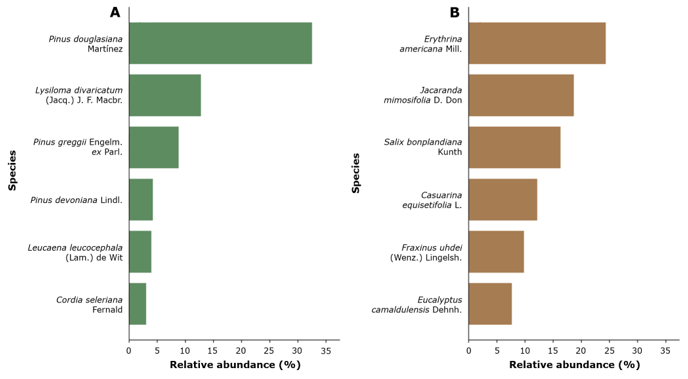
A = Zapopan Metropolitan Park (ZMP); B = Luis Quintanar Park (LQP).
Figure 2. Relative abundance of the main tree species recorded in the evaluated parks.
The information obtained in this study indicates that the ZMP supported a more diverse tree community with a greater presence of native species, while the LQP has a larger number of individuals, but within a more limited floristic group dominated by species widely used in urban green spaces. This pattern suggests that the two parks have different establishment and management histories, and that the composition of each site depends not only on the number of trees present, but also on the criteria that have shaped the vegetation over time. A similar pattern was documented by Ortega-Álvarez et al. (2011), who noted that the tree composition varies significantly depending on the urban context, and by Leal-Elizondo et al. (2018), who in Linares, state of Nuevo León, Mexico, found a community with high representation within the total population, dominated by a few taxa.
The higher richness observed in the ZMP is consistent with the findings described by Martínez-Trinidad et al. (2021) in parks in Texcoco, State of Mexico, Mexico, where diversity did not depend exclusively on the number of individuals but on the taxonomic variety present at each site as well. In this study, both in the ZMP and the LQP, only a few species accounted for a significant proportion of the records, although the dominant group was not the same. This characteristic has also been described in urban forests in Mexico City, where the tree community is typically structured around a limited number of species with high relative abundance (Saavedra-Romero et al., 2019).
Structural differences between the metropolitan parks
The LQP scored higher than the ZMP on all the evaluated variables. In relative terms, the average DBH was 30.7 % higher; the total height, 47.9 % higher; the crown diameter, 11.6 % higher; the basal area, 79.2 % higher, and the crown area, 24.4 % higher. This pattern indicates that, even though the ZMP had greater floristic richness, the LQP was dominated by larger trees that occupied a larger portion of the canopy (Table 3).
Table 3. Structural attributes of the ZMP and the LQP (mean±standard error).
Variable |
ZMP |
LQP |
p |
DBH (cm) |
17.78±0.47 |
23.23±0.56 |
<0.001 |
H (m) |
7.34±0.19 |
10.86±0.18 |
<0.001 |
Crown diameter (m) |
5.40±0.13 |
6.03±0.12 |
0.001 |
Basal area (m2 tree-1) |
0.03±0.00 |
0.05±0.00 |
<0.001 |
Crown area (m2 tree-1) |
27.54±1.58 |
34.24±1.54 |
0.001 |
ZMP = Zapopan Metropolitan Park; LQP = Luis Quintanar Park. DBH = Diameter at breast height; H = Total height. The values are expressed as mean±standard error. The p-value corresponds to the Student’s t-test or the Mann-Whitney U test, depending on whether or not the assumptions were met; differences were considered significant when p≤0.05.
The differences between the parks were significant for all the structural variables evaluated. The LQP exhibited higher values for DBH, total height, crown diameter, basal area, and crown area. From an ecological perspective, the larger average size recorded in the LQP suggests a community dominated by individuals with greater structural development, a condition that is often associated with greater shade provision and the ability to accumulate more aboveground biomass. Pretzsch et al. (2015) noted that crown size and growing space are key traits for interpreting tree performance in urban environments. In a similar way, McPherson et al. (2013) reported that larger trees tend to account for a significant portion of the ecological benefits of urban trees. In parks in the city of Texcoco, Martínez-Trinidad et al. (2021) also documented structural contrasts associated with the composition and management of each site, while Leal-Elizondo et al. (2018) observed, in Linares, Nuevo León, that the abundance of certain taxa may influence the group structure more than the species richness alone.
Aboveground biomass and aboveground carbon
Higher values of aboveground biomass and aboveground carbon were recorded in the LQP, both per tree and per unit area (Table 4). This pattern was consistent with the structure observed previously, as larger individuals predominated in the LQP. Studies on urban tree stands have shown that larger trees account for a significant portion of the biomass and stored carbon; therefore, the pattern observed in this study is consistent with the findings of McPherson et al. (2013), and Velasco and Chen (2019).
Table 4. Aboveground biomass and carbon stored in the ZMP and LQP parks.
Variable |
ZMP |
LQP |
p |
Aboveground biomass (kg tree-1) |
257.07±22.88b |
553.84±43.38a |
<0.001 |
Aboveground carbon (kg C tree-1) |
120.82±10.75b |
260.31±20.39a |
<0.001 |
Aboveground biomass (Mg ha-1) |
1.69±0.05b |
6.13±0.23a |
<0.001 |
Aboveground carbon (Mg C ha-1) |
0.80±0.01b |
2.88±0.07a |
<0.001 |
ZMP = Zapopan Metropolitan Park; LQP = Luis Quintanar Park; p = Probability associated with the comparison between ZMP and LQP. The values per tree are expressed as the mean±standard error.
The values refer exclusively to the aboveground carbon stored in the tree component. Other carbon reservoirs—such as shrubs, herbaceous plants, leaf litter, roots, and soil—were not accounted for; therefore, the results do not represent the total carbon in each park’s ecosystem.
Conclusions
The ZMP has greater floral richness and diversity, as well as a higher proportion of native species. In contrast, the LQP is dominated by trees with greater structural development and with higher values for DBH, height, basal area, aboveground biomass, and aboveground carbon. The Shannon diversity index is significantly higher in the ZMP, while in the LQP there is a greater accumulation of carbon per individual and per unit area. These results show that the floristic composition and tree structure are complementary ecological components for assessing the provision of ecosystem services and guiding the management of Guadalajara’s urban parks.
Acknowledgments
The authors are grateful to Marilyn Zuleth Ruiz Guzmán for her support throughout this work.
Conflict of interest
The authors declare that they have no conflicts of interest.
Contribution by author
Efrén Hernández-Alvarez: conceptualization, fieldwork, and revision of the manuscript; Bayron Alexander Ruiz-Blandon: conceptualization, supervision, data analysis, and drafting of the manuscript; Mario Alberto Hernández-Tovar: data analysis and fieldwork; Rosario Marilu Bernaola-Paucar: technical revision and editing of the manuscript. All authors reviewed and approved the final version of the manuscript.
References
Amer, A., Franceschi, E., Hjazin, A., Shoqeir, J. H., Moser-Reischl, A., Rahman, M. A., Tadros, M., Pauleit, S., Pretzsch, H., & Rötzer, T. (2023). Structure and ecosystem services of three common urban tree species in an arid climate city. Forests, 14(4), Article 671. https://doi.org/10.3390/f14040671
Avery, T. E., & Burkhart, H. E. (2015). Forest measurements (5th ed.). Waveland Press, Inc. https://books.google.com.pe/books?id=IWx1CQAAQBAJ&printsec=copyright#v=onepage&q&f=false
Bidolakh, D., Lakyda, P., Myroniuk, V., Hayda, Y., & Pidkhovna, S. (2023). Assessment and representation of Urban Trees Ecosystem Services: A case study in Pryzamkovyi park. Folia Forestalia Polonica, 65(2), 104-116. https://doi.org/10.2478/ffp-2023-0011
Burkhart, H. E., & Tomé, M. (2012). Modeling forest trees and stands. Springer Science. https://doi.org/10.1007/978-90-481-3170-9
Castro-Díez, P., Vaz, A. S., Silva, J. S., van Loo, M., Alonso, Á., Aponte, C., Bayón, Á., Bellingham, P. J., Chiuffo, M. C., DiManno, N., Julian, K., Kandert, S., La Porta, N., Marchante, H., Maule, H. G., Mayfield, M. M., Metcalfe, D., Monteverdi, M. C., Núñez, M. A., … Godoy, O. (2019). Global effects of non-native tree species on multiple ecosystem services. Biological Reviews, 94(4), 1477-1501. https://doi.org/10.1111/brv.12511
Chao, A., Gotelli, N. J., Hsieh, T. C., Sander, E. L., Ma, K. H., Colwell, R. K., & Ellison, A. M. (2014). Rarefaction and extrapolation with Hill numbers: a framework for sampling and estimation in species diversity studies. Ecological Monographs, 84(1), 45-67. https://doi.org/10.1890/13-0133.1
Chave, J., Réjou-Méchain, M., Búrquez, A., Chidumayo, E., Colgan, M. S., Delitti, W. B. C., Duque, A., Eid, T., Fearnside, P. M., Goodman, R. C., Henry, M., Martínez-Yrízar, A., Mugasha, W. A., Muller-Landau, H. C., Mencuccini, M., Nelson, B. W., Ngomanda, A., Nogueira, E. M., Ortiz-Malavassi, E., … Vieilledent, G. (2014). Improved allometric models to estimate the aboveground biomass of tropical trees. Global Change Biology, 20(10), 3177-3190. https://doi.org/10.1111/gcb.12629
Cruz-de León, G., & Cruz-de León, J. (2006). The segmental conic model for forest measurements. Madera y Bosques, 12(2), 3-13. https://doi.org/10.21829/myb.2006.1221245
García-Valencia, A., Sánchez-Sánchez, O., Ramírez-Soto, A., & Ramos-Palacios, C. R. (2025). Diagnóstico y servicios ecosistémicos del arbolado de alineación en Xalapa, Veracruz, México. Polibotánica, (59), 159-180. https://doi.org/10.18387/polibotanica.59.10
Instituto Nacional de Estadística, Geografía e Informática. (2010a). Compendio de información geográfica municipal 2010. Guadalajara, Jalisco. Instituto Nacional de Estadística, Geografía e Informática. https://www.inegi.org.mx/contenidos/app/mexicocifras/datos_geograficos/14/14039.pdf
Instituto Nacional de Estadística, Geografía e Informática. (2010b). Compendio de información geográfica municipal 2010. Zapopan, Jalisco. Instituto Nacional de Estadística, Geografía e Informática. https://www.inegi.org.mx/contenidos/app/mexicocifras/datos_geograficos/14/14120.pdf
Kim, J., Kang, Y., Kim, D., Son, S., & Kim, E. J. (2024). Carbon storage and sequestration analysis by urban park grid using i-Tree Eco and drone-based modeling. Forests, 15(4), Article 683. https://doi.org/10.3390/f15040683
Leal-Elizondo, C. E., Leal-Elizondo, N., Alanís-Rodríguez, E., Pequeño-Ledezma, M. Á., Mora-Olivo, A., & Buendía-Rodríguez, E. (2018). Estructura, composición y diversidad del arbolado urbano de Linares, Nuevo León. Revista Mexicana de Ciencias Forestales, 9(48), 252-270. https://doi.org/10.29298/rmcf.v8i48.129
Magurran, A. E. (2004). Measuring biological diversity. Blackwell Science Ltd. http://www.bio-nica.info/Biblioteca/Magurran2004MeasuringBiological.pdf
Mann, H. B., & Whitney, D. R. (1947). On a test of whether one of two random variables is stochastically larger than the other. The Annals of Mathematical Statistics, 18(1), 50-60. https://doi.org/10.1214/aoms/1177730491
Martínez-Trinidad, T., Hernández-López, P., López-López, S. F., & Mohedano-Caballero, L. (2021). Diversidad, estructura y servicios ecosistémicos del arbolado en cuatro parques de Texcoco mediante i-Tree Eco. Revista Mexicana de Ciencias Forestales, 12(67), 202-223. https://doi.org/10.29298/rmcf.v12i67.880
McPherson, E. G., Xiao, Q., & Aguaron, E. (2013). A new approach to quantify and map carbon stored, sequestered and emissions avoided by urban forests. Landscape and Urban Planning, 120, 70-84. https://doi.org/10.1016/j.landurbplan.2013.08.005
Moreno, R., Nery, A., Zamora, R., Lora, Á., & Galán, C. (2024). Contribution of urban trees to carbon sequestration and reduction of air pollutants in Lima, Peru. Ecosystem Services, 67, Article 101618. https://doi.org/10.1016/j.ecoser.2024.101618
Morgenroth, J., Nowak, D. J., & Koeser, A. K. (2020). DBH distributions in America’s urban forests—An overview of structural diversity. Forests, 11(2), Article 135. https://doi.org/10.3390/f11020135
Nero, B. F., Kuusaana, E. D., Ahmed, A., & Campion, B. B. (2024). Carbon storage and tree species diversity of urban parks in Kumasi, Ghana. City and Environment Interactions, 24, Article 100156. https://doi.org/10.1016/j.cacint.2024.100156
Nowak, D. J., & Crane, D. E. (2002). Carbon storage and sequestration by urban trees in the USA. Environmental Pollution, 116(3), 381-389. https://doi.org/10.1016/S0269-7491(01)00214-7
Ortega-Álvarez, R., Rodríguez-Correa, H. A., & MacGregor-Fors, I. (2011). Trees and the city: Diversity and composition along a Neotropical Gradient of Urbanization. International Journal of Ecology, 2011, Article 704084. https://doi.org/10.1155/2011/704084
Pretzsch, H., Biber, P., Uhl, E., Dahlhausen, J., Rötzer, T., Caldentey, J., Koike, T., van Con, T., Chavanne, A., Seifert, T., du Toit, B., Farnden, C., & Pauleit, S. (2015). Crown size and growing space requirement of common tree species in urban centres, parks, and forests. Urban Forestry & Urban Greening, 14(3), 466-479. https://doi.org/10.1016/j.ufug.2015.04.006
Saavedra-Romero, L. de L., Hernández-de la Rosa, P., Alvarado-Rosales, D., Martínez-Trinidad, T., & Villa-Castillo, J. (2019). Diversidad y estructura arbórea, indicadores de salud aplicados a un bosque urbano de la Ciudad de México. Polibotánica, (47), 25-37. https://doi.org/10.18387/polibotanica.47.3
SAS Institute Inc. (2017). SAS/Stat User’s Guide, Version 9.4 [Computer software]. SAS Institute Inc. https://www.scienceopen.com/book?vid=5f350505-ff8c-4c2b-92e0-8ab04ebc2024
Sharma, G., Morgenroth, J., Richards, D. R., & Ye, N. (2025). Advancing urban forest and ecosystem service assessment through the integration of remote sensing and i-Tree Eco: A systematic review. Urban Forestry & Urban Greening, 104, Article 128659. https://doi.org/10.1016/j.ufug.2024.128659
Sjöman, H., Hirons, A. D., & Bassuk, N. L. (2015). Urban forest resilience through tree selection—Variation in drought tolerance in Acer. Urban Forestry & Urban Greening, 14(4), 858-865. https://doi.org/10.1016/j.ufug.2015.08.004
Velasco, E., & Chen, K. W. (2019). Carbon storage estimation of tropical urban trees by an improved allometric model for aboveground biomass based on terrestrial laser scanning. Urban Forestry & Urban Greening, 44, Article 126387. https://doi.org/10.1016/j.ufug.2019.126387
World Flora Online. (2026). World Flora Online [Data set]. Global Strategy for Plant Conservation and Convention on Biological Diversity. https://www.worldfloraonline.org/
Todos los textos publicados por la Revista Mexicana de Ciencias Forestales –sin excepción– se distribuyen amparados bajo la licencia Creative Commons 4.0 Atribución-No Comercial (CC BY-NC 4.0 Internacional), que permite a terceros utilizar lo publicado siempre que mencionen la autoría del trabajo y a la primera publicación en esta revista.