Soil seed bank of shrub and tree species in closed urban landfills
DOI:
https://doi.org/10.29298/rmcf.v17i98.1690Keywords:
Monterrey Metropolitan Area, seed dispersal, Tamaulipas thorn scrub, urban matrix, Neltuma laevigata (Humb. & Bonpl. ex Willd.) Britton & Rose, ecological restorationAbstract
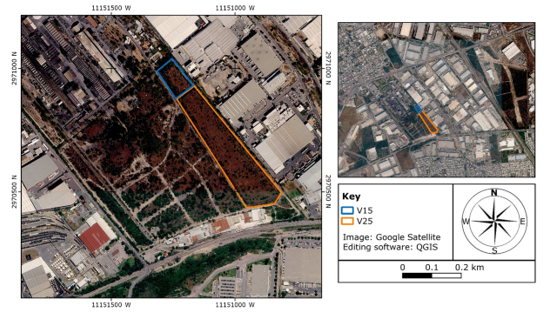
Closed landfills located within the urban matrix face particular challenges for natural regeneration, since the cover soil used in their closure generally lacks a preexisting soil seed bank (SSB), and their isolation limits the arrival of propagules through dispersal. Therefore, their study enhances our understanding of the processes of colonization and regeneration of newly formed habitats in urban environments and helps identify the necessary restoration measures. This study describes and explores differences in the woody species’ SSB at two demolition and construction waste landfills of different sizes (1 and 4.5 ha) and closure durations (15 and 25 years), located in an industrial park in the Monterrey Metropolitan Area, Mexico. A total of six species were recorded, all of which are common in the study area, with a density of 120±57.10 seeds m-2 at the 15-year-old site and 182.86±81.91 seeds m-2 at the 25-year-old site. Species richness and density were similar across the areas (P>0.05), and the spatial pattern of the seeds was clustered at both sites (p<0.001). Neltuma laevigata concentrated the highest abundance at the two landfills. The current SSB represents potential vegetation that is limited in the short term; therefore, it is recommended to supplement it with active ecological restoration efforts using native species of the Tamaulipan thorn scrub.
Downloads
References
Castillo-Muñoz, M., & Guzmán-Hernández, J. L. (2021). Composición y estructura de la comunidad de aves en un corredor ribereño urbano del área metropolitana de Monterrey, Nuevo León, México. Huitzil Revista Mexicana de Ornitología, 22(2), Articulo e-628. https://www.scielo.org.mx/scielo.php?script=sci_arttext&pid=S1870-74592021000200003
Chao, A. (1987). Estimating the population size for capture-recapture data with unequal catchability. Biometrics, 43(4), 783-791. https://doi.org/10.2307/2531532
Damschen, E. I., Brudvig, L. A., Haddad, N. M., Levey, D. J., Orrock, J. L., & Tewksbury, J. J. (2008). The movement ecology and dynamics of plant communities in fragmented landscapes. Proceedings of the National Academy of Sciences, 105(49), 19078-19083. https://doi.org/10.1073/pnas.0802037105
Fenner, M., & Thompson, K. (2009). The ecology of seeds. Cambridge University Press. https://doi.org/10.1017/CBO9780511614101
Gann, G. D., McDonald, T., Walder, B., Aronson, J., Nelson, C. R., Jonson, J., Hallett, J. G., Eisenberg, C., Guariguata, M. R., Liu, J., Hua, F., Echeverría, C., Gonzales, E., Shaw, N., Decleer, K., & Dixon, K. W. (2019). International principles and standards for the practice of ecological restoration. Second edition. Restoration Ecology, 27(S1), S1–S46. https://doi.org/10.1111/rec.13035
García-Alanís, L. C. (1997). Estudio fenológico y de crecimiento de once especies leñosas del matorral espinoso tamaulipeco en Linares, Nuevo León, México [Tesis de Maestría en Ciencias Forestales, Universidad Autónoma de Nuevo León]. Repositorio universitario UANL. http://eprints.uanl.mx/7770/1/1020120181.PDF
Gelmi-Candusso, T. A., & Hämäläinen, A. M. (2019). Seeds and the city: the interdependence of zoochory and ecosystem dynamics in urban environments. Frontiers in Ecology and Evolution, 7, Article 41. https://doi.org/10.3389/fevo.2019.00041
Hoefer, W., Gallagher, F., Hyslop, T., Wibbelt, T. J., & Ravit, B. (2016). Environmental reviews and case studies: Unique landfill restoration designs increase opportunities to create urban open space. Environmental Practice, 18(2), 106-115. https://doi.org/10.1017/S1466046616000090
Instituto Nacional de Estadística, Geografía e Informática. (1976). Carta uso del suelo y vegetación. Apodaca, escala 1:50 000, Clave G14C16 (Cartas de Uso del Suelo y Vegetación). Instituto Nacional de Estadística, Geografía e Informática. https://www.inegi.org.mx/app/biblioteca/ficha.html?upc=702825656348&utm
Instituto Nacional de Estadística, Geografía e Informática. (2002). Condiciones geográficas y medio ambiente natural de la zona metropolitana. En Instituto Nacional de Estadística, Geografía e Informática (Ed.), Estadísticas del medio ambiente de la zona metropolitana de Monterrey (pp. 15-19). Instituto Nacional de Estadística y Geografía. https://www.inegi.org.mx/contenidos/productos/prod_serv/contenidos/espanol/bvinegi/productos/historicos/181/702825480486/702825480486_5.pdf
Jiménez-Pérez, J., Jiménez-Quintana, P., Alanís-Rodríguez, E., Martínez-Adriano, C. A., Mora-Olivo, A., & Rubio-Camacho, E. (2025). Estructura del arbolado urbano en parques y calzadas de San Pedro Garza García, México. Revista Forestal Mesoamericana Kurú, 22(51), 22-32. https://doi.org/10.18845/rfmk.v22i51.8059
Jiménez-Pérez, J., Sandoval-García, R., Alanís-Rodríguez, E., Yerena-Yamallel, J. I., & Aguirre-Calderón, O. A. (2022). Dinámica de cambio en ecosistemas urbanos y periurbanos en el área metropolitana de Monterrey, México. Revista Cubana de Ciencias Forestales, 10(3), 278-291. https://dialnet.unirioja.es/servlet/articulo?codigo=9539664
Johnson, A. L., Borowy, D., & Swan, C. M. (2018). Land use history and seed dispersal drive divergent plant community assembly patterns in urban vacant lots. Journal of Applied Ecology, 55(1), 451-460. https://doi.org/10.1111/1365-2664.12958
Jurado, E., Estrada, E., & Mole s̀, A. (2001). Characterizing plant attributes with particular emphasis on seeds in Tamaulipan thornscrub in semi-arid Mexico. Journal of Arid Environments, 48(3), 309-321. https://doi.org/10.1006/jare.2000.0762
Jurado, E., García, J. F., Flores, J., & Estrada, E. (2006). Leguminous seedling establishment in Tamaulipan thornscrub of northeastern Mexico. Forest Ecology and Management, 221(1-3), 133-139. https://doi.org/10.1016/j.foreco.2005.09.011
Kim, K. D., & Lee, E. J. (2005). Soil seed bank of the waste landfills in South Korea. Plant and Soil, 271(1), 109-121. https://doi.org/10.1007/s11104-004-2159-2
Kisvarga, S., Horotán, K., Neményi, A., Jana, T., Istvánfi, Z., & Orlóci, L. (2025). The ecology of urban vegetation: Trade-offs, stressors, and adaptive strategies. Environmental and Sustainability Indicators, 28, Article 100887. https://doi.org/10.1016/j.indic.2025.100887
Ma, M., Collins, S. L., Ratajczak, Z., & Du, G. (2021). Soil seed banks, alternative stable state theory, and ecosystem resilience. BioScience, 71(7), 697-707. https://doi.org/10.1093/biosci/biab011
Mann, H. B., & Whitney, D. R. (1947). On a test of whether one of two random variables is stochastically larger than the other. The Annals of Mathematical Statistics, 18(1), 50-60. https://www.jstor.org/stable/2236101
Martínez-Adriano, C. A., Jurado, E., Flores, J., Estrada-Castillon, E., & Gonzalez-Rodriguez, H. (2021). Effect of induced warming on seedling emergence of Tamaulipan thornscrub at northeastern Mexico. Flora, 285, Article 151965. https://doi.org/10.1016/j.flora.2021.151965
Mendes, S. B., Olesen, J. M., Nogales, M., Marrero, P., Romero, J., Nieves, C., & Heleno, R. (2025). Urbanization of seed dispersal networks. Conservation Biology, 39(6), Article e70097. https://doi.org/10.1111/cobi.70097
Oksanen, J., Simpson, G. L., Blanchet, F. G., Kindt, R., Legendre, P., Minchin, P. R., O'Hara, R. B., Solymos, P., Stevens, M. H. H., Szoecs, E., Wagner, H., Barbour, M., Bedward, M., Bengtsson, H., Bolker, B., Borcard, D., Borman, T., Carvalho, G., Chirico, M., … & Weedon, J. (2026). vegan: Community Ecology Package (version 2.7-6) [Computer software]. Comprehensive R Archive Network. https://doi.org/10.32614/CRAN.package.vegan
Pando-Moreno, M., Jurado, E., Castillo, D., Flores, J., & Estrada, E. (2010). Physical crust does not affect soil seed bank. Arid Land Research and Management, 24(3), 263-266. https://doi.org/10.1080/15324981003744966
Pang, C.-C., Lo, W.-F., Yan, R. W.-M., & Hau, B. C.-H. (2020). Plant community composition on landfill sites after multiple years of ecological restoration. Landscape Research, 45(4), 458-469. https://doi.org/10.1080/01426397.2019.1674266
R Core Team. (2026). R: A Language and Environment for Statistical Computing (Version 4.4.1) [Computer software]. R Foundation for Statistical Computing. https://doi.org/10.32614/R.manuals
Rawlinson, H., Dickinson, N., Nolan, P., & Putwain, P. (2004). Woodland establishment on closed old-style landfill sites in N.W. England. Forest Ecology and Management, 202(1-3), 265-280. https://doi.org/10.1016/j.foreco.2004.07.034
Rebele, F., & Lehmann, C. (2016). Twenty years of woodland establishment through natural succession on a sandy landfill site in Berlin, Germany. Urban Forestry & Urban Greening, 18, 182-189. https://doi.org/10.1016/j.ufug.2016.06.006
Robinson, G. R., & Handel, S. N. (1993). Forest restoration on a closed landfill: rapid addition of new species by bird dispersal. Conservation Biology, 7(2), 271-278. https://doi.org/10.1046/j.1523-1739.1993.07020271.x
RStudio Team. (2026). RStudio: Integrated Development Environment for R (Version 2026.04.0+526) [Computer software]. Posit Software, PBC. https://dailies.rstudio.com/version/2026.04.0+526/
Shapiro, S. S., & Wilk, M. B. (1965). An analysis of variance test for normality (complete samples). Biometrika, 52(3-4), 591-611. https://doi.org/10.1093/biomet/52.3-4.591
Smith-Gill, S. J. (1975). Cytophysiological basis of disruptive pigmentary patterns in the leopard frog, Rana pipiens. II. Wild type and mutant cell specific patterns. Journal of Morphology, 146(1), 35-54. https://doi.org/10.1002/jmor.1051460103
Spennemann, D. H. R. (2020). Palms fanning out: a review of the ecological provisioning services provided by Washingtonia filifera and W. robusta in their native and exotic settings. Plant Ecology & Diversity, 13(3-4), 289-324. https://doi.org/10.1080/17550874.2020.1819465
Valdes-Alameda, R., Jurado, E., Flores, J., & Estrada, E. (2023). Banco de semillas del suelo bajo individuos aislados de especies arbóreas del Matorral Espinoso Tamaulipeco. Revista Mexicana de Ciencias Forestales, 14(79), 31-57. https://doi.org/10.29298/rmcf.v14i79.1344
Valdes-Alameda, R., Jurado, E., Flores, J., Pando-Moreno, M., Estrada, E., & Gurvich, D. E. (2021). Densidad de semillas y plántulas de Zanthoxylum fagara en México y Zanthoxylum coco en Argentina: influencia de plantas bajo las cuales ocurren y borde de la vegetación. Botanical Sciences, 99(1), 67-79. https://doi.org/10.17129/botsci.2636
Vincevica-Gaile, Z., Burlakovs, J., Fonteina-Kazeka, M., Wdowin, M., Hanc, E., Rudovica, V., Krievans, M., Grinfelde, I., Siltumens, K., Kriipsalu, M., Aouissi, H. A., Gaagai, A., & Zahoor, M. (2023). Case study-based integrated assessment of former waste disposal sites transformed to green space in terms of ecosystem services and land assets recovery. Sustainability, 15(4), Article 3256. https://doi.org/10.3390/su15043256
Wong, J. T.-F., Chen, X.-W., Mo, W.-Y., Man, Y.-B., Ng, C. W.-W., & Wong, M.-H. (2016). Restoration of plant and animal communities in a sanitary landfill: A 10-year case study in Hong Kong. Land Degradation & Development, 27(3), 490-499. https://doi.org/10.1002/ldr.2402
Xia, S., Zhang, S., Cui, Y., Gao, Z., Song, K., & Da, L. (2024). Spatial variations of soil seed banks in Shanghai’s urban wasteland: a gradient analysis of urbanization effects. PeerJ, 12, Article e18764. https://doi.org/10.7717/peerj.18764
Downloads
Published
Issue
Section
License
Copyright (c) 2026 Revista Mexicana de Ciencias Forestales

This work is licensed under a Creative Commons Attribution-NonCommercial 4.0 International License.
The authors who publish in Revista Mexicana de Ciencias Forestales accept the following conditions:
In accordance with copyright laws, Revista Mexicana de Ciencias Forestales recognizes and respects the authors’ moral right and ownership of property rights which will be transferred to the journal for dissemination in open access.
All the texts published by Revista Mexicana de Ciencias Forestales –with no exception– are distributed under a Creative Commons License Attribution-NonCommercial 4.0 International (CC BY-NC 4.0), which allows third parties to use the publication as long as the work’s authorship and its first publication in this journal are mentioned
The author(s) can enter into independent and additional contractual agreements for the nonexclusive distribution of the version of the article published in Revista Mexicana de Ciencias Forestales (for example, include it into an institutional repository or publish it in a book) as long as it is clearly and explicitly indicated that the work was published for the first time in Revista Mexicana de Ciencias Forestales.
For all the above, the authors shall send the form of Letter-transfer of Property Rights for the first publication duly filled in and signed by the author(s). This form must be sent as a PDF file to: ciencia.forestal2@inifap.gob.mx
This work is licensed under a Creative Commons Attribution-Noncommercial 4.0 International license.