Influence of park size on the structure and diversity of urban trees in the city of Monterrey, Nuevo León, Mexico
DOI:
https://doi.org/10.29298/rmcf.v17i98.1687Keywords:
Ecological dominance, urban ecology, Importance Value Index, green infrastructure, urban management, species selectionAbstract
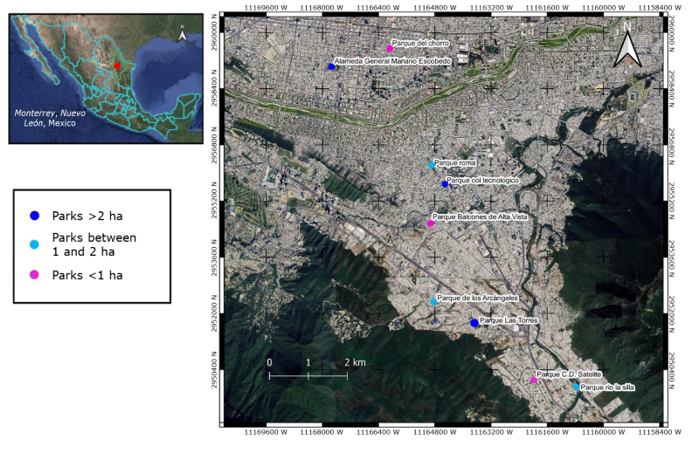
Urban trees provide important ecosystem services in cities; however, their structure and diversity may be influenced more by management practices than by natural ecological processes. The objective of this study was to evaluate the structure, diversity, and dominance of urban trees in parks of different sizes in Monterrey, Mexico, and to assess the influence of park size. Nine urban parks were classified into three size categories: small, medium, and large. Circular plots representing 10 % of the area of each park were established. Structural variables were recorded, and the Margalef, Shannon-Wiener, Simpson's complement, and Importance Value Index (IVI) were calculated. Differences among park size categories were analyzed using the Kruskal-Wallis test. A total of 243 tree individuals were recorded. No statistically significant differences were detected among park size categories for most of the variables evaluated, including species richness, number of families, and diversity indexes. Tree density was the only variable that differed significantly, with higher values in small parks. The IVI analysis revealed the dominance of a small number of species, particularly Fraxinus americana and Quercus virginiana. Results suggest that, in the parks evaluated, management practices and species selection may exert a greater influence than park size on the structure of the urban tree community.
Downloads
References
Alanís-Rodríguez, E., Mora-Olivo, A., Jiménez-Pérez, J., & Cuéllar-Rodríguez, G. (2023). Uso de árboles nativos en áreas verdes urbanas: tendencias en el noreste de México. Revista Mexicana de Ciencias Forestales, 14(76), 4-21. https://doi.org/10.29298/rmcf.v14i76.1314
Alanís-Rodríguez, E., Mora-Olivo, A., Molina-Guerra, V. M., Gárate-Escamilla, H., & Sigala-Rodríguez, J. Á. (2022). Caracterización del arbolado urbano del centro de Hualahuises, Nuevo León. Revista Mexicana de Ciencias Forestales, 13(73), 29-49. https://doi.org/10.29298/rmcf.v13i73.1271
Anderson, E. C., Locke, D. H., Pickett, S. T. A., & LaDeau, S. L. (2023). Just street trees? Street trees increase local biodiversity and biomass in higher income, denser neighborhoods. Ecosphere, 14(2), Article e4389. https://doi.org/10.1002/ecs2.4389
Aronson, M. F. J., Nilon, C. H., Lepczyk, C. A., Parker, T. S., Warren, P. S., Cilliers, S. S., Goddard, M. A., Hahs, A. K., Herzog, C., Katti, M., La Sorte, F. A., Williams, N. S. G., & Zipperer, W. C. (2016). Hierarchical filters determine community assembly of urban species pools. Ecology, 97(11), 2952-2963. https://doi.org/10.1002/ecy.1535
Atchadé, A. J., Kanda, M., Folega, F., Yédomonhan, H., Dourma, M., Wala, K., & Akpagana, K. (2023). Trees diversity and species with high ecological importance for a resilient urban area: Evidence from Cotonou City (West Africa). Climate, 11(9), Article 182. https://doi.org/10.3390/cli11090182
Avery, T. E., & Burkhart, H. E. (2002). Forest measurements (5th ed.). McGraw-Hill. https://www.scirp.org/reference/referencespapers?referenceid=3377804
Beninde, J., Veith, M., & Hochkirch, A. (2015). Biodiversity in cities needs space: a meta-analysis of factors determining intra-urban biodiversity variation. Ecology Letters, 18, 581-592. https://doi.org/10.1111/ele.12427
Canizales-Velázquez, P. A., Alanís-Rodríguez, E., García-García, S. A., Holguín-Estrada, V. A., & Collantes-Chávez-Costa, A. (2021). Estructura y diversidad arbórea de un bosque de galería urbano en el río Camachito, Noreste de México. Polibotánica, 51, 91-105. https://doi.org/10.18387/polibotanica.51.6
Chang, C.-R., Chen, M.-C., & Su, M.-H. (2021). Natural versus human drivers of plant diversity in urban parks and the anthropogenic species-area hypotheses. Landscape and Urban Planning, 208, Article 104023. https://doi.org/10.1016/j.landurbplan.2020.104023
Drakare, S., Lennon, J. J., & Hillebrand, H. (2006). The imprint of the geographical, evolutionary and ecological context on species–area relationships. Ecology Letters, 9(2), 95-241. https://doi.org/10.1111/j.1461-0248.2005.00848.x
Grimm, N. B., Faeth, S. H., Golubiewski, N. E., Redman, C. L., Wu, J., Bai, X., & Briggs, J. M. (2008). Global change and the ecology of cities. Science, 319(5864), 756-760. https://doi.org/10.1126/science.1150195
Hammer, Ø., Harper, D. A. T., & Ryan, P. D. (2001). PAST: Paleontological statistics software package for education and data analysis. Palaeontologia Electronica, 4(1), Article 4. https://palaeo-electronica.org/2001_1/past/past.pdf
Instituto Nacional de Estadística y Geografía. (2020). Censo de población y vivienda (CPV) 2020. Instituto Nacional de Estadística y Geografía. https://www.inegi.org.mx/programas/ccpv/2020/
Jara-Toto, E., Armenta-Montero, S., Aquino-Zapata, A. M., & Carvajal-Hernández, C. I. (2023). Diversidad y estructura de la vegetación leñosa en cuatro bosques urbanos de la zona conurbada Xalapa-Banderilla, Veracruz, México. Acta Botánica Mexicana, (130), Artículo e2214. https://doi.org/10.21829/abm130.2023.2214
Kendal, D., Williams, N. S. G., & Williams, K. J. H. (2012). A cultivated environment: Exploring the global distribution of plants in gardens, parks and streetscapes. Urban Ecosystems, 15, 637-652. https://doi.org/10.1007/s11252-011-0215-2
Kowarik, I. (2011). Novel urban ecosystems, biodiversity, and conservation. Environmental Pollution, 159(8-9), 1974-1983. https://doi.org/10.1016/j.envpol.2011.02.022
Leal-Elizondo, C. E., Leal-Elizondo, N., Alanís-Rodríguez, E., Pequeño-Ledezma, M. Á., Mora-Olivo, A., & Buendía-Rodríguez, E. (2018). Estructura, composición y diversidad del arbolado urbano de Linares, Nuevo León. Revista Mexicana de Ciencias Forestales, 9(48), 252-270. https://doi.org/10.29298/rmcf.v8i48.129
Love, N. L. R., Nguyen, V., Pawlak, C., Pineda, A., Reimer, J. L., Yost, J. M., Fricker, G. A., Ventura, J. D., Doremus, J. M., Crow, T., & Ritter, M. K. (2022). Diversity and structure in California’s urban forest: What over six million data points tell us about one of the world's largest urban forests. Urban Forestry & Urban Greening, 74, Article 127679. https://doi.org/10.1016/j.ufug.2022.127679
Magurran, A. E. (2004). Measuring biological diversity. Blackwell Publishing. https://www.scirp.org/reference/referencespapers?referenceid=1371188
McKinney, M. L. (2006). Urbanization as a major cause of biotic homogenization. Biological Conservation, 127(3), 247-260. https://doi.org/10.1016/j.biocon.2005.09.005
Moreno, C. E. (2001). Métodos para medir la biodiversidad. Programa Iberoamericano de Ciencia y Tecnología para el Desarrollo, Oficina Regional de Ciencia y Tecnología para América Latina y el Caribe, Sociedad Entomológica Aragonesa. https://www.researchgate.net/publication/304346666_Metodos_para_medir_la_biodiversidad
Nowak, D. J., Greenfield, E. J., Hoehn, R. E., & Lapoint, E. (2013). Carbon storage and sequestration by trees in urban and community areas of the United States. Environmental Pollution, 178, 229-236. https://doi.org/10.1016/j.envpol.2013.03.019
Osako, L. K., Brito, L., & Silva, P. A. (2022). Urban forest trees: an ecological perspective for a management that promotes and mantains biodiversity in the city. Research, Society and Developmen, 11(1), Article e31811124887. https://doi.org/10.33448/rsd-v11i1.24887
Pretzsch, H. (2009). Forest dynamics, growth and yield. Springer. https://doi.org/10.1007/978-3-540-88307-4
QGIS Development Team. (2021). QGIS Geographic Information System (Version 3.18.3) [Software]. QGIS Development Team. https://www.qgis.org
Rzedowski, J. (2006). Vegetación de México (1ra ed. digital). Comisión Nacional para el Conocimiento y Uso de la Biodiversidad. https://drive.google.com/file/d/0B4QXYW6LByLUeDNSaE5jUFBWbmM/view?resourcekey=0-47doiOVtp0RQ13PyUp1PLw
Saavedra-Romero, L. de L., Hernández-de la Rosa, P., Alvarado-Rosales, D., Martínez-Trinidad, T., & Villa-Castillo, J. (2019). Diversidad, estructura arbórea e índice de valor de importancia en un bosque urbano de la Ciudad de México. Polibotánica, (47), 25-37. https://doi.org/10.18387/polibotanica.47.3
Sjöman, H., Hirons, A. D., & Bassuk, N. L. (2018). Improving confidence in tree species selection for challenging urban sites: a role for leaf turgor loss. Urban Ecosystems, 21, 1171-1188. https://doi.org/10.1007/s11252-018-0791-5
Sjöman, H., Watkins, H., Kelly, L. J., Hirons, A., Kainulainen, K., Martin, K. W. E., & Antonelli, A. (2024). Resilient trees for urban environments: The importance of intraspecific variation. Plants, People, Planet, 6(6), 1180-1189. https://doi.org/10.1002/ppp3.10518
Tzoulas, K., Korpela, K., Venn, S., Yli-Pelkonen, V., Kaźmierczak, A., Niemela, J., & James, P. (2007). Promoting ecosystem and human health in urban areas using green infrastructure: A literature review. Landscape and Urban Planning, 81(3), 167-178. https://doi.org/10.1016/j.landurbplan.2007.02.001
Williams, N. S. G., Schwartz, M. W., Vesk, P. A., McCarthy, M. A., Hahs, A. K., Clemants, S. E., Corlett, R. T., Duncan, R. P., Norton, B. A., Thompson, K., & McDonell, M. J. (2009). A conceptual framework for predicting the effects of urban environments on floras. Journal of Ecology, 97(1), 4-9. https://doi.org/10.1111/j.1365-2745.2008.01460.x
Yang, G., Ouyang, Y., Hou, X., Zhou, T., Ge, Y., Lu, Y., Wang, Y., & Chang, J. (2023). Homogenization of urban forests across the subtropical zones of China. Land, 12(8), Article 1559. https://doi.org/10.3390/land12081559
Downloads
Published
Issue
Section
License
Copyright (c) 2026 Revista Mexicana de Ciencias Forestales

This work is licensed under a Creative Commons Attribution-NonCommercial 4.0 International License.
The authors who publish in Revista Mexicana de Ciencias Forestales accept the following conditions:
In accordance with copyright laws, Revista Mexicana de Ciencias Forestales recognizes and respects the authors’ moral right and ownership of property rights which will be transferred to the journal for dissemination in open access.
All the texts published by Revista Mexicana de Ciencias Forestales –with no exception– are distributed under a Creative Commons License Attribution-NonCommercial 4.0 International (CC BY-NC 4.0), which allows third parties to use the publication as long as the work’s authorship and its first publication in this journal are mentioned
The author(s) can enter into independent and additional contractual agreements for the nonexclusive distribution of the version of the article published in Revista Mexicana de Ciencias Forestales (for example, include it into an institutional repository or publish it in a book) as long as it is clearly and explicitly indicated that the work was published for the first time in Revista Mexicana de Ciencias Forestales.
For all the above, the authors shall send the form of Letter-transfer of Property Rights for the first publication duly filled in and signed by the author(s). This form must be sent as a PDF file to: ciencia.forestal2@inifap.gob.mx
This work is licensed under a Creative Commons Attribution-Noncommercial 4.0 International license.