The urban vegetation in the conservation of the abundance and diversity of day-flying butterflies in Ciudad Victoria, state of Tamaulipas
DOI:
https://doi.org/10.29298/rmcf.v17i98.1682Keywords:
green area, city, species composition, urban ecology, invertebrates, urbanizationAbstract
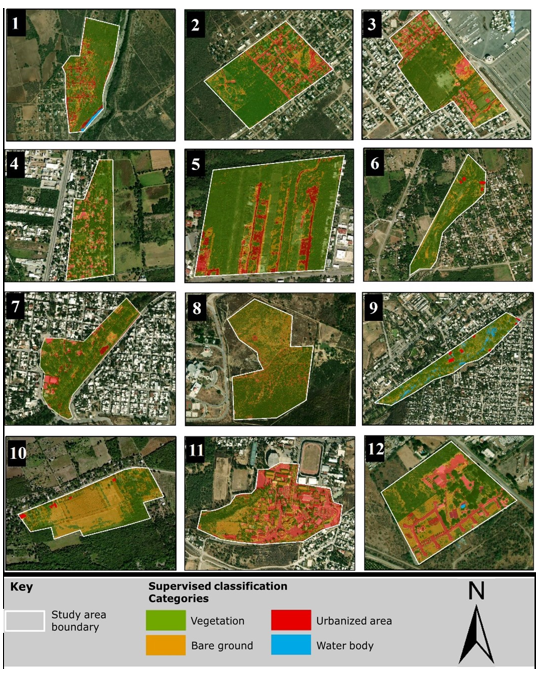
Urbanization transforms vegetation cover and fragments habitats, affecting resource availability for invertebrates, including butterflies, which perform essential ecological functions. The presence, density, and structure of vegetation in urban areas influence the richness, diversity, and composition of butterfly communities because these organisms depend on plant resources for feeding, reproduction, and persistence. This study analyzed the diversity, composition, and distribution of diurnal butterflies in relation to vegetation heterogeneity in Ciudad Victoria, Tamaulipas, Mexico. Twelve study sites were selected, and supervised classification was conducted to characterize and quantify land-cover types. A total of 144 surveys were conducted using entomological nets along designated sampling routes. 297 species wre identified which belong to 186 genera and six families. Kricogonia lyside and Phoebis agarithe had the highest abundances. The Río San Marcos site had the highest species richness (197 spp.), followed by Benito Juárez ejido. Comparative analysis of community composition detected no significant differences among sites with different vegetation types. These results indicate that, despite urbanization, Ciudad Victoria keeps green areas with vegetation cover that can support the persistence of diverse diurnal butterfly communities. These green spaces play an important role in maintaining local diversity and resource availability within the urban mosaic.
Downloads
References
Anderson, M. J. (2001). A new method for non-parametric multivariate analysis of variance. Austral Ecology, 26(1), 32-46. https://doi.org/10.1111/j.1442-9993.2001.01070.pp.x
Anoop, N. R., Femi, E. B., Yathumon, M. A., & Punnath, A. (2023). Butterflies with a taste for elephant dung: Puddling of adult butterflies on elephant dung in India's Western Ghats. Food Webs, 37, Article e00323. https://doi.org/10.1016/j.fooweb.2023.e00323
Ayala-Azcárraga, C., Hinojosa-Díaz, I. A., Segura, O., Pacheco-Muñoz, R., Larrucea-Garritz, A., & Díaz, D. (2025). Evaluation of sustainable landscape design: presence of native pollinators in an urban park in Mexico City, Mexico. Sustainability, 17(2), Article 799. https://doi.org/10.3390/su17020799
Colwell, R. K. (2025). EstimateS (Version 8.2) [Computer software]. Academic Website-EstimateS. https://www.robertkcolwell.org/pages/1407
Colwell, R. K., & Coddington, J. A. (1994). Estimating terrestrial biodiversity through extrapolation. Philosophical Transactions of the Royal Society B Biological Sciences, 345(1311), 101-118. https://doi.org/10.1098/rstb.1994.0091
Comisión Nacional para el Conocimiento y Uso de la Biodiversidad. (2024). EncicloVida [Base de datos]. Comisión Nacional para el Conocimiento y Uso de la Biodiversidad. https://enciclovida.mx/
Comisión Nacional para el Conocimiento y Uso de la Biodiversidad. (2026). Geoportal Conabio 2026. Climas [Mapa interactivo escala 1:1 000 000]. Comisión Nacional para el Conocimiento y Uso de la Biodiversidad. http://www.conabio.gob.mx/informacion/gis/?vns=gis_root/clima/climas/clima1mgw
Czech, B., Krausman, P. R., & Devers, P. K. (2000). Economic associations among causes of species endangerment in the United States: Associations among causes of species endangerment in the United States reflect the integration of economic sectors, supporting the theory and evidence that economic growth proceeds at the competitive exclusion of nonhuman species in the aggregate. BioScience, 50(7), 593-601. https://doi.org/10.1641/0006-3568(2000)050[0593:EAACOS]2.0.CO;2
Environmental Systems Research Institute. (2025). ArcGIS Esri comprehensive geospatial platform (Version 10.2) [Computer software]. Environmental Systems Research Institute. https://www.esri.com/en-us/home
Glassberg, J. (2017). A Swift Guide to Butterflies of Mexico and Central America. Princeton University Press. https://www.jstor.org/stable/j.ctt1wf4d1m
Gómez-Moreno, V. del C., González-Gaona, O. J., Niño-Maldonado, S., Azuara-Domínguez, A., & Barrientos-Lozano, L. (2023). Las áreas verdes urbanas con vegetación mixta favorecen la riqueza y abundancia de aves en Ciudad Victoria, Tamaulipas, México. Revista de Biología Tropical, 71(1), Article e50729. https://doi.org/10.15517/rev.biol.trop..v71i1.50729
Gotelli, N. J., & Colwell, R. K. (2001). Quantifying biodiversity: procedures and pitfalls in the measurement and comparison of species richness. Ecology Letters, 4(4), 379-391. https://doi.org/10.1046/j.1461-0248.2001.00230.x
Greeney, H. F., Dyer, L. A., & Smilanich, A. M. (2012). Feeding by lepidopteran larvae is dangerous: A review of caterpillars’ chemical, physiological, morphological, and behavioral defenses against natural enemies. Invertebrate Survival Journal, 9, 7-34. https://www.isj.unimore.it/index.php/ISJ/article/view/256
Hammer, Ø., & Harper, D. A. T. (2025). PAST data analysis package (version 4.03) [Computer software]. University of Oslo. https://palaeo-electronica.org/2001_1/past/pastprog/index.html
Hong, S.-H., Han, B.-H., Choi, S.-H., Sung, C. Y., & Lee, K.-J. (2012). Planning an ecological network using the predicted movement paths of urban birds. Landscape and Ecological Engineering, 9, 165-174. https://doi.org/10.1007/s11355-012-0194-3
Instituto Nacional de Estadística y Geografía. (2018). Conjunto de datos Vectoriales de Uso de Suelo y Vegetación. Escala 1:250 000. Serie VII. Conjunto Nacional [Cartas de Uso del Suelo y Vegetación]. Instituto Nacional de Estadística y Geografía. https://www.inegi.org.mx/app/biblioteca/ficha.html?upc=889463842781
Instituto Nacional de Estadística y Geografía. (2025). Consulta de indicadores sociodemográficos y económicos por área geográfica [Base de datos]. Instituto Nacional de Estadística y Geografía. https://www.inegi.org.mx/
Instituto Nacional de Estadística, Geografía e informática. (2016). Conjunto de Datos Vectoriales de Uso de Suelo y Vegetación. Escala 1:250 000. Serie VI. Capa Unión [Cartas de Uso del Suelo y Vegetación]. Instituto Nacional de Estadística, Geografía e informática. https://www.inegi.org.mx/app/biblioteca/ficha.html?upc=889463173359
International Union for Conservation of Nature. (2025). The IUCN Red List of Threatened Species. Version 2026-1 [Database]. International Union for Conservation of Nature. https://www.iucnredlist.org/en
Jost, L. (2007). Partitioning diversity into independent alpha and beta components. Ecology, 88(10), 2427-2439. https://doi.org/10.1890/06-1736.1
Koptur, S., Salas-Primoli, A., Ferrerira-Paulino-Neto, H., & Whitfield, J. (2024). Pierid butterflies, legume hostplants, and parasitoids in urban areas of Southern Florida. Insects, 15(2), Article 123. https://doi.org/10.3390/insects15020123
Kumar, P., Parmar, B., & Kumar, P. (2023). Preliminary checklist of butterfly diversity from the Himachal Pradesh Agricultural University, Palampur, India. Environment Conservation Journal, 24(3), 215-221. https://doi.org/10.36953/ecj.16492525
León-Cortés, J. L., Caballero, U., Miss-Barrera, I. D., & Girón-Intzin, M. (2019). Preserving butterfly diversity in an ever-expanding urban landscape? A case study in the highlands of Chiapas, México. Journal of Insect Conservation, 23, 405-418. https://doi.org/10.1007/s10841-019-00149-7
Lizee, M.-H., Tatoni, T., & Deschamps-Cottin, M. (2016). Nested patterns in urban butterfly species assemblages: respective roles of plot management, park layout and landscape features. Urban Ecosystems, 19, 205-224. https://doi.org/10.1007/s11252-015-0501-5
Llorente-Bousquets, J. E., Oñate-Ocaña, L., Luis-Martínez, A., Vargas-Fernández, I. (1997). Papilionidae y Pieridae de México: distribución geográfica e ilustración. Universidad Nacional Autónoma de México. https://books.google.com.ec/books?id=X_5HfolC85EC&printsec=frontcover&hl=es&source=gbs_ge_summary_r&cad=0#v=onepage&q&f=false
Llorente-Bousquets, J., Vargas-Fernández, I., Luis-Martínez, A., Trujano-Ortega, M., Hernández-Mejía, B. C., & Warren, A. D. (2014). Biodiversidad de Lepidoptera en México. Revista Mexicana de Biodiversidad, 85(Supl. 85), S353-S371. https://doi.org/10.7550/rmb.31830
Luis-Martínez, A., Llorente-Bousquets, J. E., & Vargas-Fernández, I. (2003). Nymphalidae de México I (Danainae, Apaturinae, Biblidinae y Heliconiinae): Distribución geográfica e ilustración. Universidad Nacional Autónoma de México. https://books.google.com.mx/books?id=41LBD5QLPK4C&printsec=frontcover&hl=es&source=gbs_ge_summary_r&cad=0#v=onepage&q&f=false
McDonnell, M. J., & Hahs, A. K. (2010). Comparative ecology of cities and towns: past, present and future. In M. J. McDonnell, A. K. Hahs & J. H. Breuste (Eds.), Ecology of cities and towns: A comparative approach. Cambridge University Press. https://doi.org/10.1017/cbo9780511609763.006
McKinney, M. L. (2008). Effects of urbanization on species richness: A review of plants and animals. Urban Ecosystems, 11, 161-176. https://doi.org/10.1007/s11252-007-0045-4
Muñoz-Galicia, D., Lara, C., Castillo-Guevara, C., Cuautle, M., & Rodríguez-Flores, C. (2023). Impacts of land use change on native plant–butterfly interaction networks from central Mexico. PeerJ, 11, Article e16205. https://doi.org/10.7717/peerj.16205
Myers, A., Bahlai, C. A., & Landis, D. A. (2019). Habitat type influences Danaus plexippus (Lepidoptera: Nymphalidae) oviposition and egg survival on Asclepias syriaca (Gentianales: Apocynaceae). Environmental Entomology, 48(3), 675-684. https://doi.org/10.1093/ee/nvz046
Natuhara, Y., Imai, C., & Takahashi, M. (1999). Pattern of land mosaics affecting butterfly assemblage at Mt Ikoma, Osaka, Japan. Ecological Research, 14(2), 105-118. https://doi.org/10.1046/j.1440-1703.1999.00287.x
Posit Software PBC. (2025). Downloads: RStudio 2025-09 Desktop [Software computer]. RStudio Builds. https://dailies.rstudio.com/version/2025.09.0+387/
Potgieter, L. J., Li, D., Baiser, B., Kühn, I., Aronson, M. F. J., Carboni, M., Celesti-Grapow, L., De Matos, A. C. L., Lososová, Z., Montaño-Centellas, F. A., Pyšek, P., Richardson, D. M., Tsang, T. P. N., Zenni, R. D., & Cadotte, M. W. (2024). Cities shape the diversity and spread of nonnative species. Annual Review of Ecology, Evolution and Systematics, 55, 157-180. https://doi.org/10.1146/annurev-ecolsys-102722-012749
Ramírez-Restrepo, L., & Halffter, G. (2013). Butterfly diversity in a regional urbanization mosaic in two Mexican cities. Landscape and Urban Planning, 115, 39-48. https://doi.org/10.1016/j.landurbplan.2013.03.005
Ramírez-Restrepo, L., Cultid-Medina, C. A., & MacGregor-Fors, I. (2015). How many butterflies are there in a city of Circa half a million people? Sustainability, 7(7), 8587-8597. https://doi.org/10.3390/su7078587
Secretaría de Medio Ambiente y Recursos Naturales. (2025). PROYECTO de Norma Oficial Mexicana PROY-NOM-059-SEMARNAT-2025, Protección ambiental-Especies nativas de México de flora y fauna silvestres-Categorías de riesgo y especificaciones para su inclusión, exclusión o cambio. Diario Oficial de la Federación. https://diariooficial.gob.mx/nota_detalle_popup.php?codigo=5754858
Sidat, A., & Bhatt, U. (2020). Annotated checklist of butterflies of Ankleshwar—an industrial town in Gujarat, India. Check List, 16(4), 997-1015. https://doi.org/10.15560/16.4.997
United States Geological Survey. (2025). SGS Global Visualization Viewer (GloVis). United States Government. http://glovis.usgs.gov/
Vargas-Sanabria, D., & Campos-Vargas, C. (2018). Sistema multi-algoritmo para la clasificación de coberturas de la tierra en el bosque seco tropical del Área de Conservación Guanacaste, Costa Rica. Tecnología en Marcha, 31(1), 58-69. https://doi.org/10.18845/tm.v31i1.3497
Villaseñor, J. L. (2016). Checklist of the native vascular plants of México. Revista Mexicana de Biodiversidad, 87(3), 559-902. https://doi.org/10.1016/j.rmb.2016.06.017
World Flora Online. (2026, 6 May). World Flora Online [Data set]. Global Strategy for Plant Conservation and Convention on Biological Diversity. https://www.worldfloraonline.org/
Zurita-Zaragoza, O., & Elizondo-Elizondo, R. (2009). Guía de árboles y otras plantas nativas de la zona metropolitana de Monterrey. Fondo Editorial de Nuevo León. https://fondoeditorialnl.gob.mx/producto/guia-de-arboles-nativos-en-la-zona-metropolitana-de-monterrey-digital/
Downloads
Additional Files
Published
Issue
Section
License
Copyright (c) 2026 Revista Mexicana de Ciencias Forestales

This work is licensed under a Creative Commons Attribution-NonCommercial 4.0 International License.
The authors who publish in Revista Mexicana de Ciencias Forestales accept the following conditions:
In accordance with copyright laws, Revista Mexicana de Ciencias Forestales recognizes and respects the authors’ moral right and ownership of property rights which will be transferred to the journal for dissemination in open access.
All the texts published by Revista Mexicana de Ciencias Forestales –with no exception– are distributed under a Creative Commons License Attribution-NonCommercial 4.0 International (CC BY-NC 4.0), which allows third parties to use the publication as long as the work’s authorship and its first publication in this journal are mentioned
The author(s) can enter into independent and additional contractual agreements for the nonexclusive distribution of the version of the article published in Revista Mexicana de Ciencias Forestales (for example, include it into an institutional repository or publish it in a book) as long as it is clearly and explicitly indicated that the work was published for the first time in Revista Mexicana de Ciencias Forestales.
For all the above, the authors shall send the form of Letter-transfer of Property Rights for the first publication duly filled in and signed by the author(s). This form must be sent as a PDF file to: ciencia.forestal2@inifap.gob.mx
This work is licensed under a Creative Commons Attribution-Noncommercial 4.0 International license.