Composition, structure, and diversity of reforested urban trees in ten green areas of Monterrey, Nuevo León
DOI:
https://doi.org/10.29298/rmcf.v17i98.1675Keywords:
floristic composition, Fabaceae, Importance Value Index, green infrastructure, environmental regulation, Vachellia farnesiana (L.) Wight & ArnAbstract
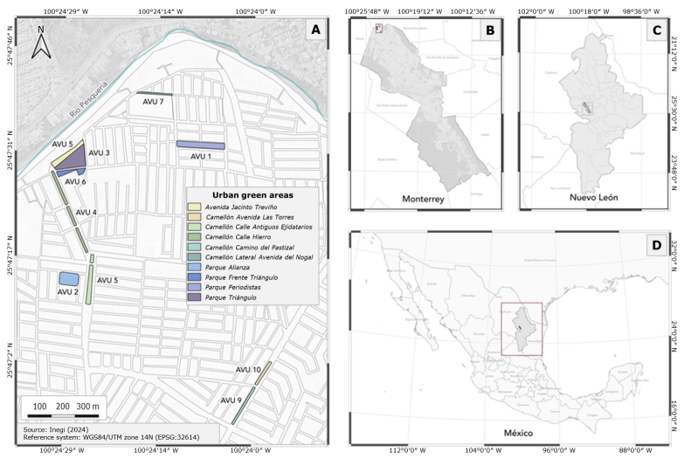
While planning reforestation in urban areas, it is necessary to consider species resilient to local conditions and a balanced taxonomic distribution in order to increase biodiversity. This study evaluated the composition, structure, and diversity of reforested trees in ten green areas of Monterrey, Nuevo León, Mexico, and determined their compliance with Santamour’s 10-20-30 rule. In spring 2024, the research team (firm GEMA S. C.) conducted a complete inventory of the individuals planted between September and October 2023. For each species, the analysis calculated abundance, dominance, frequency, and the Importance Value Index (IVI); it also estimated the Margalef (DMg) and Shannon (H′) indices and first-order effective diversity (1D). The inventory recorded 1 034 individuals belonging to five families, nine genera, and nine species, all native to the region. Fabaceae accounted for 67.02 % of the individuals. Vachellia farnesiana showed the highest relative abundance (44.78 %), relative dominance (46.19 %), and IVI (39.33 %). The tree community reached values of DMg=1.15, H′=1.56, and 1D=4.77. The planting did not comply with the 10-20-30 rule because of the high concentration of individuals within Fabaceae, Vachellia and V. farnesiana. These findings document the use of native species in urban reforestation but demonstrate the need to increase taxonomic diversity in future plantings to strengthen the resilience of the urban tree population over time.
Downloads
References
Alanís-Flores, G. J., & González-Alanís, D. (2003). Flora nativa ornamental para el área metropolitana de Monterrey, Nuevo León, México. Descripción botánica y requerimientos de las especies para el paisaje urbano. Universidad Autónoma de Nuevo León. https://static1.squarespace.com/static/5ecfd7b1d5367e68d807d415/t/60edd345bf52576c624606d7/1626198856280/Flora+nativa+Ornamental+para+Mty+Glafiro-Diego.pdf
Alanís-Rodríguez, E., Mora-Olivo, A., Molina-Guerra, V. M., Gárate-Escamilla, H., & Sigala-Rodríguez, J. Á. (2022). Caracterización del arbolado urbano del centro de Hualahuises, Nuevo León. Revista Mexicana de Ciencias Forestales, 13(73), 29-49. https://doi.org/10.29298/rmcf.v13i73.1271
Alanís-Rodríguez, E., Mora-Olivo, A., Molina-Guerra, V. M., Patiño-Flores, A. M., Sigala-Rodríguez, J. Á., Zamudio-Castillo, E., & Rubio-Camacho, E. (2023). Cambios en la composición y diversidad del arbolado urbano de Linares, Nuevo León. Gayana Botánica, 80(1), 64-74. http://dx.doi.org/10.4067/S0717-66432023000100064
Canizales-Velázquez, P. A., Alanís-Rodríguez, E., Holguín-Estrada, V. A., García-García, S., & Collantes-Chávez-Costa, A. (2020). Caracterización del arbolado urbano de la ciudad de Montemorelos, Nuevo León. Revista Mexicana de Ciencias Forestales, 11(62), 111-135. https://doi.org/10.29298/rmcf.v11i62.768
Freiburger, M. R., Murphy-Dunning, C., Doroski, D. A., Ashton, P. M., & Peters, J. D. J. (2025). The 10/20/30 planting rule aligns with traditional plant diversity metrics across spatial scales. Urban Forestry & Urban Greening, 114, Article 129112. https://doi.org/10.1016/j.ufug.2025.129112
García, E. & Comisión Nacional para el Conocimiento y Uso de la Biodiversidad. (2001). Climas Escala 1:1 000 000 (Catálogo de metadatos geográficos). Comisión Nacional para el Conocimiento y Uso de la Biodiversidad. http://geoportal.conabio.gob.mx/metadatos/doc/html/clima1mgw.html
Hernández-Cavazos, M. C., Alanís-Rodríguez, E., Molina-Guerra, V. M., Jiménez-Pérez, J., Aguirre-Calderón, O. A., & Cuéllar-Rodríguez, L. G. (2024). Composición, estructura y diversidad del arbolado urbano de la colonia Contry en Monterrey, México. Polibotánica, (58), 85-101. https://doi.org/10.18387/polibotanica.58.6
Instituto Nacional de Estadística, Geografía e Informática. (2017). Uso del suelo y vegetación, escala 1:250 000, Serie VI (Continuo nacional). Comisión Nacional para el Conocimiento y Uso de la Biodiversidad. http://geoportal.conabio.gob.mx/metadatos/doc/html/usv250s6gw.html
Jiménez-Pérez, J., Jiménez-Quintana, P., Alanís-Rodríguez, E., Martínez-Adriano, C. A., Mora-Olivo, A., & Rubio-Camacho, E. (2025). Estructura del arbolado urbano en parques y calzadas de San Pedro Garza García, México. Revista Forestal Mesoamericana Kurú, 22(51), 22-32. https://doi.org/10.18845/rfmk.v22i51.8059
Jost, L. (2006). Entropy and diversity. Oikos, 113(2), 363-375. https://doi.org/10.1111/j.2006.0030-1299.14714.x
Leal-Elizondo, C. E., Leal-Elizondo, N., Alanís-Rodríguez, E., Pequeño-Ledezma, M. Á., Mora-Olivo, A., & Buendía-Rodríguez, E. (2018). Estructura, composición y diversidad del arbolado urbano de Linares, Nuevo León. Revista Mexicana de Ciencias Forestales, 9(48), 252-270. https://doi.org/10.29298/rmcf.v8i48.129
Mostacedo, B., & Fredericksen, T. S. (2000). Manual de métodos básicos de muestreo y análisis en ecología vegetal. Proyecto de Manejo Forestal Sostenible (BOLFOR). http://www.bio-nica.info/biblioteca/mostacedo2000ecologiavegetal.pdf
Santamour, Jr., F. S. (1990). Trees for urban planting: Diversity, uniformity, and common sense. In Metropolitan Tree Improvement Alliance (Ed.), METRIA 7: Trees for the Nineties: Landscape Tree Selection, Testing, Evaluation, and Introduction: Proceedings of the Seventh Conference of the Metropolitan Tree Improvement Alliance (pp. 57-65). The Morton Arboretum. https://bzb.kennisbank.norminstituutbomen.nl/storage/handreiking//santamour-trees-for-urban-planting-diversity-uniformity-and-common-sense-1618393013-3mA4A.pdf
Secretaría de Medio Ambiente de Nuevo León. (2022). Norma Ambiental Estatal NAE-SMA-007-2022, Arbolado urbano del estado de Nuevo León. Gobierno del Estado de Nuevo León. https://www.nl.gob.mx/sites/default/files/repositorio/Dependencias/Comisi%C3%B3n%20Estatal%20de%20Mejora%20Regulatoria/Convocatorias/2022/32_norma_ambiental_estatal_0072022/proyecto_regulatorio.pdf
Xelhuantzi-Carmona, J., Rubio-Camacho, E. A., Alanís-Rodríguez, E., & Chávez-Durán, Á. A. (2024). DIVECOFOR: Una herramienta para la caracterización de la composición y diversidad en ecosistemas forestales. Instituto Nacional de Investigaciones Forestales, Agrícolas y Pecuarias. https://doi.org/10.13140/RG.2.2.25983.73126
Downloads
Published
Issue
Section
License
Copyright (c) 2026 Revista Mexicana de Ciencias Forestales

This work is licensed under a Creative Commons Attribution-NonCommercial 4.0 International License.
The authors who publish in Revista Mexicana de Ciencias Forestales accept the following conditions:
In accordance with copyright laws, Revista Mexicana de Ciencias Forestales recognizes and respects the authors’ moral right and ownership of property rights which will be transferred to the journal for dissemination in open access.
All the texts published by Revista Mexicana de Ciencias Forestales –with no exception– are distributed under a Creative Commons License Attribution-NonCommercial 4.0 International (CC BY-NC 4.0), which allows third parties to use the publication as long as the work’s authorship and its first publication in this journal are mentioned
The author(s) can enter into independent and additional contractual agreements for the nonexclusive distribution of the version of the article published in Revista Mexicana de Ciencias Forestales (for example, include it into an institutional repository or publish it in a book) as long as it is clearly and explicitly indicated that the work was published for the first time in Revista Mexicana de Ciencias Forestales.
For all the above, the authors shall send the form of Letter-transfer of Property Rights for the first publication duly filled in and signed by the author(s). This form must be sent as a PDF file to: ciencia.forestal2@inifap.gob.mx
This work is licensed under a Creative Commons Attribution-Noncommercial 4.0 International license.