Reference sites for the restoration of mining-affected peri-urban forests in the Inambari Region, Peruvian Amazon
DOI:
https://doi.org/10.29298/rmcf.v17i98.1674Keywords:
Efective diversity, forest structure, Importance Value Index, gold mining, Hill´s numbers, floristic similarityAbstract
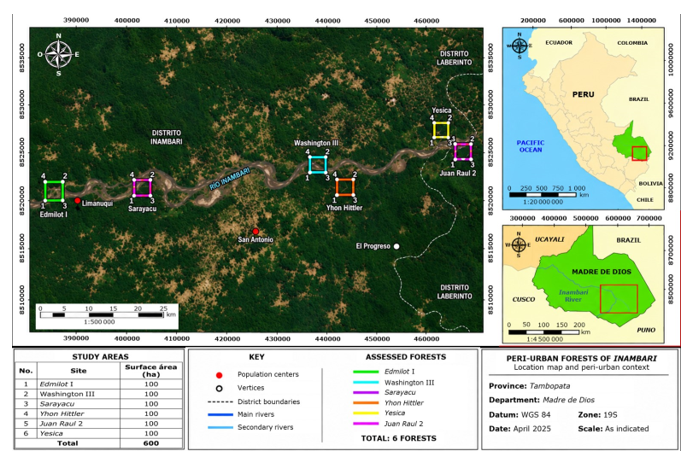
Peri-urban forests affected by mining activities can provide ecological benchmarks to guide the restoration of degraded areas when they retain representative attributes of composition, diversity, and structure. This study evaluated the potential of six mining concessions in the Inambari River basin, in the Peruvian Amazon, to serve as reference sites for future restoration efforts. Rectangular plots of 0.1 ha were established, and all tree individuals with a diameter at breast height ≥10 cm were recorded. Taxonomic richness, Hill’s q-numbers for orders q=0, q=1, and q=2, diameter, height, basal area, Importance Value Index, and floristic similarity were determined using the Jaccard and Bray-Curtis indexes, along with a non-metric multidimensional scaling (NMDS) analysis. A total of 2 063 individuals were recorded, grouped into 57 families, 172 genera, and 404 species. Edmilot I had the greatest observed richness and basal area; Washington III had the highest effective number of common species, while Yesica had the highest effective number of dominant species. Yhon Hittler and Juan Raul 2 showed lower effective diversity and a marked dominance of Iriartea deltoidea. Washington III and Sarayacu had very similar NMDS results, and so did Yhon Hittler and Juan Raul 2. The complementary use of multiple sites allows for the establishment of more representative benchmarks of the landscape’s ecological variability to guide the restoration of peri-urban forests affected by mining.
Downloads
References
Alvarez-Montalván, C. E., Manrique-León, S., Vela-Da Fonseca, M., Cardozo-Soarez, J., Callo-Ccorcca, J., Bravo-Camara, P., Castañeda-Tinco, I., & Alvarez-Orellana, J. (2021). Composición florística, estructura y diversidad arbórea de un bosque amazónico en Perú. Scientia Agropecuaria, 12(1), 73-82. https://doi.org/10.17268/sci.agropecu.2021.009
Asigbaase, M., Sjogersten, S., Lomax, B. H., & Dawoe, E. (2019). Tree diversity and its ecological importance value in organic and conventional cocoa agroforests in Ghana. PLoS ONE, 14(1), Article e0210557. https://doi.org/10.1371/journal.pone.0210557
Beauchamp, V. B., & Shafroth, P. B. (2011). Floristic composition, beta diversity, and nestedness of reference sites for restoration of xeroriparian areas. Ecological Applications, 21(2), 465-476. https://doi.org/10.1890/09-1638.1
Bray, J. R., & Curtis, J. T. (1957). An ordination of the upland forest communities of southern Wisconsin. Ecological Monographs, 27(4), 325-349. https://doi.org/10.2307/1942268
Caballero-Espejo, J., Messinger, M., Román-Dañobeytia, F., Ascorra, C., Fernandez, L. E., & Silman, M. (2018). Deforestation and forest degradation due to gold mining in the Peruvian Amazon: A 34-year perspective. Remote Sensing, 10(12), Article 1903. https://doi.org/10.3390/rs10121903
Chazdon, R. L., Norden, N., Colwell, R. K., & Chao, A. (2022). Monitoring recovery of tree diversity during tropical forest restoration: lessons from long-term trajectories of natural regeneration. Philosophical Transactions of the Royal Society B, 378(1867), Article 20210069. https://doi.org/10.1098/rstb.2021.0069
Chazdon, R. L., Peres, C. A., Dent, D., Sheil, D., Lugo, A. E., Lamb, D., Stork, N. E., & Miller, S. E. (2009). The potential for species conservation in tropical secondary forests. Conservation Biology, 23(6), 1406-1417. https://doi.org/10.1111/j.1523-1739.2009.01338.x
Clarke, K. R. (1993). Non-parametric multivariate analyses of changes in community structure. Australian Journal of Ecology, 18(1), 117-143. https://doi.org/10.1111/j.1442-9993.1993.tb00438.x
Curtis, J. T., & McIntosh, R. P. (1951). An upland forest continuum in the Prairie-Forest Border Region of Wisconsin. Ecology, 32(3), 476-496. https://doi.org/10.2307/1931725
Garate-Quispe, J., Herrera-Machaca, M., Pareja-Auquipata, V., Alarcón-Aguirre, G., Baez-Quispe, S., & Carpio-Vargas, E. E. (2024). Resilience of aboveground biomass of secondary forests following the abandonment of gold mining activity in the southeastern Peruvian Amazon. Diversity, 16(4), Article 233. https://doi.org/10.3390/d16040233
Gastauer, M., de Medeiros-Sarmento, P. S., Araujo-Santos, V. C., Frois-Caldeira, C., Ramos, S. J., Teodoro, G. S., & Siqueira, J. O. (2020). Vegetative functional traits guide plant species selection for initial mineland rehabilitation. Ecological Engineering, 148, Article 105763. https://doi.org/10.1016/j.ecoleng.2020.105763
Govaerts, R., Lughadha, E. N., Black, N., Turner, R., & Paton, A. (2021). The World Checklist of Vascular Plants, a continuously updated resource for exploring global plant diversity. Scientific Data, 8(1), Article 215. https://doi.org/10.1038/s41597-021-00997-6
Hammer, Ø., Harper, D. A. T., & Ryan, P. D. (2001). PAST: Paleontological Statistics Software Package for Education and Data Analysis. Palaeontologia Electronica, 4(1), Article 4. https://palaeo-electronica.org/2001_1/past/issue1_01.htm
Higgs, E., Falk, D. A., Guerrini, A., Hall, M., Harris, J., Hobbs, R. J., Jackson, S. T., Rhemtulla, J. M., & Throop, W. (2014). The changing role of history in restoration ecology. Frontiers in Ecology and the Environment, 12(9), 499-506. https://doi.org/10.1890/110267
Jaccard, P. (1912). The distribution of the flora in the alpine zone. New Phytologist, 11(2), 37-50. https://doi.org/10.1111/j.1469-8137.1912.tb05611.x
Jost, L., & González-Oreja, J. (2012). Midiendo la diversidad biológica: Más allá del índice de Shannon. Acta Zoológica Lilloana, 56(1-2), 3-14. https://www.lillo.org.ar/journals/index.php/acta-zoologica-lilloana/article/view/240
Juárez-Fragoso, M. A., Perroni, Y., Dáttilo, W., Gómez-Díaz, J. A., & Guevara, R. (2024). The landscape scale of effect on the alpha and beta diversities of woody species in a semideciduous tropical forest. Landscape Ecology, 39, Article 33. https://doi.org/10.1007/s10980-024-01809-z
Nytch, C. J., Rojas-Sandoval, J., Erazo-Oliveras, A., Santiago-García, R. J., & Meléndez-Ackerman, E. J. (2023). Effects of historical land use and recovery pathways on composition, structure, ecological function, and ecosystem services in a Caribbean secondary forest. Forest Ecology and Management, 546, Article 121311. https://doi.org/10.1016/j.foreco.2023.121311
Pitman, N. C. A., Silman, M. R., & Terborgh, J. W. (2013). Oligarchies in Amazonian tree communities: a ten-year review. Ecography, 36(2), 114-123. https://doi.org/10.1111/j.1600-0587.2012.00083.x
Pretzsch, H., Biber, P., Uhl, E., Dahlhausen, J., Rötzer, T., Caldentey, J., Koike, T., van Con, T., Chavanne, A., Seifert, T., du Toit, B., Farnden, C., & Pauleit, S. (2015). Crown size and growing space requirement of common tree species in urban centres, parks, and forests. Urban Forestry & Urban Greening, 14(3), 466-479. https://doi.org/10.1016/j.ufug.2015.04.006
Python Software Foundation. (2026). Python 3.13.5 [Software]. Python Software Foundation. https://www.python.org/downloads/release/python-3135/
Román-Dañobeytia, F., Cabanillas, F., Lefebvre, D., Farfan, J., Alferez, J., Polo-Villanueva, F., Llacsahuanga, J., Vega, C. M., Velasquez, M., Corvera, R., Condori, E., Ascorra, C., Fernandez, L. E., & Silman, M. R. (2021). Survival and early growth of 51 tropical tree species in areas degraded by artisanal gold mining in the Peruvian Amazon. Ecological Engineering, 159, Article 106097. https://doi.org/10.1016/j.ecoleng.2020.106097
Rosenfield, M. F., Jakovac, C. C., Vieira, D. L. M., Poorter, L., Brancalion, P. H. S., Vieira, I. C. G., de Almeida, D. R. A., Massoca, P., Schietti, J., Albernaz, A. L. M., Ferreira, M. J., & Mesquita, R. C. G. (2023). Ecological integrity of tropical secondary forests: concepts and indicators. Biological Reviews, 98(2), 662-676. https://doi.org/10.1111/brv.12924
Rother, D. C., Liboni, A. P., Silva-Magnago, L. F., Chao, A., Chazdon, R. L., & Ribeiro-Rodrigues, R. (2019). Ecological restoration increases conservation of taxonomic and functional beta diversity of woody plants in a tropical fragmented landscape. Forest Ecology and Management, 451, Article 117538. https://doi.org/10.1016/j.foreco.2019.117538
Ruiz-Jaén, M. C., & Aide, T. M. (2005). Vegetation structure, species diversity, and ecosystem processes as measures of restoration success. Forest Ecology and Management, 218(1), 159-173. https://doi.org/10.1016/j.foreco.2005.07.008
San-José, M., Werden, L. K., Joyce, F. H., Reid, J. L., Holl, K. D., & Zahawi, R. A. (2022). Effects of landscape structure on restoration success in tropical premontane forest. Scientific Reports, 12, Article 13452. https://doi.org/10.1038/s41598-022-16542-3
SAS Institute Inc. (2016). SAS/STAT User’s Guide, Version 9.4 [Software]. SAS Institute Inc. https://www.scirp.org/reference/referencespapers?referenceid=2877863
Ssekuubwa, E., van Goor, W., Snoep, M., Riemer, K., Wanyama, F., Waiswa, D., Yikii, F., & Tweheyo, M. (2022). Does restoration success vary with tree size under restoration plantings and regrowth forests? Conservation Science and Practice, 4(9), Article e12781. https://doi.org/10.1111/csp2.12781
Velásquez-Ramírez, M. G., Guerrero-Barrantes, J. A., Thomas, E., Gamarra-Miranda, L. A., Pillaca, M., Tello-Peramas, L. D., & Bazán-Tapia, L. R. (2020). Heavy metals in alluvial gold mine spoils in the peruvian amazon. CATENA, 189, Article 104454. https://doi.org/10.1016/j.catena.2020.104454
Villa, P. M., Martins, S. V., Rodrigues, A. C., Safar, N. V. H., Castro-Bonilla, M. A., & Ali, A. (2019). Testing species abundance distribution models in tropical forest successions: Implications for fine-scale passive restoration. Ecological Engineering, 135, 28-35. https://doi.org/10.1016/j.ecoleng.2019.05.015
Zhen, W., Kwan, K. Y., Wang, C.-C., Wu, X., Guo, G., Deng, Q., Huang, X., Wang, X., Zhu, J., & Xu, P. (2022). Community structure of benthic macroinvertebrates in native and introduced mangroves of northern Beibu Gulf, China: Implication for restoring mangrove ecosystems. Marine Pollution Bulletin, 180, Article 113796. https://doi.org/10.1016/j.marpolbul.2022.113796
Downloads
Published
Issue
Section
License
Copyright (c) 2026 Revista Mexicana de Ciencias Forestales

This work is licensed under a Creative Commons Attribution-NonCommercial 4.0 International License.
The authors who publish in Revista Mexicana de Ciencias Forestales accept the following conditions:
In accordance with copyright laws, Revista Mexicana de Ciencias Forestales recognizes and respects the authors’ moral right and ownership of property rights which will be transferred to the journal for dissemination in open access.
All the texts published by Revista Mexicana de Ciencias Forestales –with no exception– are distributed under a Creative Commons License Attribution-NonCommercial 4.0 International (CC BY-NC 4.0), which allows third parties to use the publication as long as the work’s authorship and its first publication in this journal are mentioned
The author(s) can enter into independent and additional contractual agreements for the nonexclusive distribution of the version of the article published in Revista Mexicana de Ciencias Forestales (for example, include it into an institutional repository or publish it in a book) as long as it is clearly and explicitly indicated that the work was published for the first time in Revista Mexicana de Ciencias Forestales.
For all the above, the authors shall send the form of Letter-transfer of Property Rights for the first publication duly filled in and signed by the author(s). This form must be sent as a PDF file to: ciencia.forestal2@inifap.gob.mx
This work is licensed under a Creative Commons Attribution-Noncommercial 4.0 International license.