Ecosystem services of urban trees in two parks in Guadalajara, Jalisco state
DOI:
https://doi.org/10.29298/rmcf.v17i98.1671Keywords:
aboveground biomass, aboveground carbon, plant diversity, native species, tree structure, urban landscapeAbstract
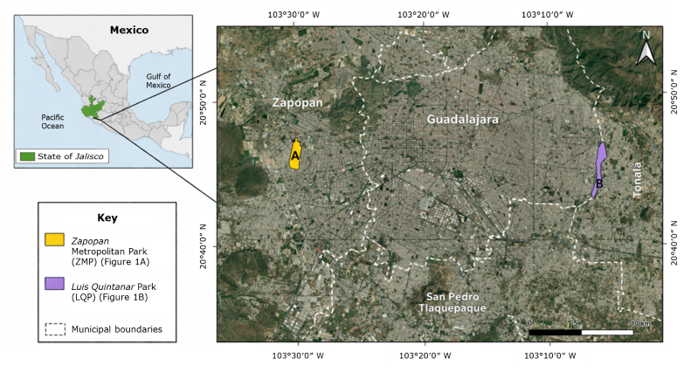
Urban trees are part of the green infrastructure and provide ecosystem services that depend on their structure, composition, management, and development. In this regard, this study compares the floristic composition, tree structure and stored aboveground carbon in the Zapopan Metropolitan Park and the Luis Quintanar Park in Guadalajara, Jalisco, Mexico. A random subsample equivalent to 50 % of the individuals at each site was analyzed, consisting of 329 trees in the former park and 509 in the latter. The taxonomic richness, relative abundance, species origin, and Shannon, Simpson and Pielou indexes were determined. The structure was characterized by diameter at breast height, total height, crown diameter, basal area and crown area. The aboveground biomass was estimated using an allometric equation based on the diameter, and the aboveground carbon was estimated using a fraction of 0.47. The Zapopan Metropolitan Park featured 35 species, 23 genera and 14 families, with a higher proportion of native species and a high Shannon diversity index. The Luis Quintanar Park recorded 18 taxa, 18 genera, and 13 families; in addition, individuals with greater structural development predominated. At this site, the diameter, height, basal area, aboveground biomass and aboveground carbon were significantly higher. The stored carbon reached 2.88 Mg C ha-1 in the Luis Quintanar Park and 0.80 Mg C ha-1 in the Zapopan Metropolitan Park. Results show that the floristic diversity and the structural development are complementary components for assessing the ecosystem services provided by urban trees.
Downloads
References
Amer, A., Franceschi, E., Hjazin, A., Shoqeir, J. H., Moser-Reischl, A., Rahman, M. A., Tadros, M., Pauleit, S., Pretzsch, H., & Rötzer, T. (2023). Structure and ecosystem services of three common urban tree species in an arid climate city. Forests, 14(4), Article 671. https://doi.org/10.3390/f14040671
Avery, T. E., & Burkhart, H. E. (2015). Forest measurements (5th ed.). Waveland Press, Inc. https://books.google.com.pe/books?id=IWx1CQAAQBAJ&printsec=copyright#v=onepage&q&f=false
Bidolakh, D., Lakyda, P., Myroniuk, V., Hayda, Y., & Pidkhovna, S. (2023). Assessment and representation of Urban Trees Ecosystem Services: A case study in Pryzamkovyi park. Folia Forestalia Polonica, 65(2), 104-116. https://doi.org/10.2478/ffp-2023-0011
Burkhart, H. E., & Tomé, M. (2012). Modeling forest trees and stands. Springer Science. https://doi.org/10.1007/978-90-481-3170-9
Castro-Díez, P., Vaz, A. S., Silva, J. S., van Loo, M., Alonso, Á., Aponte, C., Bayón, Á., Bellingham, P. J., Chiuffo, M. C., DiManno, N., Julian, K., Kandert, S., La Porta, N., Marchante, H., Maule, H. G., Mayfield, M. M., Metcalfe, D., Monteverdi, M. C., Núñez, M. A., … Godoy, O. (2019). Global effects of non-native tree species on multiple ecosystem services. Biological Reviews, 94(4), 1477-1501. https://doi.org/10.1111/brv.12511
Chao, A., Gotelli, N. J., Hsieh, T. C., Sander, E. L., Ma, K. H., Colwell, R. K., & Ellison, A. M. (2014). Rarefaction and extrapolation with Hill numbers: a framework for sampling and estimation in species diversity studies. Ecological Monographs, 84(1), 45-67. https://doi.org/10.1890/13-0133.1
Chave, J., Réjou-Méchain, M., Búrquez, A., Chidumayo, E., Colgan, M. S., Delitti, W. B. C., Duque, A., Eid, T., Fearnside, P. M., Goodman, R. C., Henry, M., Martínez-Yrízar, A., Mugasha, W. A., Muller-Landau, H. C., Mencuccini, M., Nelson, B. W., Ngomanda, A., Nogueira, E. M., Ortiz-Malavassi, E., … Vieilledent, G. (2014). Improved allometric models to estimate the aboveground biomass of tropical trees. Global Change Biology, 20(10), 3177-3190. https://doi.org/10.1111/gcb.12629
Cruz-de León, G., & Cruz-de León, J. (2006). The segmental conic model for forest measurements. Madera y Bosques, 12(2), 3-13. https://doi.org/10.21829/myb.2006.1221245
García-Valencia, A., Sánchez-Sánchez, O., Ramírez-Soto, A., & Ramos-Palacios, C. R. (2025). Diagnóstico y servicios ecosistémicos del arbolado de alineación en Xalapa, Veracruz, México. Polibotánica, (59), 159-180. https://doi.org/10.18387/polibotanica.59.10
Instituto Nacional de Estadística, Geografía e Informática. (2010a). Compendio de información geográfica municipal 2010. Guadalajara, Jalisco. Instituto Nacional de Estadística, Geografía e Informática. https://www.inegi.org.mx/contenidos/app/mexicocifras/datos_geograficos/14/14039.pdf
Instituto Nacional de Estadística, Geografía e Informática. (2010b). Compendio de información geográfica municipal 2010. Zapopan, Jalisco. Instituto Nacional de Estadística, Geografía e Informática. https://www.inegi.org.mx/contenidos/app/mexicocifras/datos_geograficos/14/14120.pdf
Kim, J., Kang, Y., Kim, D., Son, S., & Kim, E. J. (2024). Carbon storage and sequestration analysis by urban park grid using i-Tree Eco and drone-based modeling. Forests, 15(4), Article 683. https://doi.org/10.3390/f15040683
Leal-Elizondo, C. E., Leal-Elizondo, N., Alanís-Rodríguez, E., Pequeño-Ledezma, M. Á., Mora-Olivo, A., & Buendía-Rodríguez, E. (2018). Estructura, composición y diversidad del arbolado urbano de Linares, Nuevo León. Revista Mexicana de Ciencias Forestales, 9(48), 252-270. https://doi.org/10.29298/rmcf.v8i48.129
Magurran, A. E. (2004). Measuring biological diversity. Blackwell Science Ltd. http://www.bio-nica.info/Biblioteca/Magurran2004MeasuringBiological.pdf
Mann, H. B., & Whitney, D. R. (1947). On a test of whether one of two random variables is stochastically larger than the other. The Annals of Mathematical Statistics, 18(1), 50-60. https://doi.org/10.1214/aoms/1177730491
Martínez-Trinidad, T., Hernández-López, P., López-López, S. F., & Mohedano-Caballero, L. (2021). Diversidad, estructura y servicios ecosistémicos del arbolado en cuatro parques de Texcoco mediante i-Tree Eco. Revista Mexicana de Ciencias Forestales, 12(67), 202-223. https://doi.org/10.29298/rmcf.v12i67.880
McPherson, E. G., Xiao, Q., & Aguaron, E. (2013). A new approach to quantify and map carbon stored, sequestered and emissions avoided by urban forests. Landscape and Urban Planning, 120, 70-84. https://doi.org/10.1016/j.landurbplan.2013.08.005
Moreno, R., Nery, A., Zamora, R., Lora, Á., & Galán, C. (2024). Contribution of urban trees to carbon sequestration and reduction of air pollutants in Lima, Peru. Ecosystem Services, 67, Article 101618. https://doi.org/10.1016/j.ecoser.2024.101618
Morgenroth, J., Nowak, D. J., & Koeser, A. K. (2020). DBH distributions in America’s urban forests—An overview of structural diversity. Forests, 11(2), Article 135. https://doi.org/10.3390/f11020135
Nero, B. F., Kuusaana, E. D., Ahmed, A., & Campion, B. B. (2024). Carbon storage and tree species diversity of urban parks in Kumasi, Ghana. City and Environment Interactions, 24, Article 100156. https://doi.org/10.1016/j.cacint.2024.100156
Nowak, D. J., & Crane, D. E. (2002). Carbon storage and sequestration by urban trees in the USA. Environmental Pollution, 116(3), 381-389. https://doi.org/10.1016/S0269-7491(01)00214-7
Ortega-Álvarez, R., Rodríguez-Correa, H. A., & MacGregor-Fors, I. (2011). Trees and the city: Diversity and composition along a Neotropical Gradient of Urbanization. International Journal of Ecology, 2011, Article 704084. https://doi.org/10.1155/2011/704084
Pretzsch, H., Biber, P., Uhl, E., Dahlhausen, J., Rötzer, T., Caldentey, J., Koike, T., van Con, T., Chavanne, A., Seifert, T., du Toit, B., Farnden, C., & Pauleit, S. (2015). Crown size and growing space requirement of common tree species in urban centres, parks, and forests. Urban Forestry & Urban Greening, 14(3), 466-479. https://doi.org/10.1016/j.ufug.2015.04.006
Saavedra-Romero, L. de L., Hernández-de la Rosa, P., Alvarado-Rosales, D., Martínez-Trinidad, T., & Villa-Castillo, J. (2019). Diversidad y estructura arbórea, indicadores de salud aplicados a un bosque urbano de la Ciudad de México. Polibotánica, (47), 25-37. https://doi.org/10.18387/polibotanica.47.3
SAS Institute Inc. (2017). SAS/Stat User’s Guide, Version 9.4 [Computer software]. SAS Institute Inc. https://www.scienceopen.com/book?vid=5f350505-ff8c-4c2b-92e0-8ab04ebc2024
Sharma, G., Morgenroth, J., Richards, D. R., & Ye, N. (2025). Advancing urban forest and ecosystem service assessment through the integration of remote sensing and i-Tree Eco: A systematic review. Urban Forestry & Urban Greening, 104, Article 128659. https://doi.org/10.1016/j.ufug.2024.128659
Sjöman, H., Hirons, A. D., & Bassuk, N. L. (2015). Urban forest resilience through tree selection—Variation in drought tolerance in Acer. Urban Forestry & Urban Greening, 14(4), 858-865. https://doi.org/10.1016/j.ufug.2015.08.004
Velasco, E., & Chen, K. W. (2019). Carbon storage estimation of tropical urban trees by an improved allometric model for aboveground biomass based on terrestrial laser scanning. Urban Forestry & Urban Greening, 44, Article 126387. https://doi.org/10.1016/j.ufug.2019.126387
World Flora Online. (2026). World Flora Online [Data set]. Global Strategy for Plant Conservation and Convention on Biological Diversity. https://www.worldfloraonline.org/
Downloads
Published
Issue
Section
License
Copyright (c) 2026 Revista Mexicana de Ciencias Forestales

This work is licensed under a Creative Commons Attribution-NonCommercial 4.0 International License.
The authors who publish in Revista Mexicana de Ciencias Forestales accept the following conditions:
In accordance with copyright laws, Revista Mexicana de Ciencias Forestales recognizes and respects the authors’ moral right and ownership of property rights which will be transferred to the journal for dissemination in open access.
All the texts published by Revista Mexicana de Ciencias Forestales –with no exception– are distributed under a Creative Commons License Attribution-NonCommercial 4.0 International (CC BY-NC 4.0), which allows third parties to use the publication as long as the work’s authorship and its first publication in this journal are mentioned
The author(s) can enter into independent and additional contractual agreements for the nonexclusive distribution of the version of the article published in Revista Mexicana de Ciencias Forestales (for example, include it into an institutional repository or publish it in a book) as long as it is clearly and explicitly indicated that the work was published for the first time in Revista Mexicana de Ciencias Forestales.
For all the above, the authors shall send the form of Letter-transfer of Property Rights for the first publication duly filled in and signed by the author(s). This form must be sent as a PDF file to: ciencia.forestal2@inifap.gob.mx
This work is licensed under a Creative Commons Attribution-Noncommercial 4.0 International license.