Dendrometric assessment, diversity, and overall condition of the urban tree population in Tingo María, Huánuco, Peruuánuco, Peru
DOI:
https://doi.org/10.29298/rmcf.v17i98.1641Keywords:
urban green species, physical condition, phytosanitary assessment, urban management, diversity indices, dasometric variablesAbstract
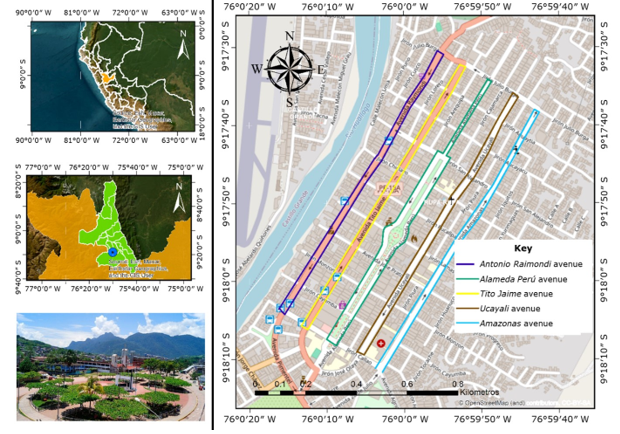
Urban trees are key to the environment and quality of life in cities. Thus, this study aimed to assess the urban tree population along five major avenues in the city of Tingo María, in the Huánuco region of Peru, in order to identify dasometric and phytosanitary variables, as well as biodiversity and associated risks. A tree census was conducted on each avenue, and the following information was recorded for each individual tree: normal diameter (Nd), total height (Th), and crown area (CA). In addition, the Shannon (H') and Margalef (DMg) diversity indices were calculated, and the structural, physical, and health status of the trees was assessed, along with the potential risks associated with urban trees. A total of 759 individuals were recorded, representing 50 species and 26 families, with a predominance of Arecaceae and Fabaceae, as well as a significant presence of exotic species such as Terminalia catappa. The dasometric variables exhibited high structural variability (Nd=26.12 cm; Th=6.29 m; CA=39.50 m2). Alameda Perú Avenue showed greater diversity (H'=2.11; DMg=4.72). In conclusion, the urban tree population in Tingo María is in good physical and health condition and causes minimal interference with the city’s infrastructure; however, priority should be given to the use of native species.
Downloads
References
Abd-Kadir, M. A., & Othman, N. (2012). Towards a better tomorrow: street trees and their values in urban areas. Procedia-Social and Behavioral Sciences, 35, 267-274. https://doi.org/10.1016/j.sbspro.2012.02.088
Alani, A. M., & Lantini, L. (2020). Recent advances in tree root mapping and assessment using non-destructive testing methods: a focus on ground penetrating radar. Surveys in Geophysics, 41, 605-646. https://doi.org/10.1007/s10712-019-09548-6
Andrade, R., Franklin, J., Larson, K. L., Swan, C. M., Lerman, S. B., Bateman, H. L., Warren, P. S., & York, A. (2021). Predicting the assembly of novel communities in urban ecosystems. Landscape Ecology, 36, 1-15. https://doi.org/10.1007/s10980-020-01142-1
Angeles-Vasquez, R., Angeles-Suazo, J. M., Lavado-Meza, C., Gutiérrez-Collao, J. E., Meza-Mitma, P. M., de la Cruz-Cerron, L., Flores-Rojas, J., Karam, H. A., & Angeles-Suazo, N. (2025). Urban heat island in the city of Brasilia: A multi-method analysis. Ecological Engineering & Environmental Technology, 26(10), 115-127. https://doi.org/10.12912/27197050/210313
Baró, F., Chaparro, L., Gómez-Baggethun, E., Langemeyer, J., Nowak, D. J., & Terradas, J. (2014). Contribution of ecosystem services to air quality and climate change mitigation policies: the case of urban forests in Barcelona, Spain. Ambio, 43(4), 466-479. https://doi.org/10.1007/s13280-014-0507-x
Cultid-Medina, C. A., & Escobar, F. (2019). Pautas para la estimación y comparación estadística de la diversidad biológica (qD). En C. E. Moreno (Ed.), La biodiversidad en un mundo cambiante: Fundamentos teóricos y metodológicos para su estudio (pp. 175-202). Universidad Autónoma del Estado de Hidalgo. https://www.researchgate.net/publication/340104672_Pautas_para_la_estimacion_y_comparacion_estadistica_de_la_diversidad_biologica_qD
Day, S. D., Wiseman, P. E., Dickinson, S. B., & Harris, J. R. (2010). Contemporary concepts of root system architecture of urban trees. Arboriculture & Urban Forestry, 36(4), 149-159. https://doi.org/10.48044/jauf.2010.020
Di Rienzo, J. A., Balzarini, M. G., Casanoves, F., Gonzalez, L., Tablada, M., & Robledo, C. W. (2020). InfoStat (Versión 2020) [Software de computadora]. Universidad Nacional de Córdoba. http://www.infostat.com.ar
Esperon-Rodriguez, M., St-Denis, A., Messier, J., Gallagher, R. V., Tjoelker, M. G., & Messier, C. (2025). An integrative urban tree risk index as a novel framework for risk assessment: A case study of Montreal, Canada. Urban Forestry & Urban Greening, 113, Article 129025. https://doi.org/10.1016/j.ufug.2025.129025
Esquivel, T., & Quijas, S. (2021). Daño a la infraestructura (pavimento) causado por el arbolado urbano en Puerto Vallarta, Jalisco. Revista Mexicana de Ciencias Forestales, 12(68), 178-201. https://doi.org/10.29298/rmcf.v12i68.1166
Gutiérrez-Collao, J. E., Meza-Mitma, P. M., Ramos-Huaman, K. D., Ospina-Castro, L. R., Pariona-Duran, S. Z., Chancha-Inga, J. J., Murga-Tirado, C. E., & Vasquez-Salazar, A. G. (2025a). Caracterización del arbolado y arbustos urbanos en Pampas, Huancavelica, Perú. Revista Mexicana de Ciencias Forestales, 16(90), 133-153. https://doi.org/10.29298/rmcf.v16i90.1549
Gutiérrez-Collao, J. E., Chahuaylacc-De La Cruz, F. A., Juñuruco-Pituy, L. N., Lujan-Huamani, N., Torres-Flores, E. L., Huayllani-Agui, Y. Y., Murga-Tirado, C. E., & Chihuan-Quispe, R. J. (2025b). Valoración económica de los servicios ecosistémicos de dos espacios abiertos de la ciudad de Pampas, Huancavelica, Perú. Revista Mexicana de Ciencias Forestales, 16(89), 159-179. https://doi.org/10.29298/rmcf.v16i89.1550
Hernández-López, P., Martínez-Trinidad, T., Mohedano-Caballero, L., Hernández-de la Rosa, P., & González-Guillén, M. de J. (2024). Características estructurales y nivel de riesgo de arbolado en un parque periurbano. Madera y Bosques, 30(2), Artículo e3022606. https://doi.org/10.21829/myb.2024.3022606
Hilbert, D. R., North, E. A., Hauer, R. J., Koeser, A. K., McLean, D. C., Northrop, R. J., Andreu, M., & Parbs, S. (2020). Predicting trunk flare diameter to prevent tree damage to infrastructure. Urban Forestry & Urban Greening, 49, Article 126645. https://doi.org/10.1016/j.ufug.2020.126645
Holdridge, L. R. (1978). Ecología basada en zonas de vida. Servicio editorial Instituto Interamericano de Cooperación para la Agricultura. https://repositorio.iica.int/items/1133111c-6a7a-4a9a-bc12-e87b2d68d824
Jiménez-Pérez, J., Sandoval-García, R., Alanís-Rodríguez, E., Yerena-Yamallel, J. I., & Aguirre-Calderón, O. A. (2022). Dinámica de cambio en ecosistemas urbanos y periurbanos en el área metropolitana de Monterrey, México. Revista Cubana de Ciencias Forestales, 10(3), 278-291. https://cfores.upr.edu.cu/index.php/cfores
Jost, L. (2006). Entropy and diversity. Oikos, 113(2), 363-375. https://doi.org/10.1111/j.2006.0030-1299.14714.x
Lucchezi-Miyahara, A. A., Wild, T., Sandre, A. A., Mesquita-Pellegrino, P. R., da Silva-Filho, C. A., Silveira-Buckeridge, M., & Maselli-Locosselli, G. (2022). Developing and classifying urban biomes as a basis for nature-based solutions. Urban Climate, 45, Article 101251. https://doi.org/10.1016/j.uclim.2022.101251
Lyytimäki, J. (2017). Disservices of urban trees. In F. Ferrini, C. C. K. van den Bosch & A. Fini (Eds.), Routledge handbook of urban forestry (pp. 164-176). Routledge. https://www.taylorfrancis.com/chapters/edit/10.4324/9781315627106-12/disservices-urban-trees-jari-lyytim%C3%A4ki
Madayani, C., & Yola, L. (2025). Impact of trees cooling effect in Jakarta’s green open space: Urban thermal simulation. In E. M. Nia, M. Awang, M. F. N. Aulady, M. Traykova & L. Yola (Eds.), Selected articles from the 8th International Conference on Architecture and Civil Engineering (ICACE 2024) (pp. 252-261). Springer. https://doi.org/10.1007/978-981-96-5654-7_25
Martínez-Juárez, G., Rodríguez-Trejo, D. A., Granados-Sánchez, D., Mohedano-Caballero, L., & Villanueva-Morales, A. (2022). Descripción del arbolado de alineación de la ciudad de Puebla por grado de marginación y vialidad. Revista Mexicana de Ciencias Forestales, 13(70), 85-111. https://doi.org/10.29298/rmcf.v13i70.830
Martínez-Trinidad, T., Hernández-López, P., López-López, S. F., & Mohedano-Caballero, L. (2021). Diversidad, estructura y servicios ecosistémicos del arbolado en cuatro parques de Texcoco mediante i-Tree Eco. Revista Mexicana de Ciencias Forestales, 12(67), 202-223. https://doi.org/10.29298/rmcf.v12i67.880
Ministerio de Desarrollo Agrario y Riego. (2022). Guía metodológica para el estudio de levantamiento de la cobertura vegetal (bosques) para la clasificación de tierras por su capacidad de uso mayor (Ctcum). Ministerio de Desarrollo Agrario y Riego. https://cdn.www.gob.pe/uploads/document/file/3943514/GUIA_METODOLOGICA_EV_CTCUM_VF_23NOV22FF.pdf.pdf?v=1671211112
Otero-Durán, L., & Torres, A. (2024). Trees and sidewalks: toward an infrastructure protection approach. Frontiers in Sustainable Cities, 6, Article 1336472. https://doi.org/10.3389/frsc.2024.1336472
Semeraro, T., Scarano, A., Buccolieri, R., Santino, A., & Aarrevaara, E. (2021). Planning of urban green spaces: An ecological perspective on human benefits. Land, 10(2), Article 105. https://doi.org/10.3390/land10020105
Servicio Nacional de Meteorología e Hidrología del Perú. (2022). Datos hidrometeorológicos a nivel nacional [Conjunto de datos]. Ministerio del Ambiente. https://www.senamhi.gob.pe/?&p=estaciones
Sharma, S., Hussain, S., Kumar, P., & Singh, A. N. (2024). Urban trees’ potential for regulatory services in the urban environment: an exploration of carbon sequestration. Environmental Monitoring and Assessment, 196, Article 504. https://doi.org/10.1007/s10661-024-12634-x
Sikuzani, Y. U., Malaisse, F., Kaleba, S. C., Mwanke, A. K., Yamba, A. M., Khonde, C. N., Bogaert, J., & Kankumbi, F. M. (2019). Tree diversity and structure on green space of urban and peri-urban zones: The case of Lubumbashi City in the Democratic Republic of Congo. Urban Forestry & Urban Greening, 41, 67-74. https://doi.org/10.1016/j.ufug.2019.03.008
Sjöman, H., Hirons, A. D., & Bassuk, N. L. (2018). Improving confidence in tree species selection for challenging urban sites: a role for leaf turgor loss. Urban Ecosystems, 21, 1171-1188. https://doi.org/10.1007/s11252-018-0791-5
Tomao, A., Secondi, L., Corona, P., Giuliarelli, D., Quatrini, V., & Agrimi, M. (2015). Can composite indices explain multidimensionality of tree risk assessment? A case study in an historical monumental complex. Urban Forestry and Urban Greening, 14(3), 456-465. https://doi.org/10.1016/j.ufug.2015.04.009
Vashist, M., Singh, S. K., & Kumar, T. V. (2025). Enhancing resilience for sustainable cities: a review of threats to urban trees. Biodiversity and Conservation, 34, 1231-1258. https://doi.org/10.1007/s10531-025-03025-w
Vogt, J., Hauer, R. J., & Fischer, B. C. (2015). The costs of maintaining and not maintaining the urban forest: A review of the urban forestry and arboriculture literature. Arboriculture & Urban Forestry, 41(6), 293-323. https://doi.org/10.48044/jauf.2015.027
World Flora Online. (2025). WFO Plant List Snapshots of the taxonomy [Data set]. Royal Botanic Gardens and the Missouri Botanical Garden. https://wfoplantlist.org/
Zevgolis, Y. G., Alsamail, M. Z., Akriotis, T., Dimitrakopoulos, P. G., & Troumbis, A. Y. (2022). Detecting, quantifying, and mapping urban trees' structural defects using infrared thermography: Implications for tree risk assessment and management. Urban Forestry & Urban Greening, 75, Article 127691. https://doi.org/10.1016/j.ufug.2022.127691
Downloads
Published
Issue
Section
License
Copyright (c) 2026 Revista Mexicana de Ciencias Forestales

This work is licensed under a Creative Commons Attribution-NonCommercial 4.0 International License.
The authors who publish in Revista Mexicana de Ciencias Forestales accept the following conditions:
In accordance with copyright laws, Revista Mexicana de Ciencias Forestales recognizes and respects the authors’ moral right and ownership of property rights which will be transferred to the journal for dissemination in open access.
All the texts published by Revista Mexicana de Ciencias Forestales –with no exception– are distributed under a Creative Commons License Attribution-NonCommercial 4.0 International (CC BY-NC 4.0), which allows third parties to use the publication as long as the work’s authorship and its first publication in this journal are mentioned
The author(s) can enter into independent and additional contractual agreements for the nonexclusive distribution of the version of the article published in Revista Mexicana de Ciencias Forestales (for example, include it into an institutional repository or publish it in a book) as long as it is clearly and explicitly indicated that the work was published for the first time in Revista Mexicana de Ciencias Forestales.
For all the above, the authors shall send the form of Letter-transfer of Property Rights for the first publication duly filled in and signed by the author(s). This form must be sent as a PDF file to: ciencia.forestal2@inifap.gob.mx
This work is licensed under a Creative Commons Attribution-Noncommercial 4.0 International license.