Revista Mexicana de Ciencias Forestales Vol. 17 (98)
Dasonomía Urbana (2026)
DOI: https://doi.org/10.29298/rmcf.v17i98.1689 Research article
Woody and arborescent floristic diversity in the streets of Puerto Vallarta, Jalisco, Mexico Diversidad florística leñosa y arborescente en calles de Puerto Vallarta, Jalisco, México
Jazmin Arechiga1,2, Elisa Bueno-Alvarado1, Tahamara Esquivel2, Karen E. Peña-Joya3, Sandra Quijas1,4* |
Fecha de recepción/Reception date: 13 de mayo de 2026.
Fecha de aceptación/Acceptance date: 13 de agosto de 2026.
_______________________________
1Universidad de Guadalajara, Centro Universitario de la Costa, Laboratorio de Biodiversidad y Servicios Ecosistémicos. México.
2Organización de la Conservación de los Árboles. México.
3Universidad de Guadalajara, Centro Universitario de la Costa, Laboratorio de Ecología, Paisaje y Sociedad. México.
4Universidad de Guadalajara, Centro Universitario de la Costa, Herbario PV. México.
*Autor para correspondencia; correo-e: sandra.qfonseca@academicos.udg.mx
*Corresponding author; e-mail: sandra.qfonseca@academicos.udg.mx
Abstract
Street trees provide critical ecosystem services, but stressful conditions shape their diversity and composition. This study evaluated the taxonomic diversity of Puerto Vallarta’s urban woody and arborescent vegetation through floristic surveys and analyzed the influence of physical, biological, and social variables to generate useful information for urban forest planning and management. Taxonomic distinctiveness and similarity indexes were used to evaluate species composition and taxonomic relationships. A total of 2 602 individuals belonging to 39 families, 85 genera, 100 species, and one infraspecific category (54 native and 47 exotic species) were recorded. The most abundant taxa were Terminalia catappa, Ficus benjamina, and Tabebuia rosea. The taxonomic distinctness of the streets remained within expected values; however, the floristic similarity with respect to the region—specifically Bahía de Banderas and the Sierra El Cuale—was less than 10 %. The level of marginalization and distance from the mountain were associated with the floristic diversity of the streets. Puerto Vallarta is home to significant biodiversity and shows evidence of biotic homogenization associated with the predominance of exotic taxa and the low representation of native regional flora.
Keywords: Street trees, composition, taxonomic distinctness, exotic species, native species, similarity.
Resumen
El arbolado de alineación de calles proporciona servicios ecosistémicos críticos, pero enfrenta condiciones de estrés que moldean su diversidad y composición. En este estudio se evaluó la diversidad taxonómica del arbolado leñoso y arborescente urbano de Puerto Vallarta mediante censos florísticos, y se analizó la influencia de variables físicas, biológicas y sociales para generar información útil para la planeación y el manejo del bosque urbano. Se utilizaron índices de distintividad taxonómica y de similitud para evaluar la composición de especies y sus relaciones taxonómicas. Se registraron 2 602 individuos pertenecientes a 39 familias, 85 géneros, 100 especies y una categoría infraespecífica (54 nativas y 47 exóticas). Los taxa más abundantes fueron Terminalia catappa, Ficus benjamina y Tabebuia rosea. La distintividad taxonómica de las calles se mantuvo dentro de los valores esperados; sin embargo, la similitud florística respecto a la región a nivel de Bahía de Banderas y la Sierra El Cuale fue inferior a 10 %. El nivel de marginación y la distancia a la montaña se asociaron a la diversidad florística de las calles. Puerto Vallarta alberga una riqueza relevante, presenta evidencias de homogeneización biótica asociada al predominio de taxones exóticos y la baja representatividad de la flora regional nativa.
Palabras claves: Árboles de calles, composición, distintividad taxonómica, especies exóticas, especies nativas, similitud.
Introduction
Urban vegetation is defined as the system comprising trees, shrubs, palm trees, and associated vegetation such as grasses, vines, and succulents found in urban and peri-urban areas (Hernández-Cavazos et al., 2025; Román-Guillén et al., 2019). Within the cities, the trees lining the streets and sidewalks are a significant component of the urban landscape (Román-Guillén et al., 2019) that provides critical ecosystem services, such as thermal regulation, which mitigates the heat island effect, improves air quality by removing gaseous pollutants and particulate matter, helps reduce surface runoff, and promotes rainwater infiltration; furthermore, it promotes psychological well-being, reduces stress, and increases property values (García-Valencia et al., 2025; Jiang et al., 2024; Shams et al., 2020).
However, street trees face extreme stress conditions, such as limited root space, compacted and contaminated soil, requiring careful selection of species to prevent problems such as damage to infrastructure or pollen allergies (Zong et al., 2020).
Assessing the diversity of urban trees at the local and regional levels is essential to understand the socio-ecological processes that shape the urban landscape (Galle et al., 2021). Diversity in cities is not random; it is shaped by a complex interplay of biological, physical, and socioeconomic factors (Falfán & MacGregor-Fors, 2020; Galle et al., 2021). At the regional level, tree composition is influenced by biogeographic and climatic factors that determine the viability of native species compared to exotic ones (Antunes-Jimenez et al., 2026). At the local level, physical gradients such as the altitude and proximity to natural areas act as environmental filters that define the richness and structure of the community (Falfán & MacGregor-Fors, 2020; Galle et al., 2021; García-Valencia et al., 2025). The city’s historical development (legacy effect) and the socioeconomic status of its residents (luxury effect) have been identified as factors driving spatial inequality in urban tree diversity or coverage (Liu et al., 2026; Martínez-Juárez et al., 2022; Shams et al., 2020). In particular, the luxury effect refers to the fact that, in areas with higher purchasing power, there tends to be greater affluence and more extensive landscaping, attributable to a high capacity for investment, the maintenance of green spaces, and the selection of ornamental plant species (Hope et al., 2003). However, the most recent evidence shows that this effect is amplified in arid cities and cities with older neighborhoods, and is reduced in tropical areas (Leong et al., 2018).
The study of urban trees requires an approach that goes beyond simply counting species and incorporates a wider variety of metrics (Antunes-Jimenez et al., 2026). Specific richness alone assumes that all species contribute equally to biodiversity, overlooking the evolutionary relationships among them (Moreno et al., 2009).
In this context, the Average taxonomic distinctiveness index (Δ+) assesses the structural complexity of the community above the species level, using the Linnaean hierarchy as a proxy for phylogeny (Moreno et al., 2009; Pérez-Hernández, 2019). Unlike traditional indexes, taxonomic distinctness is robust to variations in sampling effort and can identify taxonomically impoverished assemblages or communities with divergent evolutionary histories (Pérez-Hernández, 2019). Based on the indexes and multivariate analyses, the similarities in composition and relative abundance help detect dominant species that undermine the stability of urban tree stands (Falfán & MacGregor-Fors, 2020). In order to enhance stability and prevent the overrepresentation of taxa, the 10-20-30 rule is often applied, which recommends not exceeding 10 % of a single species, 20 % of a single genus, or 30 % of a single family (Almeida-Cerino et al., 2024; Shams et al., 2020). This promotes resilience to pests, diseases, and climate change (Antunes-Jimenez et al., 2026).
The city of Puerto Vallarta, located in the Bahía de Banderas region between the states of Jalisco and Nayarit, features woody, arborescent vegetation shaped by the tropical ecosystems of the Sierra Madre del Sur (Gudiño-Cano et al., 2025). Despite their importance for tourism and the environment, the trees lining its streets and sidewalks face pressure from urban development and infrastructure damage (Esquivel & Quijas, 2021). In this regard, this study stems from the need to have an up-to-date inventory of Puerto Vallarta’s urban trees and to identify how the species assemblage fits into the regional context.
Given these scenarios, the question arises: How do local physical, biological, and socioeconomic factors influence the richness, composition, and taxonomic distinctness of street trees in Puerto Vallarta, and how does this assemblage fit into the regional context? To answer this question, the following objective is proposed: to assess the taxonomic diversity of woody and arborescent plants on the streets and sidewalks of Puerto Vallarta through censuses and multivariate analyses to estimate the floristic richness of woody and arborescent plants and establishing guidelines for improved regional urban forest planning and management.
Materials and Methods
Study area
The city of Puerto Vallarta, located on the Northern coast of the state of Jalisco, Mexico (Figure 1A), is surrounded by tropical deciduous and subdeciduous forests (Gallardo-Arce et al., 2022), with an altitude ranging between 0 and 150 m, a surface area of 13.4 km2, and a population of 291 839 inhabitants (Instituto de Información Estadística y Geográfica de Jalisco [IIEG Jalisco], 2026). For site selection, the city was divided into three zones (North, Central, and South) to prevent concentrating sites in a single sector. Three sites were then selected in each zone, allowing balanced sampling across the urban gradient and facilitating comparisons of diversity, species richness, and individual abundance between sites (Figure 1). In addition, each site was assigned physical and social characteristics (Table 1).
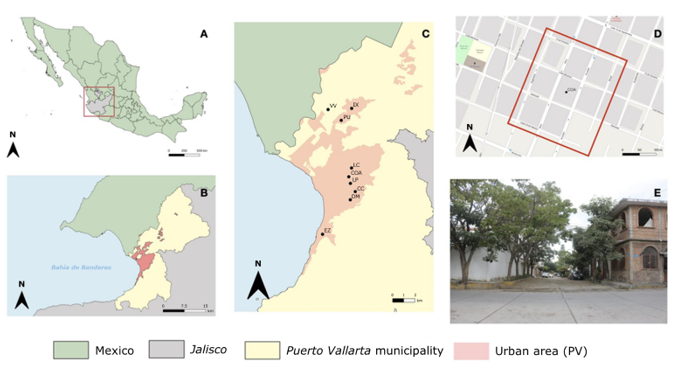
A = Jalisco, Mexico; B = Puerto Vallarta (PV), Jalisco; C = Urban area (pink) and peri-urban area (yellow), showing the location of the surveyed sites (black dots); D = City blocks within the site; E = View of the street and registered sidewalks. IX = Ixtapa; VV = Verde Vallarta; PU = Paseos Universidad II; LC = Lomas del Calvario; COA = Coapinole; LP = La Playita; CC = Cristóbal Colón; EZ = Emiliano Zapata; DM = Del Mar.
Figure 1. Location of the study sites in Puerto Vallarta, in the Bahía de Banderas region, Jalisco-Nayarit, Mexico.
Table 1. Physical and social characteristics of sites in Puerto Vallarta, Jalisco, Mexico.
Code |
Sites |
Altitude |
Distance to the mountain (km) |
Paved street (%) |
Site surface area (km2) |
Level of marginalization |
Total length of the street (km) |
No. of blocks |
IX |
Ixtapa |
25.15 |
1.14 |
62 |
0.05 |
Medium |
1.68 |
9 |
VV |
Verde Vallarta |
9.37 |
2.68 |
100 |
0.06 |
Medium |
1.86 |
15 |
PU |
Paseos Universidad II |
17.06 |
0.66 |
100 |
0.05 |
Low |
1.21 |
9 |
LC |
Lomas del Calvario |
37.06 |
1.85 |
75 |
0.06 |
High |
1.49 |
9 |
COA |
Coapinole |
39.32 |
1.8 |
50 |
0.06 |
Medium |
1.49 |
9 |
LP |
La Playita |
21.05 |
1.71 |
50 |
0.07 |
Medium |
1.40 |
11 |
CC |
Cristóbal Colón |
19.41 |
0.92 |
83 |
0.05 |
Medium |
1.31 |
10 |
EZ |
Emiliano Zapata |
47.12 |
0.25 |
79 |
0.03 |
Medium |
1.72 |
9 |
DM |
Del Mar |
27.72 |
0.79 |
100 |
0.07 |
Low |
1.32 |
7 |
The sites were primarily residential, each with an average surface area of 0.06 km2 and sizes ranging between 7 and 15 blocks (Figure 1D, Table 1), as site characteristics—such as access limitations, terrain conditions, and safety concerns—precluded a uniform number of blocks. The distance separating the sampled sites from the El Cuale mountain range, which surrounds the city of Puerto Vallarta, was also taken into account, having been measured up to the boundary where the mountain’s continuous natural vegetation begins. This variable is intended to represent the proximity of urban sites to natural vegetation as a potential source of individuals.
The level of marginalization is not based on an official index but on a qualitative classification (high, medium, and low), determined through direct observations of infrastructure condition and public-space maintenance during fieldwork (Figure 1E). The “high” category was characterized by poor infrastructure conditions and a lack of public-space maintenance; the “medium” category fell somewhere in between; and the “low” category corresponded to visible infrastructure and well-maintained public space.
Street-level vegetation surveys
A survey of the streets that make up each site was conducted, and all of them were taken into account even though they had varying physical characteristics, for example, the presence or absence of road infrastructure such as pavement, sidewalks, curbs, or flower beds. An average of 1.5 km was surveyed; all trees, shrubs, palms, herbs, and arborescent succulents found on the streets were recorded; woody plants on private property were excluded. Each woody and arborescent species was classified as native or exotic, based on its origin or potential distribution. A native species is one found within its natural or original range, based on its dispersal potential; an exotic or introduced species is found outside its natural range (Gudiño-Cano et al., 2025). In this study, exotic species were defined as those not native to North and Central America. The origin of the species was derived from Plants of the World Online (Royal Botanic Gardens Kew [RBGK], 2025).
Research on regional vegetation
To determine the taxonomic diversity of the trees in Puerto Vallarta, we considered the floristic reports of two regions: Bahía de Banderas and the Sierra El Cuale (Bravo-Bolaños et al., 2016; Secretaría de Medio Ambiente y Desarrollo Territorial [Semadet], 2016) (Figure 1B). The Bahía de Banderas region covers a surface area of 1 407 km2, with elevations ranging from 0 to 2 000 m. It is part of the Mexican Pacific Coastal Plain and includes the following municipalities: Bahía de Banderas in Nayarit, and Puerto Vallarta and Cabo Corrientes in Jalisco.
The predominant vegetation consists of tropical deciduous and semi-deciduous forests, with 453 species, 326 genera, and 103 families of vascular plants (Bravo-Bolaños et al., 2016). The El Cuale region covers 1 214 km2 and encompasses parts of the municipalities of Puerto Vallarta, Cabo Corrientes, Talpa de Allende, and Mascota in Jalisco. The vegetation types include subdeciduous tropical forest, tropical deciduous forest, pine-oak forest, mesophilic mountain forest, xerophilous scrub (on cliffs), Byrsonima, Curatella, or Crescentia forest, and gallery forest. This region is home to 28 % of all plant species recorded in the state of Jalisco, with 2 063 species, 823 genera, and 163 families of vascular plants (Semadet, 2016).
Data analysis
Taxonomic diversity. Taxonomic diversity was assessed at the local level (nine sites in Puerto Vallarta) and the regional level (comparison with Bahía de Banderas and the Sierra El Cuale), using the Average Taxonomic Distinctness Index (AvTD; Clarke & Warwick, 1999). Presence-absence matrices linked to an aggregation matrix of four taxonomic hierarchies (order, family, genus, and species) were used. Systematic weighting followed the criteria established by Clarke and Gorley (2015): species within the same genus (w1), the same family but different genus (w2), the same order but different family (w3), and different order (w4). To determine whether the observed taxonomic distinctness, both locally and regionally, differed significantly from what would be expected by chance, probability funnels were constructed using 1 000 random iterations, and the expected value and its respective 95 % confidence intervals were estimated (Clarke & Gorley, 2015).
Species composition. This was assessed using the Jaccard index, which measures the similarities in species composition between two communities based on the species they share (Moreno, 2001). For this analysis, a presence-absence matrix of woody and tree species at the nine sites was used. To visualize the similarities in the composition of the sites, a nonmetric multidimensional scaling (NMDS) analysis was performed, supplemented by a cluster analysis to describe groupings at a cutoff level of 50 % similarity. The analysis of tree composition at the regional level used a matrix of the presence and absence of tree species in Puerto Vallarta, Bahía de Banderas, and the Sierra El Cuale. At this level, the similarities were represented using cluster analysis (Clarke & Gorley, 2015).
Biological, physical, and socioeconomic variables. To determine which variables are associated with the sites in Puerto Vallarta (Table 1), a principal coordinate analysis (PCoA) was conducted based on Gower’s similarity (for mixed data) and supplemented with multiple correlations (Gower, 1971). This analysis was conducted using seven variables: biological (native species, exotic species, and abundance), physical (elevation and distance from the mountain), and socioeconomic (paved streets, level of marginalization, and number of city blocks). The analyses were performed using the software PRIMER V7® (Clarke & Gorley, 2015).
Results
Taxonomic diversity
A total of 2 602 individuals belonging to 39 families, 85 genera, 100 species, and one infraspecific category were recorded; of these, 54 were native and 47 were exotic (Table 2). Trees were the most diverse group (89 species), followed by palms (12) and shrubs (8). The most abundant and common species across sites were Terminalia catappa L. (467) and Ficus benjamina L. (191), followed by the native taxa Tabebuia rosea (Bertol.) DC. (150) and Artocarpus heterophyllus Lam. (111). The sites surveyed in Puerto Vallarta partially met the 10-20-30 rule; of the total number of specimens recorded, no genus accounted for more than 20 %, and no family accounted for more than 30 %. However, at the species level, T. catappa exceeded the 10 % suggested by this rule, reaching 18 %.
Table 2. Plant species recorded on the streets of Puerto Vallarta, Jalisco, Mexico.
Order |
Family |
Species |
OR |
HA |
AB |
Araucariales |
Araucariaceae |
Araucaria heterophylla (Salisb.) Franco |
E |
Ab |
6 |
Arecales |
Arecaceae |
Adonidia merrillii (Becc.) Becc. |
E |
P |
78 |
Areca catechu L. |
E |
P |
7 |
||
Attalea cohune Mart. |
N |
P |
12 |
||
Caryota mitis Lour. |
E |
P |
3 |
||
Cocos nucifera L. |
E |
P |
95 |
||
Chrysalidocarpus lutescens H. Wendl. |
E |
P |
102 |
||
Hyophorbe lagenicaulis (L. H. Bailey) H. E. Moore |
E |
P |
1 |
||
Phoenix roebelenii O'Brien |
E |
P |
13 |
||
Roystonea regia (Kunth) O. F. Cook |
E |
P |
12 |
||
Sabal mexicana Mart. |
N |
P |
3 |
||
Syagrus romanzoffiana (Cham.) Glassman |
E |
P |
12 |
||
Washingtonia filifera var. robusta (H. Wendl.) Parish |
N |
P |
41 |
||
Asparagales |
Asparagaceae |
Dracaena fragrans (L.) Ker Gawl. |
E |
Ar |
6 |
Yucca gigantea Lem. |
N |
Sa |
20 |
||
Boraginales |
Ehretiaceae |
Ehretia tinifolia L. |
N |
Ab |
12 |
Brassicales |
Caricaceae |
Carica papaya L. |
N |
Ha |
50 |
Moringaceae |
Moringa oleifera Lam. |
E |
Ab |
22 |
|
Caryophyllales |
Nyctaginaceae |
Bougainvillea glabra Choisy |
E |
Ar |
1 |
Cupressales |
Cupressaceae |
Hesperocyparis macrocarpa (Hartw.) Bartel |
N |
Ab |
30 |
Cupressus sempervirens L. |
E |
Ab |
9 |
||
Ericales |
Primulaceae |
Ardisia compressa Kunth |
N |
Ab |
6 |
Fabales |
Fabaceae |
Albizia lebbeck (L.) Benth. |
E |
Ab |
4 |
Bauhinia variegata L. |
E |
Ab |
17 |
||
Caesalpinia pulcherrima (L.) Sw. |
N |
Ar |
1 |
||
Cassia fistula L. |
E |
Ab |
15 |
||
Delonix regia (Bojer ex Hook.) Raf. |
E |
Ab |
19 |
||
Enterolobium cyclocarpum (Jacq.) Griseb. |
N |
Ab |
9 |
||
Gliricidia sepium (Jacq.) Kunth |
N |
Ab |
10 |
||
Hymenaea courbaril L. |
N |
Ab |
2 |
||
Leucaena leucocephala (Lam.) de Wit |
N |
Ab |
19 |
||
Pithecellobium dulce (Roxb.) Benth. |
N |
Ab |
68 |
||
Tamarindus indica L. |
E |
Ab |
14 |
||
Vachellia farnesiana (L.) Wight & Arn. |
N |
Ab |
1 |
||
Gentianales |
Apocynaceae |
Plumeria rubra L. |
N |
Ab |
23 |
Tabernaemontana divaricata (L.) R. Br. ex Roem. & Schult. |
E |
Ar |
1 |
||
Cascabela thevetia (L.) Lippold |
N |
Ab |
14 |
||
Rubiaceae |
Arachnothryx leucophylla (Kunth) Planch. |
N |
Ar |
2 |
|
Morinda citrifolia L. |
E |
Ab |
19 |
||
Lamiales |
Bignoniaceae |
Crescentia alata Kunth |
N |
Ab |
1 |
Jacaranda mimosifolia D. Don |
E |
Ab |
1 |
||
Parmentiera aculeata (Kunth) Seem. |
N |
Ab |
1 |
||
Roseodendron donnell-smithii (Rose) Miranda |
N |
Ab |
61 |
||
Spathodea campanulata P. Beauv. |
E |
Ab |
27 |
||
Tabebuia rosea (Bertol.) DC. |
N |
Ab |
150 |
||
Tecoma stans (L.) Juss. |
N |
Ab |
32 |
||
Lamiaceae |
Clerodendrum quadriloculare (Blanco) Merr. |
E |
Ar |
1 |
|
Vitex mollis Kunth |
N |
Ab |
4 |
||
Tectona grandis L. f. |
E |
Ab |
3 |
||
Oleaceae |
Fraxinus uhdei (Wenz.) Lingelsh. |
N |
Ab |
2 |
|
Verbenaceae |
Duranta erecta L. |
N |
Ar |
7 |
|
Laurales |
Lauraceae |
Persea americana Mill. |
N |
Ab |
7 |
Magnoliales |
Annonaceae |
Annona muricata L. |
N |
Ab |
82 |
Annona purpurea Moc. & Sessé ex Dunal |
N |
Ab |
11 |
||
Malpighiales |
Chrysobalanaceae |
Couepia polyandra (Kunth) Rose |
N |
Ab |
2 |
Euphorbiaceae |
Cnidoscolus aconitifolius (Mill.) I. M. Johnst. |
N |
Ab |
9 |
|
Hura polyandra Baill. |
N |
Ab |
1 |
||
Malpighiaceae |
Byrsonima crassifolia (L.) Kunth |
N |
Ab |
62 |
|
Malpighia emarginata DC. |
N |
Ar |
6 |
||
Malvales |
Bixaceae |
Cochlospermum vitifolium (Willd.) Spreng. |
N |
Ab |
3 |
Malvaceae |
Guazuma ulmifolia Lam. |
N |
Ab |
24 |
|
Hibiscus tiliaceus L. |
E |
Ab |
6 |
||
Pachira aquatica Aubl. |
N |
Ab |
6 |
||
Pseudobombax ellipticum (Kunth) Dugand |
N |
Ab |
11 |
||
Muntingiaceae |
Muntingia calabura L. |
N |
Ab |
4 |
|
Myrtales |
Combretaceae |
Bucida buceras L. C. Wright |
E |
Ab |
37 |
Terminalia catappa L. |
E |
Ab |
467 |
||
Myrtaceae |
Psidium cattleyanum Sabine |
N |
Ab |
2 |
|
Psidium guajava L. |
N |
Ab |
104 |
||
Psidium oligospermum Mart. ex DC. |
N |
Ab |
10 |
||
Syzygium jambos (L.) Alston |
E |
Ab |
37 |
||
Oxalidales |
Oxalidaceae |
Averrhoa carambola L. |
E |
Ab |
33 |
Pinales |
Pinaceae |
Pinus sp. |
N |
Ab |
1 |
Rosales |
Moraceae |
Artocarpus heterophyllus Lam. |
E |
Ab |
111 |
Ficus benjamina L. |
E |
Ab |
191 |
||
Ficus benjamina L. var. variegata |
E |
Ab |
1 |
||
Ficus maclellandii King |
E |
Ab |
3 |
||
Ficus carica L. |
E |
Ab |
1 |
||
Ficus cotinifolia Kunth |
N |
Ab |
4 |
||
Ficus elastica Roxb. ex Hornem. |
E |
Ab |
3 |
||
Ficus insipida Willd. |
N |
Ab |
1 |
||
Ficus lapathifolia Miq. |
N |
Ab |
2 |
||
Ficus microcarpa L. f. |
E |
Ab |
5 |
||
Ficus obtusifolia Kunth |
N |
Ab |
6 |
||
Ficus pertusa L. f. |
N |
Ab |
1 |
||
Urticaceae |
Cecropia obtusifolia Bertol. |
N |
Ab |
5 |
|
Sapindales |
Anacardiaceae |
Anacardium occidentale L. |
N |
Ab |
1 |
Mangifera indica L. |
E |
Ab |
48 |
||
Burseraceae |
Bursera simaruba (L.) Sarg. |
N |
Ab |
12 |
|
Meliaceae |
Azadirachta indica A. Juss. |
E |
Ab |
29 |
|
Melia azedarach L. |
E |
Ab |
28 |
||
Swietenia humilis Zucc. |
N |
Ab |
15 |
||
Rutaceae |
Casimiroa edulis La Llave |
N |
Ab |
1 |
|
Citrus × latifolia Tanaka ex Q. Jiménez |
E |
Ab |
1 |
||
Citrus × tangerina Yu. Tanaka |
E |
Ab |
1 |
||
Citrus aurantium L. |
E |
Ab |
9 |
||
Citrus limon (L.) Osbeck |
E |
Ab |
52 |
||
Sapindaceae |
Melicoccus bijugatus Jacq. |
E |
Ab |
7 |
|
Simaroubaceae |
Simarouba amara Aubl. |
N |
Ab |
41 |
|
Zingiberales |
Musaceae |
Musa × paradisiaca L. |
E |
Ha |
26 |
Strelitziaceae |
Ravenala madagascariensis Sonn. |
E |
Ha |
3 |
OR = Origin; HA = Habit; n = Number of individuals. E = Exotic; N = Native. P = Palm tree; Ar = Shrub; Sa = Arborescent succulent; Ha = Arborescent grass; Ab = tree.
The species richness ranged from 41 to 57 species, from 21 to 29 genera, and from 11 to 16 families per site; the abundance ranged between 235 and 396 individuals (Table 3). The number of native species ranged from 31 to 40, and the number of exotic species, from 12 to 18. The exotic species Terminalia catappa was the most abundant at eight of the nine sites, while Ficus benjamina (exotic) was the dominant species at the Emiliano Zapata site.
Table 3. Species richness and abundance by site in Puerto Vallarta, Jalisco, Mexico.
Sites |
Total |
Trees |
Shrubs |
Palm trees |
Native |
Exotic |
||||||||
Ab |
Sp |
Ge |
Fa |
Sp |
Ab |
Sp |
Ab |
Sp |
Ab |
Sp |
Ab |
Sp |
Ab |
|
IX |
235 |
46 |
23 |
14 |
37 |
218 |
4 |
8 |
5 |
9 |
32 |
87 |
14 |
148 |
VV |
253 |
45 |
23 |
13 |
35 |
216 |
2 |
4 |
8 |
33 |
31 |
151 |
14 |
102 |
PU |
396 |
57 |
25 |
16 |
45 |
267 |
4 |
20 |
8 |
109 |
39 |
242 |
18 |
154 |
LC |
255 |
47 |
25 |
12 |
40 |
236 |
1 |
1 |
6 |
18 |
34 |
146 |
13 |
109 |
COA |
270 |
46 |
22 |
13 |
40 |
235 |
2 |
3 |
4 |
32 |
32 |
147 |
14 |
121 |
LP |
278 |
45 |
26 |
13 |
39 |
244 |
3 |
6 |
3 |
28 |
32 |
150 |
13 |
128 |
CC |
349 |
52 |
27 |
11 |
43 |
303 |
3 |
6 |
6 |
40 |
40 |
227 |
12 |
121 |
EZ |
286 |
41 |
21 |
14 |
31 |
205 |
1 |
2 |
9 |
79 |
27 |
114 |
14 |
171 |
DM |
280 |
49 |
29 |
13 |
41 |
246 |
2 |
3 |
6 |
31 |
36 |
196 |
13 |
84 |
Ab = Abundance; Sp = Species; Ge = Genus; Fa = Family. IX = Ixtapa; VV = Verde Vallarta; PU = Paseos Universidad II; LC = Lomas del Calvario; COA = Coapinole; LP = La Playita; CC = Cristóbal Colón; EZ = Emiliano Zapata; DM = Del Mar.
The results of the taxonomic distinctness analysis show that all sites in Puerto Vallarta fall within the probability funnel, indicating that the taxonomic diversity of tree species at the nine sites is consistent with expected values (Figure 2A). The sites Del Mar (AvTD=95.96), Lomas del Calvario (AvTD=95.32), Ixtapa (AvTD=95.44), La Playita (AvTD=94.80), and Cristóbal Colón (AvTD=95.78) exhibited taxonomic distinctness values above the expected average, indicating that they contain tree species belonging to a greater variety of supraspecific taxa. In contrast, the Emiliano Zapata (AvTD=93.78), Paseos Universidad II (AvTD=94.40), and Verde Vallarta (AvTD=94.52) sites exhibited a lower taxonomic distinctness than expected. As for Coapinole’s taxonomic distinctness (AvTD=95.00), it is exactly at the expected average value and, therefore, it includes the most representative tree species and supraspecific taxa for Puerto Vallarta.
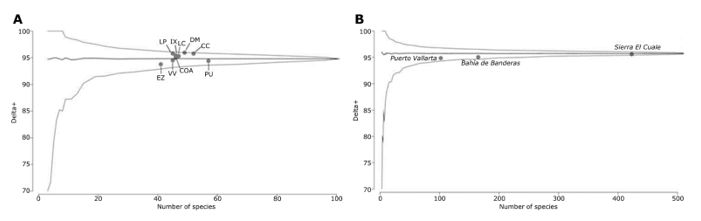
A = Local scale; B = Regional scale. IX = Ixtapa; VV = Verde Vallarta; PU = Paseos Universidad II; LC = Lomas del Calvario; COA = Coapinole; LP = La Playita; CC = Cristóbal Colón; EZ = Emiliano Zapata; DM = Del Mar. The dashed horizontal line represents the expected mean, and the solid line represents the confidence intervals (95 %). The dots represent observed values for each site.
Figure 2. Average taxonomic distinctness of woody and arborescent vegetation at the local and regional scales.
At the regional level, Puerto Vallarta (AvTD=94.85) exhibited the lowest taxonomic distinctness, followed by Bahía de Banderas (AvTD=95.60) and the Sierra El Cuale (AvTD=95.05) (Figure 2B). Emphasized that CC's taxonomic distinctness matched the expected average value, i. e., it contains the region's most representative tree species and taxa, as well as the largest number of species.
Species composition
At the local scale, the NMDS results show similarities in tree species composition across the sites evaluated (Figure 3A). One cluster and two isolated entities are shown at a similarity level of 50 %. The group under study consists of seven sites (LC, IX, CC, VV, PU, LP, COA). This shows that they share some tree species; the DM and EZ sites have different tree compositions.
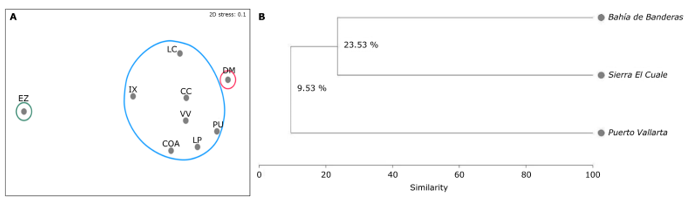
A = Local scale; B = Regional scale. IX = Ixtapa; VV = Verde Vallarta; PU = Paseos Universidad II; LC = Lomas del Calvario; COA = Coapinole; LP = La Playita; CC = Cristóbal Colón; EZ = Emiliano Zapata; DM = Del Mar. The circles represent the groups identified at a 50 % similarity level.
Figure 3. Nonmetric multidimensional scaling (NMDS) analyzing the similarity of tree species in Puerto Vallarta (A) and a cluster analysis of the similarity of tree species in Bahía de Banderas (B).
At the regional level, it was determined that the tree species composition of Puerto Vallarta, Bahía de Banderas, and the Sierra El Cuale differs (Figure 3B). Bahía de Banderas and the Sierra El Cuale exhibit less than 25 % similarity, and Puerto Vallarta shows less than 10 % similarity compared to the other two regions; therefore, its tree species composition is more distinct.
Factors affecting the richness and composition of woody and tree species on streets
The PCoA analysis yielded a cumulative explained variance of 75.4 % across the first two axes (Figure 4). In particular, the results show that the LC, COA, LP, and IX sites are located in the positive values of axis 1, where the variables level of marginalization (0.45), distance to the mountains (0.33), altitude (0.18), and number of blocks (0.19) have the strongest correlation. On the other hand, sites located toward negative values on axis 1 (PU, CC, and DM) showed a stronger correlation than tree species abundances (-0.48), the number of native species (-0.38), exotic species (-0.35), and paved streets (-0.33). On the positive values of axis 2 is the VV site, which is associated with the number of city blocks (0.59), while on the negative values is EZ, where the strongest correlation is with altitude (-0.60).
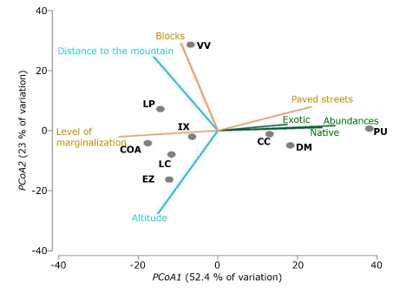
IX = Ixtapa; VV = Verde Vallarta; PU = Paseos Universidad II; LC = Lomas del Calvario; COA = Coapinole; LP = La Playita; CC = Cristóbal Colón; EZ = Emiliano Zapata; DM = Del Mar.
Figure 4. Principal coordinate analysis (PCoA) for the Puerto Vallarta sites and their relationship to biological (green), physical (blue), and socioeconomic (orange) variables.
Discussion
The results show that Puerto Vallarta's streets have significant plant species diversity. The record of 100 species and one infraspecific category of woody and arborescent plants (85 genera and 39 families) in Puerto Vallarta represents a moderately high level of biodiversity, exceeding the record of 67 species in Morelia (Madrigal-Sánchez & Gomez-Peralta, 2007) or the 75 taxa in Puebla (Martínez-Juárez et al., 2022), and are close to the values of cities with humid tropical climates such as Tapachula (130 species; Almeida-Cerino et al., 2024), Tuxtla Gutiérrez (114 species; Román-Guillén et al., 2019), and Xalapa (140 species; Falfán & MacGregor-Fors, 2016).
However, the dominance of exotic species such as T. catappa (467 individuals) and F. benjamina (191) is a recurring phenomenon in studies of urban tree cover in Mexico (Almeida-Cerino et al., 2024; Falfán & MacGregor-Fors, 2016; García Valencia et al., 2025; Román-Guillén et al., 2019). This overrepresentation of a single species explains why the 10-20-30 rule (Almeida-Cerino et al., 2024; Shams et al., 2020) does not fully align with the results of the present study. The preference for exotic or introduced taxa reflects a pattern linked to the limited selection available at commercial nurseries and the scarcity of native regional flora, as well as their rapid growth and ornamental value; however, it often overlooks its negative effects on urban infrastructure, such as the lifting of sidewalks caused by the aggressive roots of species of Ficus (Esquivel & Quijas, 2021; Ramos-Palacios, 2019).
In Puerto Vallarta, a remarkable balance exists, with 54 native species recorded, in contrast to other cities where exotic woody and tree species overwhelmingly predominate, such as Tuxtla Gutiérrez, where 74 % of individuals are introduced (Román-Guillén et al., 2019). The abundance of the native Tabebuia rosea (150) and the presence of edible species such as Artocarpus heterophyllus (111) reflect the integration of the regional flora, as well as its high capacity for propagation and growth under adverse conditions. The local preference for taxa that provide ecosystem services is similar to what has been observed in Amazonian cities, where 52 % are fruit trees (Antunes-Jimenez et al., 2026).
The low compositional similarity between Puerto Vallarta, Bahía de Banderas, and the Sierra El Cuale highlights urban biotic homogenization, in which landscape design favors generalist or commercial species over the local flora of the subdeciduous tropical forest (Falfán & MacGregor-Fors, 2020). Although Puerto Vallarta exhibits the lowest regional taxonomic distinctness, the fact that its blocks fall within the probability funnel indicates that the observed taxonomic diversity is consistent with the expected values for the species richness present.
Areas such as Del Mar and Lomas del Calvario stand out for harboring taxa belonging to a wider variety of supraspecific lineages, suggesting a community structure that is more resilient to pests or environmental changes (Almeida-Cerino et al., 2024). Conversely, the lower distinctiveness of Emiliano Zapata could indicate a saturation of closely related species (such as the widespread use of various Ficus species), which is a factor contributing to phytosanitary vulnerability (Román-Guillén et al., 2019). The Cristóbal Colón area is emerging as a model of representativeness for the city, as it balances species richness with an average distinctness value (94.81).
It has been confirmed that street vegetation is not distributed randomly but is shaped by socioeconomic and biophysical gradients. In particular, the level of marginalization is associated with variations in richness and composition, possibly due to a luxury effect (Hope et al., 2003); although this effect is less pronounced in tropical climates (Leong et al., 2018). In areas such as Paseos Universidad II (PU) and Cristóbal Colón (CC), the stronger correlation with the abundance of trees and native species suggests more active management or better infrastructure conditions—such as paved streets—that facilitate investment in and maintenance of street trees (Martínez-Juárez et al., 2022).
The variables distance to the mountains and altitude at sites such as Lomas del Calvario (LC) and Ixtapa (IX) indicate that proximity to remnants of natural vegetation (subdeciduous tropical forest) influences urban composition, likely through the natural dispersal of seeds or the preservation of plants that existed prior to urbanization (Falfán & MacGregor-Fors, 2020; Ramos-Palacios, 2019). This pattern is consistent with studies that highlight the importance of peri-urban forests as reservoirs of biodiversity for the city (Hernández-Cavazos et al., 2025).
The findings' implications for the city of Puerto Vallarta—part of the Bahía de Banderas region in Nayarit-Jalisco—call for a strategic reorientation of planning and management of its urban green spaces. Given the tourism boom and rapid population growth, a massive loss of native species has been documented due to unplanned urbanization and the destruction of coastal dunes (Gallardo-Arce et al., 2022). It is imperative to transition to a model that prioritizes local biodiversity, one that profits from the ornamental potential of the species recorded in the municipality (Gudiño-Cano et al., 2025) and the bay (Bravo-Bolaños et al., 2016), many of which are endemic or under special protection. Management efforts should focus on replacing invasive exotic species with native regional taxa, such as T. rosea, that ensure connectivity with remnant areas of subdeciduous tropical forest and riparian vegetation (Mora-Santacruz et al., 2006).
The results provide evidence to strengthen the planning and management of urban trees in Puerto Vallarta as they address the city’s specific socio-environmental and infrastructure issues and contexts, such as the indiscriminate use of certain species. In this context, it is important to emphasize the need to increase taxonomic and functional diversity through the selection and strategic placement of regional native species with characteristics similar to those of species that have been overused. Such a strategy would help counteract the decline in taxonomic distinctness and maximize the provision of ecosystem services—such as temperature regulation, pollutant capture, and habitat for biodiversity—which are greater in more structurally and functionally diverse tree communities.
Conclusions
The streets of Puerto Vallarta are home to 100 species and one infraspecific category, 85 genera, and 39 families, with a local taxonomic distinctness consistent with expected values. However, the dominance of exotic species such as Terminalia catappa and Ficus benjamina exceeds the limit set by the 10-20-30 rule, and the compositional similarity with the regional flora (Bahía de Banderas, Sierra El Cuale) is less than 10 %, indicating a process of biotic homogenization. The degree of marginalization and the distance from the mountains are associated with variations in richness and composition across sites. These findings highlight the need to prioritize regional native species in the city's urban tree planning.
Conflict of interest
The authors declare that they have no conflict of interest.
Contributions by author
Jazmin Arechiga: research design, fieldwork, data analysis, creation of figures and tables; Elisa Bueno-Alvarado: research design, fieldwork, data analysis, creation of figures and tables; Tahamara Esquivel: field surveys, data analysis, creation of figures and tables; Karen E. Peña-Joya: data analysis and reporting of results, creation of figures; Sandra Quijas: research design, fieldwork, integration of data, and drafting of the first version of the manuscript. All authors reviewed and approved the final version of the manuscript.
References
Almeida-Cerino, C. M., Bertolini, V., & Martínez-Trinidad, T. (2024). Estructura y diversidad florística en áreas verdes urbanas de la ciudad de Tapachula, Chiapas, México. Revista Mexicana de Ciencias Forestales, 15(83), 131-154. https://doi.org/10.29298/rmcf.v15i83.1457
Antunes-Jimenez, L., Barros-Lobato-Cambraia, T., Baia-Furtado, E., Campelo, W., Meneses-Silvestre de Sousa, S., Freire, L. M., Trujillo, L. R., Pereira-Lima, R. A., & Toledo, J. J. (2026). Patterns of tree species abundance and diversity on urban sidewalks in Macapá, Amapá, Brazil. Ecological Research, 41(2), Article e70059. https://doi.org/10.1111/1440-1703.70059
Bravo-Bolaños, O., Sánchez-González, A., de Nova-Vázquez, J. A., & Pavón-Hernández, N. P. (2016). Composición y estructura arbórea y arbustiva de la vegetación de la zona costera de Bahía de Banderas, Nayarit, México. Botanical Sciences, 94(3), 603-623. https://doi.org/10.17129/botsci.461
Clarke, K. R., & Gorley, R. N. (2015). PRIMER v7: User manual/tutorial. PRIMER-e Learning Hub. https://learninghub.primer-e.com/books/primer-v7-user-manual-tutorial
Clarke, K. R., & Warwick, R. M. (1999). The taxonomic distinctness measure of biodiversity: weighting of step lengths between hierarchical levels. Marine Ecology Progress Series, 184, 21-29. https://doi.org/10.3354/meps184021
Esquivel, T., & Quijas, S. (2021). Daño a la infraestructura (pavimento) causado por el arbolado urbano en Puerto Vallarta, Jalisco. Revista Mexicana de Ciencias Forestales, 12(68), 178-201. https://doi.org/10.29298/rmcf.v12i68.1166
Falfán, I., & MacGregor-Fors, I. (2016). Woody neotropical streetscapes: a case study of tree and shrub species richness and composition in Xalapa. Madera y Bosques, 22(1), 95-110. https://doi.org/10.21829/myb.2016.221479
Falfán, I., & MacGregor-Fors, I. (2020). Mismatching streetscapes: Woody plant composition across a Neotropical city. Urban Ecosystems, 24, 265-274. https://doi.org/10.1007/s11252-020-01033-y
Gallardo-Arce, B. G., Morales-Hernández, J. C., Frausto-Martínez, O., Bravo-Olivas, M. L., & Carrillo-González, F. M. (2022). Cambio de cobertura vegetal y uso de suelo generado por actividades agrícolas en el municipio de Bahía de Banderas, Nayarit, México. Acta Universitaria, 32, 1-18. https://doi.org/10.15174/au.2022.3618
Galle, N. J., Halpern, D., Nitoslawski, S., Duarte, F., Ratti, C., & Pilla, F. (2021). Mapping the diversity of street tree inventories across eight cities internationally using open data. Urban Forestry & Urban Greening, 61, Article 127099. https://doi.org/10.1016/j.ufug.2021.127099
García-Valencia, A., Sánchez-Sánchez, O., Ramírez-Soto, A., & Ramos-Palacios, C. R. (2025). Diagnóstico y servicios ecosistémicos del arbolado de alineación en Xalapa, Veracruz, México. Polibotánica, (59), 159-180. https://doi.org/10.18387/polibotanica.59.10
Gower, J. C. (1971). A general coefficient of similarity and some of its properties. Biometrics, 27, 857-871. https://doi.org/10.2307/2528823
Gudiño-Cano, A. K., De-Nova, J. A., Ortiz, E., Vargas-Ponce, O., Carrillo-Reyes, P., Munguía-Lino, G., Villaseñor, J. L., & Ruiz-Sánchez, E. (2025). Inventario de la flora vascular de Jalisco, México. Botanical Sciences, 103(1), 176-206. https://doi.org/10.17129/botsci.3499
Hernández-Cavazos, M. C., Alanís-Rodríguez, E., Molina-Guerra, V. M., Jiménez-Pérez, J., Aguirre-Calderón, O. A., & Cuellar, L. G. (2025). Tendencias en la investigación de bosques urbanos de México: Una revisión de la literatura. E-CUCBA, 12(26), 1-10. https://doi.org/10.32870/e-cucba.vi26.395
Hope, D., Gries, C., Zhu, W., Fagan, W. F., Redman, C. L., Grimm, N. B., Nelson, A. L., Martin, C., & Kinzig, A. (2003). Socioeconomics drive urban plant diversity. Proceedings of the National Academy of Sciences, 100(15), 8788-8792. https://doi.org/10.1073/pnas.1537557100
Instituto de Información Estadística y Geográfica de Jalisco. (2026). Puerto Vallarta Cuadernillo municipal. Agosto 2026 [Libro blanco]. Gobierno del Estado de Jalisco. https://iieg.jalisco.gob.mx/acervo/portal/cuadernillos/2026/67_puerto_vallarta_cuadernillo_municipal_2026.pdf
Jiang, Y., Liu, D., Ren, L., Grekousis, G., & Lu, Y. (2024). Tree abundance, species richness, or species mix? Exploring the relationship between features of urban street trees and pedestrian volume in Jinan, China. Urban Forestry & Urban Greening, 95, Article 128294. https://doi.org/10.1016/j.ufug.2024.128294
Leong, M., Dunn, R. R., & Trautwein, M. D. (2018). Biodiversity and socioeconomics in the city: a review of the luxury effect. Biology Letters, 14(5), Article 20180082. https://doi.org/10.1098/rsbl.2018.0082
Liu, D., Lu, Y., & Jiang, Y. (2026). Exploring the environmental justice of street tree provision: Adding biodiversity to automatic assessment of street-level greenery. Urban Forestry & Urban Greening, 115, Article 129184. https://doi.org/10.1016/j.ufug.2025.129184
Madrigal-Sánchez, X., & Gómez-Peralta, M. (2007). Árboles de las áreas urbanas y suburbanas de Morelia, Michoacán, México. Biológicas, 9, 12-22.
Martínez-Juárez, G., Rodríguez-Trejo, D. A., Granados-Sánchez, D., Mohedano-Caballero, L., & Villanueva-Morales, A. (2022). Descripción del arbolado de alineación de la ciudad de Puebla por grado de marginación y vialidad. Revista Mexicana de Ciencias Forestales, 13(70), 85-111. https://doi.org/10.29298/rmcf.v13i70.830
Mora-Santacruz, A., Valdez-Hernández, J. I., Ángeles-Pérez, G., Musálem-Santiago, M. A., & Vaquera-Huerta, H. (2006). Establecimiento y desarrollo de plántulas de Tabebuia rosea (Bignoniaceae) en una selva subcaducifolia manejada de la costa Pacífica de México. Revista de Biología Tropical, 54(4), 1215-1225. https://doi.org/10.15517/rbt.v54i4.3099
Moreno, C. E. (2001). Métodos para medir la biodiversidad. Programa Iberoamericano de Ciencia y Tecnología para el Desarrollo, Oficina Regional de Ciencia y Tecnología para América Latina y el Caribe, UNESCO, y Sociedad Entomológica Aragonesa. https://www.researchgate.net/publication/304346666_Metodos_para_medir_la_biodiversidad
Moreno, C. E., Castillo-Campos, G., & Verdú, J. R. (2009). Taxonomic diversity as complementary information to assess plant species diversity in secondary vegetation and primary tropical deciduous forest. Journal of Vegetation Science, 20(5), 935-943. https://doi.org/10.1111/j.1654-1103.2009.01094.x
Pérez-Hernández, C. X. (2019). Distintividad taxonómica: Evaluación de la diversidad en la estructura taxonómica en los ensambles. En C. E. Moreno (Ed.), La biodiversidad en un mundo cambiante: Fundamentos teóricos y metodológicos para su estudio(pp. 285-306). Universidad Autónoma del Estado de Hidalgo. https://www.researchgate.net/publication/339150175_Distintividad_taxonomica_Evaluacion_de_la_diversidad_en_la_estructura_taxonomica_en_los_ensambles
Ramos-Palacios, C. R. (2019). Guía del arbolado y otras formas vegetales en situación de banqueta. Ciudad de San Luis Potosí (1ra ed.). Universidad Autónoma de San Luis Potosí, Secretaría de Ecología y Gestión Ambiental. https://ambiental.uaslp.mx/storage/imagenes/introduccion/Guiadelarbolado_y_otrasformasvegetales.pdf
Román-Guillén, L. M., Orantes-García, C., del Carpio-Penagos, C. U., Sánchez-Cortés, M. S., Ballinas-Aquino, M. L., & Farrera Sarmiento, Ó. (2019). Diagnóstico del arbolado de alineación de la ciudad de Tuxtla Gutiérrez, Chiapas. Madera y Bosques, 25(1), Artículo e2511559. https://doi.org/10.21829/myb.2019.2511559
Royal Botanic Gardens Kew. (2025). Plants of the World Online [Database]. Royal Botanic Gardens Kew. https://powo.science.kew.org/
Secretaría de Medio Ambiente y Desarrollo Territorial. (2016). Estudio Técnico Justificativo para el establecimiento del Área Estatal de Protección Hidrológica Sierra “El Cuale” Jalisco [Libro blanco]. Secretaría de Medio Ambiente y Desarrollo Territorial. https://siga.jalisco.gob.mx/comunicacionsemadet/SIERRACUALE.pdf
Shams, Z. I., Shahid, M., Nadeem, Z., Naz, S., Raheel, D., Aftab, D., Fraz, T. R., & Roomi, M. S. (2020). Town socio-economic status and road width determine street tree density and diversity in Karachi, Pakistan. Urban Forestry & Urban Greening, 47, Article 126473. https://doi.org/10.1016/j.ufug.2019.126473
Zong, H., Yao, M., Tang, Y., & Chen, H. (2020). Assessing the composition, diversity, and allergenic risk of street trees in Qingyang District of Chengdu City. Urban Forestry & Urban Greening, 54, Article 126747. https://doi.org/10.1016/j.ufug.2020.126747
Todos los textos publicados por la Revista Mexicana de Ciencias Forestales –sin excepción– se distribuyen amparados bajo la licencia Creative Commons 4.0 Atribución-No Comercial (CC BY-NC 4.0 Internacional), que permite a terceros utilizar lo publicado siempre que mencionen la autoría del trabajo y a la primera publicación en esta revista.