Revista Mexicana de Ciencias Forestales Vol. 17 (97)
Septiembre - Octubre (2026)
DOI: https://doi.org/10.29298/rmcf.v17i98.1687 Research article
Influence of park size on the structure and diversity of urban trees in the city of Monterrey, Nuevo León, Mexico Influencia del tamaño del parque sobre la estructura y diversidad del arbolado urbano en Monterrey, Nuevo León, México
Homero Gárate-Escamilla1, Melvin Isac De La Rosa-Estrada1, Aldo Tovar-Cárdenas1*, José Israel Yerena-Yamallel1, Pablo Marroquín-Morales2 |
Fecha de recepción/Reception date: 8 de mayo de 2026.
Fecha de aceptación/Acceptance date: 21 de julio de 2026.
_______________________________
1Universidad Autónoma de Nuevo León, Facultad de Ciencias Forestales. México.
2Universidad Autónoma de Chiapas, Facultad de Ciencias Agrícolas. México.
*Autor para correspondencia; correo-e: aldo_tc11@hotmail.com
*Corresponding author; e-mail: aldo_tc11@hotmail.com
Abstract
Urban trees provide important ecosystem services in cities; however, their structure and diversity may be influenced more by management practices than by natural ecological processes. The objective of this study was to evaluate the structure, diversity, and dominance of urban trees in parks of different sizes in Monterrey, Mexico, and to assess the influence of park size. Nine urban parks were classified into three size categories: small, medium, and large. Circular plots representing 10 % of the area of each park were established. Structural variables were recorded, and the Margalef, Shannon-Wiener, Simpson's complement, and Importance Value Index (IVI) were calculated. Differences among park size categories were analyzed using the Kruskal-Wallis test. A total of 243 tree individuals were recorded. No statistically significant differences were detected among park size categories for most of the variables evaluated, including species richness, number of families, and diversity indexes. Tree density was the only variable that differed significantly, with higher values in small parks. The IVI analysis revealed the dominance of a small number of species, particularly Fraxinus americana and Quercus virginiana. Results suggest that, in the parks evaluated, management practices and species selection may exert a greater influence than park size on the structure of the urban tree community.
Keywords: Ecological dominance, urban ecology, Importance Value Index, green infrastructure, urban management, species selection.
Resumen
El arbolado urbano aporta servicios ecosistémicos relevantes en las ciudades; sin embargo, su estructura y diversidad pueden estar condicionadas más por el manejo que por procesos ecológicos naturales. El objetivo de este estudio fue evaluar la estructura, diversidad y dominancia del arbolado urbano en parques de distinto tamaño en Monterrey, México, además de determinar la influencia del tamaño del parque. Se evaluaron nueve parques urbanos clasificados en tres categorías de tamaño: pequeños, medianos y grandes. En cada uno se establecieron parcelas circulares que representaron 10 % de su superficie. Se registraron variables estructurales y se calcularon los índices de Margalef, Shannon-Wiener, complemento de Simpson e Índice de Valor de Importancia (IVI). Las diferencias entre categorías se analizaron mediante la prueba de Kruskal-Wallis. Se registraron 243 individuos arbóreos. No se detectaron diferencias significativas entre las categorías de tamaño de los parques en la mayoría de las variables evaluadas, incluyendo riqueza de especies, número de familias e índices de diversidad. La densidad de individuos fue la única variable con diferencias significativas, y valores más altos en parques pequeños. El análisis del IVI evidenció la dominancia de un número reducido de especies, particularmente Fraxinus americana y Quercus virginiana. Los resultados sugieren que, en los parques evaluados, las prácticas de manejo y la selección de especies tienen mayor influencia sobre la estructura del arbolado urbano que el tamaño del parque.
Palabras clave: Dominancia ecológica, ecología urbana, Índice de Valor de Importancia, infraestructura verde, manejo urbano, selección de especies.
Introduction
Urban growth has transformed natural ecosystems, giving rise to urban environments where vegetation establishes itself under conditions modified by human activity (Grimm et al., 2008). In this context, urban parks represent key spaces within green infrastructure, fulfilling ecological, social, and landscape functions while contributing to microclimate regulation, carbon sequestration, and human well-being (Nowak et al., 2013; Tzoulas et al., 2007).
Unlike natural ecosystems, where the composition and diversity of plant communities are determined by ecological processes such as dispersal, competition, and environmental conditions, urban systems are characterized by a strong influence of anthropogenic management (Anderson et al., 2023; Aronson et al., 2016). Species selection, reforestation programs, and maintenance practices directly influence urban tree structure, generating patterns distinct from those observed in natural environments (Alanís-Rodríguez et al., 2023; Sjöman et al., 2018).
In this regard, although the species-area relationship establishes that larger areas tend to harbor greater species richness (Drakare et al., 2006), this pattern may be weakened in urban environments due to the dominance of design and management decisions (Chang et al., 2021; Kowarik, 2011). Consequently, parks of varying sizes may exhibit similar diversity values, as they are subject to homogeneous tree-planting criteria (Aronson et al., 2016).
Various studies have documented that urban systems are often characterized by the recurring presence of a limited set of tree species across different green spaces (McKinney, 2006; Williams et al., 2009; Yang et al., 2023). This pattern is associated with the frequent use of ornamental species, their availability in nurseries, and the implementation of standardized management practices—factors that can influence the structure and diversity of urban tree populations, regardless of park size (Kendal et al., 2012).
In Monterrey and its metropolitan area, urban parks represent significant spaces for green infrastructure and the urban environment. The tree populations in these green spaces consist of both native and introduced species; however, recent tree-planting programs have increased the use of native species (Alanís-Rodríguez et al., 2023). Despite this, knowledge regarding the structure and diversity of trees in these spaces remains limited. In particular, it has not been clearly assessed whether park size influences urban tree structure and diversity, or if these attributes respond primarily to management practices, as has been described in other urban contexts (Beninde et al., 2015; Chang et al., 2021). Determining the influence of park size on these attributes will provide useful information for the planning, design, and management of urban green spaces, thereby contributing to the establishment of tree-planting strategies aimed at promoting more diverse and functional tree communities. Therefore, this study aimed to evaluate the influence of park size on the structure and diversity of urban trees in Monterrey's parks. The hypothesis proposed was that larger parks would exhibit greater tree diversity than smaller parks, consistent with the species-area relationship described for plant communities.
Materials and Methods
Study area
This study was conducted in urban parks within Monterrey municipality, Nuevo León, Mexico, located in Northeastern Mexico at approximately 537 masl. The municipality is part of the Monterrey metropolitan area and it has high urban density and a network of green spaces distributed across several sectors of the city (Alanís-Rodríguez et al., 2023; Instituto Nacional de Estadística y Geografía [Inegi], 2020).
Site selection and sampling
Field sampling was carried out in June 2024, at the end of spring and prior to the onset of the region's canícula (mid-summer heatwave) period. Nine urban parks in Monterrey municipality were evaluated; they were purposively selected to represent the variability in size and spatial distribution of the city's green spaces (Figure 1). Selection criteria included accessibility, public use, the presence of established trees, and location across different urban sectors (Alanís-Rodríguez et al., 2023).
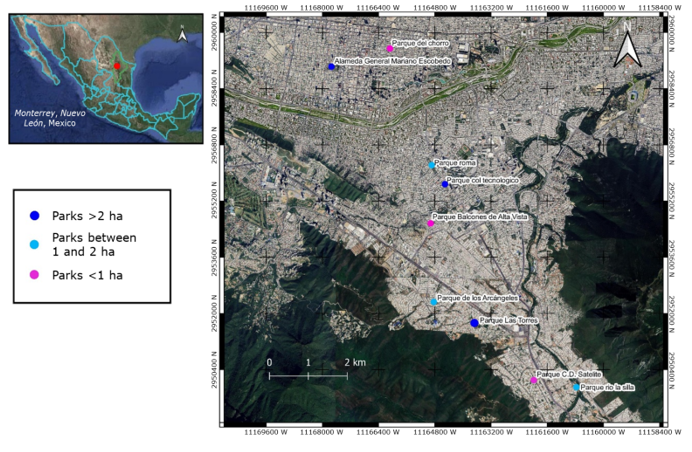
Parque del Chorro = Parque del Chorro; Alameda General Mariano Escobedo = Parque Alameda; Parque Roma = Parque Roma; Parque Col. Tecnológico = Parque Col. Tecnológico; Parque Balcones de Altavista = Parque Balcones de Altavista; Parque de los Arcángeles = Parque Arcángeles; Parque Las Torres = Parque Col. Las Torres; Parque C. D. Satélite = Parque CD Satélite; Parque río la silla = Parque Río La Silla.
Figure 1. Location of the urban parks evaluated in Monterrey municipality, Nuevo León, Mexico.
Size classification was based on the surface area of the urban parks, as delineated using Inegi (2020) mapping data. The parks were grouped into three categories—small (0.5-1.0 ha), medium (1.0-2.0 ha), and large (>2.0 ha), based on the recorded distribution of surface areas. Three parks were included in each category, resulting in a total of nine sites (Figure 2). Three circular plots were established in each park, with their combined surface area representing exactly 10 % of the total park area. The sampling intensity (10 % of the surface area) was identical for all parks to standardize sampling effort across size categories and enable comparisons of tree structure and diversity based on a criterion proportional to the area evaluated. Plot radii varied and were adjusted according to the size of each park to keep a constant sampling intensity equivalent to 10 % of its surface area. This adjustment was made solely to account for differences in park size, ensuring a proportional sampling effort across all evaluated categories. Plots were randomly distributed within each park by generating random points using QGIS software version 3.18.3 (QGIS Development Team, 2021). Subsequently, each point served as the center of a circular plot, ensuring the plot remained entirely within the park boundaries.
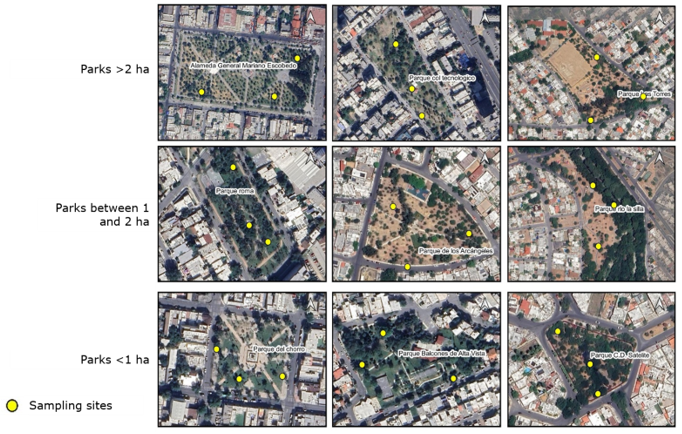
Parque del Chorro = Parque del Chorro; Alameda General Mariano Escobedo = Parque Alameda; Parque Roma = Parque Roma; Parque Col. Tecnológico = Parque Col. Tecnológico; Parque Balcones de Altavista = Parque Balcones de Altavista; Parque de los Arcángeles = Parque Arcángeles; Parque Las Torres = Parque Col. Las Torres; Parque C. D. Satélite = Parque CD Satélite; Parque río la silla = Parque Río La Silla.
Figure 2. Urban parks evaluated in Monterrey municipality, Nuevo León, Mexico.
Mensuration variables and tree recording
All individual trees within the sampling plots with a diameter at breast height (DBH) of 5 cm or greater were recorded. For each individual, DBH was measured at 1.30 m above ground level using forestry calipers (model Mantax Blue Haglöf®) (Avery & Burkhart, 2002). Total height was estimated using indirect methods with a clinometer (model PM-5 Suunto®), and crown diameter was measured in two perpendicular directions—North-South (N-S) and East-West (E-W)—using a tape measure (model 12639 Truper®, 30 m) to calculate the mean crown diameter (the average of the two measurements) and subsequently estimate crown cover (Pretzsch, 2009).
Taxonomic identification was carried out at the species level using specialized literature and regional botanical keys (Rzedowski, 2006). Additionally, the number of individuals per species was recorded to analyze the composition, structure, and diversity of the urban tree population.
Tree population structure
To evaluate the ecological contribution of each species within the urban tree population, relative abundance (Ra), relative dominance (Rd), relative frequency (Rf), and the Importance Value Index (IVI) were calculated following the methodology proposed by Alanís-Rodríguez et al. (2022). The IVI was obtained by summing Ra, Rd and Rf and dividing the result by three, in order to standardize the values on a scale of 0 to 100 and facilitate interpretation. This index made it possible to identify the species with the greatest ecological relevance within each park.
Diversity indexes
Urban tree diversity was assessed independently for each park using species richness (S) and the Margalef (DMg), Shannon-Wiener (H′), and Simpson’s complement (1-D) indexes—metrics widely used to describe biological diversity in plant communities (Magurran, 2004; Moreno, 2001). Species richness (S) corresponded to the total number of species recorded in each park. Subsequently, the values obtained for each park were used to compare diversity across size categories.
Statistical analysis
To evaluate differences in urban tree structure, diversity, and dominance among small, medium, and large parks, the non-parametric Kruskal-Wallis test was applied, given the small sample size per group and the lack of data normality. The structural variables analyzed were the number of individuals, number of species, number of families, and density (individual ha-1), while the Margalef, Shannon-Wiener and Simpson’s complement indexes were used to assess diversity. In addition, dominance metrics derived from the Importance Value Index (IVI) were evaluated, including the maximum IVI per park, the number of dominant species (IVIr>10 %), and the cumulative proportion of the IVI corresponding to the three species with the highest values in each park. Analyses were performed using PAST software version 4 (Hammer et al., 2001), with a significance level of α=0.05.
Results
A total of 243 individual trees were recorded across nine urban parks in Monterrey municipality. The number of individuals per park ranged from 13 to 49, while species richness varied between 2 and 15; generally, both species richness and the number of families were higher in the larger parks, notably the Parque Alameda, which featured 15 species and 12 families. In contrast, some small and medium-sized parks showed lower richness, particularly Parque Roma, where only two species and two families were recorded. Tree density varied across sites, with higher values in small parks and lower values in large parks (Table 1).
Table 1. Structural characterization of urban trees in parks in Monterrey, Nuevo León, Mexico.
Park |
Size |
Area (ha) |
I |
E |
F |
Den |
Balcones de Altavista |
Small |
0.56 |
18 |
6 |
4 |
32.1 |
del Chorro |
0.65 |
13 |
5 |
4 |
20.0 |
|
CD Satélite |
0.63 |
21 |
3 |
2 |
33.3 |
|
Roma |
Medium |
1.14 |
21 |
2 |
2 |
18.4 |
Arcángeles |
1.17 |
32 |
7 |
5 |
27.4 |
|
Río La Silla |
1.78 |
30 |
7 |
6 |
16.9 |
|
Col. Tecnológico |
Large |
2.50 |
27 |
5 |
3 |
10.8 |
Col. Las Torres |
2.83 |
32 |
11 |
7 |
11.3 |
|
Alameda |
6.41 |
49 |
15 |
12 |
7.6 |
I = Individuals; E = Species; F = Families; Den = Density (ind ha-1).
The IVI analysis revealed a marked dominance of certain species within the assessed urban tree population. In small parks, Fraxinus americana L. and Quercus virginiana Mill. exhibited the highest IVI values; F. americana was particularly prominent in Parque CD Satélite, with a IVIr of 77.2 %. In a similar way, this species also showed high dominance in Parque El Chorro, alongside Quercus polymorpha Schltdl. & Cham. and Eucalyptus globulus Labill. (Table 2).
Table 2. Population variables for species recorded in small parks in Monterrey, Nuevo León, Mexico.
Park |
Species |
Ni |
Ra (%) |
Rd (%) |
Rf (%) |
IVIr (%) |
Balcones de Alta vista |
Fraxinus americana L. |
7 |
38.9 |
44.8 |
22.2 |
35.3 |
Quercus virginiana Mill. |
7 |
38.9 |
30 |
33.3 |
34.1 |
|
Neltuma laevigata (Humb. & Bonpl. ex Willd.) M. C. Johnst |
1 |
5.6 |
12.6 |
11.1 |
9.8 |
|
Pinus halepensis Mill. |
1 |
5.6 |
5.1 |
11.1 |
7.2 |
|
Ebenopsis ebano (Berland.) Barneby & J. W. Grimes |
1 |
5.6 |
4.8 |
11.1 |
7.2 |
|
Lagerstroemia indica L. |
1 |
5.6 |
2.7 |
11.1 |
6.4 |
|
CD Satélite |
Fraxinus americana L. |
18 |
85.7 |
85.8 |
60 |
77.2 |
Ebenopsis ebano (Berland.) Barneby & J. W. Grimes |
2 |
9.5 |
10 |
20 |
13.2 |
|
Erythrostemon mexicanus (A. Gray) Gagnon & G. P. Lewis |
1 |
4.8 |
4.2 |
20 |
9.7 |
|
del Chorro |
Fraxinus americana L. |
6 |
46.2 |
22.7 |
28.6 |
32.5 |
Quercus polymorpha Schltdl. & Cham. |
3 |
23.1 |
30 |
28.6 |
27.2 |
|
Eucalyptus globulus Labill. |
1 |
7.7 |
32 |
14.3 |
18 |
|
Koelreuteria elegans (Seem.) A. C. Sm. |
2 |
15.4 |
14.6 |
14.3 |
14.8 |
|
Quercus virginiana Mill. |
1 |
7.7 |
0.7 |
14.3 |
7.6 |
Ni = Number of individuals; Ra = Relative abundance; Rd = Relative dominance; Rf = Relative frequency; IVIr = Relative Importance Value Index.
A similar trend was observed in medium-sized parks, with strong Rd of Fraxinus americana in Parque Roma (IVIr=81.4 %). In other parks, such as Río La Silla and Arcángeles, although dominance was distributed among several species, F. americana, Taxodium mucronatum Ten., and Neltuma laevigata (Humb. & Bonpl. ex Willd.) M. C. Johnst maintained high IVI values, indicating their structural importance within these sites (Table 3).
Table 3. Population variables for species recorded in medium size parks in Monterrey, Nuevo León, Mexico.
Park |
Species |
Ni |
Ra (%) |
Rd (%) |
Rf (%) |
IVIr (%) |
Arcángeles |
Eucalyptus globulus Labill. |
7 |
21.9 |
46.7 |
14.3 |
27.6 |
Quercus virginiana Mill. |
8 |
25 |
16.4 |
21.4 |
20.9 |
|
Neltuma laevigata (Humb. & Bonpl. ex Willd.) M. C. Johnst |
8 |
25 |
17 |
14.3 |
18.8 |
|
Fraxinus americana L. |
4 |
12.5 |
9.5 |
21.4 |
14.5 |
|
Celtis laevigata Willd. |
2 |
6.3 |
4.6 |
14.3 |
8.4 |
|
Parkinsonia aculeata L. |
2 |
6.3 |
5.2 |
7.1 |
6.2 |
|
Ebenopsis ebano (Berland.) Barneby & J. W. Grimes |
1 |
3.1 |
0.6 |
7.1 |
3.6 |
|
Río La Silla |
Fraxinus americana L. |
8 |
26.7 |
30.8 |
18.2 |
25.2 |
Taxodium mucronatum Ten. |
3 |
10 |
33.5 |
18.2 |
20.6 |
|
Ehretia anacua (Terán & Berland.) I. M. Johnst. |
6 |
20 |
8.8 |
18.2 |
15.7 |
|
Platanus occidentalis L. |
6 |
20 |
14.1 |
9.1 |
14.4 |
|
Celtis laevigata Willd. |
4 |
13.3 |
8.9 |
18.2 |
13.5 |
|
Salix humboldtiana Willd. |
2 |
6.7 |
3.1 |
9.1 |
6.3 |
|
Leucaena leucocephala (Lam.) de Wit |
1 |
3.3 |
0.7 |
9.1 |
4.4 |
|
Roma |
Fraxinus americana L. |
19 |
90.5 |
93.6 |
60 |
81.4 |
Quercus virginiana Mill. |
2 |
9.5 |
6.4 |
40 |
18.6 |
Ni = Number of individuals; Ra = Relative abundance; Rd = Relative dominance; Rf = Relative frequency; IVIr = Relative Importance Value Index.
In large parks, dominance was also concentrated among a small number of species. F. americana remained one of the most important species, particularly in Tecnológico and Las Torres parks. Likewise, Quercus virginiana stood out in Parque Alameda, alongside other species such as Washingtonia robusta H. Wendl. Despite the greater species richness in these parks, IVI values reveal that the tree structure is dominated by a few species with high abundance and cover (Table 4).
Table 4. Population variables of species recorded in large parks in Monterrey, Nuevo León, Mexico.
Park |
Species |
Ni |
Ra (%) |
Rd (%) |
Rf (%) |
IVIr (%) |
Alameda |
Quercus virginiana Mill. |
18 |
36.7 |
39.2 |
19.5 |
31.7 |
Fraxinus americana L. |
14 |
28.6 |
27.6 |
14.3 |
23.5 |
|
Washingtonia robusta H. Wendl. |
4 |
8.2 |
16.7 |
9.5 |
11.5 |
|
Morus celtidifolia Kunth |
2 |
4.1 |
3.6 |
9.5 |
5.7 |
|
Celtis laevigata Willd. |
2 |
4.1 |
4.4 |
4.8 |
4.4 |
|
Populus tremuloides Michx. |
1 |
2 |
3.4 |
4.8 |
3.4 |
|
Platanus occidentalis L. |
1 |
2 |
1.6 |
4.8 |
2.8 |
|
Diospyros palmeri Eastw. |
1 |
2 |
0.9 |
4.8 |
2.6 |
|
Koelreuteria elegans (Seem.) A. C. Sm. |
1 |
2 |
0.9 |
4.8 |
2.6 |
|
Juniperus deppeana Steud. |
1 |
2 |
0.5 |
4.8 |
2.4 |
|
Taxodium mucronatum Ten. |
1 |
2 |
0.4 |
4.8 |
2.4 |
|
Washingtonia filifera (Gloner ex Kerch., Burv., Pynaert, Rodigas & Hull) de Bary |
1 |
2 |
0.4 |
4.8 |
2.4 |
|
Yucca filifera Chabaud |
1 |
2 |
0.2 |
4.8 |
2.3 |
|
Ehretia anacua (Terán & Berland.) I. M. Johnst. |
1 |
2 |
0.2 |
4.8 |
2.3 |
|
Las Torres |
Fraxinus americana L. |
14 |
43.8 |
37.1 |
21.4 |
34.1 |
Eucalyptus globulus Labill. |
5 |
15.6 |
30.2 |
7.1 |
17.7 |
|
Populus tremuloides Michx. |
3 |
9.4 |
12.3 |
14.3 |
12 |
|
Neltuma laevigata (Humb. & Bonpl. ex Willd.) M. C. Johnst |
1 |
3.1 |
9.3 |
7.1 |
6.5 |
|
Quercus virginiana Mill. |
2 |
6.3 |
3.7 |
7.1 |
5.7 |
|
Ehretia anacua (Terán & Berland.) I. M. Johnst |
2 |
6.3 |
2.5 |
7.1 |
5.3 |
|
Vachellia farnesiana (L.) Wight & Arn. |
1 |
3.1 |
1.9 |
7.1 |
4.1 |
|
Neltuma glandulosa (Torr.) Britton & Rose |
1 |
3.1 |
1.8 |
7.1 |
4 |
|
Syagrus romanzoffiana (Cham.) Glassman |
1 |
3.1 |
0.7 |
7.1 |
3.6 |
|
Citrus×limon (L.) Osbeck |
1 |
3.1 |
0.4 |
7.1 |
3.6 |
|
Ligustrum japonicum Thunb. |
1 |
3.1 |
0.1 |
7.1 |
3.5 |
|
Tecnológico |
Fraxinus americana L. |
23 |
85.2 |
83.3 |
33.3 |
67.3 |
Neltuma laevigata (Humb. & Bonpl. ex Willd.) M. C. Johnst |
1 |
3.7 |
8.1 |
16.7 |
9.5 |
|
Leucaena leucocephala (Lam.) de Wit |
1 |
3.7 |
5 |
16.7 |
8.5 |
|
Parkinsonia aculeata L. |
1 |
3.7 |
3.6 |
16.7 |
8 |
|
Ehretia anacua (Terán & Berland.) I. M. Johnst |
1 |
3.7 |
0 |
16.7 |
6.8 |
Ni = Number of individuals; Ra = Relative abundance; Rd = Relative dominance; Rf = Relative frequency; IVIr = Relative Importance Value Index.
Diversity indexes varied among the evaluated parks, with no statistically significant differences found between park size categories. The Margalef index ranged from 0.33 to 3.60, with the highest values in Parque Alameda, while the Shannon-Wiener index ranged from 0.31 to 1.94, indicating variation in tree diversity across the evaluated parks. The Simpson complement ranged from 0.17 to 0.82, highlighting differences in species dominance among parks. Overall, the analysis detected no statistically significant differences in diversity indexes between park size categories (Table 5).
Table 5. Urban tree diversity in Monterrey parks based on size.
Size |
Site |
Margalef index |
Simpson index |
Shannon-Weiner index |
Small |
Balcones |
1.73 |
0.69 |
1.38 |
del Chorro |
1.56 |
0.70 |
1.38 |
|
Satélite |
0.66 |
0.25 |
0.50 |
|
Medium |
Roma |
0.33 |
0.17 |
0.31 |
Río la Silla |
1.76 |
0.82 |
1.79 |
|
Arcángeles |
1.73 |
0.80 |
1.74 |
|
Large |
Alameda |
3.60 |
0.78 |
1.94 |
Tecnológico |
1.21 |
0.27 |
0.62 |
|
Las Torres |
2.89 |
0.80 |
1.87 |
The Kruskal-Wallis test indicated that individual density (ind ha-1) was the only variable showing significant differences among park size categories. In a descriptive way, the highest density values were observed in small parks, whereas the lowest corresponded to large parks (Table 1 and 6). In contrast, no significant differences were detected regarding the number of individuals, number of species, number of families, or diversity indexes among the size categories evaluated. In a similar way, dominance metrics derived from the IVI showed no significant differences in maximum IVI per park, the number of dominant species, or the cumulative IVI proportion of leading species; this demonstrates that no statistically significant differences in dominance metrics were detected among the size categories evaluated (Table 6).
Table 6. Comparison of structural variables, diversity indexes, and dominance metrics of urban trees across park size categories in Monterrey, Nuevo León, Mexico.
Variable |
Stadístic (H) |
P-value |
Number of individuals |
1.87 |
0.392 |
Number of species |
2.67 |
0.263 |
Number of families |
2.40 |
0.301 |
Density (ind ha-1) |
6.22 |
0.045* |
Margalef index |
2.00 |
0.368 |
Simpson index (1-D) |
0.89 |
0.641 |
Shannon-Wiener index |
1.56 |
0.459 |
Maximum IVI per park |
0.80 |
0.670 |
Number of dominant species (IVIr>10 %) |
2.27 |
0.322 |
Cumulative IVI of the three main species |
1.69 |
0.430 |
*Indicates significant differences (p<0.05)
Discussion
In this study, no significant differences were detected in the structure, diversity, or dominance of urban trees among parks of varying sizes in Monterrey. These results suggest that, in the evaluated parks, tree organization may be more closely linked to management practices and species selection than to the ecological processes traditionally associated with area size (Anderson et al., 2023; Aronson et al., 2016; Kowarik, 2011). This pattern has also been documented in studies conducted in Mexico, where urban tree structure responds primarily to management decisions and species selection rather than to environmental or spatial factors (Alanís-Rodríguez et al., 2023; Canizales-Velázquez et al., 2021).
In ecology, one of the most widely investigated patterns is the species-area relationship, which posits that a larger surface area results in greater species richness and diversity due to increased environmental heterogeneity and niche availability (Drakare et al., 2006). However, this study found no clear relationship between park size and tree species diversity, a finding consistent with reports by Chang et al. (2021).
These results, based on the parks evaluated in this study, suggest that management practices and species selection may exert a greater influence on tree community structure than area size does. In these systems, vegetation composition depends not only on ecological processes such as dispersal or competition but also on design decisions, species selection, and management practices (Kowarik, 2011). Consequently, parks of different sizes may exhibit similar diversity values when subject to uniform tree-planting criteria. This decoupling between area and diversity has been documented in urban studies, where anthropogenic factors can override the influence of spatial gradients on the structuring of plant communities (Aronson et al., 2016; Beninde et al., 2015).
Similar results have been reported for Mexico, where urban tree diversity shows no consistent relationship with green space size, owing to the prevalence of management practices and species selection (Jara-Toto et al., 2023; Saavedra-Romero et al., 2019). The results obtained pertain to the set of parks evaluated and provide a foundation for future studies incorporating a larger number of sites and complementary analytical approaches.
The dominance patterns observed in this study revealed that a small number of species—particularly Fraxinus americana and Quercus virginiana—accounted for the highest Importance Value Index (IVI) scores across the evaluated parks. This result reflects communities in which a few species contribute a large proportion of the urban tree population's abundance, cover, and frequency. The predominance of a limited set of species has been documented in various studies on urban ecosystems and linked to recurrent species selection and urban tree management practices (Aronson et al., 2016; Kendal et al., 2012; Yang et al., 2023).
In Mexico, studies conducted in various cities have reported similar trends regarding the structural simplification of urban tree populations (Jara-Toto et al., 2023; Saavedra-Romero et al., 2019). At a regional level, research in the country's Northeast has also documented the predominance of a few species associated with management and selection practices (Alanís-Rodríguez et al., 2022; Leal Elizondo et al., 2018). This process is linked to species availability in nurseries, the preference for ornamental species, and the implementation of standardized tree-planting schemes, which lead to similar urban tree configurations despite environmental differences between sites (Kendal et al., 2012).
The concentration of the Importance Value Index (IVI) in a small number of species also has implications for the ecological functioning of urban tree populations (Atchadé et al., 2023). Communities dominated by few species exhibit lower evenness in abundance distribution—a condition that can reduce resilience to biotic and abiotic disturbances due to reliance on a limited set of species (Sjöman et al., 2018, 2024). Diversifying tree composition is a widely recommended strategy for enhancing the ecological stability of urban green spaces and mitigating risks associated with pests, diseases, or extreme weather events (Sjöman et al., 2018). The results of this study align with findings from various Mexican cities, where the concentration of the IVI in a few species is a recurring characteristic of urban tree populations (Alanís-Rodríguez et al., 2022; Jara-Toto et al., 2023; Leal Elizondo et al., 2018; Saavedra-Romero et al., 2019).
Although species diversity did not show significant differences across size categories, the IVI analysis revealed dominance patterns that are not detectable through traditional diversity indexes alone (Osako et al., 2022). The concentration of abundance, dominance, and frequency within a small number of species indicates an uneven distribution of ecological importance among urban trees, thereby complementing the information provided by diversity indexes. This aligns with studies highlighting that taxonomic diversity and structural indicators provide complementary information for characterizing plant community organization in urban environments (Magurran, 2004; Sjöman et al., 2018).
In this regard, the joint assessment of diversity and structural metrics is fundamental to understanding urban tree dynamics (Love et al., 2022), as it allows for the identification not only of the number of species present but also of the relative ecological importance of each within the community (Magurran, 2004). This integrated approach has been widely recommended to guide urban tree management (Aronson et al., 2016; Kendal et al., 2012). Based on the results obtained, it is recommended that tree-planting programs promote greater species diversity, reduce reliance on a limited number of dominant species, and prioritize the use of native species adapted to local environmental conditions, with the aim of fostering tree communities that are more diverse and structurally balanced.
Conclusions
The results of this study show that, in the parks evaluated, no significant differences were detected in the structure, diversity, or dominance of urban trees across the size categories considered. Overall, these findings suggest that management practices and species selection may exert a greater influence than park size on the configuration of trees in the green spaces evaluated.
The observed dominance patterns reveal a concentration of ecological importance in a small number of species, highlighting the value of incorporating structural metrics—alongside traditional diversity indexes—to characterize these tree populations more comprehensively. Based on the data obtained, it is recommended that tree-planting programs promote greater species diversity, reduce reliance on a limited number of dominant species, and prioritize the use of native species adapted to local environmental conditions, in order to foster tree communities that are more diverse and structurally balanced.
Acknowledgments
We thank the Secretariat of Science, Humanities, Technology, and Innovation (Secihti) for providing the master's scholarship for Melvin Isac De La Rosa Estrada.
Conflict of interest
The authors declare no conflict of interest. Homero Gárate Escamilla states that he did not participate in the editorial process for the manuscript.
Contribution by author
Homero Gárate-Escamilla: writing of the manuscript and interpretation of results; Melvin Isac De La Rosa-Estrada: data analysis; Aldo Tovar-Cárdenas: interpretation of results and writing of the manuscript; José Israel Yerena-Yamallel and Pablo Marroquin-Morales: review and writing of the manuscript.
References
Alanís-Rodríguez, E., Mora-Olivo, A., Jiménez-Pérez, J., & Cuéllar-Rodríguez, G. (2023). Uso de árboles nativos en áreas verdes urbanas: tendencias en el noreste de México. Revista Mexicana de Ciencias Forestales, 14(76), 4-21. https://doi.org/10.29298/rmcf.v14i76.1314
Alanís-Rodríguez, E., Mora-Olivo, A., Molina-Guerra, V. M., Gárate-Escamilla, H., & Sigala-Rodríguez, J. Á. (2022). Caracterización del arbolado urbano del centro de Hualahuises, Nuevo León. Revista Mexicana de Ciencias Forestales, 13(73), 29-49. https://doi.org/10.29298/rmcf.v13i73.1271
Anderson, E. C., Locke, D. H., Pickett, S. T. A., & LaDeau, S. L. (2023). Just street trees? Street trees increase local biodiversity and biomass in higher income, denser neighborhoods. Ecosphere, 14(2), Article e4389. https://doi.org/10.1002/ecs2.4389
Aronson, M. F. J., Nilon, C. H., Lepczyk, C. A., Parker, T. S., Warren, P. S., Cilliers, S. S., Goddard, M. A., Hahs, A. K., Herzog, C., Katti, M., La Sorte, F. A., Williams, N. S. G., & Zipperer, W. C. (2016). Hierarchical filters determine community assembly of urban species pools. Ecology, 97(11), 2952-2963. https://doi.org/10.1002/ecy.1535
Atchadé, A. J., Kanda, M., Folega, F., Yédomonhan, H., Dourma, M., Wala, K., & Akpagana, K. (2023). Trees diversity and species with high ecological importance for a resilient urban area: Evidence from Cotonou City (West Africa). Climate, 11(9), Article 182. https://doi.org/10.3390/cli11090182
Avery, T. E., & Burkhart, H. E. (2002). Forest measurements (5th ed.). McGraw-Hill. https://www.scirp.org/reference/referencespapers?referenceid=3377804
Beninde, J., Veith, M., & Hochkirch, A. (2015). Biodiversity in cities needs space: a meta-analysis of factors determining intra-urban biodiversity variation. Ecology Letters, 18, 581-592. https://doi.org/10.1111/ele.12427
Canizales-Velázquez, P. A., Alanís-Rodríguez, E., García-García, S. A., Holguín-Estrada, V. A., & Collantes-Chávez-Costa, A. (2021). Estructura y diversidad arbórea de un bosque de galería urbano en el río Camachito, Noreste de México. Polibotánica, 51, 91-105. https://doi.org/10.18387/polibotanica.51.6
Chang, C.-R., Chen, M.-C., & Su, M.-H. (2021). Natural versus human drivers of plant diversity in urban parks and the anthropogenic species-area hypotheses. Landscape and Urban Planning, 208, Article 104023. https://doi.org/10.1016/j.landurbplan.2020.104023
Drakare, S., Lennon, J. J., & Hillebrand, H. (2006). The imprint of the geographical, evolutionary and ecological context on species–area relationships. Ecology Letters, 9(2), 95-241. https://doi.org/10.1111/j.1461-0248.2005.00848.x
Grimm, N. B., Faeth, S. H., Golubiewski, N. E., Redman, C. L., Wu, J., Bai, X., & Briggs, J. M. (2008). Global change and the ecology of cities. Science, 319(5864), 756-760. https://doi.org/10.1126/science.1150195
Hammer, Ø., Harper, D. A. T., & Ryan, P. D. (2001). PAST: Paleontological statistics software package for education and data analysis. Palaeontologia Electronica, 4(1), Article 4. https://palaeo-electronica.org/2001_1/past/past.pdf
Instituto Nacional de Estadística y Geografía. (2020). Censo de población y vivienda (CPV) 2020. Instituto Nacional de Estadística y Geografía. https://www.inegi.org.mx/programas/ccpv/2020/
Jara-Toto, E., Armenta-Montero, S., Aquino-Zapata, A. M., & Carvajal-Hernández, C. I. (2023). Diversidad y estructura de la vegetación leñosa en cuatro bosques urbanos de la zona conurbada Xalapa-Banderilla, Veracruz, México. Acta Botánica Mexicana, (130), Artículo e2214. https://doi.org/10.21829/abm130.2023.2214
Kendal, D., Williams, N. S. G., & Williams, K. J. H. (2012). A cultivated environment: Exploring the global distribution of plants in gardens, parks and streetscapes. Urban Ecosystems, 15, 637-652. https://doi.org/10.1007/s11252-011-0215-2
Kowarik, I. (2011). Novel urban ecosystems, biodiversity, and conservation. Environmental Pollution, 159(8-9), 1974-1983. https://doi.org/10.1016/j.envpol.2011.02.022
Leal-Elizondo, C. E., Leal-Elizondo, N., Alanís-Rodríguez, E., Pequeño-Ledezma, M. Á., Mora-Olivo, A., & Buendía-Rodríguez, E. (2018). Estructura, composición y diversidad del arbolado urbano de Linares, Nuevo León. Revista Mexicana de Ciencias Forestales, 9(48), 252-270. https://doi.org/10.29298/rmcf.v8i48.129
Love, N. L. R., Nguyen, V., Pawlak, C., Pineda, A., Reimer, J. L., Yost, J. M., Fricker, G. A., Ventura, J. D., Doremus, J. M., Crow, T., & Ritter, M. K. (2022). Diversity and structure in California’s urban forest: What over six million data points tell us about one of the world's largest urban forests. Urban Forestry & Urban Greening, 74, Article 127679. https://doi.org/10.1016/j.ufug.2022.127679
Magurran, A. E. (2004). Measuring biological diversity. Blackwell Publishing. https://www.scirp.org/reference/referencespapers?referenceid=1371188
McKinney, M. L. (2006). Urbanization as a major cause of biotic homogenization. Biological Conservation, 127(3), 247-260. https://doi.org/10.1016/j.biocon.2005.09.005
Moreno, C. E. (2001). Métodos para medir la biodiversidad. Programa Iberoamericano de Ciencia y Tecnología para el Desarrollo, Oficina Regional de Ciencia y Tecnología para América Latina y el Caribe, Sociedad Entomológica Aragonesa. https://www.researchgate.net/publication/304346666_Metodos_para_medir_la_biodiversidad
Nowak, D. J., Greenfield, E. J., Hoehn, R. E., & Lapoint, E. (2013). Carbon storage and sequestration by trees in urban and community areas of the United States. Environmental Pollution, 178, 229-236. https://doi.org/10.1016/j.envpol.2013.03.019
Osako, L. K., Brito, L., & Silva, P. A. (2022). Urban forest trees: an ecological perspective for a management that promotes and mantains biodiversity in the city. Research, Society and Developmen, 11(1), Article e31811124887. https://doi.org/10.33448/rsd-v11i1.24887
Pretzsch, H. (2009). Forest dynamics, growth and yield. Springer. https://doi.org/10.1007/978-3-540-88307-4
QGIS Development Team. (2021). QGIS Geographic Information System (Version 3.18.3) [Software]. QGIS Development Team. https://www.qgis.org
Rzedowski, J. (2006). Vegetación de México (1ra ed. digital). Comisión Nacional para el Conocimiento y Uso de la Biodiversidad. https://drive.google.com/file/d/0B4QXYW6LByLUeDNSaE5jUFBWbmM/view?resourcekey=0-47doiOVtp0RQ13PyUp1PLw
Saavedra-Romero, L. de L., Hernández-de la Rosa, P., Alvarado-Rosales, D., Martínez-Trinidad, T., & Villa-Castillo, J. (2019). Diversidad, estructura arbórea e índice de valor de importancia en un bosque urbano de la Ciudad de México. Polibotánica, (47), 25-37. https://doi.org/10.18387/polibotanica.47.3
Sjöman, H., Hirons, A. D., & Bassuk, N. L. (2018). Improving confidence in tree species selection for challenging urban sites: a role for leaf turgor loss. Urban Ecosystems, 21, 1171-1188. https://doi.org/10.1007/s11252-018-0791-5
Sjöman, H., Watkins, H., Kelly, L. J., Hirons, A., Kainulainen, K., Martin, K. W. E., & Antonelli, A. (2024). Resilient trees for urban environments: The importance of intraspecific variation. Plants, People, Planet, 6(6), 1180-1189. https://doi.org/10.1002/ppp3.10518
Tzoulas, K., Korpela, K., Venn, S., Yli-Pelkonen, V., Kaźmierczak, A., Niemela, J., & James, P. (2007). Promoting ecosystem and human health in urban areas using green infrastructure: A literature review. Landscape and Urban Planning, 81(3), 167-178. https://doi.org/10.1016/j.landurbplan.2007.02.001
Williams, N. S. G., Schwartz, M. W., Vesk, P. A., McCarthy, M. A., Hahs, A. K., Clemants, S. E., Corlett, R. T., Duncan, R. P., Norton, B. A., Thompson, K., & McDonell, M. J. (2009). A conceptual framework for predicting the effects of urban environments on floras. Journal of Ecology, 97(1), 4-9. https://doi.org/10.1111/j.1365-2745.2008.01460.x
Yang, G., Ouyang, Y., Hou, X., Zhou, T., Ge, Y., Lu, Y., Wang, Y., & Chang, J. (2023). Homogenization of urban forests across the subtropical zones of China. Land, 12(8), Article 1559. https://doi.org/10.3390/land12081559
Todos los textos publicados por la Revista Mexicana de Ciencias Forestales –sin excepción– se distribuyen amparados bajo la licencia Creative Commons 4.0 Atribución-No Comercial (CC BY-NC 4.0 Internacional), que permite a terceros utilizar lo publicado siempre que mencionen la autoría del trabajo y a la primera publicación en esta revista.