Revista Mexicana de Ciencias Forestales Vol. 17 (98)
Dasonomía Urbana (2026)
DOI: https://doi.org/10.29298/rmcf.v17i98.1675 Research note
Composition, structure and diversity of reforested urban trees in ten green areas of Monterrey, Nuevo León Composición, estructura y diversidad del arbolado urbano reforestado en 10 áreas verdes de Monterrey, Nuevo León
José Manuel Mata Balderas1,2, Andrea Michelle Luna Vasconcelos1,3*, Karen Alejandra Cavada Prado1, Eduardo Alanís Rodríguez3 |
Fecha de recepción/Reception date: 10 de abril de 2026.
Fecha de aceptación/Acceptance date: 5 de octubre de 2026.
_______________________________
1Gestión Estratégica y Manejo Ambiental S. C. México.
2Biólogos y Silvicultores forestales por el Ambiente A. C. México.
3Facultad de Ciencias Forestales, Universidad Autónoma de Nuevo León. México.
*Autor para correspondencia; correo-e: andrea.luna@gemasc.com
*Corresponding author; e-mail: andrea.luna@gemasc.com
Abstract
While planning reforestation in urban areas, it is necessary to consider species resilient to local conditions and a balanced taxonomic distribution in order to increase biodiversity. This study evaluated the composition, structure, and diversity of reforested trees in ten green areas of Monterrey, Nuevo León, Mexico, and determined their compliance with Santamour’s 10-20-30 rule. In spring 2024, the research team (firm GEMA S. C.) conducted a complete inventory of the individuals planted between September and October 2023. For each species, the analysis calculated abundance, dominance, frequency, and the Importance Value Index (IVI); it also estimated the Margalef (DMg) and Shannon (H′) indices and first-order effective diversity (1D). The inventory recorded 1 034 individuals belonging to five families, nine genera, and nine species, all native to the region. Fabaceae accounted for 67.02 % of the individuals. Vachellia farnesiana showed the highest relative abundance (44.78 %), relative dominance (46.19 %), and IVI (39.33 %). The tree community reached values of DMg=1.15, H′=1.56, and 1D=4.77. The planting did not comply with the 10-20-30 rule because of the high concentration of individuals within Fabaceae, Vachellia and V. farnesiana. These findings document the use of native species in urban reforestation but demonstrate the need to increase taxonomic diversity in future plantings to strengthen the resilience of the urban tree population over time.
Keywords: Floristic composition, Fabaceae, Importance Value Index, green infrastructure, environmental regulation, Vachellia farnesiana (L.) Wight & Arn.Resumen
Al planificar reforestaciones en zonas urbanas, es necesario considerar especies resilientes a las condiciones locales y una distribución taxonómica equilibrada con el fin de aumentar la biodiversidad. El presente estudio evaluó la composición, estructura y diversidad del arbolado reforestado en 10 áreas verdes de Monterrey, Nuevo León, para determinar si su distribución taxonómica cumplía con la regla 10-20-30 de Santamour. En la primavera de 2024, el equipo de la empresa GEMA S. C. realizó un inventario completo de los individuos plantados entre septiembre y octubre de 2023. El análisis calculó la abundancia, dominancia, frecuencia e Índice de Valor de Importancia (IVI), además de los índices de Margalef (DMg), Shannon (H′) y la diversidad efectiva de primer orden (1D). Se registraron 1 034 individuos de cinco familias, nueve géneros y nueve especies, todas nativas. Fabaceae concentró 67.02 % de los individuos. Vachellia farnesiana presentó la mayor abundancia relativa (44.78 %), dominancia relativa (46.19 %) e IVI (39.33 %). La comunidad alcanzó valores de DMg=1.15, H′=1.56 y 1D=4.77. La plantación incumplió la regla 10-20-30 por la concentración de individuos en Fabaceae, Vachellia y V. farnesiana. Los resultados documentan el uso de especies nativas, pero evidencian la necesidad de diversificar las plantaciones futuras para fortalecer la resiliencia del arbolado urbano.
Palabras clave: Composición florística, Fabaceae, Índice de Valor de Importancia, infraestructura verde, normatividad ambiental, Vachellia farnesiana (L.) Wight & Arn.
Development of the topic
Taxonomic diversity among urban trees reduces vulnerability to pests and disturbances, while also enhancing the provision of ecosystem services. In the Monterrey Metropolitan Area, extreme temperatures are a critical environmental factor to consider when selecting species for urban reforestation programs (Alanís-Flores & González-Alanís, 2003). Consequently, the planning of such initiatives must account for both the suitability of species for local environmental conditions and a balanced taxonomic distribution. One indicator of biodiversity in urban areas is Santamour’s 10-20-30 rule, which stipulates that no single species should account for more than 10 % of the individual trees, no single genus for more than 20 %, and no single family for more than 30 % (Freiburger et al., 2025; Santamour, 1990). Based on this, the study characterized the composition, structure, and diversity of the trees planted across ten urban green spaces (UGSs) in Monterrey, state of Nuevo León, Mexico, and compared their taxonomic distribution against these thresholds.
The study area features a semi-warm, dry climate with summer rainfall (BS1hw), an average annual temperature of approximately 21 °C, an annual precipitation of about 600 mm, and an average elevation of 565 m; the potential natural vegetation is characterized as matorral subinerme (a type of semi-open scrubland) (García & Comisión Nacional para el Conocimiento y Uso de la Biodiversidad [Conabio], 2001; Instituto Nacional de Estadística, Geografía e Informática [INEGI], 2017). The research encompassed ten UGSs, located around the coordinates 25°47′22.98″ N and 100°24′21.45″ W (Figure 1). These sites include spaces used for recreation and religious gatherings, abandoned areas, median strips, and a park adjacent to a school—all of which exhibit varying degrees of disturbance, pollution, and/or a lack of tree cover.
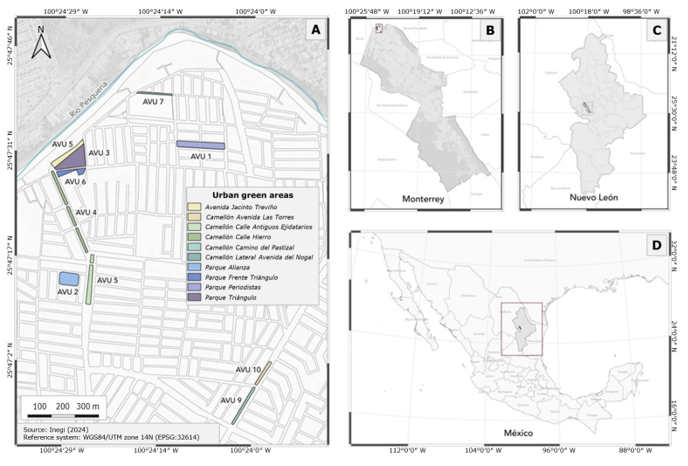
A = Spatial distribution of the evaluated urban green areas (UGSs); B = Location of the UGSs in Monterrey; C = Monterrey municipality in the state of Nuevo León; D = Location of the state of Nuevo León within Mexico. Río Pesquería = Pesquería River; Monterrey = Monterrey municipality; Nuevo León = State of Nuevo León; México = Mexico. AVU = UGS.
Figure 1. Spatial distribution map of the evaluated urban green areas (UGSs).
A civil society organization carried out the planting between September and October 2023, using native species sourced from local forest nurseries. The individual plants had an average diameter of 2.3 cm and an average height of 2.93 m. Personnel excavated planting pits two to three times the diameter of the root ball, provided initial irrigation, and constructed individual terraces, incorporating deep irrigation and mulching. In March 2024, the team from the firm GEMA S. C. conducted a comprehensive inventory, identifying each tree by species and measuring its diameter at breast height (d1.30) using a model Cal1 Gadnic® metric caliper, and its total height using a model FCG-10m Truper® tape measure. The inventory excluded pre-existing vegetation, focusing exclusively on the trees from the 2023 reforestation program.
The analysis calculated abundance, dominance (via basal area), frequency across green spaces, and the Importance Value Index (IVI)—derived from the relative values of these metrics (Mostacedo & Fredericksen, 2000). It also estimated the Margalef index (DMg), the Shannon index (H′), and the first-order effective diversity (1D) (Jost, 2006) using the DIVECOFOR tool (Xelhuantzi-Carmona et al., 2024). Finally, the proportion of individuals per species, genus, and family was compared against the thresholds established by the 10-20-30 rule.
The inventory recorded 1 034 individuals belonging to five families, nine genera, and nine species, all of which are native. The Fabaceae family exhibited the greatest richness, with five species, and accounted for 67.02 % of the individuals. Across the green spaces, species richness ranged from one to seven, the H′ from 0 to 1.49, and the 1D from 1.00 to 4.43. One green space (UGS 5) contained exclusively Vachellia farnesiana (L.) Wight & Arn., a species that also dominated in five of the ten areas evaluated. For the plantation as a whole, the DMg was 1.15, H′ was 1.56, and 1D was 4.77; the latter value indicates that the nine recorded species exhibited a diversity equivalent to 4.77 equally abundant species.
Vachellia farnesiana showed the highest relative abundance (44.78 %), relative dominance (46.19 %), and Importance Value Index (IVI=39.33 %), and was present in all ten green spaces. Neltuma glandulosa (Torr.) Britton & Rose ranked second (IVI=16.94 %), followed by Quercus fusiformis Small (16.36 %) and Cordia boissieri A. DC. (11.35 %). The remaining five species each had values below 6 %, indicating a structure concentrated among a few components (Table 1).
Table 1. Abundance, dominance, frequency, and Importance Value Index of the species recorded in the study area.
Scientific name |
Abundance |
Dominance |
Frecuency |
IVI |
|
N |
(%) |
(%) |
(%) |
(%) |
|
Vachellia farnesiana (L.) Wight & Arn. |
463 |
44.778 |
46.192 |
27.027 |
39.332 |
Neltuma glandulosa (Torr.) Britton & Rose |
186 |
17.988 |
22.011 |
10.811 |
16.937 |
Quercus fusiformis Small |
167 |
16.151 |
14.001 |
18.919 |
16.357 |
Cordia boissieri A. DC. |
100 |
9.671 |
8.166 |
16.216 |
11.351 |
Ebenopsis ebano (Berland.) Barneby & J. W. Grimes |
40 |
3.868 |
3.194 |
10.811 |
5.958 |
Platanus occidentalis L. |
59 |
5.706 |
4.351 |
5.405 |
5.154 |
Celtis laevigata Willd. |
15 |
1.451 |
1.429 |
5.405 |
2.762 |
Parkinsonia aculeata L. |
3 |
0.29 |
0.557 |
2.703 |
1.183 |
Erythrostemon mexicanus (A. Gray) Gagnon & G. P. Lewis |
1 |
0.097 |
0.099 |
2.703 |
0.966 |
Summ |
1 034 |
100 |
100 |
100 |
100 |
The planting exclusively utilized native flora, in contrast to regional inventories that documented 48.4 % introduced species in Monterrey (Hernández-Cavazos et al., 2024), 49.0 % in San Pedro Garza García (Jiménez-Pérez et al., 2025), 53.8 % in Montemorelos (Canizales-Velázquez et al., 2020), 63.2 % in Hualahuises (Alanís-Rodríguez et al., 2022), and 66.7 % in Linares (Alanís-Rodríguez et al., 2023). It should be noted that these studies evaluated existing tree cover, whereas the present research considered only the individual plants from the 2023 program. Nevertheless, the exclusive use of native species aligns with standard NAE-SMA-007-2022, which prioritizes native or naturalized species for planting programs in Nuevo León (Secretaría de Medio Ambiente de Nuevo León, 2022).
The Fabaceae family also stood out in other inventories conducted in Northeastern Mexico, confirming its frequent use in regional urban tree populations (Alanís-Rodríguez et al., 2022; Leal-Elizondo et al., 2018). However, the presence of several species from the same family does not guarantee a balanced distribution if that family accounts for the majority of the individual plants. Furthermore, the discrepancy between the nine observed species and an effective diversity of 4.77 indicates low evenness, primarily driven by the high abundance of V. farnesiana.
The composition did not meet the three thresholds of the 10-20-30 rule. The Fabaceae family accounted for 67.02 % of the individuals—exceeding the recommended limit for families—while the Vachellia genus and the species V. farnesiana reached 44.78 %, surpassing the thresholds for both genus and species. This result does not imply that these dominant taxa are unsuitable for Monterrey; rather, their high proportions may increase vulnerability to specific pests, diseases, or disturbances. A more balanced distribution across families, genera, and species, combined with the inclusion of shrub and herbaceous layers, would foster greater functional diversity.
The data presented reflect the initial structure of a reforestation project evaluated five months after planting; therefore, it is not yet possible to determine differences in survival or performance among the species. Given the descriptive scope of this study, no statistical comparisons were made between the urban tree sites. Periodic monitoring should track survival, replacement, growth, and phytosanitary condition. In conclusion, while the planting consisted exclusively of native species, it exhibited low diversity and a high concentration of individuals belonging to the Fabaceae family and the species V. farnesiana. It is advisable to aim for a more heterogeneous taxonomic distribution as a strategy to reduce the vulnerability of the urban tree population.
Acknowledgments
The authors thank the staff of GEMA S. C. and Vivero GEMA S. C. for their support during the forest inventory; SUPERA A. C. for providing logistical support for the fieldwork; and the Secretaría de Medio Ambiente del estado de Nuevo León, for the trust placed in them to conduct this study.
Conflict of interest
The authors declare no conflict of interest. Eduardo Alanís Rodríguez states that he did not participate in the editorial process for the manuscript.
Contribution by author
José Manuel Mata Balderas and Eduardo Alanís Rodríguez: development of the original concept and initial drafting of the manuscript; Andrea Michelle Luna Vasconcelos and Karen Alejandra Cavada Prado: fieldwork, data analysis, final review of the text, implementation of corrections, addition of supplementary information, and adaptation of the manuscript to editorial guidelines. All authors approved the final version of the manuscript.
References
Alanís-Flores, G. J., & González-Alanís, D. (2003). Flora nativa ornamental para el área metropolitana de Monterrey, Nuevo León, México. Descripción botánica y requerimientos de las especies para el paisaje urbano. Universidad Autónoma de Nuevo León. https://static1.squarespace.com/static/5ecfd7b1d5367e68d807d415/t/60edd345bf52576c624606d7/1626198856280/Flora+nativa+Ornamental+para+Mty+Glafiro-Diego.pdf
Alanís-Rodríguez, E., Mora-Olivo, A., Molina-Guerra, V. M., Gárate-Escamilla, H., & Sigala-Rodríguez, J. Á. (2022). Caracterización del arbolado urbano del centro de Hualahuises, Nuevo León. Revista Mexicana de Ciencias Forestales, 13(73), 29-49. https://doi.org/10.29298/rmcf.v13i73.1271
Alanís-Rodríguez, E., Mora-Olivo, A., Molina-Guerra, V. M., Patiño-Flores, A. M., Sigala-Rodríguez, J. Á., Zamudio-Castillo, E., & Rubio-Camacho, E. (2023). Cambios en la composición y diversidad del arbolado urbano de Linares, Nuevo León. Gayana Botánica, 80(1), 64-74. http://dx.doi.org/10.4067/S0717-66432023000100064
Canizales-Velázquez, P. A., Alanís-Rodríguez, E., Holguín-Estrada, V. A., García-García, S., & Collantes-Chávez-Costa, A. (2020). Caracterización del arbolado urbano de la ciudad de Montemorelos, Nuevo León. Revista Mexicana de Ciencias Forestales, 11(62), 111-135. https://doi.org/10.29298/rmcf.v11i62.768
Freiburger, M. R., Murphy-Dunning, C., Doroski, D. A., Ashton, P. M., & Peters, J. D. J. (2025). The 10/20/30 planting rule aligns with traditional plant diversity metrics across spatial scales. Urban Forestry & Urban Greening, 114, Article 129112. https://doi.org/10.1016/j.ufug.2025.129112
García, E. & Comisión Nacional para el Conocimiento y Uso de la Biodiversidad. (2001). Climas Escala 1:1 000 000 (Catálogo de metadatos geográficos). Comisión Nacional para el Conocimiento y Uso de la Biodiversidad. http://geoportal.conabio.gob.mx/metadatos/doc/html/clima1mgw.html
Hernández-Cavazos, M. C., Alanís-Rodríguez, E., Molina-Guerra, V. M., Jiménez-Pérez, J., Aguirre-Calderón, O. A., & Cuéllar-Rodríguez, L. G. (2024). Composición, estructura y diversidad del arbolado urbano de la colonia Contry en Monterrey, México. Polibotánica, (58), 85-101. https://doi.org/10.18387/polibotanica.58.6
Instituto Nacional de Estadística, Geografía e Informática. (2017). Uso del suelo y vegetación, escala 1:250 000, Serie VI (Continuo nacional). Comisión Nacional para el Conocimiento y Uso de la Biodiversidad. http://geoportal.conabio.gob.mx/metadatos/doc/html/usv250s6gw.html
Jiménez-Pérez, J., Jiménez-Quintana, P., Alanís-Rodríguez, E., Martínez-Adriano, C. A., Mora-Olivo, A., & Rubio-Camacho, E. (2025). Estructura del arbolado urbano en parques y calzadas de San Pedro Garza García, México. Revista Forestal Mesoamericana Kurú, 22(51), 22-32. https://doi.org/10.18845/rfmk.v22i51.8059
Jost, L. (2006). Entropy and diversity. Oikos, 113(2), 363-375. https://doi.org/10.1111/j.2006.0030-1299.14714.x
Leal-Elizondo, C. E., Leal-Elizondo, N., Alanís-Rodríguez, E., Pequeño-Ledezma, M. Á., Mora-Olivo, A., & Buendía-Rodríguez, E. (2018). Estructura, composición y diversidad del arbolado urbano de Linares, Nuevo León. Revista Mexicana de Ciencias Forestales, 9(48), 252-270. https://doi.org/10.29298/rmcf.v8i48.129
Mostacedo, B., & Fredericksen, T. S. (2000). Manual de métodos básicos de muestreo y análisis en ecología vegetal. Proyecto de Manejo Forestal Sostenible (BOLFOR). http://www.bio-nica.info/biblioteca/mostacedo2000ecologiavegetal.pdf
Santamour, Jr., F. S. (1990). Trees for urban planting: Diversity, uniformity, and common sense. In Metropolitan Tree Improvement Alliance (Ed.), METRIA 7: Trees for the Nineties: Landscape Tree Selection, Testing, Evaluation, and Introduction: Proceedings of the Seventh Conference of the Metropolitan Tree Improvement Alliance (pp. 57-65). The Morton Arboretum. https://bzb.kennisbank.norminstituutbomen.nl/storage/handreiking//santamour-trees-for-urban-planting-diversity-uniformity-and-common-sense-1618393013-3mA4A.pdf
Secretaría de Medio Ambiente de Nuevo León. (2022). Norma Ambiental Estatal NAE-SMA-007-2022, Arbolado urbano del estado de Nuevo León. Gobierno del Estado de Nuevo León. https://www.nl.gob.mx/sites/default/files/repositorio/Dependencias/Comisi%C3%B3n%20Estatal%20de%20Mejora%20Regulatoria/Convocatorias/2022/32_norma_ambiental_estatal_0072022/proyecto_regulatorio.pdf
Xelhuantzi-Carmona, J., Rubio-Camacho, E. A., Alanís-Rodríguez, E., & Chávez-Durán, Á. A. (2024). DIVECOFOR: Una herramienta para la caracterización de la composición y diversidad en ecosistemas forestales. Instituto Nacional de Investigaciones Forestales, Agrícolas y Pecuarias. https://doi.org/10.13140/RG.2.2.25983.73126
Todos los textos publicados por la Revista Mexicana de Ciencias Forestales –sin excepción– se distribuyen amparados bajo la licencia Creative Commons 4.0 Atribución-No Comercial (CC BY-NC 4.0 Internacional), que permite a terceros utilizar lo publicado siempre que mencionen la autoría del trabajo y a la primera publicación en esta revista.